J. V. Fesko Exemplifies Deliberate Calvinist Deception
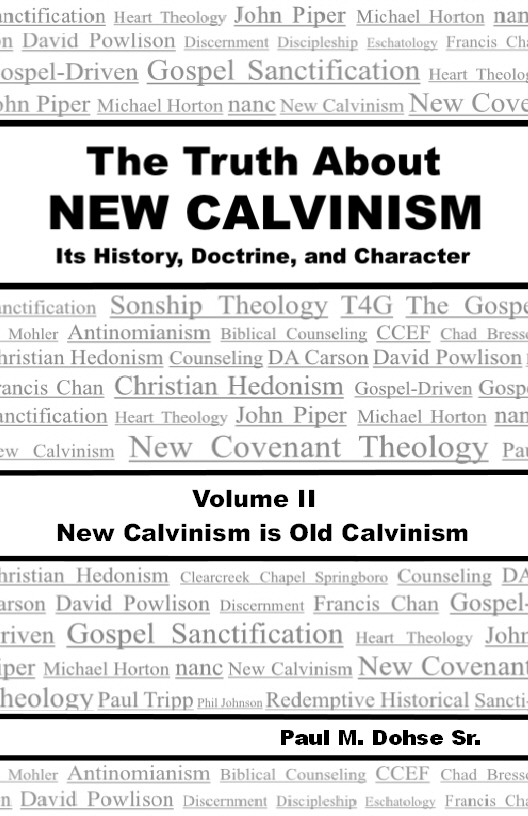 What Dr. Robert Congdon now calls “Classic Calvinism” expressed in contemporary New Calvinism has redefined almost every word used in theological discussion. If the false gospel of Calvinism, the epic supercult of the ages is to be contended against, Calvinists must be exposed for redefining terms and words for the deliberate purpose of deception.
This is difficult to get our minds around; that nicely polished academics would communicate to us while not clarifying what they know is being assumed by most of those listening or reading. For example, “total depravity”— they know the unregenerate as the subject is assumed. However, if they keep talking about total depravity while the subject is Christians, the idea that Christians are totally depraved will be slowly assimilated into people’s minds. This is Brainwashing 101. Furthermore, it’s true, Christians sin; so, if that is all you talk about, the idea follows without it being stated outright: Christians do nothing but sin and cannot please God. If you never talk about the good works of Christians it is assumed that there aren’t any good works without that being stated clearly. This is a deliberate communication construct:
1. Deliberately overemphasizing some realties to the exclusion of others for purposes of a particular outcome. What IS NOT being said is just as important as what IS being said.
2. Talking about subject B while subject A is the context will eventually lead people to believe A=B. For example: talking about justification in a sanctification way; eventually, justification and sanctification become the same thing.
3. Transition manipulation: This takes a number of ideas under one context and manipulates the transitions between the ideas for purposes of a specific outcome. Most Christians are lazy thinkers and don’t pay attention to transitions.
4. The redefinition of words and terms. Example: the “new birth” as realm manifestation rather than new creaturehood.
5. Word splitting. If the normal meaning of a word is a roadblock to what you want to teach, make a case for other meanings, or synonyms, and then proceed with the synonym that fits the objective. This is different from redefinition—this assigns multiple meanings to a word in order to use it for a specific goal. A good example of this is when the definition of the word, “knowledge” becomes a problem for Calvinists. In this case, Bible knowledge. It would seem that for the Christian, Bible knowledge is Bible knowledge. But that creates a problem for Calvinism, so they split Bible knowledge into “fleshly knowledge” and “intimate knowledge.” They then choose intimate knowledge as the only valid knowledge. This is framed as, “knowing the Bible and knowing Jesus are two different things.” They can now make Bible knowledge anything they want it to be. Supposedly, factual knowledge followed by obedience cannot lead to intimacy with God (not so, Peter taught that knowledge leads to intimacy with God as well as our wives); hence, we must seek Jesus in all the Scriptures. The only true knowledge is that of “Jesus’ personhood” while factual knowledge of Jesus does nothing for our relationship with him. By the way, this is the stand taken by the postmodern Emergent church as well.
6. Metaphysical dogma: Always speak to people from the prism that interprets reality the way you want it to be interpreted. When people are confused by this, the assumption is that they are ignorant and unable to understand true realty. If you persistently communicate with people according to your own view of reality, they will eventually begin to be programmed accordingly. Only your view of reality is recognized as valid.
7. Nuance, and the generic use of words. While redefining some words, and attaching multiple definitions to others, some words are used generically to fill in gaps and connect large leaps in logic. There is no better example here than the word, “gospel.” Nuance is also used to shade or soften the full brunt of what is being said.
In Reformed circles, this is the Either/Or hermeneutic. This is Gnostic epistemology. EVERYTHING must be interpreted via material (evil) or invisible (true). In the final analysis, it is the Redemptive Historical hermeneutic.
8. Redefined use of words. This is not the redefinition of meaning, but the redefinition of application; using nouns as verbs, distorted modifiers, etc.
Elitism is used to condone these techniques. This is the mythological noble lie that teaches truth in story form for the consumption of the great unwashed masses. These preordained philosopher kings understand things that the masses are unable to understand, so they can’t let the normative understanding of words stand in the way of teaching creeds for social unity. As John MacArthur associate Rick Holland once stated: good grammar makes bad theology.
Here, an excerpt sent to this author will be used to make the point. According to the sender,
The Fruit Of The Spirit is…(book written by J. V. Fesko, Westminster Seminary,CA) [Academic Dean, Professor of Systematic Theology and Historical Theology].
If you go to Fesko’s bio on Westminster’s website, he is quoted as follows:
What I Want to Instill in My Students
“A passion to proclaim Christ and him crucified in word and deed and to serve the church to the glory of Christ.”
We may well begin our example here. A proclamation to the unregenerate is assumed, but what Fesko is really talking about is the perpetual proclamation of the gospel within the church. This is because Reformed soteriology holds to the idea that Christians need perpetual re-justification (re-salvation). John Calvin makes no bones about this in his Institutes (3.14.11). Reformed soteriology also holds to the idea that this efficacious re-justification can only be found in the formal institutional church (4.15.4).
The excerpt sent follows:
Unlike Old Testament Israel who had the law written upon tablets of stone, we have the law written upon the tablets of our hearts. We also have the indwelling power of the Spirit enabling us to be obedient, even causing us to walk in God’s statutes, to borrow Ezekiel’s words. This hopefully alerts us to the important point that so many Christians miss–namely, the nature of our sanctification. The law does not produce godliness. The law only condemns. Obedience does not produce godliness. Obedience that is carried out in the power of the flesh fails every time. Rather, only the Holy Spirit produces his fruit in us and enables us to be obedient, to produce good works. In other words, in our sanctification, for our growth in godliness, we must seek the power of the Holy Spirit. The Spirit alone is both the source and the power of our sanctification, good works, and obedience.
We must therefore seek the power of the Holy Spirit through God’s appointed means: through the Word, preached, read and meditated upon; the sacraments, baptism and the Lord’s Supper; and prayer. So often people cut themselves off from the means of grace: moving away from the church, failing to attend church, or even cutting themselves off from the sacraments. To do so is to cut ourselves off from the power of the Holy Spirit.
Much could be discussed here, like the eschatological law/gospel train wreck of the first sentence, but we will move on to…
We also have the indwelling power of the Spirit enabling us to be obedient, even causing us to walk in God’s statutes, to borrow Ezekiel’s words.
First of all, Calvinists who know what they believe do not believe that the Holy Spirit does work within us and through us. They do not believe that the power is “indwelling,” and they know it. “Indwelling” is redefined, and “obedience” is also redefined as what the Reformed call, “new obedience.” What’s that? It is not an action we do, it is an action done to us by the Holy Spirit that we ONLY experience. Calvinism also adds the perfect obedience of Christ to the atonement, and that obedience is imputed to our lives by faith alone in order to keep ourselves saved. Nothing is going on within the believer at all, that would be works salvation because justification and sanctification are made to be the same thing. Yet, they use the “in” terminally in order to not unsettle the herd. Calvinists like John Piper make it clear that Reformed soteriology disavows any work by the Spirit within the believer:
This meant the reversal of the relationship of sanctification to justification. Infused grace, beginning with baptismal regeneration, internalized the Gospel and made sanctification the basis of justification. This is an upside down Gospel…When the ground of justification moves from Christ outside of us to the work of Christ inside of us, the gospel (and the human soul) is imperiled. It is an upside down gospel.
In fact, one of the most popular terms among Calvinists in our day is, “the objective gospel outside of us,” or simply, the “objective gospel.” There is no need to be confused by these concepts; it is simply Gnosticism which teaches that material beings cannot know spiritual truth (the invisible). The manifestations of this philosophy always have an epistemology that births the wellbeing of the invisible world to the material world by way of experience. In Reformed theology, the epistemology is gospel contemplationism.
But the point here is that J. V. Fesko knows grade-A-well that “in” doesn’t mean “in.”
This hopefully alerts us to the important point that so many Christians miss–namely, the nature of our sanctification.
Here, Fesko will now define “sanctification.” This lays the groundwork for the rest of the theses that he wants to proffer. Unfortunately, most Christians do not have the discernment skills that would immediately qualify the definition of sanctification to prevent deception. Instead of drawing conclusions from the definition of the word, and how it is used in Scripture, Fesko wants to talk about its “nature.” The actual definition is skipped, and the word is defined by how it behaves, or its “nature.” Sanctification covers a wide spectrum of action, so Fesko can now attach any meaning to the word that he wants to at this point. He is skipping the actual definition, and making its “nature” the definition, and proceeding with the desired agenda.
This enables him to make an outrageous logical leap with the following:
The law does not produce godliness. The law only condemns. Obedience does not produce godliness. Obedience that is carried out in the power of the flesh fails every time. Rather, only the Holy Spirit produces his fruit in us and enables us to be obedient, to produce good works. In other words, in our sanctification, for our growth in godliness, we must seek the power of the Holy Spirit. The Spirit alone is both the source and the power of our sanctification, good works, and obedience.
The primary technique used in the above excerpt is #7, the Either/Or hermeneutic. But again, he skips a biblical definition of law, and its application, and redefines it as something that can only condemn. Therefore, there is EITHER the “power of the flesh,” OR the “power of the Spirit.” Notice how he uses the aforementioned techniques to say that the Holy Spirit obeys for us, and we only experience His obedience through realm manifestation, without actually saying it:
Rather, only the Holy Spirit produces his fruit in us [BY faith which is a conduit that enables us to experience works outside of us] and enables us to be obedient, to produce good works. In other words, in our sanctification, for our growth in godliness, we must seek the power of the Holy Spirit. The Spirit alone is both the source and the power of our sanctification, good works, and obedience.
Herein, “obedience” is redefined as “seeking.” If we “seek the power of the Holy Spirit,” the righteousness of Christ will be imputed to us by seeking alone (ie, faith alone/gospel meditation alone) and we will remain saved. So, how then do we seek?
We must therefore seek the power of the Holy Spirit through God’s appointed means: through the Word, preached, read and meditated upon; the sacraments, baptism and the Lord’s Supper; and prayer. So often people cut themselves off from the means of grace: moving away from the church, failing to attend church, or even cutting themselves off from the sacraments. To do so is to cut ourselves off from the power of the Holy Spirit.
Any questions? The church is our gas station for receiving a refilling of our salvation gas tank through formal preaching, the sacraments, and church attendance. To replace seeking with obedience, or forsaking the assembly of the institutional church, we “cut ourselves off from the power of the Holy Spirit.” Fesko deliberately adds the word, “power” to imply Christian living more than actual salvation, but salvation is what’s being referred to for all practical purposes.
Calvinist communication is saturated with ancient brainwashing communication techniques. The discerning Christian does well to be educated in regard to them accordingly.
The Potter’s House 7/20/2014
 Susan and I will be visiting a home fellowship in Columbus, Ohio today. See you next week!
“< Tweet, Tweet

Paul M. Dohse @PaulMDohse 23s Capitalism tells people to create their own stuff and leave other people’s stuff alone.http://wp.me/pmd7S-3gg
When the Truth UnCalvinizes a Calvinist
A TTANC 2 Freewriting post and book review of Dr. Robert Congdon’s latest booklet in his New Calvinist series.
Dr. Robert Congdon, according to his own bio, is an “international Bible teacher, conference speaker, author, and radio commentator on subjects relating to current trends in Christianity. He holds a B.S. in mechanical engineering from the University of Illinois, a M.Div. in theology from Grace Theological Seminary, and TH.D in theology from Trinity Theological Seminary.”
Dr. Congdon, according to him, was compelled to write a series of booklets on the New Calvinist movement because he has observed its ill effects on the church*; specifically, the dividing of churches and families, fear in regard to assurance of salvation, and a fatalistic mentality leading to a mindset of irresponsibility.[1]
Correctly, Dr. Congdon also charges that New Calvinism is “traditional Reformed/Covenant theology that has been repackaged in post-modern ‘wrappings.’” This is true in that both New Calvinism and Postmodernism interpret reality from a narrative standpoint. This is meta-narrative in regard to metaphysical narrative. New Calvinists believe that all of reality is a prewritten gospel narrative. Postmoderns believe the same thing, but there is a distinction in how we “enter into the plot,” or “make the Bible story our story—the story of every believer.” New Calvinists believe you participate by living the Christian life the same way you were saved, by faith alone. You then merely watch what unfolds in God’s pre-written narrative with a focus on how He is glorified by what happens. Life events merely make us better see’ers in regard to what “Jesus has done, not anything we do.”
Faith is an eye that can only see outward. Inner light depends on how we see the world, and the payoff is joy regardless of circumstances because circumstances are part of the narrative that increases our faith as we see what God is doing in the world. Also, inner light is a partial experience of the light we will actually experience in heaven. This philosophical** side of Calvinism will be addressed in volume III of The Truth About New Calvinism series.
The Postmoderns believe that you “enter into the plot” by doing what Jesus would do. Both camps see “entering into the plot” as an act of faith, but this brings a charge of works salvation by the New Calvinists against the Postmoderns because salvation is seen as a PROCESS and not a finished work, so what people do or believe in the middle between beginning justification and final justification determines justification by faith alone or works justification. The Postmoderns would cry foul by insisting that they are merely participating in works prepared ahead of time in the metaphysical narrative of reality. By participating, they are merely experiencing the works pre-wrought by Christ—the works are being done to us not by us.
____1______________________________________________________
* Throughout this book, “church” is used in regard to the institutional church, not the called out assembly.
** The metaphysic is a plenary progression of all things from the material to the spiritual in time.
New Calvinists believe the same thing. Seemingly, the difference is that Postmoderns believe participation is a choice which robs God of His sovereignty.*
As a short aside, Congdon’s mention of the divisive nature of New Calvinism needs to be addressed. The so-called “factious” man of Titus 3:10 (ASV) is interpreted in all English Bibles as pertaining to individuals [who question elder authority]. Actually, the Bible has little to say about individuals who cause strife. The overarching concern is groups who divide with a particular false doctrine. The actual word for this so-called divisive individual in Titus 3:10 is…
g0141. αἱρετικός hairetikos; from the same as 140; a schismatic:— heretic (the Greek word itself). AV (1)- that is a heretic 1; fitted or able to take or choose a thing schismatic, factious, a follower of a false doctrine, heretic.
Therefore, New Calvinism takes its place among one of the mountain peak concerns of the Scriptures: sectarian groups that divide with false doctrine (See Addendum A).
Congdon qualifies as the quintessential hybrid Calvinist. Often, he refers to himself as grammatical, premillennial, and dispensational. In the latest booklet of his New Calvinist series[2], he reiterates this and describes himself as a former four-point Calvinist. A grammarian interpretation of reality is mutually exclusive from Calvinism which he apparently now realizes because the theses of his newest addition to the series follows:
- New Calvinism is Old Calvinism.
- Both are false gospels.
- He misunderstood what the five points of Calvinism really represented.
- He is now a Biblicist, not a Calvinist.
His journey into researching New Calvinism has led him to this conclusion:
For many years I thought that I understood what Calvin meant by each of these five points. However, the recent emphasis on this teaching through the New Calvinist movement has caused me to look more deeply into what he actually believed, and I have been amazed to discover that I, along with many of my pastor/teacher friends and acquaintances, have misunderstood his original intent that is now being so strongly promoted.[3]
___2___________________________________________________
* See https://paulspassingthoughts.com/wp-content/uploads/2012/04/emergent-church-ebook1.pdf online ebook: The Emergent Postmodern Church and New Calvinism by Paul M. Dohse 2012.
This speaks volumes to the problem with church and its orthodox* seminaries versus the free thinking Bereans of the called out assembly. Congdon was misled for “many years” because formal theological certification is based upon Reformed presuppositions and the redefinition of words. It is testimony to the fact that a seminary degree is all but worthless in our day.
However, we mustn’t miss the important significance of Congdon’s journey: “…along with many of my pastor/teacher friends and acquaintances.” Dr. Congdon represents the first notable Calvinist that has been willing to openly admit that he has been led astray by Reformed soteriology, and many others have seen the light as well.
How does this happen? Congdon and others like him misunderstand the foundation of Reformed thought especially in regard to the metaphysical side of it. Most think that the issue is Bible interpretation, when in reality the primary concern of the Reformers was how one interprets reality itself. The Reformation was founded upon a primary concern for metaphysics—not theology. However, meta-narrative is not the normative way to interpret reality. People naturally gravitate to the literal meaning of words; grammatical interpretation is what comes natural to us.
Therefore, what you end up with is a confusion between original intent and the literal meaning of words. Reformed soteriology was a direct result of narrative metaphysics which imbibes passive Christian living by default. You read life, you don’t do life. Even though adjustments are made and some measure of literal interpretation replaces redemptive allegory, the fundamental foundation still produces weak Christian living (sanctification). When weak sanctification pains the church and a solution is sought, it is assumed that the problem is the following: the church has drifted away from the original. In reality, the original peaks (culminating into the behavior that Dr. Congdon describes in his booklets) and therefore dies a periodic social death.
But, what is left is still errant soteriology leading to weak sanctification and lesser ills flowing. This has been the vicious cycle of death and resurgence since Calvin’s Geneva theocracy. New Calvinism is probably the sixth resurgence of what Congdon calls “Classic” Calvinism since Geneva. This book refers to it as authentic Calvinism.
Moreover, there is a logical conclusion that must be drawn here as well: Protestantism itself is a false gospel and has produced its own dark age of ignorance and bad fruit. Congdon’s journey is in fact a journey that most Christians must now embark on—the whole church motif must be torn down and rebuilt from the ground up with the truth of God’s word. Congdon’s aforementioned latest booklet is a good start in that direction, but much work remains.
___3_________________________________________________________
* See Addendum B
If his Biblicist alternative is valid, it must replace a massive theological system that has been under construction for more than 500 years. The inductive study found in said booklet is a start in the right direction, so let us examine it.
Congdon uses the five points of Calvinism to frame and construct his argument. One of his early points is that his prior four point acclamation wasn’t valid on its face because he has come to believe that all five points depend on each other; if one falls, they all fall. This is true because without total inability (the T in TULIP), no case can be made for the other four. Prior to accepting four point Calvinism, he rejected Arminianism because of its apparent tenet of man’s free will to reject God after accepting Him. This circumvents once saved always saved and eternal security in general.
Congdon admits on page 2f. that he had accepted the assertion of many “scholars” that there are only two systematic theologies to choose from: Calvinism or Arminianism. He had already rejected the latter because…
The theology of Arminianism holds that salvation is conditioned upon one’s continuing in the faith; that is, just as an individual may freely choose to believe and accept the gospel of salvation, he may also choose to turn away in unbelief and “fall from grace,” or lose his salvation.[4]
Congdon initially rejected limited atonement, the L in TULIP, and like many others labeled themselves four point Calvinists. I won’t belabor his reasoning behind rejecting that point as it is a no-brainer for any grammarian. One example of low hanging fruit for the argument against it follows:
2-Peter 2:1- But there were also false prophets among the people, just as there will be false teachers among you. They will secretly introduce destructive heresies, even denying the sovereign Lord who bought them—bringing swift destruction on themselves (NIV).
____4___________________________________________________________
Throughout Congdon’s latest booket in the New Calvinist series, he emphasizes that many, many Christians embrace Calvinism based on assumptions and assumed definition of terms; he then begins to make his case starting with the T in TULIP, total depravity, or total inability/willingness. He also emphasizes, and correctly so, that the Reformed unabashedly make the five points of Calvinism synonymous with the gospel itself. Indeed, Calvinism, and therefore Protestantism as well, stands or falls on the five points.
Congdon argues this from the ever taxing order of salvation argument. Is man able to believe the word before the Holy Spirit regenerates him/her? He makes a lengthy argument that man believes first and is then immediately sealed by the Holy Spirit, or born again.
Ephesians 1:13 – In him you also, when you heard the word of truth, the gospel of your salvation, and believed in him, were sealed with the promised Holy Spirit, 14 who is the guarantee of our inheritance until we acquire possession of it, to the praise of his glory.
He also diagnoses the biblical definition of death to mean “separation” as opposed to the idea that unregenerate man is dead like a stone and completely unable to respond. The argument is lengthy, detailed, and will not be fully expounded on here, but it is indeed an impressive argument. Suffice to say that if man is able to make wise choices in everyday life, it doesn’t make sense that God’s means of salvation would be the one item where he was unable to make a choice. Even if man chooses God in order to escape hell, he is conceding that he deserves to go there.
Mankind is not totally depraved. The book of Romans states the following:
Romans 1:16 – For I am not ashamed of the gospel: for it is the power of God unto salvation to everyone that believeth; to the Jew first, and also to the Greek. 17 For therein is revealed a righteousness of God from faith unto faith: as it is written, But the righteous shall live by faith. 18 For the wrath of God is revealed from heaven against all ungodliness and unrighteousness of men, who hinder the truth in unrighteousness; 19 because that which is known of God is manifest in them; for God manifested it unto them. 20 For the invisible things of him since the creation of the world are clearly seen, being perceived through the things that are made, even his everlasting power and divinity; that they may be without excuse: 21 because that, knowing God, they glorified him not as God, neither gave thanks; but became vain in their reasonings, and their senseless heart was darkened (ASV).
___5________________________________________________________
Romans 2:14 – (for when Gentiles that have not the law do by nature the things of the law, these, not having the law, are the law unto themselves; 15 in that they show the work of the law written in their hearts, their conscience bearing witness therewith, and their thoughts one with another accusing or else excusing them); (ASV).
Mankind in general has the law of God written on their heart and a conscience that either accuses them or excuses them. Also, they knowingly and deliberately suppress the truth in unrighteousness. This strongly implies ability to make a choice. Moreover, the Bible often blames Satan for deceiving people and blinding them. What’s the point of stating that if man has no ability to discern to begin with?
Clearly, man is not totally depraved, and besides, another assumption by many is that total depravity only applies to unbelievers. Elsewhere in this volume we have addressed the Calvinist absurd notion of the total depravity of the saints. Calvinists themselves make these five points the gospel, and all hinge on the first, total depravity. This alone is enough reason to utterly reject Calvinism.
Congdon addresses unmerited election or the U of TULIP in chapter three. He makes the point that election has very little to do with individual salvation. He reminds us that Christ was elected, but obviously has never needed salvation. The angels are elect, but redemption has never been offered to the angels. The nation of Israel is elect, but not every Israelite will be saved. Hence, election has no direct relationship to individual salvation. Says Congdon:
I have concluded that “election” is a term used of specific groups, without respect to salvation.*[5]
And…
Furthermore, one must conclude that those who are not elect are simply consigned to an existence of eternal punishment with no real purpose, service, or goal, apart from them being “props” on the stage of redemptive history.[6]
Exactly. That’s the Reformed metaphysical narrative in a nutshell. We read life, we don’t do it. This is alluded to in said booklet:
In the New Testament, “believe” is always an active verb—something one does, not something done to him.[7]
1 Peter 1:22 indicates the mutual participation of our belief and the Spirit’s regeneration:
Seeing you have purified your souls in obeying the truth through the Spirit…
Congdon also comments on what the results of this will be. I consider this to be a major consideration in judging why people follow after such doctrines:
According to this view, one can only conclude that God is a Deity who requires no discernment, decision making, or responsibility on the part of His creation, for humans are merely preprogrammed robots carrying out His decrees.
___6________________________________________________________
* Congdon’s specific definition of election on p. 45: “Election refers to God’s choosing/electing to use a specific group of beings in a unique way to serve Him in order to accomplish His plan and purposes to his glory. The group’s election assures that it will accomplish its God-given tasks under His provision, assurance, and supervision, because He is Sovereign. Election indicates selection of a group for service, not selection of individuals for salvation.”
This is one of the reasons why many find New Calvinism to be so appealing today, for if God has predetermined the course of life, they need only “go with the flow,” having no responsibility or accountability. New Calvinism offers a fatalistic view of life. Time magazine, declares that today’s New Calvinist pictures God as “an utterly sovereign and micromanaging deity.” One can only wonder then, what is the purpose of the Judgement Seat of Christ or the Great White Throne Judgment? If everyone has been preprogrammed to receive reward or punishment, judgement becomes a mere mockery (Ibid pp. 41, 42).
Not a “mockery,” just a metaphysical narrative that upholds God’s sovereignty. Supposedly, God is glorified in the destruction of man which shows forth His justice, and those saved show forth His great mercy. Though Calvinists speak often of the uniqueness of this “man humbling doctrine” that gives all glory to God, it is far, far from being unique. In fact, mythological predeterminism based on metaphysical narratives have dominated the religious landscape of history from the cradle of civilization.[8] And from another logical viewpoint, this redemptive historical approach demands the reinterpretation and tortured use of many common words. Following are a few examples:
- Reason: Any inclination that man can be reasoned with must be excluded. Reasoning with someone to obtain a more favorable outcome is pointless; reason has no purpose.
- God’s Promises: No one can really know if the promise is to them. The legitimacy of the promise for you is ambiguous.
- Cause and effect: As Congdon points out, man is not really responsible or accountable for any of his decisions because everything is predetermined. Nothing a man does, or chooses to do, can cause an effect—everything is predetermined.
- Judgement: This is where you are being judged for your predetermined actions. This is where you are judged for being a created being fitted for destruction.
- Duty: Can’t be fulfilled for any logical purpose.
- Hope: One can only hope that they have hope.
___7_________________________________________________________
- Love: A little known Calvinist doctrine is that of love being defined by God’s self-love. Think about it, if man is not worthy of love, God must do all for the sake of His self-love.[9]
- Choice: Man can choose everything but God, but even those choices are predetermined.
- Commandments: Obedience is predetermined and not executed by the one commanded. This is an actual Reformed doctrine; the imperative command is grounded in the indicative event. All obedience flows out of the “Christ event” and is not really performed by the one commanded. The subject only experiences the imputed righteousness of Christ subjectively.[10]
- Whosoever will: Whosoever is predetermined.
- Evangelism: Offer not legitimate for all.
- Good News: …that some have been predetermined for hell and that we will not know for certain who is going to heaven until the final judgement?
- Reality: A prewritten divine narrative.
- Rewards: Only condemnation can be earned.
- Obedience: Fulfilled by the actions of God.
- Ethics: All definitions glorify God regardless of appearance. For example, tragedy should be a time of rejoicing because it glorifies God.
- Ability: Man has only been granted the ability to know that he has no ability.
- We “persuade men”: Apparently we don’t. This is the art of “persuasion” to see if they have been preselected or not.
Later, we will consider Congdon’s alternative to total inability…to choose God, but we must remember that his definitive observations are biblically sound and make Calvinism impossible. His inductive observations have perhaps not yet led to the best conclusions, but in the interim we must consider that the above eighteen concepts make perfect sense as normally understood when under the auspices of his foreknowledge theory presented in the booket at hand. We must remember that we are just beginning to crawl out of the Protestant dark age, and there is much study left to do.
This brings us to the I in TULIP, Irresistible grace. Here is what Congdon states regarding the I:
Underlying the doctrine of irresistible grace is the Calvinistic concept that it is impossible for God to be truly sovereign if He allows His will to be resisted.[11]
He created man in His own image, for He desired to have fellowship with willing individuals, not pre-programmed robots. Since salvation is a gift of God, that gift may be either received or rejected by individuals exercising their free wills. Granting human beings freedom to choose is fully compatible with God’s nature in terms of His grace, mercy, justice, love, etc. Instead of diminishing His sovereignty, God’s decision to grant
___8____________________________________________________________
human beings the freedom of choice actually demonstrates His sovereignty and glorifies Him more.[12]
Instead of forcing individuals to be saved through the irresistible prompting of the Holy Spirit, God uses His Word and the convicting work of the Spirit to confirm its truth in order to bring individuals to the point of decision. It is certainly God’s grace that offers it, but at this point they are free to accept or reject salvation.[13]
Calvinists teach that the Spirit’s offer of irresistible grace is based upon God’s election; it is the “wind” that arbitrarily comes upon preselected individuals and regenerates them, independent of personal choice…. According to Biblicists, however, the Spirit’s part is to confirm the truth of the Gospel and convict individuals of their sin/need so that they may choose to believe or reject it (John 16:7-14).[14]
So, what do we have so far?
- Man is rebellious, but able to choose. He is not totally depraved. The fact that man did not seek-out God for a reconciliation (in that regard being totally unable) does not negate choice when God grants the gift and calls on man to accept it.
- God seeks after man to reconcile man to Himself; first, by the death of His Son on the cross for a propitiation for sin, then He pursues men with the truth of His word and the convicting power of the Holy Spirit.
- The preached word and the Spirit corners mankind into a decision that they are able to make. Faith comes by hearing the word of God, and conviction of sin and coming judgement through the Spirit.*
- God only elects the means of salvation and not individuals. According to His foreknowledge of who will believe in Him, He elects certain individuals to be part of the body of Christ.[15]**
Maybe.
We know that Calvinism, and also the whole Protestant Reformation myth must be utterly rejected as false for more reasons than you can shake a stick at, but the American called out assembly has a lot of learning/studying/praying to do in order to build Biblicism in its place. Congdon’s book is a good start and offers valid building blocks, but again, there is much work to do. The first step is to get rid of the bad leaven.
Finally, we come to the P in TULIP, Perseverance of the saints. This is where Congdon makes his strongest points though not entirely correct. This isn’t surprising because Reformed doctrine in general is very problematic on this point. Up to this point in the book (chapter 5), Congdon posits the expected traditional error of the church is the Bride of Christ (it is not, but is rather the guest of the Bridegroom—New Jerusalem is the Bride), and the righteousness of Christ is imputed to us (no, Christ died for us, it is the Father’s righteousness that is imputed to us, and yes, it’s an important distinction if you don’t hold to the Reformed doctrine of double imputation). As Congdon journeys farther away from Reformation heresy he will realize that the whole the church is the Bride of Christ thing relates to Amillennialism, and the idea that Christ’s righteousness is
___9__________________________________________________________
* The Bible states clearly that Christ was lifted up to draw ALL men to Him (John 12:32). They are drawn, but ultimately it is their choice to accept the gift.
** Other considerations can be added. In Romans 8:30, God justifies who He calls, but Christ said many are called but few chosen. Obviously, not everyone called believes. Add this to the idea mentioned by Congdon in regard to Arminianism: in the same way you can freely choose God, you can also freely choose to stop believing in Him. This might be where election comes in; it guarantees the outcome of your decision. It doesn’t determine what you will believe by your own choice, but it determines that the end result will be glorification.
imputed to us relates to the very progressive justification that he complains about in chapter 5.
Nevertheless, Congdon calls out Calvinism in chapter 5 for having a “two-part process.” This is huge—this is the Achilles heel of Calvinism. Says Congdon:
In essence, the individual is merely coming to a realization of what God has already done for him or her.* At this first act of faith, God credits the individual with an imputed righteousness that has not been fully achieved as yet. It is a credit that must be borne out or earned throughout life. Time allows the person to demonstrate their election by obedience or works, such as keeping the moral law of Moses. After death all these works will be used as “evidence” to determine this. If there is sufficient evidence, the person is elect; if not, he or she isn’t elect. According to Calvinism, it is only at this point that individuals will know for certain if they are saved. According to Calvinists, this demonstration will occur at the final judgement, the Great White Throne judgement.[16]
Congdon’s summation here is absolutely correct. Sort of. Calvinism posits a working out of your salvation with trembling and fear to gain assurance that you will “stand in the judgement.” He also makes the apt observation that justification is confused with sanctification (Ibid p.64). Though he doesn’t expound on it further, it should be mentioned that this leads to confusion regarding redemption versus justification (the saving of the soul versus salvation from the body of death), and fear of consequences for ill Christian living as opposed to fear of eternal judgement. Christians live in love, and there is NO fear in love, fear has to do with judgement. Wise fear of being disciplined as a believer is a different matter—Calvinism makes the two the same thing.
On this point, Congdon also flirts with the idea that this makes Calvinist eschatology errant as well (Ibid pp. 61, 64, 65, 70); Christians will not stand in the final judgement to verify their election—that’s a settled issue. But the flirtation is too ambiguous—since 25% of the Bible is eschatology, it shouldn’t surprise us that our eschatology also reveals our gospel. Eschatology is NOT a “secondary” issue—it is the gospel as well. Your eschatology should match your gospel.
As should be expected, Congdon still suffers from residual side effects of the Calvinist disease that has plagued him most of his life. He mentions yielding, gratitude-driven, and obedience via mere natural flow as valid sanctification concepts when these are in-fact ill remnants of Reformed sanctification by faith ALONE and progressive justification.
____10__________________________________________________________
*Many “New” Calvinists call this, “getting used to our sanctification.”
Though his rightful proclamation that Calvinism is progressive justification, is a huge step forward, he is errant in the assertion that Calvinist final justification is earned by perseverance in law-keeping. First of all, in Classic Calvinism/Old Calvinism/New Calvinism, obedience is not performed by the “Christian.” Obedience, viz, Christ’s “active obedience” is imputed to the Christian by FAITH ALONE throughout his/her’s “Christian” life. As the “Christian” preaches the gospel to himself, lives a cross-driven life, and continually lives out his/her’s baptism,* Christ’s perfect obedience is applied to the “Christian’s” life and said person remains justified until the final judgement.
The Bible aids in this because it enables the “Christian” to see the “saving acts”(PLURAL) of Christ “throughout the whole Bible” and not anything “we have done.” Hence, the Bible aids in the Reformed doctrines of double imputation and mortification and vivification. This is the Redemptive Historical hermeneutic.
Secondly, the person does not actually perform the obedience, he/she only EXPERIENCES the imputed obedience of Christ. These imputations and the resulting joy (see John Piper’s Christian Hedonism) proffer assurance that the person will be able to “stand in the judgement by faith alone.” But, they won’t know for certain until they get the thumbs-up at the final judgement. Congdon is correct about it being works justification in regard to the “Christian” yet being under law, and the Reformed legal loophole being the following…that’s ok because Jesus keeps the law for us as we meditate on His “saving works (PLURAL) in all of the Bible.” No, we are not under law at all, and there is NO law in justification—we are justified apart from the law. This is the egregious problem with fusing justification and sanctification together.
Thirdly, this is not a two-part justification, it is actually three-part according to Calvinists themselves: definitive justification, subjective justification, and final justification. Or, definitive justification, subjective justification, and objective justification, known as the “objective gospel.”
Fourthly, it’s no whit different from Arminianism except final justification is predetermined according to Calvinists. Both fuse justification and sanctification together while demanding a sanctification by faith alone to keep yourself justified (that is, Arminianism in its purest form). The difference is that the Arminians think you can actually participate in faith alone by not working, viz,
___11______________________________________________________
*This is perpetual death and rebirth through “deep repentance” to keep yourself justified by faith alone in the cross-work of Christ. The formal Calvinistic doctrine is mortification and vivification.
Christ fulfills the law for you if you live by faith alone, while Calvinists believe that you can only work for assurance and vivification joy experiences, but the final outcome is determined by God. Calvinists therefore can lay the charge down against Arminians that they do not believe in the “Gospel of Sovereignty.” Arminians can keep themselves saved by faith alone in the same progression of justification. Because Arminians believe that you do more than merely experience justification, the charge of works is leveled by the Calvinists. Is the gospel a “gospel of sovereignty”? Is the fact that God predetermined some to eternal destruction while saving others, and no one will know for certain who is in and who is out until the final judgement really “good news”?
Apparently not. As Congdon notes near the conclusion of his most recent booklet in his New Calvinist series, many of the Puritans held in Calvinistic historical high regard, laid in terror on their deathbeds.[17] This is not the rich entry into heaven promised by God for those who add loving works to the foundation of their faith (2Peter 1:5-11).
I will close here with Congdon’s call to replace Calvinism with Biblicism:
Another crucial issue is Calvinism’s incorrect teaching on God’s judgments and end-time events that are facilitating Satan’s plan in bringing apostasy into the church and render it ineffective in these critical latter days of the Church age. This topic would fill another booklet. The fact that this aggressive movement is successfully redefining the Gospel of Salvation should be enough to alert earnest believers to the seriousness of the times we are in and our need to contend for the faith…It is vitally important to understand the true gospel as revealed in the Bible by God, not in the thoughts and creeds of men, such as Calvinism. Are your beliefs based upon the Scriptures alone or the philosophies of men? Are you a Biblicist or a 4-point Calvinist? It does make a difference![18]
_____12_______________________________________________________
Endnotes
1. Dr. Robert R. Congdon: New Calvinism’s Upside-Down Gospel; Congdon Ministries International Inc. 2012 Greer, South Carolina | Preface.
2. Dr. Robert R. Congdon: Oops! I Thought I Was a Four-Pt Calvinist; Congdon Ministries International Inc. 2014 Greer, South Carolina.
3. Dr. Robert R. Congdon: Oops! I Thought I Was a Four-Pt Calvinist; Congdon Ministries International Inc. 2014 Greer, South Carolina | p. 4.
4. Dr. Robert R. Congdon: Oops! I Thought I Was a Four-Pt Calvinist; Congdon Ministries International Inc. 2014 Greer, South Carolina | p. 3.
5. Dr. Robert R. Congdon: Oops! I Thought I Was a Four-Pt Calvinist; Congdon Ministries International Inc. 2014 Greer, South Carolina | p. 39.
6. Dr. Robert R. Congdon: Oops! I Thought I Was a Four-Pt Calvinist; Congdon Ministries International Inc. 2014 Greer, South Carolina | p. 40.
7. Dr. Robert R. Congdon: Oops! I Thought I Was a Four-Pt Calvinist; Congdon Ministries International Inc. 2014 Greer, South Carolina | p. 44.
8. Paul M. Dohse: Paul’s passing Thoughts .com;Romans Series Interlude: Predestination, a Potter’s House Journey, Part 3; Election and Total Depravity were NOT New with the Reformers and Far from being Unique. Online source April 27, 2014: https://paulspassingthoughts.com/2014/04/27/romans-series-interlude-predestination-a-potters-house-journey-part-3-election-and-total-depravity-were-not-new-with-the-reformers-and-far-from-being-unique/
9. God Loves Himself .wordpress.com: Meditations on the God-Centered God; http://godloveshimself.wordpress.com/2014/02/10/musings-35/
10. Paul M. Dohse: Another Gospel; TANC Publishing 2010 | pp. 152-159.
11. Dr. Robert R. Congdon: Oops! I Thought I Was a Four-Pt Calvinist; Congdon Ministries International Inc. 2014 Greer, South Carolina | p. 47.
12. Dr. Robert R. Congdon: Oops! I Thought I Was a Four-Pt Calvinist; Congdon Ministries International Inc. 2014 Greer, South Carolina | p. 48.
13. Dr. Robert R. Congdon: Oops! I Thought I Was a Four-Pt Calvinist; Congdon Ministries International Inc. 2014 Greer, South Carolina | p. 48.
14. Dr. Robert R. Congdon: Oops! I Thought I Was a Four-Pt Calvinist; Congdon Ministries International Inc. 2014 Greer, South Carolina | p. 49.
15. Congdon states this specifically on p.66 of Oops! I Thought I Was a Four-Pt Calvinist.
16. Dr. Robert R. Congdon: Oops! I Thought I Was a Four-Pt Calvinist; Congdon Ministries International Inc. 2014 Greer, South Carolina | pp. 60, 61.
17. Dr. Robert R. Congdon: Oops! I Thought I Was a Four-Pt Calvinist; Congdon Ministries International Inc. 2014 Greer, South Carolina | p. 68.
18. Dr. Robert R. Congdon: Oops! I Thought I Was a Four-Pt Calvinist; Congdon Ministries International Inc. 2014 Greer, South Carolina | p. 70.
Addendum A
What is a Biblical “Sect,” and why should New Calvinism be classified as such?
The Biblical Meaning of Heresy
Discernment ministries serve as a teaching tool by antithesis (finding error often leads to discovering more truth in the antithesis). And here, we have an excellent example, for I would have never known the true meaning of the word “heresy” if not for this ministry. Like most folks, I assumed the word just referred to erroneous teachings by “heretics.” Such is not the case. The word refers to a group of people, or a movement that causes division and controversies by teaching error.
First, the foundation of what sects do is based on the biblical concept that truth unifies and error divides. A call for unity by the apostles is also a call to be of the “same” mind and judgment:
1 Corinthians 1:10
I appeal to you, brothers, by the name of our Lord Jesus Christ, that all of you agree, and that there be no divisions among you, but that you be united in the same mind and the same judgment.
1 Corinthians 9:8
Do I say these things on human authority? Does not the Law say the same?
Philippians 2:2
…complete my joy by being of the same mind, having the same love, being in full accord and of one mind.
Secondly, the cause of division:
Romans 16:17
I appeal to you, brothers, to watch out for those who cause divisions and create obstacles contrary to the doctrine that you have been taught; avoid them.
1 Corinthians 1:10
I appeal to you, brothers, by the name of our Lord Jesus Christ, that all of you agree, and that there be no divisions among you, but that you be united in the same mind and the same judgment.
Jude 1:17
But you must remember, beloved, the predictions of the apostles of our Lord Jesus Christ. 18 They said to you, “In the last time there will be scoffers, following their own ungodly passions.” 19 It is these who cause divisions, worldly people, devoid of the Spirit.
Ephesians 4:13
Till we all come in the unity of the faith, and of the knowledge of the Son of God, unto a perfect man, unto the measure of the stature of the fulness of Christ:14 That we henceforth be no more children, tossed to and fro, and carried about with every wind of doctrine, by the sleight of men, and cunning craftiness, whereby they lie in wait to deceive;
Truth unites, and error divides; therefore, a heretic is described in Titus 3:10:
As for a person who stirs up division, after warning him once and then twice, have nothing more to do with him,…
The actual word for “division” as translated in the ESV is the English word “heretic[k]” (KJV). It is translated that way because of the following note that is found in some English/Greek dictionaries: “From the same as G140; a schismatic. (“heretic” is the Greek word itself).”
Therefore, in the Bible, those who teach error and are divisive are synonymous.
Division With a Purpose
In the same way that heresy, heretics, and division cannot be separated, the idea that these are always sectarian is also the biblical maxim. In fact, Young’s Literal Translation uses the word “sectarian” in place of “divisive” or “heretic” in Titus 3:10. 1Corinthians 11:19 states the following:
For there must be also heresies among you, that they which are approved may be made manifest among you.
The word in Titus 3:10 is “heretic”, and likewise, the English form of the word in 1Corinthians 11:19 is “heresies.” But most English translations use the word “faction.” The ESV is one example among many. It means “party,” “group,” or “sect.” In other words, these English words translated from the Greek are all used interchangeably in the biblical text, especially with “heresy” or “heretic.” This idea that sects, division, and doctrinal error go hand in hand is plainly stated in the Bible:
Acts 20:30
…and from among your own selves will arise men speaking twisted things, to draw away the disciples after them.
Acts 24:5
For we have found this man a plague, one who stirs up riots among all the Jews throughout the world and is a ringleader of the sect of the Nazarenes.
In fact, Christianity was seen as a sect because of the divisions caused by sanctification:
Acts 24:14
But this I confess to you, that according to the Way, which they call a sect, I worship the God of our fathers, believing everything laid down by the Law and written in the Prophets, (refer back to 1Corinthians 11:19 as well).
Note that the word used in the ESV for “sect” is “heresy,” which is the same word used in Titus 3:10 to describe a heretic. Hence the following reference by others that I found helpful in regards to Titus 3:10:
Some say that in Titus 3:10 ‘a factious [sectarian] man’ should be translated ‘a man who teaches heresy’ and that this expression does not refer to a divisive person. But in Greek this expression denotes a person who holds an opinion or a different doctrine that tends toward division. Thus, the English versions translate this as (1) a factious man—American Standard Version, New American Standard Bible, Marshall’s Interlinear Greek-English New Testament; (2) a man who is factious—Revised Standard Version, Amplified Bible; (3) a heretical sectarian and cause of divisions—Amplified Bible; (4) a heretical person causing divisions—Wuest; (5) a sectarian—W. J. Conybeare; (6) a man who causes divisions—R. F. Weymouth; (7) a factious person—James Moffatt; (8) a sectarian man—Concordant Literal New Testament, Berry’s Interlinear Greek-English New Testament; (9) a factious person—Berkeley Version; (10) a heretical man, i.e., one given to ‘lift up’ opinions, sound or unsound, and an unstable, unsettled individual who wishes to form sects—Young’s Translation; (11) causing division by a party spirit, factious—Vine’s Expository Dictionary of New Testament Words; (12) a divisive person—New International Version.
To say that division over doctrine exemplifies New Calvinism would be the understatement of the century! Throughout the Bible, sectarians are also described as COVERT—another adjective describing New Calvinism that is an understatement on steroids. In fact, they themselves boast that they are divisive because they preach a “scandalous” gospel. Well, that’s exactly what the apostle Paul said sectarians do:
I appeal to you, brothers, to watch out for those who cause divisions and create obstacles contrary to the doctrine that you have been taught; avoid them.
The word for “obstacles” in this verse is, “scandalon” or “scandal.” So for all practical purposes, New Calvinists admit that they preach a divisive gospel. New Calvinism came forth from its Australian Forum womb drawing away disciples and causing divisions on personal levels and corporate levels to a degree that may be unprecedented in church history.
The Cure
New Calvinism is a super-sect that must be exposed and stopped, and only one cure will work: biblical separation. The apostles described sectarianism as a disease that would quickly spread and wreak havoc on God’s people (“gangrene”). They said that a little leaven will leaven the whole lump. Men who gather to “discuss” the symptoms of sectarianism with its proponents show that they do not understand what the Bible teaches about sectarianism. While they feast with these men and discuss “issues,” the gangrene does not wait.
Addendum B
When We Use Words, Should We Know What They Mean? Truth, Mythology, Orthodoxy, and Creed
In order to control people, you have to control their minds. And in order to control their minds, you have to control the definitions of words. The meanings of words form what we believe about truth and reality. And, when it gets right down to it, a proper assessment of reality is the foundation of truth (and by the way, you can only control people by force for so long. The key is to control their minds).
Truth is not “fact.” Truth has a moral value to it. Facts are building blocks that can build any theory of truth.
I have written about all of this before, but this short essay was inspired by one of my Facebook friends. She announced that she was using The Westminster Shorter Catechism for Kids to instruct her young child. Why would she do that? Because the WSC is “orthodoxy,” and that word has come to mean…TRUTH. Hence, the opposite of “orthodoxy” is “heterodoxy,” a practice that I am often accused of; meaning: untruth.
Now, the WSC is often spoken of as being “subordinate truth.” And in fact, that is a fact, but let’s think about this: why is a subordinate truth needed? Isn’t truth powerful enough by itself?
“Well Paul, a creed, or confession, or catechism, is just a form of truth that is taught on the common person’s level, it makes truth easier to understand for the average person.”
Exactly.
The assumption is that there is a truth caste system. There are those who understand Truth, big T, and then those who are only capable of understanding a revisal form of truth on a more elementary level.
Orthodoxy is NOT truth, orthodoxy is an elitist interpretation of truth by those preordained by God (or mother nature) to have a special gift for interpreting truth. People merely pick the orthodoxy of preference which ranges from A-Z of world religions. Protestantism, like Catholicism, or for that matter Hinduism, was founded on orthodoxy which has become a word fictitiously associated with the meaning of the word…truth. The title of those who penned the Westminster Confession should be telling: the “Westminster Divines.” What would be our first clue?
Orthodoxy is not truth, orthodoxy is some man’s interpretation of truth. This is what separates Protestantism from the true called out assembly of Christ: the priesthood of believers. Clearly, this states that every human being is capable of understanding truth on their own, and is culpable before God ALONE for the adjudication of that truth. This also assumes that man is created with freedom of conscience. And by the way, the horizontal political expression of this is an idea that we call the United States of America. And by the way, there is a reason why the Pope and New Calvinists alike are brazen Socialists, confused Protestants notwithstanding. Will we be judged individually for following God, or men appointed by God? This should be evident. We only follow men who follow Christ according to our own assessment of truth.
“But Paul! That will lead to Chaos!”
Exactly.
Herein is the rub: reality, and presuppositions regarding man; ability to understand reality, or epistemological caste? That’s it in a nutshell folks. It’s the exact lie first perpetrated in the garden: Hey Eve, you really can’t understand God without a mediator. You need somebody who has special insight into the spiritual, “nay, has God really said…?”And the priesthood of believers versus spiritual caste was a major battlefront in the first century church and a major theme of the apostle John’s writings.
Right out of the gates of the garden came the declaration of the kingdom of darkness: spiritual caste enforced by government, and the ownership of truth by Plato’s philosopher kings. Philosopher, and king, and the divine right of kings. All of human history was saturated with wars over orthodoxy until 1776. The vast number of wars fought throughout human history have been religious civil wars, or more accurately, wars over orthodoxy.
The divine right of kings is responsible for chaos, not kings who protect a reasonable freedom of conscience. This was the crying out of small voices in the wilderness of a European culture drenched in blood.
In ancient times, spiritual caste was expressed in mythology. To see mythology as ancient superstition shrouded in ignorance would be an incorrect assessment. Mythology is merely stories (parables) created by philosopher kings so that the unenlightened masses can understand principles of society for purposes of social justice. For Plato, that was UNITY period. Whatever “truth” unified was the proof in the pudding; unity equals truth.
Mythology is no different than orthodoxy, and the various teachings thereof: creeds, confessions, and catechisms. Of course it is “subordinate truth.” Of course there is a “higher truth,” but the rub is that the common folks can’t really understand THE Truth…capital T. Hence, you follow the orthodoxy of your choice…presumably to heaven. Pick well; the choices are vast, and the various enlightened choices are better than yours because of the reality that you have accepted: orthodoxy.
The prime example of this in our evangelical day is the Redemptive Historical hermeneutic that dominates the institutional church. It is, Bible as story. Bible as “gospel narrative.” This is absolutely NOTHING more or less than mythology itself dressed in uppity European intellectualism.
Christ promised YOU that you would find truth if you seek it. This isn’t a seeking to find the right man to follow, this is between you and God Himself. And this issue goes way, way back in time. It was a major issue with Moses, and the apostle John, and it is a major issue in our day. Therefore, I close with these words from Moses:
The secret things belong to the Lord our God, but the things that are revealed belong to us and to our children forever, that we may do all the words of this law… For this commandment that I command you today is not too hard for you, neither is it far off. It is not in heaven, that you should say, ‘Who will ascend to heaven for us and bring it to us, that we may hear it and do it?’ Neither is it beyond the sea, that you should say, ‘Who will go over the sea for us and bring it to us, that we may hear it and do it?’ But the word is very near you. It is in your mouth and in your heart, so that you can do it.



49 comments