Paul's Passing Thoughts

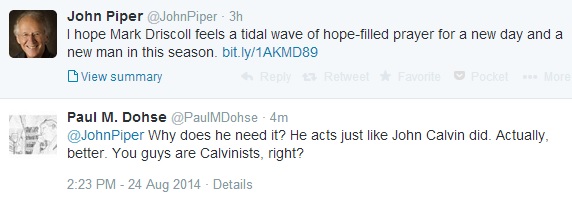
“< Tweet, Tweet @ Mark Driscoll

Posted in Uncategorized by Paul M. Dohse Sr. on August 23, 2014
Tagged with:

“< Tweet, Tweet: "Regret"

Posted in Uncategorized by Paul M. Dohse Sr. on August 23, 2014

“< Tweet, Tweet

Posted in Uncategorized by Paul M. Dohse Sr. on August 22, 2014
Tagged with: ,

Andy Young: A Believer’s Personal Bible Study

Posted in Uncategorized by Paul M. Dohse Sr. on August 22, 2014

andy-profile-1This article is the first of what I hope to be a series of articles designed to give believers the tools they need to be able to more effectively study the Word of God on their own.  It is a sad reality that most believers over the past 500+ years have not and do not really know what the Bible says.  I have been a believer for over 36 years, and I must regretfully admit, that up until about 5 years ago, I was included in that same lot.  I was taught ABOUT the Bible.  I was taught ABOUT doctrine.  And I dutifully towed the line of orthodoxy.  This, I think is indicative of most believers; they simply do not read their Bibles.

I think as Christians we intuitively know we should be reading our Bibles, but aside from the fact that the modern day institutional church purposefully seeks to keep the masses dumbed-down, one of the reasons I believe most Christians don’t read their Bibles as much as they should is that they don’t know where to start.  And those Christians who do read their Bibles on a regular basis aren’t getting as much out of it as they should be.  Their Bible reading time is ineffective because they don’t have a plan.  In either case, the results are the same:

  • boredom
  • apathy
  • distraction
  • resentfulness

Bible reading becomes a chore rather than a delight.  Do we simply trudge on ahead dutifully and have faith that the Spirit will work on us?  That seems a rather bleak prospect.  Or do we just rely on the work that others have done for us and expect them to feed us spiritual nourishment?  What hope is there for any maturity whatsoever with that mindset?

There are two key truths found in the Bible itself that must be reconciled.

Hebrews 4:12

“For the word of God is quick, and powerful, and sharper than any two-edged sword, piercing even to the dividing asunder of soul and spirit, and of the joints and marrow, and is a discerner of the thoughts and intents of the heart.”

2 Timothy 2:15

“Study to shew thyself approved unto God, a workman that needeth not to be ashamed, rightly dividing the word of truth.”

  1. The Word of God is active.

Hebrews 4:12 uses the words “quick” and “powerful” to describe the Word.  The word “quick” is the Greek word ζαω (DZAH-oh), and it means, “to live”.  It is alive! It is also powerful.  Here the word is ενεργης (en-er-GACE).  The idea is that it is full of energy.  God’s Word is different from any other written work in the world!  As we read it, because it is alive and active, we can expect it to actively work on us.  Its cuts are deep and clean, dividing and discerning.  It reveals truth to us because it is truth.  By it, we are sanctified (John 17:17).

But we don’t simply sit idly by and wait for the Word to work on us.

  1. Believers are to study the Word

The word “study” is the word σπουδαζω (spoo-DAHD-zoh).  It literally means, “to use speed.”  The implication is to make an effort, to be prompt or earnest.  Study the Word with the result of being able to use discernment (“rightly dividing the word of truth”).  The Bereans (Acts 17:10-11) were called “more noble” because they studied the Word.  They earnestly and diligently searched the scriptures daily to be able to discern truth from error.

So if we are to be good students of God’s Word, we first need to actually read it so that its life and power can work in us.  But we must also study it as well.  This places an emphasis that goes beyond merely reading a chapter or passage or verse every day.  This must include a dedicated effort to a searching for knowledge.  But unfortunately, most believers don’t know how to begin.

Let’s start with the basics.  And this is really very simple.  Just READ your Bible!  BUT…you must read with purpose.  A daily devotional book just will not cut it.  You are simply consuming someone’s pre-digested, pre-packaged orthodoxy.  You are not studying.  You must read the actual BIBLE yourself!  And you must have a plan if you want your Bible-reading time to be most effective.

Most people will tell you that you need to read your Bible through each year.  To some, that may sound like a daunting task, which is why many people will not attempt to undertake it.  Also, the Bible is comprised of many different genres of literature: historical, poetic, biographical, instructional, prophetic.  For this reason alone, simply reading your Bible straight through from Genesis to Revelation is not going to be an effective way to study scripture.  Your understanding of a passage is only going to be relevant within that genre.

The key is to include passages from every genre in your study each day.  There are many Bible-reading plans available to choose from, but there is one in particular that I use personally, and I highly recommend it.  It is called Professor Grant Horner’s Bible Reading System (http://www.challies.com/sites/all/files/attachments/professor-grant-horners-bible-reading-system.pdf).  Now, I have no idea who Professor Grant Horner is.  I don’t get any kickback for referring his system.  No, I do not know what his doctrinal beliefs are.  I don’t care.   I do, however, think he has devised a very useful tool for Bible reading and study.  Here is how it works:

This system divides the 66 books of the Bible into 10 lists.

  1. Matthew-John
  2. Genesis-Dueteronomy
  3. Romans-Colossians, Hebrews
  4. 1 Thessalonians-Philemon, James-Revelation
  5. Job, Ecclesiastes, Song of Solomon
  6. Psalms
  7. Proverbs
  8. Joshua-Esther
  9. Isaiah-Malachi
  10. Acts

With this system you read 1 chapter from each list every day.  The next day, you go on to the next chapter in each list.  When you get to the end of a particular list, you start again with the first chapter in that list.  Since each list varies in length, the combination of 10 chapters you read each day will constantly change as you work your way through.  By following this system, you can actually read every chapter in the Bible in just 250 days, less than 1 year!

Now, that still may seem like a daunting task, but reading 10 chapters from your Bible each day actually only takes less than an hour to accomplish.  With practice, you will find that it may actually take less time than that.  But is 1 hour of Bible reading each day too much to ask of someone who desires to “show themselves approved”, or who wishes to be able to “rightly divide the Word of truth”?

Following this system will result in the scriptures revealing themselves to you in ways you have probably never seen before.  The Bible is its own commentary, and as you read through the various chapters each day, you will begin to see patterns emerge; phrases, and expressions repeated over and over again.  Themes will develop and will become familiar to you.  Prophesies given in the Old Testament will be expounded upon in the New Testament.  You will see teachings in one section of scripture clarified and expounded upon in another.  You will suddenly see connections throughout the Bible that you did not realize were there before!  That is an exciting prospect, and that is a tremendous motivation.  You will suddenly find that you cannot wait to get to the next day to find out what you will discover!  Consider the words of the Psalmist:

Psalm 119:97-104

“O how love I thy law!

It is my meditation all the day. 

Thou through thy commandments hast made me wiser than mine enemies:

for they are ever with me.

I have more understanding than all my teachers:

for thy testimonies are my meditation.   

I understand more than the ancients,

because I keep thy precepts. 

I have refrained my feet from every evil way,

that I might keep thy word. 

I have not departed from thy judgments:

for thou hast taught me. 

How sweet are thy words unto my taste!

Yea, sweeter than honey to my mouth! 

Through thy precepts I get understanding:

therefore I hate every false way.”

I exhort and encourage every believer to get deep into God’s Word.  These are the instructions for life and godliness.  You must know and understand them for yourself if you are to become a mature believer who is able to discern truth from error.  And these words will equip you to go out and give these same words of life to a lost world!

By Andy Young, Delaware, Ohio

We are ALL Calvinists. Yes, You Too

Posted in Uncategorized by Paul M. Dohse Sr. on August 22, 2014

PPT HandleWhy has the Neo-Calvinist movement all but completely taken over the church? Because we are all Calvinists to begin with.

“What! I don’t believe in election! I’m not even a one-point Calvinist!”

See what I mean? Christians believe Calvinism is defined by the sovereign grace issue. No, Calvinism is defined by the plenary inability of man issue. Calvinism completely owns the prism in which Western Christianity interprets reality and the Bible. This was their goal from the very beginning, and I must give them credit for the excellent job they have done.

I catch on slow, but apparently, I eventually catch on. For years I have been sending emails to the who’s who of the Not Reformed among us stating the following:

“Uh, guys, Calvinism holds to a blatantly false justification, and this is simple theological math. If people of your stature start talking about this—they are done.”

Not one reply ever, except from a well-known evangelical that told me what I should have already known:

“We all believe the same gospel.”

Yep. What has become obvious to me is that the academics on both sides feed all of the drama to keep the dumb sheep distracted from the real issue: Protestantism is a false gospel. Arminians and Calvinists have the same gospel at stake and all of the money that goes with it. Catholicism and Protestantism both are institutions that collect a tax, and foundational to any religious institution is the idea of human mediators. In other words, religious institutions must have a spiritual caste system.

This confuses body life with authority, and the purpose of the body of Christ. The body of Christ and institutions are mutually exclusive. This is what all of the academia on both sides of the Calvinism/Arminian debate don’t want the herd to figure out. The called out assembly of Christ was based on the fellowship of likeminded believers in one mind, or one truth. It’s based on conscience and not authority. Get into the New Testament and find an institution construct that resembles what we have today in any regard—good luck. That’s not to say there isn’t organization; there most certainly is, but that’s not the same as institutional caste.

A religious institution must have one particular gospel in order to survive: a linear one; specifically, the “golden chain of salvation” (eerily similar to the “golden chain of philosophers” or the “golden chain of Platonic succession”). It isn’t complicated; justification/salvation isn’t finished and you need the religious scholars to help you make sure you finish it correctly. Come now, look around. We don’t find our own understanding in the Bible with the help of the Holy Spirit, we listen to men. Christian academia is a multi-billion dollar a year business. While we say, “The Holy Spirit is my counselor and He uses the Scriptures which I am called on to study,” that’s not how we function at all. The idea that salvation is not finished dominates the American institutional church.

“But I believe that my salvation is finished!”

No you don’t. You believe that YOUR part of it is finished while Jesus is finishing your salvation for you, lest it be by works. This is why Calvinists and Arminians only stop arguing about election long enough to say in unison, “But for the grace of God there go I.” And, “We are all just sinners saved by grace.” Calvinists and Arminians teach the exact same inability in sanctification gospel. Why? Since salvation is an ongoing process in their minds, any ability on our part in sanctification suggests a colaboring in our justification. Martin Luther taught the following: if any good work done by a Christian was “attended to with fear,” God would not consider it a mortal sin. The contemporary version of this is the often heard, “I didn’t do it, the Holy Spirit did it.” Indeed, Christians caught doing a good work even in our day must plead their case.

If salvation is truly finished, and we have ability to pursue our gifts because the only possible motive is love, that obviously decentralizes the need for authority. In contrast, the steroidal introspection continually called for in the institutional church Sunday after Sunday, after Sunday is clearly on display.

The institutional church is that research foundation looking for the latest and best way to work by faith alone so that Jesus will not be angry. You need them, and they need your money to research the best way to let Jesus finish your salvation for you, lest your part is a work that is really a work and you find yourself in hell. People will pay big money for that information, and obviously do. We have a name for all of the theories that come out of this research: Denominations. This is nothing more or less than different theories on how to live our Christian life by faith alone.

The placard below is what inspired this post; it is indicative of the Protestant gospel that encompasses all of the various denominational labels, but what they all have in common is faith alone in sanctification because justification isn’t finished. Note that each statement is a blatant contradiction to many different Bible verses. Rather than the Bible being a tool for aggressive obedience in sanctification, it is a tool for reminding us how weak we are, even in the new birth, and reminding us of how much we still need the same gospel that saved us lest we try to help Jesus finish our salvation.

paul

Carol Wimmer