The Five Lies of the Five Solas: Sola Scriptura

tancpublishing.com
Once again, as in this post, and this post, we find that people assume much about the clarion call of the Protestant Reformation: the five solas. One assumes that scripture alone means that Christianity draws all of its truth for life and godliness from an exegetical study of the Scriptures. Not so.
Scripture, according to the Reformers, cannot aid the “believer” in wisdom for living life. In fact, living life is not really the business of the believer for that would be works salvation—the Christian life must be EXPERIENCED only through the death and life of Christ.
This is the Reformed doctrine of mortification and vivification. The Christian mustn’t seek to learn the Scriptures and apply the principles to their lives; they must rather use the Scriptures to “gaze” upon the “saving works of Christ in all of the Bible.” This “gazing” upon the salvific works of Christ in all the Scriptures then results in a subjective “reflection” of Christ’s glory. Stars are really just huge chunks of rock floating around in space that reflect the sun’s light; in the same way, we are chunks of dead stones that merely reflect Christ’s light (glory) when we fix our sight on Him alone.
Therefore, according to the Reformed camp, the Bible is merely a tool for gospel contemplationism. Its sole purpose is not to learn more of God’s truth and better ways to love God and others, but rather a gospel narrative that enables us to see our own wretchedness more and more as set against the holiness of God. This results in more and more gratitude for the cross which results in Christ’s glory being REFLECTED from our dead, worthless selves.
This is the crux of the Reformed Redemptive Historical hermeneutic. It calls for seeing and interpreting all reality through the suffering of the cross, or the works of Christ seen in the Scriptures. Biblical imperatives are not anything that we are to do, but rather show us what Christ has already done for us.
Scripture alone for seeing Christ alone, so we can live by faith alone.
paul
The 5 Solas: Worshiping Under the Banners of Heresy

“If justification is completely finished, and NOTHING that we do in sanctification can change that, what do we need an elitist priesthood for? That question strikes fear in the heart of every Calvinist.”
In another article on the five solas, we looked at sola fide, or faith alone and examined why that is false soteriology. In short, it denies the new birth and redefines it as a mere perpetual death and rebirth experience only. Because the Christian life is merely an extension of the finished work of justification, which is supposedly not finished, one must live their Christian life by faith alone in order to get from beginning justification to final justification.
It also makes law the measure of justification. The Christian life becomes an endeavor to live by sola fide in a way that results in the perfect obedience of Christ being applied to our lives in place of anything that we would do. Hence, if sanctification is not done TO US by Christ instead of us DOING the Christian life—it’s works salvation. We also looked at how this cuts off the believer from the true practice of love.
But, when justification is not a finished work, and sanctification is the progression of justification, EVERYTHING is a work. Even if you are doing nothing so that you are supposedly not involved in finishing justification, you are in fact assuming a role in the process by making sure that you don’t do anything, or closely adhere to prescribed ways of doing things that qualify as doing nothing.
This is how Reformed heresy deceives based on assumption. It is assumed that sola fide concerns justification alone, but it doesn’t. In the same way, it is assumed that solus Christus (Christ Alone) means believing in no other man as a mediator between God and you for salvation. No, solus Christus means literally Christ alone as opposed to the other Trinity members. It also means Christ alone as opposed to anything we would do in what they call “progressive sanctification” which is really progressive justification. This is also known as Christ for us or Christ 100% for us.
It begins with the idea that Christ’s role in salvation was two-fold: he died for our justification, and lived in perfect adherence to the law so that His obedience could then be applied to our Christian lives by faith alone, or sola fide. Therefore, the “believer” must continually revisit the “saving works of Christ in all of the Bible” (sola scriptura) in order to keep themselves saved. It should be called Bachman Turner Overdrive soteriology because of their famous song “Taking Care of Business.” The main refrain is, “I love to work at nothing all day.” In this case, the Reformed work at nothing in order to keep yourself saved.
This is where we get into the issue of Trinitarianism leading to a role for the believer in sanctification other than sola fide. If it is the Father’s righteousness imputed to the believer apart from a perfect fulfillment of the law by Christ, that naturally implies a role for the believer in sanctification. That’s a problem for Reformed soteriology on many levels.
If the Holy Spirit is merely a manifestation of what Christ does, that excludes the enablement of believers to participate in kingdom living apart from the finished work of justification. If justification is completely finished, and NOTHING that we do in sanctification can change that, what do we need an elitist priesthood for? That question strikes fear in the heart of every Calvinist.
Protestantism and Catholicism BOTH see justification (salvation) as a PROCESS. BOTH believe in a beginning justification, progressive justification, and a final justification. BOTH are false gospels—the only disagreement is in the details about how you get from point A to point B, and the disagreement is primarily Trinitarian. Catholics traditionally believe that God does a work inside of the believer to help them finish their justification with the help of the Mother Church. Authentic Protestantism believes that NO work is done within the believer because that enables them to participate in the finishing of justification. True classical Protestantism believes that Christians do not DO anything; they only EXPERIENCE the salvific works of Christ—Catholics believe that you actually do something other than believe. It is not sola fide.
Therefore, in regard to Catholicism, they replace a perfect keeping of the law with a set of rituals to make participation in finishing justification plausible. However, remember, since it is the finishing of justification, it requires the same necessity of returning to the same gospel that saved us; viz, the Mass and absolution because sinning as a Christian is no different than sinning as an unbeliever; in both cases, the “Christian” is still under law and not under grace.
In regard to Protestantism, they cry foul because the Catholics distort the law while they uphold the law by making it the standard for justification, but the dirty little secret is that Jesus keeps the law for us via sola fide. This cuts off love from sanctification. One removes the law from sanctification by ritual; the other removes the law from sanctification by making it the sole responsibility of Christ because the perfect keeping of it finishes justification. In both cases, it is not the righteousness of God APART from the law FOR justification. One is a co-laboring with the church to finish justification, the other is “Christ 100% for us” to finish justification.
So, solus Christus means literally solus Christus…for justification and sanctification both because sanctification is really progressive justification; it isn’t Christ plus us, and for that matter, not even Christ plus the other members of the Trinity. One of the foremost authorities and proponents of Reformed soteriology stated it this way:
Luther and Calvin did not simply stress Christ alone over against the Roman Catholic emphasis on works-righteousness. The Reformers also stressed Christ alone over against all—be they Roman Catholics or Protestants—who would point to the inside of the believer as the place where justifying righteousness dwells. Christ alone means literally Christ alone, and not the believer. And for that matter, it does not even mean any other member of the Trinity! (Geoffrey Paxton: The Shaking of Adventism: p. 41).
For all practical purposes, solus Christus is the controversial modulist view of the Trinty. This is the idea that one of the Trinity members is the one, true God, and the other two members are only manifestations of the one true God. This not only makes realm manifestations that are ONLY experienced possible, but it also makes the separation of justification and sanctification impossible. In other words, a modulist view of the Trinity is the necessary companion of progressive justification. This point is reflected in statements by leading Calvinists of our day like John MacArthur Jr.:
As Christians we have one message to declare: “Jesus Christ, and Him crucified” (1 Corinthians 2:2). “For we do not preach ourselves but Christ Jesus as Lord, and ourselves as your slaves for Jesus’ sake” (2 Corinthians 4:5; cf. 1 Corinthians 2:2; Galatians 6:14).
Rick Holland understands that truth. This book is an insightful, convicting reminder that no one and nothing other than Christ deserves to be the central theme of the tidings we as Christians proclaim—not only to one another and to the world, but also in the private meditations of our own hearts.
Christ is the perfect image of God (Hebrews 1); the theme of Scripture (Luke 24); the author of salvation (Hebrews 12:2); the one proper object of saving faith (Romans 10:9-10); and the goal of our sanctification (Romans 8:2). No wonder Scripture describes the amazing growth-strategy of the early church in these terms: “They ceased not to teach and preach Jesus Christ” (Acts 5:42). That is the only blueprint for church ministry that has any sanction from Scripture.
The pastor who makes anything or anyone other than Christ the focus of his message is actually hindering the sanctification of the flock. Second Corinthians 3:18 describes in simple terms how God conforms us to the image of His Son: “And we all, with unveiled face, beholding the glory of the Lord, are being transformed into the same image from one degree of glory to another” (emphasis added). We don’t “see” Christ literally and physically, of course (1 Peter 1:8). But His glory is on full display in the Word of God, and it is every minister’s duty to make that glory known above all other subjects.
As believers gaze at the glory of their Lord—looking clearly, enduringly, and deeply into the majesty of His person and work—true sanctification takes place as the Holy Spirit takes that believer whose heart is fixed on Christ and elevates him from one level of glory to the next. This is the ever-increasing reality of progressive sanctification; it happens not because believers wish it or want it or work for it in their own energy, but because the glory of Christ captures their hearts and minds. We are transformed by that glory and we begin to reflect it more and more brightly the more clearly we see it. That’s why the true heart and soul of every pastor’s duty is pointing the flock to Christ, the Great Shepherd.
Notice in this statement that Christians merely “REFLECT” the glory of Christ as a result of meditating on His personhood and works. Notice also that any emphasis at all on anything or ANYBODY detracts from sanctification. This goes hand in hand with MacArthur’s rejection of eternal sonship as well. A debate about that issue is not the point here, the point is why they take this view of the Trinity. The point is to show the relationship between this view and their Catholicism-like progressive justification.
paul

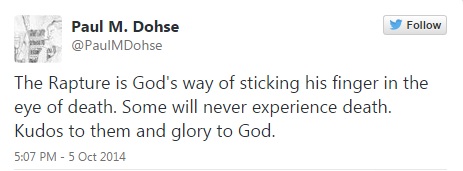
Death
The last enemy that will be defeated is death. Death is God’s enemy. He does not see any good in it. We are to prevent death at all costs until our Lord comes in all of His glory and destroys this last enemy. I have not accepted the deaths of some past family members and friends, and that is ok because death is unacceptable. God does not accept death on any wise. He sent His Son to the cross to destroy death, and He will come with all of the majesty of heaven and put an eternal end to it.
Come quickly, the Lover of our souls.
paul



leave a comment