The Heidelberg Disputation Series Part 12, Theses 22 and 23: The Vital Union, Ritual, and Law
 Listen to the program or download audio file.
So, I was over at my mom’s house minding my own business watching a little Fox News when I noticed a little booklet on the table beside the easy chair. I picked it up and observed the title: Devotions and Prayers of Martin Luther. Of course, I thought that would be interesting. When I opened it, I observed that my dad bought it for mom in 1962. That would be when her three boys, of which I am one would have been 6, 4, and 2. That’s three boys, 6, 4, and 2 which means she would have been needing a lot of prayers during that time. So this gift makes perfect sense. Anyway, I just indiscriminately cracked the thing open roughly in the middle to see what was there. Here is the prayer that I read:
Almighty God, great that we and all Christians may receive the holy sacrament savingly by thy grace. Give us our daily bread that Christ may abide in us and we in him, and that we may worthily bear the name Christians which we have received from him. Amen.
Welcome truth lovers to Blog Talk radio .com/False Reformation, this is your host Paul Dohse. Tonight, part 12 of “The Magnum Opus of the Reformation: Martin Luther’s Heidelberg Disputation – Theses 22 and 23: The Vital Union, Ritual, and Law.”
Greetings from the Potters House and TANC ministries where we are always eager to serve all of your heterodox needs. Our teaching catalog can be found at tancpublishing.com.
If you would like to add to our lesson or ask a question, call (347) 855-8317. Remember to turn your PC volume down to prevent feedback over your cellphone. If you choose to use Skype to listen to the show, my advice is to just dial direct from your Skype account without using any of the Blogtalk links. 347-855-8317.
Per the usual, we will check in with Susan towards the end of the show and listen to her perspective.
Remember, you may remain anonymous. When I say, “This is your host; you are on the air, what’s your comment or question”—just start talking.
If you would like to comment on our subject tonight, you can also email me at paul@ttanc.com. That’s Paul @ Tom, Tony, Alice, Nancy, cat .com. I have my email monitor right here and can add your thoughts to the lesson without need for you to call in. You can post a question as well.
Tonight, we continue in our sentence by sentence evaluation of the HD with thesis 22. This is where we get into the true heart of the Protestant Reformation which concerned philosophy, or state of being.
Anything to do with justification or soteriology was grounded in philosophical or metaphysical presuppositions. I opened tonight with an example of that. Notice that Luther prayed that salvation would be imparted to believers through participation in the Lord’s Table. Whether Protestants know it or not, that’s why the Lord’s Table is such a solemn ceremony in the church—it’s imparting salvation. The solemn examination of self while droopy faced deacons or elders pass around the holy plastic thimbles filled with either grape juice or real wine depending on the outcome of the Baptist civil war in your neck of the woods is the mortification part of the ceremony, and one should expect a joyful demeanor following, ie., vivification.
The Lord’s Table is one of the big five that you do to run the Protestant race of faith alone on the way to the one big final “tribunal” where you find out if you lived by faith alone well enough to make it into heaven. The other four are church membership, sitting under elder preaching, prayer (primarily confession of “present sin”), and the baptism of the holy spirit through mortification and vilification. These all result in the vital union also mentioned in the same prayer: “that Christ may abide in us and we in him.” So, in regard to the initial baptism signified by water baptism which also initiates one into membership, this same baptism is lived out through self deprivation of some sort leading to resurrection experiences of one sort or another—usually incited by praise and worship music.
The Lord’s Table was never some solemn ceremony in the Christian assemblies, but rather an informal remembrance of Christ’s death during the fellowship meal. As Rome began to take over the home fellowships and assert authority over them, the paganization of Christian traditions took place; not least of which is this idea of perpetual union, or becoming one with some god through some sort of ritual. I would like you to observe the black chart on the slide show. Remember, this is not our chart, this is a visual illustration of the vital union, a formal Protestant doctrine.

Notice that in this case, the union takes place through the “deep repentance” process noted on the left. Obviously, if the process on the left is not a onetime event, nether is the right side of the chart. Notice the title of the chart: fundamentally, Protestantism is a returning to the same gospel that saved you in order to relive the baptism of the Spirit over and over again. In other words, the “new birth” is not a onetime event that makes you part of God’s family. The goal of the so-called Christian life is new birth experiences in which the works of Christ are manifested in our realm or through us (double imputation). The Reformers draw from a number of different metaphysical theories to explain this like Idealism philosophy. That is the idea that reality only exists in the perception of the mind, and God is in control of the perceptions. But that is only one angle among many.
But let’s take that example as a way to explain how this all works. Protestantism is about justification by faith…ALONE throughout the whole course of our life. So, it begs the question: how does one live, which assumes human activity prompted by cranium activity, by faith alone? How does one work meditatively? Well, if the work you are doing is really nothing more than perception placed there by God, you aren’t really doing the work, right? You are only EXPERIENCING what Christ accomplished when He was living on earth. He lived out a perfect life for us (double imputation) which is now experienced through the vital union (“I’m in him, He’s in me”). This is also known as Christ for us, or Christ 100% for us. But you say, “But look at the top part of the chart! It says “heart changed.” Ok, let’s go to another Reformed illustration.

What does the downward trajectory represent? Right, the left side of the other chart. What does the upward trajectory represent? Right, the right side of the chart. What does the cross represent? Right, the cross on the other chart. Now, what changes, you or the cross? Right, you don’t change, and in fact, if you fail to see how sinful you are the bottom trajectory goes up and the cross gets smaller. So, what is the authentic Protestant definition of “heart change”? Right, a mere perception or experience. I have at times likened this to standing in the rain. You experience the rain, you feel the rain, but you have no control over the rain. You are not doing the rain. Sanctification is being done to you, not by you. But you do something—you merely participate in the experience of salvation—it’s experiential only. This is how you supposedly live by faith alone.
This idea of being unified or becoming one with a god through some ritual is expressly pagan. Of course, what immediately comes to mind is the Aphrodite cults throughout history. This idea of union with a god through sexual intercourse with a temple prostitute even crept into the first century home assemblies:
1Corinthians 6:14 – And God raised the Lord and will also raise us up by his power.15 Do you not know that your bodies are members of Christ? Shall I then take the members of Christ and make them members of a prostitute? Never!16 Or do you not know that he who is joined to a prostitute becomes one body with her? For, as it is written, “The two will become one flesh.”17 But he who is joined to the Lord becomes one spirit with him. 18 Flee from sexual immorality. Every other sine a person commits is outside the body, but the sexually immoral person sins against his own body. 19Or do you not know that your body is a temple of the Holy Spirit within you, whom you have from God? You are not your own, 20 for you were bought with a price. So glorify God in your body.
From the historian Herodotus we learn:
The foulest Babylonian custom is that which compels every woman of the land to sit in the temple of Aphrodite and have intercourse with some stranger at least once in her life. Many women who are rich and proud and disdain to mingle with the rest, drive to the temple in covered carriages drawn by teams, and stand there with a great retinue of attendants. But most sit down in the sacred plot of Aphrodite, with crowns of cord on their heads; there is a great multitude of women coming and going; passages marked by line run every way through the crowd, by which the men pass and make their choice. Once a woman has taken her place there, she does not go away to her home before some stranger has cast money into her lap, and had intercourse with her outside the temple; but while he casts the money, he must say, “I invite you in the name of Mylitta” (that is the Assyrian name for Aphrodite). It does not matter what sum the money is; the woman will never refuse, for that would be a sin, the money being by this act made sacred. So she follows the first man who casts it and rejects no one. After their intercourse, having discharged her sacred duty to the goddess, she goes away to her home; and thereafter there is no bribe however great that will get her. So then the women that are fair and tall are soon free to depart, but the uncomely have long to wait because they cannot fulfil the law; for some of them remain for three years, or four. There is a custom like this in some parts of Cyprus (Herodotus, The Histories 1.199, tr A.D. Godley 1920).
What is our major concluding point here? That authentic Protestantism traded the biblical definition of the new birth, a onetime event that makes us a permanent part of God’s literal family, for the ongoing experience of so-called vital union, and that Protestantism’s way of obtaining that experience is just one among many not excluding the ritual of temple prostitution. It’s the same idea; temporary experiential union in contrast to a permanent new birth and onetime Spirit baptism.
Also, and more to the point regarding this area of the HD, is that these rituals necessarily take the place of knowledge because of the authentic Protestant worldview. More on that shortly, but let me now address a comment received this week on PPT.com because it’s a good example of the waters of confusion that Protestants swim in as a result of historical ignorance.
This honestly saddens me… I just finished reading Platt’s “Radical”, and I don’t feel that he deserves this. My understanding of his book is “if you truly love Jesus, it will change your life”. Platt is living out John 14:21 by obeying God’s commands to take care of the poor and needy, and living out Matthew 28:18-20 in bringing the gospel to all nations. This book (and Platt’s life) is designed to get the church on board with the mission of God, and is built on passages like 1 John 3:16-18. I’d much rather be like Platt, trying to get the church involved in the mission of God, instead of sitting in the pews screaming at anyone who doesn’t agree with what they think. Honestly, how can we call ourselves followers of a God (who IS love), and then unlovingly thrash another human being? Maybe we should read 1 John 4:21 before we start hating on a brother? Just a thought… lest we be condemned before God for not loving him.
More than likely, the individual who wrote this comment doesn’t understand how authentic Protestantism interprets the reality that Platt appears to be calling people to. More than likely, a more careful examination of the sentences in the book would paint a different picture. Platt is a Neo-Calvinist purist and would hold to almost everything in the HD, so let us consider thesis 24 in comparison to the reader’s comment:
He, however, who has emptied himself (cf. Phil. 2:7) through suffering no longer does works but knows that God works and does all things in him. For this reason, whether God does works or not, it is all the same to him. He neither boasts if he does good works, nor is he disturbed if God does not do good works through him. He knows that it is sufficient if he suffers and is brought low by the cross in order to be annihilated all the more. It is this that Christ says in John 3:7, »You must be born anew.« To be born anew, one must consequently first die and then be raised up with the Son of Man. To die, I say, means to feel death at hand.
Platt is therefore not “living out” anything nor is he calling others to do so. Platt isn’t really talking about good works in the book, but rather manifestations of Christ’s imputed righteousness. It is VERY unlikely that Platt does not hold to double imputation.
Again, this soteriology is necessarily the application of the Reformed world philosophy of choice integrated with Scripture.
Thesis 22: That wisdom which sees the invisible things of God in works as perceived by man is completely puffed up, blinded, and hardened.
This has already been said. Because men do not know the cross and hate it, they necessarily love the opposite, namely, wisdom, glory, power, and so on. Therefore they become increasingly blinded and hardened by such love, for desire cannot be satisfied by the acquisition of those things which it desires. Just as the love of money grows in proportion to the increase of the money itself, so the dropsy of the soul becomes thirstier the more it drinks, as the poet says: »The more water they drink, the more they thirst for it.«The same thought is expressed in Eccles. 1:8: »The eye is not satisfied with seeing, nor the ear filled with hearing.« This holds true of all desires.
Thus also the desire for knowledge is not satisfied by the acquisition of wisdom but is stimulated that much more. Likewise the desire for glory is not satisfied by the acquisition of glory, nor is the desire to rule satisfied by power and authority, nor is the desire for praise satisfied by praise, and so on, as Christ shows in John 4:13, where he says, »Every one who drinks of this water will thirst again.«
The remedy for curing desire does not lie in satisfying it, but in extinguishing it. In other words, he who wishes to become wise does not seek wisdom by progressing toward it but becomes a fool by retrogressing into seeking»folly«. Likewise he who wishes to have much power, honor, pleasure, satisfaction in all things must flee rather than seek power, honor, pleasure, and satisfaction in all things. This is the wisdom which is folly to the world.
Therefore, the Reformation called for the eradication of all knowledge as an evil lust that cannot be satisfied. Consequently, the Bible only has ONE use:
Thesis 23: The »law brings the wrath« of God (Rom. 4:15), kills, reviles, accuses, judges, and condemns everything that is not in Christ.
Thus Gal. 3:13 states, »Christ redeemed us from the curse of the law«; and:»For all who rely on works of the law are under the curse« (Gal. 3:10); and Rom. 4:15: »For the law brings wrath«; and Rom. 7:10: »The very commandment which promised life proved to be the death of me«; Rom. 2:12: »All who have sinned without the law will also perish without law.«Therefore he who boasts that he is wise and learned in the law boasts in his confusion, his damnation, the wrath of God, in death. As Rom. 2:23 puts it:»You who boast in the law.«
Hence, the Bible only aids us in self condemnation in regard to the downward trajectory on the cross chart and the process of vital union. The Bible is not to be used to gain any kind of knowledge, but is only a tool for self-condemnation, or “death at hand” in order to experience the vivification of what Reformed soteriology defines as the new birth. As seen in the summary of the 22nd thesis, any notion that objective conclusions can be drawn from that which is seen is utter wickedness according to this view.
That concludes tonight’s lesson, let’s go to the phones.
Election and the Real Golden Chain of Salvation: Part 1
Let’s discuss yet another Reformed doctrine; the ordo solutis, or “order of salvation.” This is also known as the “golden chain of salvation” and the proof text is Romans 8:29,30.
For those whom he foreknew he also predestined to be conformed to the image of his Son, in order that he might be the firstborn among many brothers. 30 And those whom he predestined he also called, and those whom he called he also justified, and those whom he justified he also glorified.
It goes something like this: God fore-loved certain individuals and not others. He then predestined them to salvation. He then at some point in time calls them, and then justifies them resulting in glorification. Here is a Reformed illustration below:
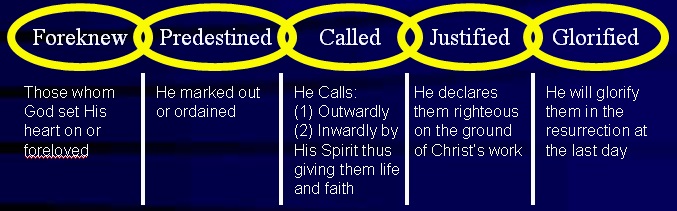
Catholic theologians often object to this take on Romans 8:29,30 because they reject once saved always saved, but they misunderstand, authentic Protestantism does NOT hold to OSAS. More to the point here, the golden chain of salvation is seen as individual, rather than a means of salvation. And that’s what election is: it chooses the means of salvation, and chooses individuals who have roles in the various purposes of salvation. God chose Christ to die on the cross, therefore Christ is elect; He chose the holy angels for certain roles in the salvation process, therefore they are elect; He chose the nation of Israel as part of the process, therefore the nation of Israel is elect, and He chose certain individuals throughout history to contribute to the process of salvation, therefore they are chosen as well to play a part in the means of salvation. That does not mean that they did not have a choice to follow God prior to that choosing for a role in God’s salvific plan. For instance, obviously, God chose the virgin Mary to bear and give birth to Christ as part of the salvation plan. It is also obvious that Mary was saved prior to that choosing. It is obvious that Christ chose the 12 disciples for a role in the slavific plan, but that doesn’t mean they had no choice in choosing God prior to that, hence,
You did not choose me, but I chose you and appointed you so that you might go and bear fruit—fruit that will last—and so that whatever you ask in my name the Father will give you. This is my command: Love each other.
In context, Christ is referring to their election as apostles, not some inability to choose God. As we shall see in the future parts, the REAL golden chain of salvation is a mode of salvation and those used by God to execute it, not a golden chain of salvation that pertains to individual salvation through determinism. Let me now make a beginning case for your consideration. Let me create some reasonable doubt in regard to the Reformed ordo solutis.
First, if you will note once again the Reformed illustration posted in this first part, it illustrates a past tense that preludes present continuous action. This, of course, is necessary for a deterministic conclusion. However, if you carefully examine Romans 8:29,30 it is strictly past tense. Paul is speaking of something that has already taken place. Any other conclusion is presumptuous at best. Paul is writing about something that has been established in the past, or a group of people who have already been glorified. This clearly casts reasonable doubt on the ordo solutis.
Secondly, the ordo solutis would indicate that all of those who are called are also justified, or saved. This is clearly not the case.
Matthew 22:1 – And again Jesus spoke to them in parables, saying, 2 “The kingdom of heaven may be compared to a king who gave a wedding feast for his son, 3 and sent his servants to call those who were invited to the wedding feast, but they would not come. 4 Again he sent other servants, saying, ‘Tell those who are invited, “See, I have prepared my dinner, my oxen and my fat calves have been slaughtered, and everything is ready. Come to the wedding feast.”’ 5 But they paid no attention and went off, one to his farm, another to his business, 6 while the rest seized his servants,treated them shamefully, and killed them. 7 The king was angry, and he sent his troops and destroyed those murderers and burned their city. 8 Then he said to his servants, ‘The wedding feast is ready, but those invited were not worthy. 9 Go therefore to the main roads and invite to the wedding feast as many as you find.’10 And those servants went out into the roads and gathered all whom they found, both bad and good. So the wedding hall was filled with guests.11 “But when the king came in to look at the guests, he saw there a man who had no wedding garment. 12 And he said to him, ‘Friend, how did you get in here without a wedding garment?’ And he was speechless. 13 Then the king said to the attendants, ‘Bind him hand and foot and cast him into the outer darkness. In that place there will be weeping and gnashing of teeth.’ 14 For many are called, but few are chosen.”
In this passage, the “called” are defined: the called are all peoples who are invited to believe in the gospel of the kingdom, and those who except the invitation are of the elect group. Not all of the called are elect. This throws a very large monkey wrench into the Reformed golden chain/order of salvation. Hence, John Calvin came up with three categories of individual preselection: the non-elect; the called; or those temperately chosen/illumined/born again, and those who persevere; or those who are both called and elected in the final analysis. Therefore, assurance of salvation is absolutely impossible in context of the ordo solutis. NO ONE can really know for certain that they are saved until they are “manifested” in the “final tribunal” where “final justification” is determined.
Yet, the apostle John wrote an epistle so that we may “know” presently that we are born again (1John 5:13). The Reformed order of salvation seems apparent based on its deterministic presuppositions, but further investigation is needed.
paul
Romans 9:11- God Does Not Choose, He Calls
 How should we interpret our Bibles? Clearly, Christ set the example. Throughout the gospels He reasoned with many via interpretation based on the technical meaning of words and how they are used in a sentence. We are to interpret the Bible grammatically. Also, the Bible is purposely written in a way that defines certain words according to the plain sense of context; so, while knowing Greek and Hebrew may be helpful, it’s far from being a prerequisite to understanding. The rules of grammar, for the most part, transcend culture. A noun is a noun, and a verb is a verb in any language. To even cite examples of this is to state the obvious, but I will mention Christ arguing for the resurrection based on the tense of “I am” in Matthew 22:31,32.
So, in regard to the question of determinism and the idea that God chooses some for salvation and others for damnation, we find something in the grammar of Romans 9:11 that should give us pause.
…though they were not yet born and had done nothing either good or bad—in order that God’s purpose of election might continue, not because of works but because of him who calls—(ESV)
If the point of Romans 9 is God’s pre-choosing of some for salvation and not others, why would Paul not have written, “because of him who chooses” rather than “him who calls”? Did Paul have a senior moment? Also peculiar to this passage is the stated purpose of election: the eradication of works from salvation. It seems that election accomplishes this for purposes of God calling all people to accept salvation as a pure gift rather than God’s choosing being the linchpin. Note the following:
For the gifts and the calling of God are irrevocable (Rom 11:29).
Again, why is it not the choosing of God that is irrevocable rather than the calling? This grammatical roadblock to determinism was not missed by John Calvin. If choosing and calling are something different, it could mean that the means of salvation was chosen for a particular purpose and then offered to all people as a gift that they could choose themselves or reject. Hence, Calvin separated determinism into 3 separate categories: the non-chosen, the temporarily chosen (the called), and the truly chosen (those who persevere). But of course, Calvin’s three-fold election construct is rarely discussed in Reformed circles for obvious reasons. You can add this fact to the list of other Reformed dirty little secrets relegated to the closets lest they would incite some sort of chemical reaction of thought within the cranium cases of Reformed Kool-Aid drinkers. And of course, no one is going to challenge me to come up with the specific citations from the Calvin Institutes because they know I can.
Here is my rudimentary hypothesis at this time: “election” is primarily a noun in the Scriptures that denotes a category of people and purpose while “calling” is the action taken by God, or the verb. God calls people, He doesn’t choose them. God chose the means of salvation, and calls all people to accept the means of salvation as a gift. The purpose of election is that salvation would be by PROMISE, and not works. Also, “election” is primarily defined in terms of miraculous new birth into the family of God and something made entirely possible by God alone. Any Bible passages that seem to make a direct connection between election and God’s choosing of individuals are rare, or completely absent at most, and ambiguous at least.
Let’s also remember that those who are not in need of salvation are also considered to be God’s “elect”; namely, the holy angels and Christ. The nation of Israel is elect for a particular purpose, and this is perhaps the best definition of election: it is a chosen means to obtain a particular purpose. God chooses the means of salvation, not individuals. Election makes salvation a pure gift and promise apart from the will of man or his abilities, but mankind is free to choose or reject the gift. True, because man fears the condemnation of God, his tendency is to not seek God, but the loving God seeks out mankind through the gospel. God seeks out man and corners him with the truth of the gospel, but man’s tendency to hide from God does not mean he has no ability to make a choice.
A good example of the ambiguity that surrounds the idea of God choosing individuals is 1Peter 5:13. Depending on the translation, it’s the “sister” that is chosen or the “church.” If the latter, that makes my point, but more interesting is the disagreement in translations concerning “elect” used as a noun or adjective as opposed to “chosen” or “elected” regarding those defined by an action, or verb. While the likes of the ESV translate “elect” as… “elected,” or “chosen,” many other mainstream translations like the ASV translate it “elect” without the ed suffix. In other words, a statement concerning the fact that we are all part of the family of God and His plan of salvation does not necessarily equal determinism, or the idea that “elect” equals those who were predetermined to be in the family of God coupled with total inability on man’s part to choose God.
And, if Christ wasn’t mincing words in His argument for the resurrection, neither is this consideration by any stretch of the imagination. And it’s funny; when I was doing word study on this and initially observed 1Peter 5:13 with the word “elected,” I assumed that if my hypothesis held any water that I would also find translations using the word “elect,” and as noted, that in fact ended up being the case.
If you follow the apostle Paul’s argument throughout Romans 9, 10, and 11, and Galatians 3 for good measure, the concern is that salvation is solely by the promise of miraculous new birth. Whether Sarah, Rebekah, Elizabeth, Mary, or the Spirit’s role described in Galatians 3, salvation is NOT by any will or work of man, but a onetime miraculous new birth. A denial of literal new birth paves the way for progressive justification via determinism which is the number one nemesis of the true gospel.
The new birth is a work of God alone, but that doesn’t mean man cannot choose it.
paul
The Heidelberg Disputation Series Part 12, Theses 22 and 23: The Vital Union, Ritual, and Law
 Live Link to Program Tonight @7pm
If you would like to add to our lesson or ask a question, call (347) 855-8317. Remember to turn your PC volume down to prevent feedback over your cellphone. If you choose to use Skype to listen to the show, my advice is to just dial direct from your Skype account without using any of the Blogtalk links. 347-855-8317.
Per the usual, we will check in with Susan towards the end of the show and listen to her perspective.
Remember, you may remain anonymous. When I say, “This is your host; you are on the air, what’s your comment or question”—just start talking.
If you would like to comment on our subject tonight, you can also email me at paul@ttanc.com. That’s Paul @ Tom, Tony, Alice, Nancy, cat .com. I have my email monitor right here and can add your thoughts to the lesson without need for you to call in. You can post a question as well.
Tonight, we continue in our sentence by sentence evaluation of the HD with thesis 22. This is where we get into the true heart of the Protestant Reformation which concerned philosophy, or state of being.
Why the “Sinner’s Prayer” is NOT the Gospel
Nowhere in the Bible are we instructed to lead someone into salvation by reciting the “sinner’s prayer,” and there is a reason for that; it’s not the gospel. The following is a typical rendition of said Prayer:
“Heavenly Father, I come to you in prayer asking for the forgiveness of my sins. I confess with my mouth and believe with my heart that Jesus is your Son, and that he died on the cross at Calvary that I might be forgiven and have eternal life in the kingdom of heaven. Father, I believe that Jesus rose from the dead and I ask you right now to come into my life and be my personal lord and savior. I repent of my sins and will worship you all the days of my life. Because your word is truth, I confess with my mouth that I am born again and cleansed by the blood of Jesus. In Jesus’ name, Amen.”
The great danger of something like this becoming an orthodox canned ritual to obtain salvation is fully realized in our day. As a recovering baptaholic, I have witnessed the falling away of most people who are “saved” by this prayer or responding to an alter call at an institutional church. Also, I have witnessed the lack of alarm following in response to this reality.
Why the lack of alarm? It’s the “prayer of faith” that saves and not the realty of it. Let me repeat that: It’s the “prayer of faith” that saves and NOT the reality of it. “It” being the reality of salvation itself. Salvation is a reality and not a mere mental assent to the facts of the gospel. However, no evidence of a new life is acceptable in Protestant circles because its gospel is a “believing only” definition of faith rather than a decision. The difference is major.
Note the structure of the prayer; it’s a disaster. Why? First of all, on the one hand, it calls for belief only rather than a decision, coupled with a commitment: “[I] will worship you all the days of my life.” Totally confusing. Is salvation by faith alone or not? “Repentance” is NOT a commitment, it is a change of mind—it is a decision to go in a different direction; specifically, from death to life.
And that is the crux: the new birth. Though the new birth is in the prayer, it is framed as something that you believe mentally only rather than something that you decide to accept as a gift. Salvation is a decision to accept the gift of the Spirit and His baptism. It is a onetime decision to follow Christ in death and resurrection, and this is only possible through the gift of the Holy Spirit otherwise known as the new birth. Salvation is NOT, I repeat, not… “Asking Jesus into my heart” or “Asking Jesus to come into my life.” No, no, no, and in fact, where are we told in Scripture to “ask” for salvation? We are told to “believe” (mental assent to the facts of the gospel) AND repent – a decision to follow Christ in death and resurrection, or a passing from death to life made possible by the Spirit, and “you WILL” receive the GIFT of God’s PROMISE concerning the Spirit (Acts 2:37-39). I hope you see the major difference here.
The correct gospel has an expectation of new life built in. It is a decision to die to the old self and become new with Christ who also received the promise of the Spirit when He resurrected Christ from the grave (Galatians 3:16). Christ paid the penalty for our sins, but without the promise of the Spirit, there is NO salvation. An overemphasis on some “receiving of Christ” in lieu of the promise of the Spirit is an ill advised gospel presentation (Galatians 3:1,2).
Salvation is a decision to accept a promise to all people. It is a repentance, not an asking. When one decides to turn from their old self to a new self made anew by the promise of the Spirit, they WILL receive the promise. This is EXACTLY what Christ was talking about when he said “follow me.” This is EXACTLY what Christ was talking about in regard to losing one’s life in order to find it. He was talking about the promise. He was talking about passing from death to life. He was talking about the new birth. He was talking about the baptism of the Holy Spirit.
Indeed, the reality of Protestant professions that do not pan-out in large numbers is due to a canned orthodox gospel that exchanges a promise for an ambiguous “asking Jesus into my heart.” It redefines the promise of the Spirit and denies the reality of a literal passing from death to life.
This is why the “walk of the new man” is optional in regard to any great concern in the institutional church while the flippant truism “We are all just sinners saved by grace” plays in our minds like a bad song that we cannot get out of our heads.
By its fruit the tree is known.
paul



leave a comment