Paul's Passing Thoughts

The Reformation LIE: Exposing the Myth on Reformation Day

Posted in Uncategorized by Paul M. Dohse Sr. on October 26, 2015

Blog Radio LogoThe Reformation is the biggest scam ever perpetrated on mankind. On Reformation Day, October 31, 2015 @ 4pm, Paul and Susan will discuss the historical roots and false gospel of the Protestant Reformation. Its impact on current church culture will also be discussed. Call in and join the conversation.

Live Link to the Program: The Reformation LIE: Exposing the Myth on Reformation Day

How Church Ruins Your Life

Posted in Uncategorized by Paul M. Dohse Sr. on October 25, 2015

12088408_1201486316563031_6525778434069415145_nMeme Post #1

“Church” was never meant to be an institution, but rather a family meeting in private homes because that’s what families do. During the soon approaching Thanksgiving Day, extended families will meet together locally. In others words, for example, the Dohse family is a large family with descendants living all over the world, but more than likely, only the descendants living in the Dayton, OH area will gather together in one place. Few families maintain a purpose-built facility for meeting together. In fact, that would be deemed rather strange.

The 1st century assembly of Christ had a family mindset that is hard for us to comprehend. “They had all things in common” is not a socialist statement, it is a statement regarding their family mindset at that time. The “Church” concept did not really get a foothold in Christianity until the 4th century. The word “church” is a replacement word added to Bible translations and goes hand in glove with the institutionalization of Christianity.

One reason this is important is because families operate differently than institutions. In families, order and unity is achieved through what families are supposed to be about – love and respect. Thanksgiving dinner will go well this year because of family cooperation. Yes, there will be organization, but it will be based on many considerations other than authority. Mom and grandma will tell the men to stay out of the kitchen, and they will obey. When mom says its time to eat, everyone will come to the table. Everyone recognizes that the food part is mom’s gift. If some of the men tarry in front of the football game, aunt Beth will enter the room with a pair of scissors and threaten to cut the power cord on the big screen TV, and so it goes.

Much could be discussed here (this is a many-faceted dynamic), but the family concept circumvents cultism. Cults are predicated on authority—always. No authority, no cult; they must have authority. The integration of authority and religion always results in cultism. It starts with an authoritative presupposition resulting in a mind-control mandate. The institutional church was clearly founded on authority supposedly mandated by Christ through what we call apostolic succession. Immediately after the demise of the most prominent apostles, the so-called church fathers began clamoring for a centralized religious authority based in Rome. The home fellowships led by elders vigorously resisted this attempted transition. After a messy power struggle that lasted for more than 200 years, for the most part, home fellowships succumbed to the Roman church’s claim of apostolic succession and divine authority.

This was the beginning of the Roman Catholic Church from which Protestantism came, but the latter claimed no less authority whatsoever. The Reformation created many splinter groups that attempted to revive home fellowships, but were met with equal persecution from both Rome and Geneva. Catholics and Protestants never ceased fighting accept for the purpose of working together unofficially to persecute the various home fellowship movements that emerged. The Catholics nor Protestants had any tolerance for those who would not come under the auspices of their authority. And, if you think the vast majority of wars fought throughout history are the result of differences regarding religious authority—you rightly assess.

The claim of authority has always been, and always will be, twofold: God ordained governments to enforce religious orthodoxy, and the church’s oversight of salvation. One gets saved in the church, and through “faithfulness to the church,” the church, in turn, doles out more and more salvation until the day of judgment.

Let’s look at this in regard to meme #1. Where does God get “full custody” of his children? Look at the picture—it’s the church building. The implication follows: if you are a casual church attender, you only do business with God on the weekends or a mere one hour during Sunday service. The other implication is that you only do business with God at the temple. On the one hand, we are His “children,” but on the other hand, apparently, we only fellowship with Dad at an institution.

The idea is flawed, unnatural in regard to truly being born again into God’s family, but also has unfortunate cause and effect ramifications. If you go to a purpose-building twice on Sunday, once on Wednesday, and for whatever else is going on during the week (e.g., choir practice, visitation, revivals, men’s Bible study, women’s Bible study, youth activities, church softball league, etc., etc., etc.), when does one have any time with their own families? They don’t.

But the following is the kicker, especially in Reformed churches: on the one hand, families have little private time together, but on the other hand, they are spending what little free time they have hearing about how everyone in their family is a “sinner” or totally depraved. Then, when certain family members begin to display an aversion to the results of this construct, the church recommends separation or shunning. This is resulting in the division of families within the institutional church that is even unprecedented in the secular realm.

The institutional church is bad for your family and will destroy your marriage at worst, and will result in mere coexistence at best. Don’t sacrifice your family at the alter of showing faithfulness to God by being present at the purpose-building “every time the doors are opened.”

There should be NO disconnect between your family life and your life with God, that’s why the family of God should fellowship together right where we live, in the home.

paul

The Differences: Covenant Theology, New Covenant Theology, Dispensationism, and the Covenant of Promise
Posted in Uncategorized by Paul M. Dohse Sr. on October 23, 2015

Blog Radio Logo

10/24/2015 @ 2 pm Live Link:

Paul and Susan Discuss Bible Covenants

Listen to archived podcast at your convenience at same link.

If there is an area where the laity is very confused, it is in regard to biblical covenants. Listen in and join the conversation.

Notes for program, actual program material will vary.

Welcome truth lovers to Blog Talk radio .com/False Reformation, this is your host Paul Dohse. Tonight, another Paul Dohse parenthesis in our Heidelberg Disputation series, “The Differences: Covenant Theology, New Covenant Theology, Dispensationism, and the Covenant of Promise.”

Greetings from the Potters House and TANC ministries where we are always eager to serve all of your heterodox needs. Our teaching catalog can be found at tancpublishing.com.

If you would like to add to our lesson or ask a question, call (347) 855-8317. Remember to turn your PC volume down to prevent feedback over your cellphone. If you choose to use Skype to listen to the show, my advice is to just dial direct from your Skype account without using any of the Blogtalk links. It’s the same number, 347-855-8317.

Per the usual, we will check in with Susan towards the end of the show and listen to her perspective.

Remember, you may remain anonymous. When I say, “This is your host; you are on the air, what’s your comment or question”—just start talking.

If you would like to comment on our subject tonight, you can also email me at paul@ttanc.com. That’s Paul @ Tom, Tony, Alice, Nancy, cat .com. I have my email monitor right here and can add your thoughts to the lesson without need for you to call in. You can post a question as well.

Have you ever wondered what all of these theologies are that Christian scholars talk about, and what the differences are? This is another one of the ironies of the institutional church; these theologies go hand in glove with one’s gospel, but few parishioners know what their pastors believe in regard to this issue. It’s like psychology: people will go to any psychologist because they have the credentials, but there are roughly 200 different metaphysical schools of thought among them. Being interpreted, 200 different views of reality itself. So, people go and pay 85-100 dollars an hour while being clueless as to whether or not the therapist is Rogerian, Freudian, or whatever. They could be, and probably are, taking advice from someone who doesn’t even see reality the same way—it’s absurd.

Let’s start with Covenant Theology. What is it? Let’s borrow some excerpts from Wikipedia to define it:

Covenant theology (also known as Covenantalism, Federal theology, or Federalism) is a Calvinist conceptual overview and interpretive framework for understanding the overall flow of the Bible. It uses the theological concept of covenant as an organizing principle for Christian theology. The standard description of covenant theology views the history of God’s dealings with mankind, from Creation to Fall to Redemption to Consummation, under the framework of the three overarching theological covenants of redemption, works, and grace.

These three covenants are called theological because, though they are not explicitly presented as such in the Bible, they are thought to be theologically implicit, describing and summarizing the wealth of Scriptural data. Within historical Reformed systems of thought, covenant theology is not merely treated as a point of doctrine or a central dogma, but the structure by which the biblical text organizes itself…

The covenant of works (Latin: foedus operum), also called the covenant of life, was made in the Garden of Eden between God and Adam who represented all mankind as a federal head. (Romans 5:12-21) It promised life for perfect and perpetual obedience and death for disobedience. Adam, and all mankind in Adam, broke the covenant, thus standing condemned. The covenant of works continues to function after the fall as the moral law.

The term foedus operum was first used by Dudley Fenner in 1585, though Zacharias Ursinus had mentioned a covenant of creation in 1562. The covenant of works became common in Reformed theology by 1590, though it was not adopted by all, and some members of the Westminster Assembly in the 1640s opposed it. While John Calvin had spoken of a probationary period for Adam, a promise of life for obedience, and the federal headship of Adam, he does not speak of a covenant of works.

Though it is not explicitly called a covenant in the opening chapters of Genesis, the comparison of the representative headship of Christ and Adam, as well as passages like Hosea 6:7 have been interpreted to support the idea. It has also been noted that Jeremiah 33:20-26 (cf. 31:35-36) compares the covenant with David to God’s covenant with the day and the night and the statutes of heaven and earth which God laid down at creation. This has led some to understand all of creation as covenantal: the decree establishing the natural laws governing heaven and earth. The covenant of works might then be seen as the moral law component of the broader creational covenant. Thus the covenant of works has also been called the covenant of creation, indicating that it is not added but constitutive of the human race; the covenant of nature in recognition of its consonance with the natural law in the human heart; and the covenant of life in regard to the promised reward…

The covenant of grace promises eternal life for all people who have faith in Christ. He also promises the Holy Spirit to the elect to give them willingness and ability to believe. Christ is the substitutionary covenantal representative fulfilling the covenant of works on their behalf, in both the positive requirements of righteousness and its negative penal consequences (commonly described as his active and passive obedience). It is the historical expression of the eternal covenant of redemption. Genesis 3:15, with the promise of a “seed” of the woman who would crush the serpent’s head, is usually identified as the historical inauguration for the covenant of grace…

The covenant of redemption is the eternal agreement within the Godhead in which the Father appointed the Son to become incarnate, suffer, and die as a federal head of mankind to make an atonement for their sin. In return, the Father promised to raise Christ from the dead, glorify him, and give him a people. Two of the earliest theologians to write about the covenant of redemption were Johannes Cocceius and John Owen, though Caspar Olevian had hinted at the idea before them. This covenant is not mentioned in the Westminster Standards, but the idea of a contractual relationship between the Father and Son is present. Scriptural support for such a covenant may be found in Psalms 2 and 110, Isaiah 53, Philippians 2:5-11and Revelation 5:9-10. Some covenant theologians have denied the intra-Trinitarian covenant of redemption, or have questioned the notion of the Son’s works leading to the reward of gaining a people for God, or have challenged the covenantal nature of this arrangement.[citation needed] Robert Letham has criticized the idea of a covenant between the persons of the trinity as a departure from trinitarian orthodoxy and tending towards tritheism, pointing to the historical fact of tritheistic heresy in Presbyterian circles during the generations immediately following the Westminster Assembly.1

Here is the long and the short of it: God made a covenant of works with Adam, which failed, and Christ came to fulfill the covenant of works, through fulfilling the law, for all that believe in him. Let me start off by making this really simple: it’s the same idea that Paul was attacking in Galatians chapter three; It’s salvation by law, not promise. “But Paul! It’s Jesus who fulfills the law covenant, not us!” So what? So what? And, furthermore, so what? What part of “by promise” and “not law” does one not understand? Again, and once again, and moreover, again, it doesn’t matter who keeps the law, the law CANNOT give life, only the new birth can give life, “You must be born again.” This is what Paul is turning himself into a pretzel to try to make clear in his letter to the Galatians, particularly chapter 3. This is the most common theology proffered in the evangelical church.

Before we move on to New Covenant Theology, let’s look a little deeper at problems with CT. The following is taken from a TANC Publishing booklet that I highly recommend, “Biblical Covenants: An Overview and Relevance to the Gospel.” That is catalog #B009, but I have uploaded it to Academic.edu for your free reading pleasure.

God never made a covenant with Adam. How do we know this? Because when God makes a covenant, He states it as such. God never calls any arrangement He made with Adam a “covenant.”

In the Garden of Eden, God calls them “trees” not a covenant. How do we get “covenant” from “tree”? In the six actual covenants, God says, “I will make a covenant.” God’s work arrangement with Adam was never called a covenant. His relationship with Eve was never called a covenant. When God covered Adam and Eve’s nakedness after the fall, He didn’t call that a covenant either. In all cases it’s pure assumption. However, when God says, “I will make a covenant,” that’s not an assumption.

Curiously, Adam is said to have broken the covenant, but the issue is that he disobeyed and ate from the tree of good and evil which is a separate issue from these other considerations: his task of caring for the garden, being fruitful, etc. Clarifying what this covenant was exactly and how Adam broke it by eating from the tree is speculative at best. Whenever God makes a covenant, He calls it a covenant, He specifies who the covenant is to, and also specifies the terms.

Granted, the tree of life ends up in the New Jerusalem, but what we primarily look for as Christians is the city built by God, not the tree. The tree of life is one of the results of the Abrahamic covenant, but it isn’t THE covenant or even a salvific covenant. The tree is never called a covenant. Those who posit the idea that God made a covenant with Adam must now split that covenant into two different covenants: the Edenic covenant of innocence, or the covenant of works prior to the fall and the Adamic Covenant of grace. This is what happens when you make something a covenant that isn’t a covenant; you have to come up with more covenants to explain the first covenant that wasn’t a covenant.  You search in vain for the covenants of innocence, works, or grace.

Ultimately, Christians look for the fulfilment of the Abrahamic covenant, not some Adamic covenant. Let’s look at some Scripture:

2Peter 3:13 – But according to his promise we are waiting for new heavens and a new earth in which righteousness dwells.

We aren’t waiting for a tree, we are waiting for a new heaven and a new earth.

Hebrews 11:10 – For he was looking forward to the city that has foundations, whose designer and builder is God.

Abraham was looking for a city, not a tree.

The definition of a salvific biblical covenant follows:  they are NEVER based on anything man does, nor are they predicated on an agreement between God and man. Covenants are predicated on one thing and one thing only: God’s promises. The six covenants are covenants of promise. They are NOT agreements between God and man, they are promises TO man.

Let’s now look at New Covenant Theology. This theology has a fascinating history that is very recent. I am going to borrow from a comment I made on PPT the other day with some editing:

Jon Zens, is one of the core 4 of the Australian Forum which brought the real Protestant gospel of progressive justification back to the Protestant church in 1970. Jon Zens is the undisputed father of New Covenant Theology. What’s that? Well, Zens went to Robert Brinsmead and said, in essence,

“Hey Bob, we have a good gig here with rediscovering the real Protestant gospel, but Calvin missed the boat on the law’s relationship to gospel. The idea that Christ fulfilled the law of Moses so that His perfect obedience can be imputed to the believer will not hold New Testament water. The problem here Bob is that the simple theological math doesn’t figure and somebody is going to eventually figure that out. So, Bob, we need to say that Christ came to totally abolish the law and usher in the New Testament law of love which is defined by however the gospel narrative reveals truth to our conscience. Besides, this is more what Luther had in mind: all reality is interpreted by the gospel, viz, ‘Jesus.’ This is more Augustinian as well”

HOWEVER, in both cases, there is only ONE law which makes both false gospels. The key is the Spirit’s 2 uses of the same law. That’s the gospel: all other gospels are false.  I am posting a lengthy post on this tonight that I started working on at 6am this morning which is freewriting for our 2016 project. Under law is the Spirit’s first use of the law and is still in effect for the unsaved. They are “under law.” The second use of the Spirit’s law is for those under grace. It’s the same law, but it no longer condemns, but is used to love God and others. This is where the literal new birth is essential, but only given lip service by the other 2 camps. The old you that was under the law of Moses and its condemnation literally dies with Christ, and then is resurrected with Christ as a new creature under the same law, but stripped of its condemnation which frees the believer to obey God in love and for love–not justification. Under grace doesn’t mean you are no longer under the law, it means that you are no longer under its condemnation. Those under law are not totally depraved and can do good works, but the only wages they can receive are death and lesser condemnation. Those under grace can sin because of the weakness of the flesh, but can only receive life to more or lesser degree. This is what the slave/master construct is all about.2

Let me explain this a little further with another excerpt; this somewhat repeats the previous point but adds some additional points:

It is the idea that the law is the standard for justification. And since that is the case, a perfect keeping of it must be maintained by Jesus THROUGH faith alone by us in sanctification. That’s the simple math of Protestantism’s soteriology of death. Instead of the law being ENDED for justification paving the way for it to be the guiding instruction of the law of the Spirit of life for sanctification, the law is restricted to the single dimension of condemnation, sin, and death.

Hence, sin maintains all of its power over us because its ENDING for justification, or APART from justification, does not exist in Reformed orthodoxy. Clearly, the power of sin and death is the law’s ability to condemn, and “Christians” are kept under that condemnation with the prescription being a COVERING for sin by institutional absolution and the “active obedience” of Christ.

When those who have sense enough to be disillusioned take another look, this simple fact of law and gospel will be obvious to them. And during the resurgence of real Protestantism in the 70’s, a man named Jon Zens knew that this simple math posed a problem for the Resurgence in the future. He was viciously attacked by Reformed Baptists early on like Walter Chantry, but like all of the rest, Chantry was clueless. Zens was only trying to correct the faulty theological math.

What was his solution? It follows: Christ in fact came to end the law, and replaced it with…depending on which New Calvinist theology (NCT) camp you are referring to…the single law of love. Instead of ONE law with two different applications/perspectives/dimensions, two different laws: one abrogated, one ushered in. A helpful book that explains the many variants of this viewpoint is “All Old Testament Laws Cancelled: 24 Reasons Why All Old Testament Laws Are Cancelled And All New Testament Laws Are for Our Obedience” by Greg Gibson. Like all of the Reformed, Gibson is confused and fundamentally full of it, but he does an excellent job of explaining all of the variant positions of NCT. However, in the final analysis, all of it is the same old progressive justification song and dance.3

Dispensationalism

This is the dreaded nemesis of both CT and NCT. Let’s go back to Wki to get a beginning definition:

John Nelson Darby is recognized as the father of dispensationalism, which was later adopted, modified significantly and then made popular in the United States by Cyrus Scofield’s Scofield Reference Bible. Charles Henry Mackintosh, 1820–96, with his popular style spread Darby’s teachings to humbler elements in society and may be regarded as the journalist of the Brethren Movement. Mackintosh popularized Darby more than any other Brethren author.

As there was no Christian teaching of a “rapture” before Darby began preaching about it in the 1830s, he is sometimes credited with originating the “secret rapture” theory wherein Christ will suddenly remove his bride, the Church, from this world before the judgments of the tribulation. Dispensationalist beliefs about the fate of the Jews and the re-establishment of the Kingdom of Israel put dispensationalists at the forefront of Christian Zionism, because “God is able to graft them in again”, and they believe that in his grace he will do so according to their understanding of Old Testament prophecy. They believe that, while the methodologies of God may change, his purposes to bless Israel will never be forgotten, just as he has shown unmerited favour to the Church, he will do so to a remnant of Israel to fulfill all the promises made to the genetic seed of Abraham…

They also gave the dispensationalist movement institutional permanence by assuming leadership of the new independent Bible institutes such as the Moody Bible Institute in 1886, the Bible Institute of Los Angeles (now Biola University) in 1908, and Philadelphia College of Bible (now Cairn University, formerly Philadelphia Biblical University) in 1913. The network of related institutes that soon sprang up became the nucleus for the spread of American dispensationalism.

The efforts of CI Scofield and his associates introduced dispensationalism to a wider audience in America through hisScofield Reference Bible. The publication of the Scofield Reference Bible in 1909 by the Oxford University Press for the first time displayed overtly dispensationalist notes to the pages of the Biblical text. The Scofield Reference Bible became a popular Bible used by independent Evangelicals and Fundamentalists in the United States. Evangelist and Bible teacher Lewis Sperry Chafer (1871–1952), who was influenced by Scofield, founded the Dallas Theological Seminary in 1924, which has become the flagship of dispensationalism in America. More recently, the Baptist Bible Seminary in Clarks Summit, Pennsylvania, became another dispensational school.

The Grace Movement, which began about 1938 with the teaching ministries of JC O’Hair, Cornelius R. Stam, Henry T. Hudson, and Charles Baker has been labeled “ultra” or “hyper” dispensationalism.4

The last paragraph is really what I wanted to get to. Did the forest ever get lost in the trees with all of the eschatology debate; wow! What a mess! Add it to the election debate as well. Are you pretrib, post trib, premil, postmil, amil, prewrath, postwrath, 1 point, 2 point, 3 point, preterist, Arminian, Palagian, Semi-Pelagian, etc., etc., etc., etc. What should the focus really be here? Yes, aside from the rapture debate, and the future of Israel, what is the soteriology (doctrine of salvation)? And what is dispensationalism? The same old song and dance of progressive justification and its singular perspective on the law.

Enter in the Law Dispensation and the Grace Dispensation, the two primary or foundational dispensations of dispensationalism. If you follow this ministry at all you can see where this is going right away. Dispensationalism goes something like this: God used the dispensation of law to show mankind that it is impossible for him to keep the law…right…“perfectly.” So here comes Jesus to do what? Right, keep the law perfectly for us. Folks, it’s all the same stuff.

So how is the right theology, the biblical theology different, and what is it? It’s the covenant of promise. 5 Note footnote #5, it’s my latest post on the covenant of promise and it goes into a lot of detail. It’s not CT, it’s not NCT, and it’s not Dispensationalism. It is the promise made to Abraham based on one seed and the other promises (covenants) that are part of the one promise. This post explains the covenant of promise, but most importantly, how it is related to the gospel, and how everything else fits into it. Very difficult it was to find a defining paragraph in the article, but here is what I decided to use:

The covenant of promise is a gospel that stands in contrast to all other gospels which make the law of sin and death the standard for righteousness and a co-life-giver with God. There is only one mediator of life. Christ did not come to fulfill the law of sin and death, the Old Covenant, which holds sin captive. He came to end that law for those who believe. Nor did Christ come to be a substitute for that law in the lives of believers for that law is for the unbelieving—not the saved. Instead, Christ came to set the captives free from that law in order to serve the righteousness of the law in loving service with no fear of condemnation. There is no fear in love because fear has to do with judgment (1Jn 4:16-19).

With that let’s go to the phones.

____________________________________________________________________________

1https://en.wikipedia.org/wiki/Covenant_theology

2History of the Australian Forum is detailed in The Truth About New Calvinism vol.1
Love

Posted in Uncategorized by Paul M. Dohse Sr. on October 23, 2015

Clarification From Galatians 3: The Trinity is Not a Paradox, Christians Don’t Live by Faith Alone, and the Covenant of Promise Defined

Posted in Uncategorized by Paul M. Dohse Sr. on October 21, 2015

ppt-jpeg4“Again, it’s the same gospel with Jesus added as perfect law-keeper; it fuses law with gospel. That’s what the Judaizers did, and that’s what Protestant elders do…There is no law in perfection; there is only law in love.”

“All of true Israel will be saved. That’s the promise made to Abraham, and from that promise all the nations find their salvation as well. Any denial of a future redemption of national Israel according to its original identity is a plenary rejection of the gospel.”

“Do you believe a gospel that makes the New Covenant a fulfillment of the Old Covenant rather than an ending of it for those who believe? Have you substituted the fulfillment of the New Covenant via love for a substitutionary fulfillment of the covenant of death? This is what sets the covenant of promise apart from all other gospels. If you are a true Christian, you don’t live by faith alone, you live by love alone, and you are the one doing the loving because you are free from condemnation. Your love is not a substitution; Christ’s death is the only substitution that sets you free to love without fear of condemnation.”

Galatians chapter 3 corrects some significant misnomers that routinely plague those who have to listen to incessant Christian blathering coming from the same who are completely comfortable with contradictions. Faith has become a license for mindlessness, and paradox is now a legitimate hermeneutic.

Since the Bible says God is one person, and also three persons, and the Bible cannot contradict itself, gee whiz, that’s a paradox, and gee whiz, there must be other paradoxes in the Bible as well, and gee whiz, only our “leaders” (dictators) know what a paradox is or isn’t. So, another paradox is the idea that Christians do things by faith alone. We do stuff, but we are not really the ones doing it. “Christians” are very comfortable with this lingo: we didn’t do it, when clearly we did do it, but supposedly, Jesus really did it, lest we get credit for the deed even though Jesus does assign merit for good deeds, but to whom is unclear since we didn’t do it.

And of course, supposedly, people don’t buy into this nonsense because it’s nonsense, but are rather “totally depraved” and will accept the offer of salvation if it is really a promise made to them even though God tells us to tell them that the promise is to them though it may not be. And so it goes; we will pay someone 85,000 dollars a year with a hefty medical package to say things like, “You don’t keep the law by keeping the law.”1 Our job is to say “amen” in between sips of coffee served up from the large vat in the lobby. If the coffee has a little burn in the taste, we wonder, “Is this the day, or just another dry run?”

I am not going to get into the trinity debate, but rather, the point of this post is that the Bible isn’t making a statement about the trinity when it states that God is one. The biblical idea is a statement that makes it clear that there are no other mediators between God and man other than God Himself. Galatians chapter 3 makes this clear. Hence, Protestant popes love to keep the masses distracted with debates about paradoxes lest we figure out that God was drawing a contrast between Himself and them who will travel land, sea, and air to make someone three times the child of hell that they are. And of course, paid for by the Protestant peasantry enslaved to the material world and its knowledge. And of course, from that perspective, spiritual truth can be expected to appear as paradox. In fact, those who demand a logical exegesis of Scripture are deemed as lacking faith, and making Jesus a “precept rather than a person.” By the way, the idea of faith over logic/reason was a major clarion call of the Nazi party during its formative years and expressly Lutheran in origin.2

Galatians chapter 3 is a vivid clarification of the relationship between law and gospel—or better stated biblically, the relationship between law and promise which also excludes every kind of mediator other than God Himself. This is one of the major points of Galatians 3. Paul begins by stating the following in his epistle to the Galatians:

Galatians 3:1 – O foolish Galatians! Who has bewitched you? It was before your eyes that Jesus Christ was publicly portrayed as crucified. 2 Let me ask you only this: Did you receive the Spirit by works of the law or by hearing with faith? 3 Are you so foolish? Having begun by the Spirit, are you now being perfected by the flesh? 4 Did you suffer so many things in vain—if indeed it was in vain? 5 Does he who supplies the Spirit to you and works miracles among you do so by works of the law, or by hearing with faith—6 just as Abraham “believed God, and it was counted to him as righteousness”?

The dictators of the Protestant super-cult focus on the words, “Are you so foolish? Having begun by the Spirit, are you now being perfected by the flesh?” The case is therefore made that we must be perfected the same way we began. This is the Protestant false gospel of progressive justification in a nutshell. It begins with the idea that perfection, viz, justification, is a process. And next, we keep that process going by faith alone. And next, if we live by some sort of faith-alone formula, the same formula that originally saved us, the Holy Spirit will continue to keep us justified. In other words, we have to live by the same gospel that saved us in order to keep ourselves saved which is backdoor works salvation.

What is Paul really saying? His rhetorical question focuses on the erroneous idea that “perfection” (justification) is based on a process. The crux is any kind of process period, but in this case, the process involves the law of Moses. Protestantism uses this text to make the exact case that Paul is arguing against. Except, they add the law to the process in the same way that the Judaizers did albeit in a less direct way. Take note: the very false gospel that Paul is arguing against in Galatians 3 is the same gospel propagated by Protestantism in our day, and the exact same gospel that the Judaizers propagated with Jesus added. In this letter, Paul argues that law cannot be part of the gospel because that would make the law a co-mediator/life-giver with God, and only God can give life. The Judaizers taught that the law does give life, and that “believers” have to continue to draw life and justification from the law.3

But we must now stop and define what Paul meant by “law” in context of keeping it for justification. Judaizer-like false gospels never promote a truthful and perfect keeping of the law in order to remain justified because they know that’s impossible. So, the traditions of men are added as a Cliff Notes keeping of the law that fulfills the “righteous demands of the law.”4 Men are mediators between God and mankind that determine the sub-law that satisfies the holy law, and supposedly, they are appointed by God. Luther and Calvin merely added Jesus to this idea. If we obey the “Christ-centered,” “gospel-centered,” orthodoxy of Protestant elders, Jesus’ perfect obedience to the law of Moses will be imputed to our account, and we will remain “perfect” or justified. Again, it’s the same gospel with Jesus added as perfect law-keeper; it fuses law with gospel. That’s what the Judaizers did, and that’s what Protestant elders do.

Let’s nail this down a little more before we progress further. It entails an understanding of what Paul meant by the receiving of the Spirit. That’s the new birth. That’s the baptism of the Holy Spirit. That changes the believers relationship to the law. Paul’s protest regards the fusion of the law of Moses with perfection which takes place upon the receiving of the Spirit. Paul is protesting a progression or process of perfection by law-keeping. The Judaizers propagated a fulfilling of the law for righteousness via adherence to their traditions5 whereas Protestants demand an adherence to their traditions which supposedly results in Jesus’ perfect law keeping being imputed to the “believer.”

Paul said, in essence, “No, if you want to be justified (perfected) by the law of Moses (the law of sin and death), you have to keep it perfectly. No, circumcision and the observance of days is not a substitution for fulfillment of the law. The law has no part in justification, one is justified (perfected) by the new birth that is received by faith alone. The justified are not justified by the law—law-keeping is what they do, but it is not the law of sin and death for purposes of law-keeping, it is the law of the Spirit of life for purposes of love. There is no law in perfection; there is only law in love.” Hence…

Galatians 4:10 – You observe days and months and seasons and years! 11 I am afraid I may have labored over you in vain…21 Tell me, you who desire to be under the law, do you not listen to the law?…5:2 Look: I, Paul, say to you that if you accept circumcision, Christ will be of no advantage to you. 3 I testify again to every man who accepts circumcision that he is obligated to keep the whole law. 4 You are severed from Christ, you who would be justified by the law; you have fallen away from grace…6 For in Christ Jesus neither circumcision nor uncircumcision counts for anything, but only faith working through love.

In addition, the law being the standard for justification rather than the receiving of the Spirit always leads to a “relaxing of the law” (Matt 5:19). Why? Because some dumbing down of the law as a replacement for true law-keeping for love, or faith working through love, always leads to neglect of the law and true love accordingly. Hence…

Galatians 2:17 – But if, in our endeavor to be justified in Christ, we too were found to be sinners, is Christ then a servant of sin? Certainly not! 18 For if I rebuild what I tore down, I prove myself to be a transgressor. 19 For through the law I died to the law, so that I might live to God…5:7 You were running well. Who hindered you from obeying the truth? 8 This persuasion is not from him who calls you…13 For you were called to freedom, brothers. Only do not use your freedom as an opportunity for the flesh, but through love serve one another. 14 For the whole law is fulfilled in one word: “You shall love your neighbor as yourself.” 15 But if you bite and devour one another, watch out that you are not consumed by one another.

The fulfillment of Moses’ law, the law of sin and death (Romans 8:2), cannot be fulfilled for justification, but said false gospel (Gal 1:6ff.) attempts to do so through mediation in addition to God. This always leads to a dumbing down of the law for purposes of justification. The traditions of men end up being a cloak for unrighteousness under the auspices of being friends of the law. Tradition fulfills the law as a standard for righteousness when the real standard for righteousness is the new birth resulting in the loving of God’s law for purposes of loving God and others, not justification. Justification is a finished work totally apart from the law of sin and death; the only work left is “faith working through love.”

Sure, we don’t do that perfectly, but in regard to justification, so what? The motives of those born of God are love because part and parcel with the new birth is a love for the truth (2Thess 2:10). The law’s ability to condemn was ended by Christ (Rom 10:4) and where there is no law there is NO sin (Rom 4:15). If you now say: “So, the law is the Spirit’s law, and for those who are under law, He uses it to condemn them, but to those who have received Him, He uses it to lead them”; you rightly assess with an additional caveat…Moses’ law of sin and death, while being a ministry of death, still serves the same purpose for New Testament unbelievers as it did for Old Testament believers, that is, it holds sin captive until they believe in Christ, then their sins are ended along with the law that the old them was under, but one who is dead is no longer under the jurisdiction of law that can condemn6 (Romans 7:1-6). Those who receive the Spirit are now free to “serve another” (Rom 6:6). The “new life of the Spirit” enables us to fulfill the law in our acts of love (Rom 8:1-8). The apostle Paul develops these same ideas as we move along in Galatians 3.

Galatians 3:7 –  Know then that it is those of faith who are the sons of Abraham. 8 And the Scripture, foreseeing that God would justify the Gentiles by faith, preached the gospel beforehand to Abraham, saying, “In you shall all the nations be blessed.” 9 So then, those who are of faith are blessed along with Abraham, the man of faith.

This is set against what the Judaizers were telling the Galatians. They were telling the Galatians that in order to be a true son of Abraham, you have to follow the recognition of days and circumcision; traditions that supposedly satisfied the law of Moses. Paul wrote this letter to set them straight. Paul wrote the letter to explain how one becomes a true son of Abraham, the man of faith. Note that the baptism of the Spirit is somewhat different from the new birth. As we will see in chapter 3 of this letter, the law of Moses had a particular purpose: to hold all sin captive. As the law increased, so did sin, but all sin is against the law (1Jn 3:4) and imputed to the law; the law of sin and death holds sin captive.

Old Testament believers were born again and ministered to by the Spirit, but their sins were still held captive by the law because the promise of the Spirit had not yet come. The promise of the Spirit would resurrect Christ from the grave who had already ended the law and its condemnation by dying on the cross, and baptize Jew and Gentile into one body.7 The promise of the Spirit was therefore to Abraham and Christ both (Gal 3:16). As King David had prophesied, God would not leave Christ in the grave to see corruption (Acts 2:27, 31, Ps 16:10).

Until then, Old Testament believers dwelt in a place called Hades which was divided into two parts with a gulf separating them (Luke 16:19-31). One side was occupied by those under law and its condemnation, and the other side was occupied by “the captives.” Why were they called “the captives”? Because Jesus had not yet ended the law’s condemnation, and the saints were yet held captive by the law. While Christ was in the grave, he went to Hades and proclaimed victory to the captives, and when the Spirit resurrected Him, according to the promise, He led the captives out of captivity because the law was ended (Eph 4:8, Ps 68:18, 1Pet 3:19). This is the gospel that God preached to Abraham face to face.

Galatians 3:10  – For all who rely on works of the law are under a curse; for it is written, “Cursed be everyone who does not abide by all things written in the Book of the Law, and do them.” 11 Now it is evident that no one is justified before God by the law, for “The righteous shall live by faith.” 12 But the law is not of faith, rather “The one who does them shall live by them.” 13 Christ redeemed us from the curse of the law by becoming a curse for us—for it is written, “Cursed is everyone who is hanged on a tree”— 14 so that in Christ Jesus the blessing of Abraham might come to the Gentiles, so that we might receive the promised Spirit through faith.

Paul is telling the Gentile Galatians, as a Jew of the Jews, that they were part of the gospel from the beginning, and are given access to the commonwealth of elect Israel (Eph 2:12) in the same way that Abraham was saved, by faith alone completely apart from the law. Paul will go on to argue that if the law is justification’s standard, the law is an additional seed, or offspring. In other words, the law is a co-life-giver with God. This is the crux of “one God.” However, don’t misunderstand and think that the law cannot give life to anyone for it can, but not those who are under its condemnation. It is impossible as Paul stated in Romans 8 for anyone under the curse of the law to find life in the law. That’s what Paul is stating here in Gal 3:10-14. Believers “live” (are justified) by faith alone in the free gift of the promise completely apart from the law. Those under grace love God’s law (Ps 119) and it can, in fact, give life to those who are born again (Jn 17:17, 1Pet 2:2).8

Those under the law can only find condemnation in the law. They can only receive the free gift by faith alone in the death and resurrection of Christ.9 When they believe, the Spirit falls on them,10 puts them to death with Christ, and thereby ending the law that all of their sins are against and imputed to, and resurrects them to new life in Christ where they walk according to the Spirit and find life in obedience to the Spirit’s law… “If you love me, keep my commandments.”11 The believer does not question motives in obedience—they know they cannot be justified by the law. They know they are justified by the new birth apart from the law. Paul furthers the point this way:

Galatians 3:15  – To give a human example, brothers: even with a man-made covenant, no one annuls it or adds to it once it has been ratified. 16 Now the promises were made to Abraham and to his offspring. It does not say, “And to offsprings,” referring to many, but referring to one, “And to your offspring,” who is Christ. 17 This is what I mean: the law, which came 430 years afterward, does not annul a covenant previously ratified by God, so as to make the promise void. 18 For if the inheritance comes by the law, it no longer comes by promise; but God gave it to Abraham by a promise.

It simply boils down to this: justification is completely void of law (Rom 3:19, 21, 28). Salvation and new birth come by believing the promise of miraculous new birth:

Romans 9:9  – For this is what the promise said: “About this time next year I will return, and Sarah shall have a son.” 10 And not only so, but also when Rebekah had conceived children by one man, our forefather Isaac,

And…“For what does the Scripture say? ‘Abraham believed God, and it was counted to him as righteousness.’” What did he believe exactly? He believed that God would bring about miraculous new birth demonstrated in Sarah, make his descendants like the sand of the sea, bless the Gentiles through him as well, and that his offspring would live forever in a city built by God (Heb 11:8-12). The miraculous conceptions of Sarah, Rebekah, Elizabeth, and Mary are not mere fodder for mystery, but speak of miraculous new birth and God’s elected means for the promised free gift. It’s by new birth, not law. There is no law in justification; the law is a protector that holds our sin captive until faith comes. Faith only believes in the promise like Abraham—the law did not come until 430 years after God made a covenant with him; the free gift—the promise. The law in NO WAY “ratified” the original covenant which had no law, but was based on the promise to Abraham and the ONE seed, Christ.

Why then the law?

Galatians 3:19  – Why then the law? It was added because of transgressions, until the offspring should come to whom the promise had been made, and it was put in place through angels by an intermediary. 20 Now an intermediary implies more than one, but God is one.

This brings us almost full circle. The law of Moses was put into place by angels on Mount Sinai in the apocalyptic event recorded in the Old Testament. Moses was the mediator, but he was the mediator for a ministry of death:

2Corinthians 3:7 – Now if the ministry of death, carved in letters on stone, came with such glory that the Israelites could not gaze at Moses’ face because of its glory, which was being brought to an end, 8 will not the ministry of the Spirit have even more glory? 9For if there was glory in the ministry of condemnation, the ministry of righteousness must far exceed it in glory. 10Indeed, in this case, what once had glory has come to have no glory at all, because of the glory that surpasses it. 11For if what was being brought to an end came with glory, much more will what is permanent have glory.

Note that Moses’ ministry of death has not completely ended, but is in the process of being abolished (Heb 8:13). Why? Because it still serves a purpose. It will be used to condemn those under it if they do not rid themselves of it. Meanwhile, all sin is imputed to it:

Hebrews 9:15  – Therefore he is the mediator of a new covenant, so that those who are called may receive the promised eternal inheritance, since a death has occurred that redeems them from the transgressions committed under the first covenant. 16 For where a will is involved, the death of the one who made it must be established. 17 For a will takes effect only at death, since it is not in force as long as the one who made it is alive. 18 Therefore not even the first covenant was inaugurated without blood. 19 For when every commandment of the law had been declared by Moses to all the people, he took the blood of calves and goats, with water and scarlet wool and hyssop, and sprinkled both the book itself and all the people, 20 saying, “This is the blood of the covenant that God commanded for you.” 21 And in the same way he sprinkled with the blood both the tent and all the vessels used in worship. 22 Indeed, under the law almost everything is purified with blood, and without the shedding of blood there is no forgiveness of sins.

Note that “a death has occurred that redeems them from the transgressions committed under the first covenant.” That’s because all sin is committed under the first covenant. If the first covenant is completely abolished, there is no sin for anyone. This is why unbelievers are “under law” (Rom 6:14). However, note that Christ has already ended the sin under that covenant for those who believe. The law, both that of the conscience written on every heart (Rom 2:14-16) and the Bible, is a “guardian” (protector) of which all sin is imputed and held captive, and also drives people towards a solution to its condemnation; that solution being the mediator of a better covenant. Again, this brings us full circle to the meaning of God being one, it refers to ONE MEDIATOR: “Now an intermediary implies more than one, but God is one.” Also, it refers to the idea that God is the only life-giver as well:

Galatians 3:21 – Is the law then contrary to the promises of God? Certainly not! For if a law had been given that could give life, then righteousness would indeed be by the law. 22 But the Scripture imprisoned everything under sin, so that the promise by faith in Jesus Christ might be given to those who believe.

23 Now before faith came, we were held captive under the law, imprisoned until the coming faith would be revealed. 24 So then, the law was our guardian until Christ came, in order that we might be justified by faith. 25 But now that faith has come, we are no longer under a guardian, 26 for in Christ Jesus you are all sons of God, through faith. 27 For as many of you as were baptized into Christ have put on Christ. 28 There is neither Jew nor Greek, there is neither slave nor free, there is no male and female, for you are all one in Christ Jesus. 29 And if you are Christ’s, then you are Abraham’s offspring, heirs according to promise.

Even though the law has no part of new birth or justification, viz, perfection, it is not contrary to the promise. Why? Because it takes all sin captive until faith comes, and its condemnation drives one to the mediator of the better covenant, the ONE mediator, Christ. Moses is not a mediator of a covenant that can give life, but yet he is not a mediator of a covenant that is contrary to the promise.

On the flip side, once a person receives the Spirit apart from the law (Gal 3:2), the law can in fact give life:

Ephesians 6:1 – Children, obey your parents in the Lord, for this is right. 2 “Honor your father and mother” (this is the first commandment with a promise), 3 “that it may go well with you and that you may live long in the land.” 4 Fathers, do not provoke your children to anger, but bring them up in the discipline and instruction of the Lord.

Of course, the new birth guarantees eternal life and cancels the law’s ability to condemn, but the believer can “love life and see good days” in the present via love, or obedience to the law (1Pet 3:10). In other words, one must use the law of God “lawfully” (1Tim 1:8). Not in any regard for justification, but for love. The law cannot under any circumstance give life for justification, but as the law of the Spirit of life (Romans 8:2), it enables us to serve God in the new way of the Spirit found in the Bible (Rom 7:6, 25).

Due to the weakness of the flesh, NOT the inherent evil of the flesh which is a Gnostic misnomer,12 the Christian can still be tempted to sin through “sinful desires.” The power of sin is broken because sin is empowered by its ability to condemn13 through the use of the law of sin and death:

1Corinthians 15:56  – The sting of death is sin, and the power of sin is the law. 57 But thanks be to God,who gives us the victory through our Lord Jesus Christ.

Before one is saved and under the condemnation of the law, the law that the unsaved have no love for provokes them to sin with strong desires lending assistance as well. The law, for them, actually makes sin come alive leading to death (Rom 7:7ff.). In the believer, sin is no longer empowered by the condemnation of the law, but sinful desires still exist. However, obeying sinful desires as opposed to the desires of the Spirit defined by Scripture can enslave a Christian to a particular sin (Rom 6:16). Providing provisions to sin can produce overwhelming desires that can control us (Rom 13:14). Wrong thinking or beliefs, in short, false doctrine, also contributes to God’s children leading confused and defeated lives.

What is the New Covenant?

The New Covenant is the second part of the covenant of promise. The Old Covenant was the first part, the New Covenant is the second part of the same covenant of promise.14 The promises (plural) are the other covenants that are the building blocks of the covenant of promise (Eph 2:12). The New Covenant was made to Israel and the father of that nation from which all other nations will be blessed. The Old Covenant proclaimed the New Covenant and held sin captive until Christ came to die. In this way, the Old Covenant was the family will executed upon Christ’s death. Old Testament believers were written into the will/inheritance:

Hebrews 9:15 – Therefore he is the mediator of a new covenant, so that those who are called may receive the promised eternal inheritance, since a death has occurred that redeems them from the transgressions committed under the first covenant.16 For where a will is involved, the death of the one who made it must be established. 17 For a will takes effect only at death, since it is not in force as long as the one who made it is alive. 18 Therefore not even the first covenant was inaugurated without blood. 19 For when every commandment of the law had been declared by Moses to all the people, he took the blood of calves and goats, with water and scarlet wool and hyssop, and sprinkled both the book itself and all the people, 20 saying, “This is the blood of the covenant that God commanded for you.” 21 And in the same way he sprinkled with the blood both the tent and all the vessels used in worship. 22 Indeed, under the law almost everything is purified with blood, and without the shedding of blood there is no forgiveness of sins.

Moses was the mediator of the Old Covenant, and Christ is the mediator of the New, but it is only the New Covenant that gives life. The Old is in no way contrary to the promise (Gal 3:21), but is a ministry of death that serves two purposes: it holds sin captive until faith comes, and will judge those who are under it. The angels are the enforcers of both covenants. They enforced the Old Covenant on Mount Sinai, and will enforce the New Covenant as detailed in the book of Revelation towards completion of the one covenant of promise. The angels are also ministers to the overall covenant of promise throughout time. Hence, their emphasis in regard to the tabernacle etc.

The New Covenant was made to Israel specifically (Jeremiah 31) because they are God’s elect people/nation from which all nations will be blessed. The New Covenant fulfilled the Old Covenant will, and baptized the Gentiles into the commonwealth of Israel. Part of the New Covenant plan was to use the baptism of the Gentiles into the family of God and its commonwealth to make the Jews jealous:

Deuteronomy 32:21 – They have made Me jealous with what is not God; They have provoked Me to anger with their idols. So I will make them jealous with those who are not a people; I will provoke them to anger with a foolish nation,

However, the New Covenant, which promises Israel eternal peace and safety in their own land, will finally be consummated after the fullness of the Gentiles come in:

Romans 11:25 – Lest you be wise in your own sight, I do not want you to be unaware of this mystery, brothers: a partial hardening has come upon Israel, until the fullness of the Gentiles has come in. 26 And in this way all Israel will be saved, as it is written, “The Deliverer will come from Zion, he will banish ungodliness from Jacob”; 27 “and this will be my covenant with them when I take away their sins.”

All of true Israel will be saved. That’s the promise made to Abraham, and from that promise all the nations find their salvation as well. Any denial of a future redemption of national Israel according to its original identity is a plenary rejection of the gospel.

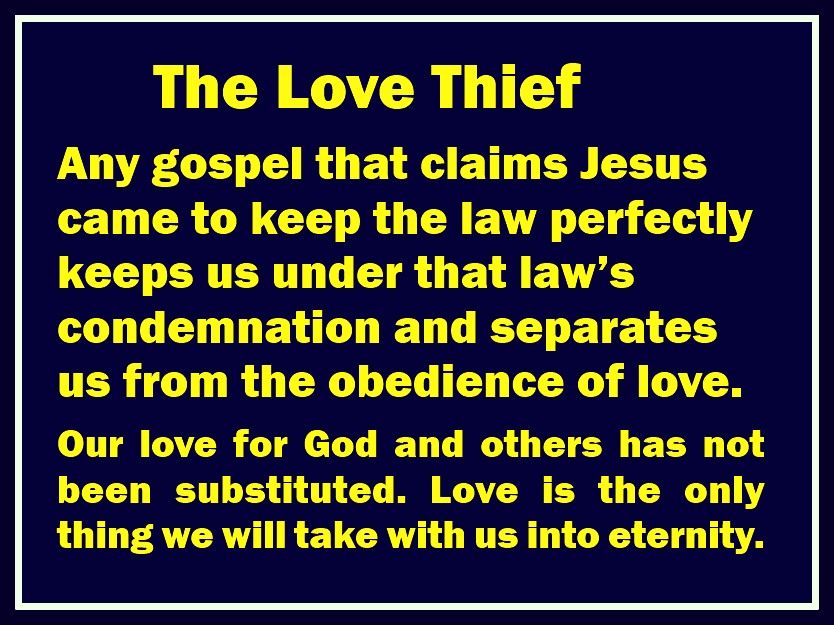
The covenant of promise is a gospel that stands in contrast to all other gospels which make the law of sin and death the standard for righteousness and a co-life-giver with God. There is only one mediator of life. Christ did not come to fulfill the law of sin and death, the Old Covenant, which holds sin captive. He came to end that law for those who believe. Nor did Christ come to be a substitute for that law in the lives of believers for that law is for the unbelieving—not the saved.15 Instead, Christ came to set the captives free from that law in order to serve the righteousness of the law in loving service with no fear of condemnation. There is no fear in love because fear has to do with judgment (1Jn 4:16-19). However, there is a fear of present consequences for obeying sinful desires as we work out our other “salvation” so to speak: the saving of ourselves from potential death that still dwells in the mortal body, and from which we will be saved from in the future, also known as “redemption.”16 Justification and obedience in sanctification ending in redemption should not be confused.

Do you believe a gospel that makes the New Covenant a fulfillment of the Old Covenant rather than an ending of it for those who believe? Have you substituted the fulfillment of the New Covenant via love for a substitutionary fulfillment of the covenant of death? This is what sets the covenant of promise apart from all other gospels.

If you are a true Christian, you don’t live by faith alone, you live by love alone, and you are the one doing the loving because you are free from condemnation. Your love is not a substitution; Christ’s death is the only substitution that sets you free to love without fear of condemnation.

_______________________________________________________________________

1Pastor Jon Young: Dayton Avenue Baptist Church, Xenia, OH.

3https://paulspassingthoughts.com/2015/01/04/the-potters-house-biblical-covenants-an-overview-and-relevance-to-the-gospel-parts-1-2/ Note citation about perpetually offering the obedience of Christ to God for the satisfying of the law.

4In the Protestant case, rituals that satisfy the law by imputing Christ’s perfect obedience to the law. One of these is church membership which is considered to be one of the “means of grace” found in the institutional church.

5This was an often cited indictment by Jesus against the Pharisees who were rank antinomians for that very reason.

6This is also the real point behind Galatians 2:20 which is a justification verse, not a sanctification verse.

7The book of Acts is the historical account of what Paul is writing about in Galatians 3.

8For the unbeliever the law is death, for the believer it is life.

9Note that Paul emphasizes Christ’s death in the receiving of the Spirit, not Christ’s law-keeping (Gal 3:1ff.).

10As seen all through the book of Acts per the order of salvation: 1. The hearing of the word 2. Faith 3. The baptism of the Spirit.

11Love also fulfills the law. Christ’s ONE act of love makes it possible for us to fulfill the Spirit’s law apart from the law of sin and death. The law is for love—not justification.

12Romans 12:1 along with many other texts makes it clear that the body can be used for holy purposes. In fact, it’s a biblical imperative. It is a weak vessel, but not inherently evil.

13Therefore, be leery of condemnation motifs in any sanctification context.

14The Old and New covenants should not be viewed in a dispensational sense at all, but rather merely two parts of the same covenant. This is a progression of one covenant, not economies.

15Note in 1Tim 1:8-11 and Rom 2:12-16 that the law of Moses is also the gospel. This is because the OT law is a PART of the covenant of promise NOT a dispensation or different plan.

16Phil 2:13, Rom 7:24,25, Lk 21:28. Phil 2:13 is not about justification; it’s about choosing life over death in sanctification with God’s help which is available and leaves us without excuse.
