
Why Every Self‐Respecting Premillennialist Isn’t a Calvinist

Originally published April 9, 2014
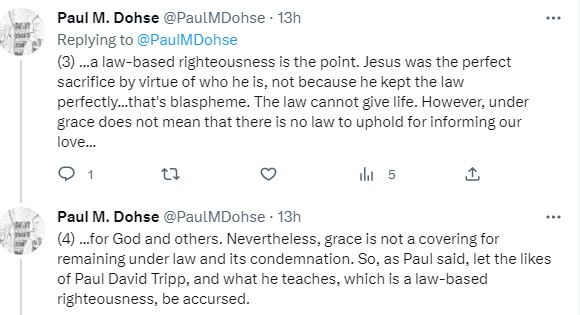
“One’s eschatology will be consistent with their view of justification—unless you’re John MacArthur.”
At the 2007 Shepherds’ Conference, Pastor John MacArthur gave the opening message titled, “Why Every Self‐Respecting Calvinist Is a Premillennialist.” The message caused a hyper hissy fit among the authentic Geneva style Calvinists that used to associate with MacArthur. Most of the hysterical reviews were whining rants about how the message was an “ambush.” They came to the conference to hear solid fatalistic Reformed doctrine while enjoying sweet fellowship among philosopher kings, and instead were personally dressed down at the very beginning of the conference that they attended with hard earned parishioner money. It just ain’t right.
No doubt, the message left amillennialism naked and freezing outside in the cold. Well, sort of, depending on your understanding of Calvin’s election construct. This is why the various responses danced around the real issue and were in bondage to MacArthur’s fundamental misunderstanding about what Calvinism is while calling himself one. Paul warned the Corinthians that elitist academia is not the venue that God works from, and this fiasco is just one good example among many as to why that is so. The Geneva popes could not expose the fact that MacArthur’s fundamental premise is wrong—that would expose what Calvin really believed about election—a truth that the totally depraved artisans can’t handle.
MacArthur said this during the message:
“But bottom line here, of all people on the planet to be pre-millennialist it should be Calvinists; those who love sovereign election. Let’s leave amillennialism for the Arminians. It’s perfect! [laughter] It’s ideal. It’s a no-brainer. God elects nobody and preserves nobody. Perfect! Arminians make great amillennialists. It’s consistent. But not for those who live and breathe the rarified air of sovereign electing grace. That makes no sense. We can leave amillennialism to the process theologians . . . The irony is that those who most celebrate the sovereign grace of election regarding the church, and its inviolable place in God’s purpose from predestination to glorification, and those who most aggressively and militantly defend the truth of promise and fulfillment, those who are the advocates of election being divine, unilateral, unconditional, and irrevocable by nature for the church, unashamedly deny the same for elect Israel. That is a strange division.”
Ok, so MacArthur highlighted one of the assumed positive notes that can be taken from the idea of Calvin’s election: Once saved always saved. And, absolute assurance of salvation because it is God’s work alone—we can’t mess it up. And, how can you proffer election for the individual and ignore the fact that Israel was elected? This put the Geneva popes in a tough spot because they know that this apparent contradiction fits perfectly with Calvin’s doctrine of election.
Calvin believed in three categories of election: the non-elect, the called elect, and the chosen elect. This necessarily denies assurance because the called elect don’t know for certain whom among them have been chosen to persevere till the end. Calvin stated this in no uncertain terms:
Let us, therefore, embrace Christ, who is kindly offered to us, and comes forth to meet us: he will number us among his flock, and keep us within his fold. But anxiety arises as to our future state. For as Paul teaches, that those are called who were previously elected, so our Savior shows that many are called, but few chosen (Mt. 22:14). Nay, even Paul himself dissuades us from security, when he says, “Let him that thinketh he standeth take heed lest he fall,” (1 Cor. 10:12). And again, “Well, because of unbelief they were broken off, and thou standest by faith. Be not high-minded, but fear: for if God spared not the natural branches, take heed lest he also spare not thee,” (Rom. 11:20, 21). In fine, we are sufficiently taught by experience itself, that calling and faith are of little value without perseverance, which, however, is not the gift of all (CI 3.24.6).
You can be called, and you can have faith, but that doesn’t seal the deal, said Calvin:
The expression of our Savior, “Many are called, but few are chosen,” (Mt. 22:14), is also very improperly interpreted (see Book 3, chap. 2, sec. 11, 12). There will be no ambiguity in it, if we attend to what our former remarks ought to have made clear—viz. that there are two species of calling: for there is an universal call, by which God, through the external preaching of the word, invites all men alike, even those for whom he designs the call to be a savor of death, and the ground of a severer condemnation. Besides this there is a special call which, for the most part, God bestows on believers only, when by the internal illumination of the Spirit he causes the word preached to take deep root in their hearts. Sometimes, however, he communicates it also to those whom he enlightens only for a time, and whom afterwards, in just punishment for their ingratitude, he abandons and smites with greater blindness (CI 3.24.8).
So, this fits perfectly with Calvin’s eschatology; Israel was temporarily elected just like many individuals are temporarily elected. The logical conclusion of Calvin is that God’s word, did in fact, fail (Romans 9:6). Moreover, and in direct contradiction to 1John 5:13, authentic Reformed doctrine has always denied assurance. This is reflected in many contemporary authentic Calvinists:
There is danger on the way to salvation in heaven. We need ongoing protection after our conversion. Our security does not mean we are home free. There is a battle to be fought (John Piper: Bethlehem Baptist Church Minneapolis, Minnesota; The Elect Are Kept by the Power of God October 17, 1993).
Words mean things. Piper is clearly saying that our battle in sanctification is a battle for justification. If you really understand the Reformed view of justification, you know: that battle is against our supposed propensity to gain favor with God through works in sanctification (“please/love God” changed to: merit for salvation). There is no separation of justification and sanctification, so works in sanctification must be sanctified with a faith alone formula. It’s salvation by Christ plus not doing any works in sanctification (Christ + antinomianism to maintain our salvation). We must be sanctified the same way we were justified so that we can properly finish justification. Therefore, Calvin believed that sins committed in the Christian life separate us from grace, and a continual repentance, the same repentance that saved us, is needed to maintain our salvation. Unless we live by faith alone in sanctification, Christ’s blood will not be applied to the new sins we commit. This is the battle Piper is talking about. Said Calvin:
…by new sins we continually separate ourselves, as far as we can, from the grace of God… Thus it is, that all the saints have need of the daily forgiveness of sins; for this alone keeps us in the family of God (John Calvin: Commentaries on the Catholic Epistles; The Calvin Translation Society 1855. Editor: John Owen, p. 165 ¶4).
And, guess what? It just so happens that your local Reformed elder, via the Reformed power of the keys, has the authority to forgive those pesky sins that take away your salvation. Whoever would have thunk it?
To impart this blessing to us, the keys have been given to the Church (Mt. 16:19; 18:18). For when Christ gave the command to the apostles, and conferred the power of forgiving sins, he not merely intended that they should loose the sins of those who should be converted from impiety to the faith of Christ; but, moreover, that they should perpetually perform this office among believers (The Calvin Institutes: 4.1.22).
Secondly, This benefit is so peculiar to the Church, that we cannot enjoy it unless we continue in the communion of the Church. Thirdly, It is dispensed to us by the ministers and pastors of the Church, either in the preaching of the Gospel or the administration of the Sacraments, and herein is especially manifested the power of the keys, which the Lord has bestowed on the company of the faithful. Accordingly, let each of us consider it to be his duty to seek forgiveness of sins only where the Lord has placed it. Of the public reconciliation which relates to discipline, we shall speak at the proper place (Ibid).
Calvinism is an egregious false gospel being flaunted in broad daylight by academic elitists who are in reality clueless, which brings me to my second point. This is where the vast majority of American Christians are functioning Calvinists…among many other ways while vehemently denying Calvin. Specifically, the whole idea that eschatology is a “secondary issue.” No, no, no, no, no, no, no! Eschatology is gospel; you cannot separate the cross from eschatology. One’s eschatology will be consistent with their view of justification—unless you’re John MacArthur.
The number of resurrections and judgments, and who stands in those judgments, are indicative of a particular view of justification, and election in particular. MacArthur’s dispensationalism coupled with naming the name of Calvinistic soteriology, which really isn’t Calvin’s soteriology to begin with, is a dumbfounding contraction that leaves one without words to fully explain. Calvin’s eschatology calls for one resurrection and one judgment at the end of time where everyone sweats it out while waiting to find out if they were antinomian enough. Some of the books at the Great White Throne Judgment are the books of the law that will be used by God to judge the works of those standing in that judgment. As one aspect of Christian security, we will not stand in that judgment because we are not under the law. Furthermore, we don’t wait to see if our antinomianism sufficiently utilized the “doing and dying” of Christ to cover our sins—our sins have been completely eradicated.
The number of resurrections and judgments speak to our view of what part of Christ’s works on the cross are finished and not finished, the separation of justification and sanctification, the new birth, election, and future Israel. Eschatology is gospel.
That’s why every self‐respecting premillennialist isn’t a Calvinist, and why MacArthur isn’t a Calvinist, but he thinks he is a Calvinist. As stated by Richard Muller,
There is every likelihood that John MacArthur’s “Calvinism” would probably not be recognized by Calvin himself.
It’s all simply pathetic.
paul
What’s Going On At Asbury, and What’s Driving It?
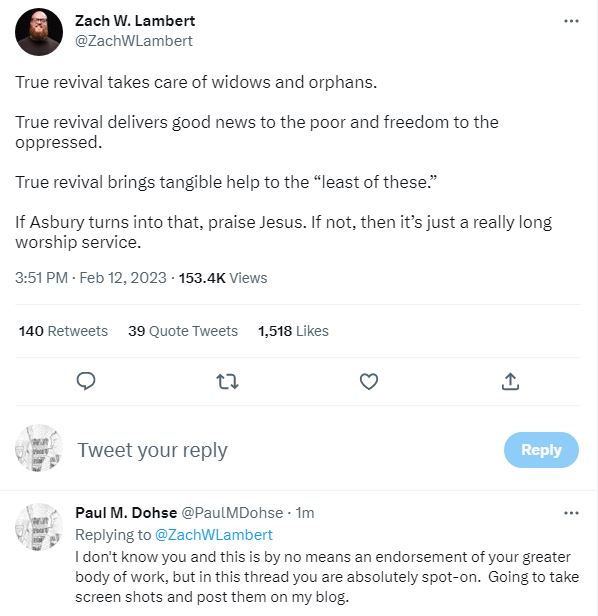
If you are reading this, you have probably heard of the spiritual “revival” at Asbury University in Wilmore, Kentucky. The event has become famous, with everyone from the blogsphere to Tucker Carlson of Fox News weighing in on the event. Journalists like Carlson were persuaded not to do any onsite reporting on the event in order to, supposedly, “keep Jesus front and center.” By the way, considering the critical thinking skills of the average American, I deem it necessary to inform you that Jesus did not attend and speak. However, thousands of attendees able to jump and chant at the same time spoke many things for Jesus throughout the revival. This reminds me of the various church councils throughout history where dogma was determined by church authoritarians; we must remind ourselves that Jesus did not attend any of them. Basically, if you accept the authority of any of these councils, you are trusting the musings of men rather than the one who received ALL authority IN HEAVEN and ON EARTH (that pretty much covers everything) from God. The Bible is clear on this; the Bereans vetted the apostle Paul’s teachings with their own understanding of the Bible and were commended for it by the Holy Spirit. If the apostle Paul did not have the authority to tell people what to believe, no one does.
There is one common theme throughout the reporting of this event; it’s some sort mysterious moving of the Spirit that no one understands. Be sure of this: It’s not the Spirit’s work, and what is going on is perfectly understandable. The vast majority of American churchgoers don’t know why they do anything they are told to do, nor do they know anything about what they supposedly believe. So, the first element is mystery, then there are two more subthemes that define the event: “Brokenness,” marked by confession and repentance (which sparked the revival), and praising God.” These two define the lion’s share of the event’s activity. That’s because these two elements define the Protestant doctrine of mortification and vivification. And few of them, if any, know that this is what’s driving the activity because, again, people who go to church don’t know why they do anything except for the assumption that it is getting them to heaven because some pope or pastor said so.
So, what is the doctrine of mortification and vivification? Well, instead of defining the new birth as a one time act of God upon an individual that seals them with the Holy Spirit for eternity, mortification and vivification defines the new birth as a perpetual reoccurring event that must be pursued with intentionality in order to remain saved. Also, this doctrinal endeavor must take place in a location ordained by God and under the auspices of his appointed authoritarians, viz, church. That’s why this “revival” took place in a chapel. And, it’s why the event is marked by nonstop praise and worship, as that defines the vivification (rebirth) part of the process. The participant partakes in repentance for “present sins,” leading to brokenness (death, or mortification of sin, or death to self), which results in the Spirit re-resurrecting you (vivification, or what John Piper calls, “exultation”). John Calvin referred to it as a re-visiting of our original baptism, which signifies our death and resurrection with Christ (new birth). According to the biblical gospel, water baptism is only a picture of what God does spiritually to make us a once-and-for-eternity child of his, but Calvin and Luther both defined water baptism as an ordinance that supplies the power needed for continual re-salvation through the mortification and vivification process. Also, according to Luther and Calvin, water baptism initiates us into the church marriage covenant, where we have access to the ordinances that make mortification and vivification possible.
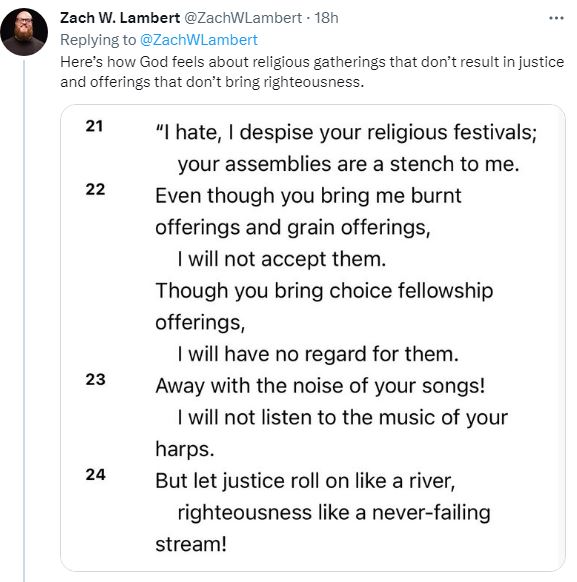
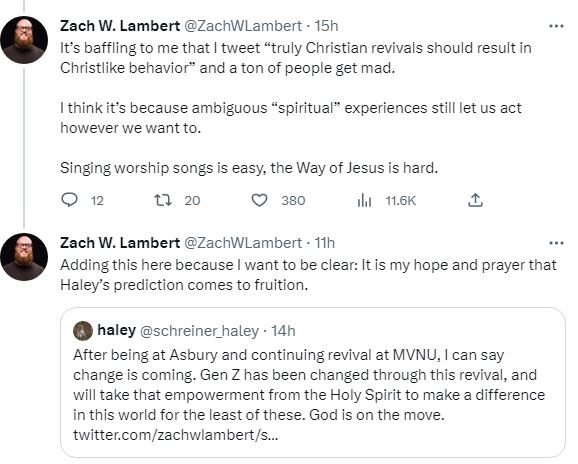
Asbury is just the practice of mortification and vivification x 10, or as one person put it, “nothing but a long church service.” And yes, it’s works salvation, or Jesus + church ritual…clearly. Hence, the number of people showing up shouldn’t surprise us; Asbury is a place to get a stronger dose of Jesus, which is efficacious for the progression of salvation.
paul
Church Re-Crucifies Christ and Puts Him to an Open Shame
Originally Published in 2016; Edited and Revised
My original salvation experience was very powerful and full of joy as I sought to add to my faith with much zeal. Initially, a lot of sin that formally enslaved me seemed powerless, and many of the former sinful desires had disappeared. Then church happened.
While seeking for the “right” church to “worship” in, my interim experience between saving faith and seeking out a place of worship, as aforementioned, was marked by joy, zeal, and power. As I invested more and more in church; more and more confusion, doubt, and fear ensued. Church made me a pathetic, joyless, and broken person. And by the way, most churches will tell you that is a good thing. In fact, most churches are clear in regard to that being their very goal. This makes you see your need for more salvation. They say it plainly all of the time.
As I read my Bible more and more…more and more of my church experience failed to add up; particularly, the incessant weekly re-visitation of the gospel. And keep in mind this was well prior to the Neo-Calvinist movement. “Why are we always talking about the gospel at church? Aren’t we already saved?,” I would often ask myself. If I would have only known way back then that the answer to that question is, “NO.”
Yes, according to orthodoxy, Protestants aren’t saved. Church is a “race of faith” and the prize for winning the race is salvation. And, the race only takes place at church. Sure, sure, they will tell you that you are already saved according to the Protestant doctrine of, “already—not yet.” What’s that? IF you are entered into the race by being faithful to church, you have hope that you are already saved, but not yet because you have not finished the race of faith alone in which the prize for winning the race is “final justification.” And by the way, even if you are one of the already, not yet crowd, you won’t know that for certain until the “final tribunal.”
This, in and of itself would be humorous if not so sad, but it gets better. Pastors, and this according to their own precious orthodoxy, in black and white, and in no uncertain terms, have authority to proclaim you an alreadian. Yep, this is the “power of the keys” doctrine that will bind in heaven whatever the church binds on earth, and the same for the loosing stuff as well. Do adults really fall for this stuff? Yep. Is this why pastors are so revered in the church and placed on a pedestal? Ya think? Ultimately, they decide where you spend eternity, and they are your wildcard that bypasses the uncertainty of Protestantism’s “already, not yet.” Supposedly, there are two things standing between you and a wrathful God that hates humanity: Christ and His “undershepherds.”
Well, this is nothing new. Church is a mirror image of every foul thing that God’s prophets fought against as documented in the Scriptures. Before we go on, what is “church”? Church is the institutionalization of Christ’s assembly that occurred in the 4th century. Simply stated, it moved the temple of God from the bodies of believers to brick and mortar temples making worship a place, not a practice of truth wherever a believer is breathing. The fellowship of Christ’s body was replaced with authorities other than Christ operating in corporate temples. Authority replaced leadership, and membership replaced fellowship. “Follow me as I follow Christ” was replaced with “Obey God’s anointed or we will take your salvation away.”
So, there is a reason why you go to church and hear about the same gospel that saved you week, after week, after week. There is a reason why the Lord’s Table is a solemn ceremony marked by self-denigration. There is a reason for alter calls. There is a reason why the pastor speaks from a fancy podium on an alter raised above where the congregants sit, and alters where the other important dictators of the church sit in gaudy chairs behind the podium. It’s crazy; this stuff does not cause people to ask what in the heck is really going on.
Scriptural examples abound, but this post is about Hebrews 6. Let’s set the table. As Christ’s assemblies meeting in private homes (because we are God’s family not members of a corporate temple named Salvation Inc.) moved forward in true discipleship, they endured persecution from the pagan-state and Judaism. In essence, they were getting flak from every angle in regard to the culture of that time, but primarily from Judaism which was clearly salvation by temple ritual. And by the way, most of the persecution from the pagan-state was instigated by the Jews politically.
Hence, many Christ followers were hedging their bets and playing both sides of the fence. Like today’s institutional church, excommunication meant the loss of salvation, and in many cases, difficulty in obtaining financial income. Be sure of this; likewise, as the economy weakens in the U.S., many cling to the institutional church for career connections, viz, financial security. There is absolutely no new thing under the sun.
This is what the Hebrew writer was addressing specifically: the continued sacrifices for maintaining salvation versus sacrifices of love performed by our bodies, which are now the temple of God indwelt by the Spirit (ROM 12:1). A return to the same gospel that saved us denies the new birth and the holiness of the believer. The holiness of the believer is part and parcel with “moving on to maturity” (HEB 6:1). A return to the basic, or elementary principles of salvation harkens back to the shame of the cross, which Christ despised (HEB 12:2) and denies the purpose for which he endured it: the glory which was set before; ie., bringing many sons to glory. By striving for maturity and adding love to our faith, we fulfill the purpose for which Christ endured the cross. But, returning to the cross…
“seeing they crucify to themselves the Son of God afresh, and put him to an open shame.”*
Shockingly, in spite of Scriptural clarity on this issue, many Protestant scholars brazenly endorse a return to what Christ despised, and make that the replacement of the very purpose for which He endured the cross; to make many holy for purposes of offering themselves in love many times as opposed to worshiping what Christ despised. Making our bodily members available for love 24/7 is our worship, or our “logical service.” True worship is no confined to a time or place.
Hence, worship is redefined by returning to the basic principles of salvation in a temple, rather than the worship of offering holy sacrifices of love in sanctification wherever we are found breathing. We then meet together to encourage each other in this worship (HEB 10:25). The Hebrew writer addressed those who ratcheted back from meeting in the home fellowships because of persecution from the temple worshipers.
And that’s church. And that’s what you do every time you go there: you sing praises to what Christ despised, and disparage the purpose for which He endured the shame.
And for some insane reason, you pay 10% of your income for the privilege.
paul
*”Those who cannot be restored to repentance” pertain to that time when they witnessed the power of the Spirit being manifested firsthand. Being exposed to the full light of the truth in such dramatic fashion and then afterward returning to a ritual of re-justification made it doubtful that they would ever be fully persuaded.


 Paul's Passing Thoughts
leave a comment