A Christian Elitist Is In The News Again And It’s Not About Love

The “Christian” elite rarely make headlines for anything good. They either get caught with both hands in the cookie jar or say something stupid. Last week, it was the latter via the mouth of Christian elitist Kirk Cameron. Apparently, this is what caused the uproar: “Wives are to honor and respect and follow their husband’s lead, not to tell a husband how he ought to be a better husband.”
Let me propose something. At best, being your wife’s master is a matter of Christian liberty. You can cite Bible verses that make you the master of the house, and your wife may buy into it, but men are never specifically commanded in the Bible to be the lords of their household. Furthermore, if you live in Saudi Arabia or a place like that, that endeavor works really well, but in America, not so much. In America, if your wife chooses to disobey you, there is really nothing you can do about it other than divorce her or other courses of action that are against the law. For example, you grab your wife by the arm and squeeze too hard—you’re going to jail. And frankly, that’s the way it should be. And wife spanking? I know a guy who went to jail for that, and again, rightfully so.
A pity the Holy Spirit didn’t see America coming; now everything is in cultural confusion. So, when you go to the Protestant temple on Sunday to get more salvation and hear a sermon about the lordship of husbands, and your wife ends up in the isle rolling on the floor laughing (ROFL), what to do?
Let’s interpret Scripture with a big picture and in context. First of all, we must be careful because the essence of sin, according to the Bible, is a lust to control others. Like sin, power-hungry people want to control others—they like to be boss. In cultures like America, those who desire control must improvise accordingly because social caste isn’t the law. This is usually done through assassinating self-esteem. The vast majority of marriage counseling is two people with a long list describing the faults of the other mate in order to make a case for control. “My husband should listen to me and do what I say because he is stupid and here is the list that proves it” and vice versa.
Hence, we can see this very dynamic in Cameron’s statement: “Wives are to honor and respect and follow their husband’s lead, not to tell a husband how he ought to be a better husband.” See it? The wife’s attempt to control; “not to tell a husband how he ought to be a better husband,” and the husband’s attempt to control: “Wives are to honor and respect and follow their husband’s lead.” Of course, Cameron’s statement, like all Protestant-speak, is full of the redefinition of words for purposes of Protestant mind control. Leadership is totally unnecessary where there is authority. Cameron could have honestly said, “Wives are to remain silent and obey their husband’s lordship.” Leadership is the art of persuasion and setting an example to follow, not a demand for subservient obedience. This particular issue is a decent example of the Protestant metaphysical shell game through the use of words: “leadership” covers for “authority,” and “follow” covers for “obey.” And “husband” covers for “lord,” and “wife” covers for “You are the women and Eve sinned first so you don’t know your right hand from your left.”
This is my personal testimony: when I caught hold of how the Bible defines all of these words and their use in context, I lost all desire to control people or tell them what to do. Seriously, I have no desire whatsoever to control anybody; not only am I poor at it to begin with, it isn’t fun anymore. It is so freeing to simply set an example and let people decide whether or not they can benefit from your example. After being a pastor in the institutional church for years and suffering through all of the control politics there are no words to explain the freedom and peace that I feel in all of this. I will give an account for my life before Christ and the example that I set for others; nothing more or less. This is the biblical definition of “love.”
Love persuades people for their own benefit and doesn’t keep a list of wrongs because the goal is not control, but cooperative unity. And unfortunately, many marriages are doomed to failure because people do not understand these biblical dynamics going into marriage. This is why Protestantism produces more marriages of slavery than any other mindset. Orthodoxy, because of the way it defines biblical words, picks a fight with common sense and creates a control war between people on many levels. And, couples are not allowed out of the war because you know; divorce is “against the law of gaaawwwd!” Amen. As a former pastor in the institutional church, I never saw more marriages of coexistence in one place.
This also goes hand in hand with the whole…”The church is the bride of Christ” thing, another orthodox refrain often espoused by Cameron. See, wives should obey husbands the way the church obeys Christ. It is a caste pecking order. The church is the wife of Christ, and He is Lord, so obviously, wives should obey their husbands the way the church obeys Christ. Again, notice that “obey” and “submit” cover for what word used specifically in the Scriptures? Right…”LOVE.” Wives are to “respect” their husbands and husbands are to “love” their wives—not lord it over them.
And remember, when it gets right down to it, Christ led, and NEVER invoked His authority. It just never happened. It will happen, but not in this age. So, there is presently an authoritative pecking order in this age? Well, in case you haven’t noticed, heaven isn’t enforcing it. If you want to know what things will look like when that happens, read the book of Revelation.
Christians are to lead quiet lives of love and edification down where we live and not be entangled in the affairs of the world where power over others is the name of the game. Because Protestantism misunderstands the difference between authority and loving leadership, conflict can be observed on every level of life. Like the world, Protestantism clamors to control the lives of people in their homes, and culturally. They believe God’s kingdom is presently on earth, and this necessarily requires authority on every level of life; what they call, “love.” Cameron even said it in the midst of the controversy: “I love all people and I have hatred toward no one. I’m also a man of conviction, and if you press me, I’ll give you my perspective on a social issue if you ask.”
Right, Protestants love everyone; that’s why you should let them rule over you for your own good. Because they love you so much. And society can also benefit from the way Protestants love their wives; that is, those wives who keep their mouths shut and “respect” (being interpreted, “obey”) their husbands.
Want a good example of how this works? Research the history of Protestantism before the American idea came along. That’s their definition of love.
paul
True Christians Are NOT “Under Construction”
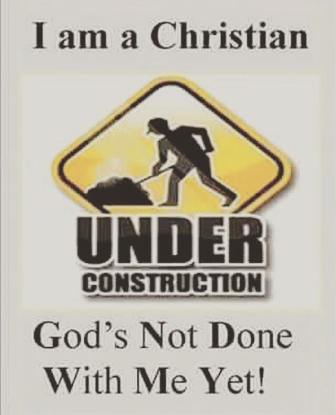 It is one thing to be wrong about the gospel, but it is yet another to be wrong about your understanding of the gospel you identify with which is also an errant gospel to begin with. I guess you could call it double wrongness or something of the sort. This is where Catholics are far less wrong than Protestants; they have a clear understanding in regard to their orthodoxy, though wrong. Most Protestants misunderstand the orthodoxy that is errant to begin with, so they are wrong about what they are wrong about. This is why the world deems Protestantism as stupid…because it is. Nobody respects double wrongness.
And this meme is yet one more example. It is popular because Protestants think the law is the ground of justification, and of course, no one can keep the law perfectly, so this meme is a Protestant lame attempt to explain to the world why professing “Christians” are not “perfect.” Supposedly, we are “under construction,” viz, we are growing in the Lord and learning to keep the law better and better as we grow.
Well, that is wrong, but also, that’s not Protestantism. So Protestants are wrong about the law being the ground of justification, but they are also wrong about the idea that Protestant orthodoxy holds to a progressive maturity of the believer. NOT. “I” is not under construction; that’s not Protestantism at all.
True Protestant orthodoxy holds to the idea that the “believer’s” ability to merely perceive or “see” a Christocentric metaphysical reality is under construction, but that excludes any possible good work done by the so-called believer. The meme suggests that the believer’s life-testimony improves according to Protestant orthodoxy, but nothing could be further from the truth.
What is in view is an ability to see a greater and greater need for our original salvation and thereby magnifying the gospel. Hence, we are supposedly more and more saved by “seeing” a greater and greater need for the same gospel that saved us. This perception supposedly increases our “gratitude” for salvation which moves our progression of salvation closer and closer to final salvation or what is known as “final justification.” According to authentic Protestantism, what is really under construction is our salvation while many assume the meme is referring to sanctification. But in Protestant thought, sanctification has been redefined to mean progressive justification. The often used term “progressive sanctification” in Protestant circles is a lie.
Some contend that gospel contemplationism increases our gratitude for salvation as we seek to see our sinfulness more and more, and this motivates us to good works. The gratitude supposedly purifies our otherwise evil works. In other words, all of our truly good works must be motivated by our gratitude or else the works are moralistic attempts to justify ourselves. So, whenever we do a deed joyfully, by this we know that the deed flows from gratitude and is not works salvation accordingly.
This idea may give some credence to sanctification by justification, but that’s not Protestantism either. Protestantism excludes the possibility of any good work performed by any human being whether saved or unsaved. The only difference between a lost person and a saved person is worldview/perception. This increased perception increases the “glory of the gospel; not our own glory” which would supposedly be works salvation. According to Martin Luther’s 97 Theses, 95 Theses, and the Heidelberg Disputation; the three foundational documents of the Protestant Reformation, any belief that any individual can do a good work is mortal sin (unforgivable and beyond the scope of salvation).
Therefore, salvation is really under construction and that is defined by an increased ability to see one’s own evil and thereby increasing their salvation. It’s salvation by glorifying the cross, not anything we do as a result of being new creatures. This is the crux of Martin Luther’s Theology of the Cross defined by the cross story versus the glory story. Only two things can receive glory: the cross, or man. Any belief that glorifies man; ie., man can do a good work, is a false gospel. That’s Protestantism plain and simple; nothing more or less.
The following illustrations were taken from a book on Protestant orthodoxy:
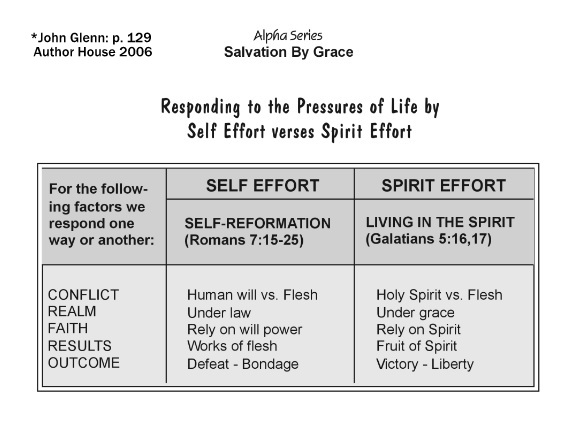
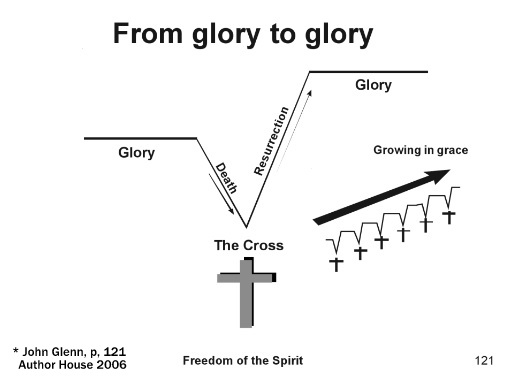
Note that non-salvation and salvation are defined by “realms” not a personal state of being. The person does not change; only one’s ability to see realms which are only experienced. Our own efforts are works of the flesh while the works of the Spirit are manifestations that we only experience. The “death” we partake in is an endeavor to see how evil we are resulting in a resurrection that increases the glory of the cross.
Seeing the glory of the cross more and more which necessarily demands that you see yourself as more and more evil results in one getting closer and closer to final salvation. Salvation is what is under construction, not the person. This is the Protestant doctrine of mortification and vivification (death and resurrection) which is a redefinition of the new birth. Instead of the new birth occurring once and justifying us by a transformation of our being, one partakes in perpetual deaths and rebirths to gain more and more salvation. In essence, finding joy in finding our evil.
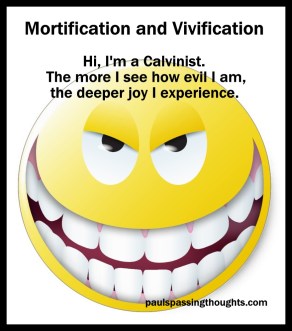
Per the usual, a true understanding of Protestantism is Clintonian; it depends on what you mean by the word “is” when you say something “is.” In the case of this meme and all other words used by Protestants, you must know the actual Protestant definition. In this case, what is under construction?
Well, it depends on what you mean by the word, “I.”
paul
Register for TANC 2016 Conference on Gospel Discernment and Spiritual Tyranny
Registration Link: http://tanc2016.weebly.com/registration.html
TANC 2016: Paul Dohse
 Paul became a Christian in 1983. His salvation experience was powerful and with much assurance. As he began studying the Scriptures for himself, contradictions between the plain sense of Scripture and his church experience increased more and more as each year passed.
Furthermore, though Paul could make some sense out the Bible that encouraged him to a point, for the most part, the Bible seemed to be confusing, mysterious, and contradictory. Paul’s initial salvation experience declined into confusion, doubt, and at times despair. Eventually frustrated by the church’s comfortable coexistence with confusion and contradiction, he set out on a journey to make sense of the chaos.
After publishing a book on the Neo-Calvinist movement in 2011 that was the culmination of four years of research, he abandoned all presuppositions and began studying the book of Romans word by word. The goal was to draw conclusions from the literal grammar alone. In other words, just let the words say what they say regardless of anything.
During this process, a profound pattern in the book of Romans began to emerge: a righteousness completely separate from the law; the idea that justification and law are mutually exclusive. The idea that the ground of our justification is the new birth—not the law or any law-keeping by Christ imputed to our account. Hence, who keeps the law is irrelevant; the law has no part with justification. It’s not just man’s law-keeping that is separate from justification; the law itself is separate from justification which would also include any law-keeping by Christ. Again, who keeps the law is irrelevant—there is no law in justification; “apart,” means just that…APART! (Romans 3:21).
The gravity of this truth is immense because Protestantism and Reformed tradition are founded on the idea that Christ fulfills the “righteous demands of the law” in our stead.
How could the Reformers have missed such a simple point? And how did this blatant error come to define Western orthodoxy? And finally, what is the alternative? This will be the subject of Paul’s three sessions at this year’s Conference on Gospel Discernment and Spiritual Tyranny.



leave a comment