The “Cross Story” and Sanctified Rape in the Church
Originally published January 31, 2013 “Be sure of it: this is how Calvinists think; this is their worldview.” “Don’t misunderstand: the problem of ‘victim mentality’ is not even on the radar scr…
Be Thankful on Thanksgiving; Protestants Can Be Saved
 Religious Tyranny: A Case Study; Chapter Nine, The True Gospel, “You Must Be Born Again”
The institutional church can claim it is better than institutions like the Olive Garden restaurant; it can claim you are also family when you are not there, but one must understand that talk of family in the institutional church is merely in a manner of speaking like job interviewers who claim, “We are just like family here.” Protestantism, like most Western religions, denies a literal new birth.
Here we go again. The average parishioner will now become indignant in the face of such a charge, but once again we ask, “How does the church function?” Does the intellectual testimony match the function? No. While claiming literal new birth into the family of God, family status is only accepted by formal membership. Luther, Calvin, MacArthur, Piper et al (Reformers old and new) have claimed in no uncertain terms that church membership is absolutely synonymous with being part of the body of Christ. In other words, unequivocally, salvation by church membership. And, your willingness to join a church also shows a willingness to “place yourself under the authority of godly men.” Bingo. When asked if that means parishioners have to do what the church leaders say, John MacArthur simply answers, “yes.”
This is where we must note a significant historical demarcation: before America, not obeying the church elders could get you an appointment with a burning stake; now the church can only launch an intimidating accusation that you will go to hell without them. In contrast, it is much more likely their pseudo-new birth will land you in hell.
Connection to the body of Christ by church membership is not the literal new birth. Fret not, we will be visiting the biblical truth about new birth soon, but there is more bad news about church membership. According to formal Protestant orthodoxy, water baptism is what makes you a real member of the institutional church. Even Baptists who claim a difference between “Reformed” theology and evangelicalism are guilty of this Reformation tradition. Please note the most recent revision of the Southern Baptist Faith and Message:
Christian baptism is the immersion of a believer in water in the name of the Father, the Son, and the Holy Spirit. It is an act of obedience symbolizing the believer’s faith in a crucified, buried, and risen Saviour, the believer’s death to sin, the burial of the old life, and the resurrection to walk in newness of life in Christ Jesus. It is a testimony to his faith in the final resurrection of the dead. Being a church ordinance, it is prerequisite to the privileges of church membership and to the Lord’s Supper.
Though the first part of this statement seems to affirm a biblical new birth, note that water baptism is required to obtain the privileges of church membership, and as stated in other places additionally, church membership is efficacious to salvation and being part of the body of Christ. Apart from all the doublespeak, this is naked salvation by church membership obtained by water baptism. This goes back to the original tenets of the Protestant Reformation.
But it gets worse. In original Protestant orthodoxy, connection to the body of Christ comes and goes. This is the formal Protestant doctrine of The Vital Union. This doctrine is routinely taught by contemporary Reformers like John Piper and goes back to original Reformation tenets of faith. What is it?
It is connected to the idea of deep repentance. As we return perpetually to the same gospel that saved us (“We must preach the gospel to ourselves every day”), we re-experience our original new birth; i.e., spirit baptism originally affected by the water experience, and come into union with Christ. This is also the official Protestant doctrine of Mortification and Vivification. How were you originally saved? By confessing your sins, right? Therefore, by confessing your “present sin” and “mortifying the flesh” you once again die with Christ, and are once again resurrected. This resurrection that occurs as a result of returning to the same gospel that saved us in turn results in the “vital union” which then results in the “works of Christ flowing through us.”
And, this process of deep repentance (returning to the same gospel that saved us for forgiveness of present sin) followed by mortification and vivification resulting in the vital union which in turn results in the works of Christ flowing through us, can only be obtained in the institutional church.
Let’s back up momentarily. When we see language like this previously cited…
Christian baptism is the immersion of a believer in water in the name of the Father, the Son, and the Holy Spirit. It is an act of obedience symbolizing the believer’s faith in a crucified, buried, and risen Saviour, the believer’s death to sin, the burial of the old life, and the resurrection to walk in newness of life in Christ Jesus
…the process of deep repentance, mortification and vivification, and the vital union is really what is being alluded to. That’s the dirty little Protestant secret. These are the “privileges” of membership. Remember the “Members Only” Jackets that were all the rage in the 80’s and its marketing mantra, “When you put it on something happens”? Well, once again an institutional example is apt.
Deep repentance, mortification and vivification, and the vital union are all under the auspices of yet another authentic Protestant doctrine: Double Imputation. What’s that? It is the idea that Christ not only came to die for our sins, but also came to live a perfect life in fulfillment of the law of Moses. Do not miss this major point: this doctrine calls for the necessary imputation of Christ’s obedience to the law as a substitute for the Christian’s obedience in order to remain justified before God (saved). Why is this needed? Because no Christian can keep the law perfectly, and perfect law-keeping is the Protestant standard for justification. We hear this constantly in Protestant circles. So, let’s be clear:
Christ came as a substitute for our sin and our good works both because no person can keep the law perfectly and the law must be fulfilled perfectly at all times for anyone to be justified before God. Therefore, he died for our sins and lived in perfect obedience that replaces our imperfect obedience to the law which must always be fulfilled perfectly to maintain a justified state before God.
Hence, Christ died for our sin and was resurrected to make the vital union possible so that His perfect law-keeping can be imputed to our lives as a substitute. This is obtained by continually returning to the same gospel that saved us for forgiveness of “present sin” resulting in a repeated death with Christ and subsequent resurrection (mortification and vivification) resulting in the vital union which imputes Christ’s perfect obedience to our lives as a substitute.
In other words, the new birth doesn’t occur once, but perpetually, and the perpetual new birth that keeps us saved can only be obtained through formal church membership.
And, this version of the new birth turns the Bible completely upside down. First of all, the standard of justification is NOT the law, but a true biblical new birth. Protestantism is not, “justification apart from the law.” With all of Protestantism’s scholarly pomp and circumstance, this is a stunningly simple aberration of the true gospel. Accordingly, Protestant scholars of all stripes openly admit that justification is a “legal declaration” while at the same time claiming that it is apart from the law. This is a stunning contradiction.
Secondly, for the Christian, there is no “present sin” that needs the same kind of forgiveness that former sin needed. While most Protestants will vehemently deny the accusations of this chapter, to the following question they will always answer, “yes.” Did Christ die for all of our past, present, and future sin? If the answer is “yes,” this clearly indicates that Christ’s work on the cross, and supposedly perfect law-keeping must be re-appropriated for future violations against the law. Hence, the “Christian” is still…
Thirdly, this keeps the “Christian” UNDER LAW and not UNDER GRACE. Supposedly, the Protestant doctrine of double imputation comprised of deep repentance, mortification and vivification, and the subsequent vital union keeps the Christian from being under law because Christ keeps/kept the law for us, but that is still under law and not under grace. Who keeps the law isn’t the point, the law, period, is the point. The standard of justification is the new birth, not the law.
Fourthly, this makes the new birth a perpetual re-occurrence, and also a perpetual re-application of Christ’s death on the cross; a pretense strictly forbidden by the Bible. Protestant scholars get cute with this by pointing out that Christ only died once in a historical sense, and this somehow circumvents an accusation of continually subjecting Christ to open shame.
Fifthly, this Protestant version of the new birth denies that it is really the Christian who is loving God and others. Love is actually performed by Christ alone and imputed to the believers account. While the believer experiences life as if they are doing the work, it is actually Christ doing it. We hear this spoken of constantly in church venues: “I didn’t do it, the Spirit did it.” “God did it through me” etc., etc.
While evangelicals are constantly bemoaning the “legalism” of the Pharisees and a return to the “Galatian error,” this is exactly what Protestantism is guilty of. It is a single perspective on sin and law resulting is Christ’s specific accusation against the Pharisees: relaxing the law. What is the problem here? It relaxes love; the very thing defines God and His children. Some tradition, an actual dumbing down of the law, fulfills the law which is not what defines justification in the first place. Sin is still sin, and law is still law, instead of what the real new birth does to the law; it makes it love.
Protestantism makes a direct act of obedience by the believer works salvation instead of love. This is because no real transformation takes place in the believer according to Protestant orthodoxy. In fact, if one pays attention, Protestant scholars of old and new say this outright all of the time. The only active role of Protestants in salvation is the recognition of these truths “revealed to them” by the Spirit if they are elected by God. Are you truly God’s elect? Then you recognize the authority of the church. Who would not be a millionaire if they received a nickel for every time we hear this at church, on the radio, Facebook, and YouTube?
In church, you are not even necessarily family when you are there depending on your status regarding the vital union. In that respect, even the Olive Garden restaurant is better.
What happens when one is truly born again? We are not merely declared righteous, we are righteous. In fact, the Bible drives the point home by calling us “perfect” and “holy.” Protestants can’t understand this because “sin” is still sin, “law” is still law, and “obedience” is still obedience. No real transformation has taken place. Only our “position” has changed, not our state of being, so all those things (sin, law, obedience) have a single perspective that doesn’t change. Protestant scholars say it all of the time: “Justification is positional.” Our legal standing before God is justification…if we go to church and thereby obtain the privileges of membership that include all of the aforementioned under double imputation.
The real goal of salvation is to escape eternal condemnation once and for all time. This is only done through the biblical new birth. A desire for salvation is a desire to die to who you are, and be recreated as a child of God and engrafted into His literal family. A person who desires salvation recognizes that he or she is under the condemnation of the law. This is why the Bible describes the unregenerate as “under law.” The saved person is “under grace.” These distinguish between two states of being, not a mere status or position. This is only accomplished by the new birth.
The new birth is obtained by believing these facts and a desire to be recreated as God’s child, and asking Him for such. This is what Christ focused on when Nicodemus visited him one night. Christ said, “You must be born again,” and then proceeded to tell Nicodemus how to obtain the new birth (see the account in John, chapter 3).
Christ died to pay the penalty for our transgressions against the law, and was resurrected for our justification. What does this mean? Christ’s death and resurrection established the new birth and made Him the “firstborn of many brothers and sisters.” Those who believe in Christ partake in a literal death of the old self and a literal resurrection to new life. This transformation involves many radical changes, but a primary one is a love for God’s truth (word) as opposed to a former indifference towards the things of God. This is probably the foremost reason people resist the gospel; intuitively, they know it would be the end of the life they presently know.
An internal miracle of new birth takes place that is little different from the non-experiential miracles of life like conception. The moment of conception is undiscernible until a test confirms that a new birth has taken place which usually results in joy. Because the book of Acts documents a historical transition for God’s family, the connection of faith and Spirit baptism was demonstrated by outward manifestations of the Spirit to establish the reality of new birth. These outward manifestations established the connection between faith and Spirit baptism.
This transformation changes the perspective on sin and law. Sin and law mean different things to those under law as opposed to those under grace or in other words, lost versus saved. A saved person is not under law. The law’s condemnation has been ended. Christ didn’t come to keep the law perfectly; he came to end the law (Romans 10:4). There is “now” NO condemnation for the Christian (Romans 8:1). Though a Christian falls short of perfect law-keeping, it is because he/she is yet “weak” in mortality but has a “willing” spirit as a result of the new birth.
Before salvation, the law is nothing but condemnation, but after salvation, the law is a means of loving God and others. “If you love me, keep my commandments.” A person under the law cannot use the law to love God—that’s impossible because that person is under the law’s condemnation. Hence, when a Christian “sins” it is really a failure to love God and others. The demarcation for the saved and lost in relationship to sin, law, obedience, and condemnation is Romans 8:2,
For the law of the Spirit of life has set you free in Christ Jesus from the law of sin and death.
Those under grace are under the law of the Spirit of life while those under law are under the law of sin and death. This is the Spirit’s two uses of the law and their differing perspectives: to condemn the lost world or to sanctify believers (John 17:17). This sets the believer free to aggressively love God and others (via the law) without any fear of condemnation because where there is no law there is no sin (Romans 3:19,20, 4:15, 5:13, 7:6,8, 10:4, 1Timothy 1:9, Galatians 2:19).
The believer is truly righteous and holy because he/she has been reborn by God into His family though still trapped in a mortal body causing a shortfall in love because of weakness. This is why the true believer longs for the redemption of the body (Romans, chapter 7). Though commonly connected to a definition of sin, “weakness” does not equal sin. The holy angels are weaker than God, and Christ was weaker as a man than He was before He left heaven to save mankind, but yet the fact that He was always holy during His ministry on earth is unarguable. And moreover, the Protestant idea that He was resurrected by God to affirm His perfect keeping of the law is little less than full-blown blasphemy. Christ invariably kept the law perfectly by virtue of who He is, but He did not keep the law perfectly as a substitute for our use of the law for loving God and others.
Because Protestantism denies a literal biblical new birth, the so-called believer is still under law, the law’s condemnation and any act of obedience by the “believer” is stripped of its love unless Christ has performed the act Himself. Indeed, this is why Protestant scholars correctly refer to the church as a “train wreck.” Yet, it is a severe pity that they are so proud of it.
Also, and perhaps a cardinal point, a biblical new birth speaks to the enablement of the individual apart from any authority other than Christ. If a saved person is family no matter where he or she is, what do we need the church for? But, if not the institutional church, then what? The answer is FAMILY. The answer is operating as the real family of God and not an institution that makes the standard for justification the law rather than the new birth.
The new birth is bad for business in general and recurring monthly revenue in particular. Family isn’t a business, it is a loving collective buttress against the challenges of life and the sharing of its joy. God’s family is all of that and more as it works together for His purposes and glory…not that of men drunk with visions of grandeur and claiming authority over other men.
Religious Tyranny: A Case Study; Chapter Eight, The Protestant Gospel of Authority
If most Protestants knew what the Protestant gospel is they wouldn’t be Protestants. Whether Baptists, Methodist, Presbyterian or some other stripe of Protestantism, few Protestants know what a Protestant is. This was demonstrated by this author and his wife at a Neo-Reformation conference in Louisville, Kentucky. Attendees were presented with seven yes or no questions about Protestant soteriology. In every case, and in regard to all seven questions, documented Protestant orthodoxy, even its primary tenets, were rejected as being true.
Once saved always saved is not a tenet of Protestant orthodoxy. A change of nature or state of being in regard to salvation is not Protestant orthodoxy. In addition, almost everything rejected by Protestants who think they know what a Protestant is—is in fact, Protestant orthodoxy. Examples include salvation by church membership, pastoral absolution, and baptismal regeneration. Again, while most Protestants reject these tenets intellectually, their functionality reflects true Protestant orthodoxy. This is because the Reformers were primarily concerned with function anyway; the fundamental Protestant worldview holds that the commoner cannot understand spiritual truth or reality to begin with.
Consequently, we constantly hear Protestants, and Baptists in particular, boasting about the simplicity of their faith! The incessant mantra, “I know nothing but Christ and him crucified” is worn as a badge of honor. Also, theological ignorance is deemed synonymous with “humbleness.” This is by design.
The testimony of a friend who converted from Protestantism to Catholicism, and a conversation with some of his Catholic compatriots says it all:
I absolutely trust the authority of the Church that has endured 2,000+ years, despite all the attacks on it, and I trust it way more than a denomination that branched off of Catholicism because they didn’t like what the Church taught. I’m not insulted by the fact that my knowledge pales in comparison to 2,000 years of theologians, church doctors, and scholars. There is nothing in Catholic Church teaching that contradicts Scripture.
No argument at all from me as you agree with my thesis in broad daylight. You don’t trust your “own knowledge” as set against ancient orthodoxy. This despite the indwelling of the Godhead bodily. Which, apparently, only enables you to agree with the Catholic Church. Bingo.
Paul, the Catholic Church was started by Jesus Christ and the apostles, popes, and church doctors carried on Jesus Christ’s mission. YOU believe in the authority of the Catholic Church—otherwise what you call scripture is nothing!
“YOU believe in the authority of the Catholic Church—otherwise what you call scripture is nothing!” Well said Irene—we agree on the premise. Your authority is the Pope and not reason. When God said, “Come, let us reason together” He assumed the Pope would be present. Look, life is about choices—it’s between you and God.
Yes, Jesus is the ONE sole mediator, but that doesn’t mean there can’t be other (lower, subordinate) mediators who, through grace, were sent forth to also mediate (intercede, teach, represent).
Look at what you just wrote: Jesus is the “ONE sole” mediator, but there are others as well [“one” doesn’t mean “one”?]. And others somehow equal authority, and then their authority is passed on to the popes because a bunch of popes say so. Really? Look Debbie, I am not your judge. Everyone one will give an account for their own choosing.
If everyone would just be obedient to one authority there would be unity and not all of these denominations and confusion.
But, to cite even more Protestant confusion in context, the Reformation fathers NEVER left the Catholic Church. Martin Luther never left the Catholic Church, and John Calvin never left the Catholic Church. And, on what authority did they disagree with the Church? The Church had drifted away from Augustinian principles. Therefore, both, I repeat, both churches, Catholic and Protestant, claim Augustine as their Doctor of Grace and doctrine. This is by no means ambiguous church history; it is blatant fact.
Perhaps no book documents this more thoroughly than Dave Hunt’s “What Love is This?” But Hunt, like everyone else, failed to draw the proper logical conclusions. How so? While assuming that Protestant denominations all share a common salvation by faith alone accompanied by secondary disagreements, the focus is the predestination controversy. Hunt’s motive was to discredit predestination by showing John Calvin’s connections to Augustine and the Catholic Church. But the problem is; Protestantism at large shares the same connections. Calvinism is not a misbehaving passenger on the church bus of salvation; it is the bus’s charter.
Hunt sought to discredit Calvinism by showing his connections to a works salvation as opposed to the Protestant salvation by faith alone which is just not true at all. Both religions propagate the same gospel of authority fathered by Saint Augustine. This is why both have displayed the exact same religious tyranny throughout church history. Splinter groups who advocated individual interpretation of the Scriptures were persecuted in unspeakable ways by both Churches at the same time. This is historical fact: teaching against Protestant orthodoxy was no less punishable by death than refuting Catholicism.
And plainly for any Protestant that cares to partake in a cursory observation, both religions advocate progressive salvation through sacraments that can only be obtained in the institutional church. Both are clearly works salvation via obedience to an authority other than Christ. When one obeys any “truth” that contradicts the plain sense of Scripture and personal conscience, they are participating in a false gospel. A gospel that advocates any mediation or authority other than Christ is a false gospel.
Think for a moment. Even if the Bible advocates “subordinate mediators/authorities,” at what church counsel did Christ himself appear and confirm the right mediators before men? We only have the claims of men themselves to consider if we believe this.
The gospel of authority necessarily requires institutions. It also requires supply and demand. An institution must sell something in order to stay in business. The church sells salvation, and people will pay very large amounts of money to obtain it. In contrast, if your salvation is a finished work, that does not bode well for RMR, that is, reoccurring monthly revenue.
There is a better way. That way is a real and living family, not “When you’re here, you’re family.” Nobody buys that. Christ’s body is not “just like family,” it is family.
Chapter Nine: The True Gospel: “You Must Be Born Again”
Religious Tyranny: A Case Study; Chapter Seven, Protecting the Church Bus. REVISED
Institutions are all about authority. Even though institutions try to be family as a way to recommend themselves, it just won’t work. The Olive Garden’s “When you’re here you’re family” add cam…
Source: Religious Tyranny: A Case Study; Chapter Seven, Protecting the Church Bus. REVISED
Religious Tyranny: A Case Study; Chapter Seven, Protecting the Church Bus. REVISED
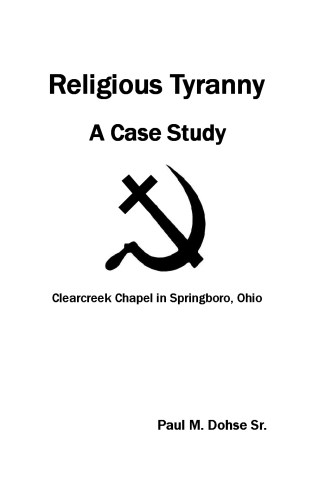
Front Cover
Institutions are all about authority. Even though institutions try to be family as a way to recommend themselves, it just won’t work. The Olive Garden’s “When you’re here you’re family” add campaign is about as close as it gets. We have all been in job interviews where those in charge of personnel claim, “We are just like family here.” It sounds good, but precious few buy it.
Institutions are where we go to get a service; families are where we go to get help unconditionally in most cases. The saying, “Blood is thicker than water” usually holds true. No venue supplies more forgiveness, comfort, and help than family. Institutions are about power; families are about love. The word “love” is commonly used in a manipulative way outside of family.
The church is an institution that supplies a service; specifically, salvation. Like all institutions, it conveys power and authority and in the case of church, a claim of God’s authority over the souls of men. And, it’s authority over truth. The church claims to rule for God by proxy.
Now factor in orthodoxy concerning the nature of man; total depravity. “We are all sinners saved by grace.” Let’s first answer the question presented by this chapter, and then put feet on the answer. The church is protected at all cost because it is the only bus going to heaven. Sure, it is a beat-up bus with lots of dents on the fenders, needs a new paint job, and has seats stained with all kinds of nastiness within, but it is the only bus chartered by God that is going to heaven. Ill behavior, illogical doctrine, and bizarre behavior isn’t the issue, we must remember that the church bus is also a medical bus; the only people on it are those who need a doctor, not those who don’t need a doctor. The only tender that will buy a boarding ticket for this bus is the recognition that you are wretched, wicked, totally depraved, and totally broken.
But here is the dirty little Protestant secret; the belief that you remain so keeps you on the bus. As a notable evangelical musician once said, “We [the church] are a train wreck.” Hence, protesting about sin in the church will more than likely get you a sarcastic, “Well, duh! Ya think?” Demanding accountability for sin which threatens the bus trip will get you church discipline and the loss of your place on the bus.
Moreover, families don’t take over every inch of every corner upon earth as the Lord’s army, institutions do. And why do churches focus on building projects more than building people? Infrastructure speaks of authority. Families build people, institutions build infrastructure that speaks of authority. In contrast, the Bible couldn’t be clearer: God’s family members are individual temples and the priests of those temples. In fact, a careful word study reveals that each believer is the Holy of Holies part of the temple.
But here is the point: the church must be protected at all cost because it is seen as the only valid representation of God on earth that executes His mission.
In the last chapter of this study we will look at this closer, but for purposes of this chapter, let it be stated that institutional churches will be defended and protected regardless of behavior because they are deemed as the only buses going to heaven, and sin is expected to be present anyway. After all, “There is no perfect church.” Yes, those who go to church looking for virtue are supposedly clueless.
Enter Clearcreek Chapel. For the most part, the Chapel is attended by well-educated people. Many of them are graduates of the nearby Cedarville University. Why have they stayed faithful to the Chapel in the face of this “radical departure” from the previous leadership? Why have they stayed faithful in the face of overt absurdity displayed by the Clearcreek elders? How can Chapel elder Dr. Devin Berry get away with teaching the following? The Clearcreek Chapel Book of Faith and Order is par with the Scriptures, and Jesus keeps its tenets for those who live by faith alone. The same congregants would have been running for the exits twenty years before; what happened? The answer is AUTHORITY.
You see, whether the elders are right or wrong is not the issue; the issue is…elders are God’s anointed. As visiting speaker Pastor Tim Pasma once said at the Chapel: God may deliberately partake in elder buffoonery to see if the congregation will obey them or not. And like the rebellion against Moses in the wilderness, God will curse those who do not obey the elders whether they are right or wrong. You can see that moving forward with a lengthy list of Chapel atrocities is a total waste of time; such atrocities are to be expected on the church bus for the aforementioned reasons.
So, the congregants are not going to stand against evil in the church, and other churches are not going to stand against evil in the church for the same reason: AUTHORITY. Many nice church people on the bus totally disagree with what’s going on, but they must keep their mouths shut and obey in order to stay on the bus. Supposedly, silence is not complicity. And besides, do we really expect people to give up their eternal salvation for taking up the cause of what is simply right? This study contends against such notion for the following reason: it’s a false choice because the formal church is not endowed with God’s authority; that is one of the paramount lies of the ages. One may change membership from a “bad” church to a “good” church but the system as a whole is still being supported along with its foundational premises.
This study contends against such notion for the following reason: it’s a false choice because the formal church is not endowed with God’s authority; that is one of the paramount lies of the ages. One may change membership from a “bad” church to a “good” church but the system as a whole is still being supported along with its foundational premises. “Good” churches merely keep the stage one cancer alive.
And lastly, discernment blogs will cry out against the injustices, but what are they really trying to do? They are merely trying to save the bus. It’s a good bus with a few rotten passengers. If we make the problems public, the church will correct itself and the church will be saved. Yes, we must purify God’s authoritative institution on earth in order to preserve the gospel.
Note the futility of this reasoning: you have to be rotten to get on the bus, but rotten people threaten the bus and hence discernment blogs to the rescue. Yes, we are all sinners saved by grace, but too much sinning threatens the bus—the medical bus cannot have people aboard that are too sick. Apparently, discernment blogs seek to save the church by obtaining the right balance of evil.
The Neo-Reformation movement (New Calvinism) peaked in 2009 and its subsequent tyranny spawned a plethora of internet discernment blogs. What real impact have these blogs had on the problem of Neo-Calvinist religious tyranny? Zero. The only justice yielded to date comes from secular law enforcement or civil jurisprudence. These haven’t received the memo on church authority.



leave a comment