The Four Types of Protestant Gnostic Dualism and Their Life Application
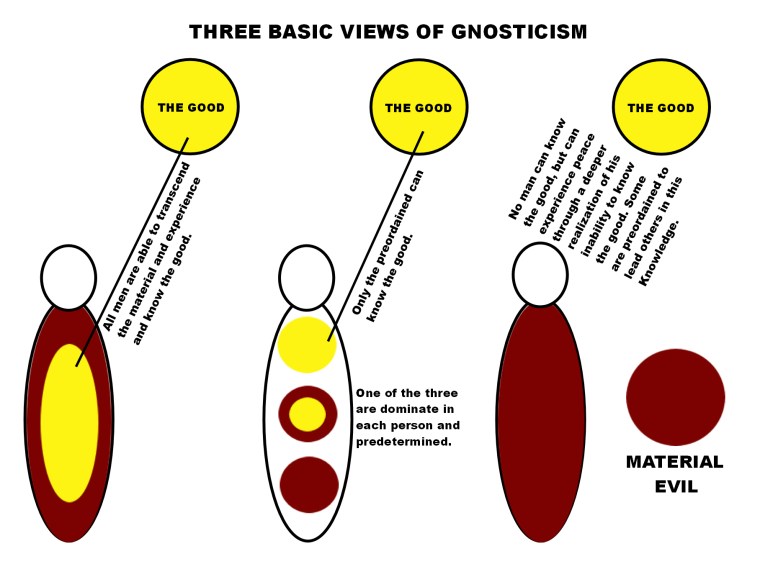
 The Reformation made the Bible accountable to world philosophy. For the most part, Plato was clearly their authority and prism for Bible interpretation. There are four models for how Protestant dualism is applied to life. Andy Young explains one of them here, and aptly explains the right alternative, so I will not have to duplicate that here. Simply stated, this dualism either takes place inside of man or outside of man, and with ability or non-ability. The model explained by Andy takes place inside of man via two natures coupled with an ability to partake in a struggle between the two natures.
First, let’s define dualism. Dualism is the basis for all world religions and was introduced in the garden by the serpent. This shouldn’t surprise us too much if you think about it. Boiled down to the least common denominator, it teaches that God’s creation is evil. It calls that which is good, “evil.” God supposedly created evil to make a cosmic point about His glory. To make His goodness known, He created a contrast to compare it with. Everything material is evil, and everything invisible is good.
Let’s look at the second type of dualism. The “new creature” is given the inner ability to “yield,” and the dualism is two realms that pressure him/her from the outside. At any given point, the “believer” YIELDS to one realm or the other.
The third type is closer to the authentic Reformation philosophy which by the way has rare understanding in Protestant circles. Per the usual, the “believer” remains unchanged, but the Holy Spirit works inside of the believer. So, two of the models have ability to act by the “believer,” and two exclude any ability of the believer to act, but only “see” or perceive. In this third model, everything done that is pleasing to God is performed by the indwelling Spirit. Other than the actions performed by the indwelling Spirit, the “believer” is merely performing his/her usual evil activity. Even in cases where the “believer” seems to do something good there are selfish or evil motives involved.
In the fourth type that is authentic Protestant ideology in its purist form, everything is outside of the “believer” and like the third model the person has NO ability to act, but only to perceive. “Faith” is defined as an ability to perceive the model while denying that any good work can be done by any person lost or saved. In this model, humans are passive in the material realm until acted upon by the invisible realm. This is where all the “we are dead” verbiage comes from. Everything that exists and moves in the material realm is evil, and the only good that takes place is an action by the invisible realm. Regarding good works we are passive until acted upon from the invisible realm. Martin Luther described it as man being like water; it just sits there dormant until acted upon by temperature or gravity. Man is dead in trespasses and sin until God acts.
Of course, Protestant views that attempt to make the believer’s life by faith alone are the epitome of a steroidal salmagundi monstrosity. Once salvation is an unfinished event that must be completed under the auspices of some earthly authority, the downward spiral of confusion begins because it’s like trying to fit a round peg in a square whole. Because salvation is not finished and is a work by God alone, and we are living in the unfinished process, we have to figure out a formula for living a good life without doing anything lest it be works salvation.
paul
Additional information: the three basic models of Gnostic epistemology; not to be confused with application. This is the difference between how the information is supposedly known and how it is applied.
PLEASE! Stop Letting Calvinists Determine the Context of the Determinism Debate

tancpublishing.com
So, my daughter referred me to a Facebook page called “The Reformed Cage.” Invariably, Andy Young and I went over there and engaged in some debate. No surprises here; the crowd over there argues from a seemingly impressive array of Bible verses that seem to say God predetermines the eternal destiny of all individuals according to salvation or damnation. Of course, none of the verses cited say that specifically, but to be fair, that is the conclusion that can be drawn.
What incited this post follows: after Andy and I rattled the cage over there, the latest post on their page is an impressive laundry list of verses that supposedly prove God predetermines the salvation and damnation of individuals. This “election” doctrine is said to humble man and makes man’s ability to choose a salvation of works. Salvation is by faith alone, and our faith is granted to us by God according to what He has predetermined. Man has no free will to choose God.
While all of that may be true, here is the problem: election is primarily, if not exclusively, the darling of Protestantism. It isn’t historically unique by any means, but no other ideology rides that hobby horse like Protestantism. Their “gospel of sovereignty” is the centerpiece. And, Protestantism is a false gospel. The Reformed have effectively kept the argument focused on the fruit of their tree and not the fact that the tree is a bad tree. Election is a deep issue while their law-based soteriology is an elementary error. In fact, the Reformed keep people distracted with a myriad of residual issues while remaining very vulnerable in regard to their false law-based gospel.
And even more uncommendable is the reality that most Protestants don’t know what Protestantism is. This explains why they joyously and boastfully and zealously defend determinism; because they believe and defend the “gospel of sovereignty,” it must mean they are God’s elect. And regardless of the notion that God predetermines apart from any merit, doesn’t the fact that He chose them make them special? Why do you think they are so arrogant? Why do you think they boast in the doctrine? God has chosen them and not others. But of course, not based on any kind of merit that makes them better than an Arminian (wink, wink). Nevertheless, their disdain for those who believe in freewill is evident.
Herein is the problem; Calvin, their Doctor of election, held to three classes/categories of elect and one of them is a temporary election. In fact, ANY professing Protestant could be of the temporary elect and destined for a greater damnation than the non-elect class. In other words, their arrogance and boasting is based on ignorance. The “P” in TULIP, represents the third class of elect; those who persevere to the end according to God’s predetermined will. Does this mean that most Calvinists have no clue regarding the full ramifications of TULIP? Yes.
Though Calvinists scripture stack verses that indicate predeterminism, let us remember that Arminians can stack just as many verses that indicate freewill. And let us also remember that God is not a God of confusion. Here is the problem: like the huge need for sanctification music in our day, there is a huge need for a body of study in reference to election and freewill. TANC has gotten the ball rolling, but a much greater collective effort of the Spirit filled laity is needed.
Stop debating Protestants about election; they don’t even hold to a biblical gospel. And therefore, their whole take on election is suspect at best. Election is an unwinnable debate at this point; debate them on the elementary theological math of their law-based gospel.
paul



1 comment