The Righteousness of Christ by the Virgin Birth, and Justification by New Birth, and Sanctification by Family Life, NOT Church
 As far as those who want to apply Christianity via church, and try to distance themselves from being Protestant, they answer the following question in the affirmative without hesitation: “Was Christ’s resurrection from the grave an affirmation by the Father that Christ lived a perfect life?”
By answering in the affirmative, they reveal true kinship with Protestant tradition regardless of their denials. Christ didn’t obtain righteousness through living a life of perfect law-keeping, He was holy because He became a man through the power of the Holy Spirit; He was the righteous God-man by virtue of the virgin birth. Nothing following could have made Him any less than what He was or is. No one born of God can be unborn.
No righteousness can come from the law; righteousness comes by being born of God. The New Covenant was a promise made to Abraham and Christ, that the Holy Spirit would raise Christ from the grave as the first fruits of many brethren. This alone ends the law of sin and death for the new creature and allows him/her to live by the law of the Spirit. Same law; different relationship (Romans 8:2).
This is why Christians must insist that we do not sin, if not to at least make the point that we are no longer under law. If Christ kept the law perfectly to prove He is righteous, or as most Protestant theologians shockingly claim, that He actually OBTAINED righteousness by perfect law-keeping, then righteousness is indeed by the law. Who keeps it is irrelevant. What then, defines righteousness? What then, makes us holy? Answer: the new birth.
“And every man that hath this hope in him purifieth himself, even as he is pure. Whosoever committeth sin transgresseth also the law: for sin is the transgression of the law. And ye know that he was manifested to take away our sins; and in him is no sin. Whosoever abideth in him sinneth not: whosoever sinneth hath not seen him, neither known him. Little children, let no man deceive you: he that doeth righteousness is righteous, even as he is righteous. He that committeth sin is of the devil; for the devil sinneth from the beginning. For this purpose the Son of God was manifested, that he might destroy the works of the devil. Whosoever is born of God doth not commit sin; for his seed remaineth in him: and he cannot sin, because he is born of God.”
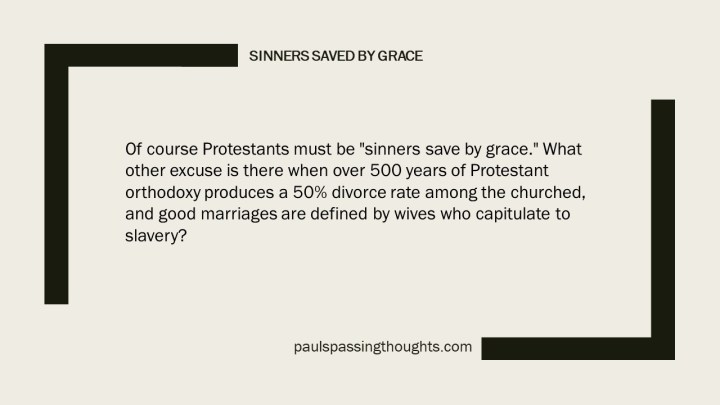
Any questions? The born again may fall short of the law in love because of the weakness of our mortality, but we must reject the whole under-law premise that we are “sinners saved by grace.” All sin is against the law, but where there is no law there is no sin (Romans 3:19,20; 4:15, 5:13, 7:6,8; 10:4, 1Timothy 1:9, Galatians 2:19, Colossians 2:14). Once a person actually grasps that we are no longer under the law, it changes one’s whole perspective on life and their relationship with God and others.
Christ was righteous by virtue of the virgin birth, and we are righteous by virtue of being born again. This is the baptism of the Spirit; we literally die with Christ, and the old us that was under the law of sin and death is gone, and we are resurrected as new creatures with Christ. Christ’s death, burial, and resurrection is the establishment of the new birth…”you must be born again.” We now live by the law of the Spirit of life; we can no longer be condemned by the law, but the law can only give us life to the degree that we fulfill it in love.
This is the significance of the Father and the Son; salvation is a family affair, not an institutional salvation based on law. God’s people meet as a family in a family home because it is a statement of our gospel; salvation is a new birth into God’s family, not a law-based institution.
Justification is NOT a “legal/forensic declaration,” it is obtained by faith in the death, burial, and resurrection of Christ, and following Him in Spirit baptism.
Go now in peace; there is no law to judge you. Go and aggressively love God and others with no fear of condemnation. The banner over us is love, not fear of condemnation. Our goal is not abstaining from law-breaking, our goal is love according to the law of the Spirit of life, not fear under the law of sin and death (Romans 8:2).
We need no “atonement.” Christ didn’t come to cover sin; He came to end it. Church is about an ongoing covering, family is about our true identity in Christ.
paul
Paul and Susan Sunday BoxCast

Page 1: The Divorce Question (1Cor 7:12).
Page 2: What the Reformers Really Taught About the Trinity
Page 3: Protestants Who Deny the Label
Live Link: Sunday 10/15/2017 @ 6pm
Seek and You Will Find: Something Wasn’t Right About Church from the Very Beginning; Part One
 Sincere people just don’t get it in many circumstances. I believe this is what the Millennial Kingdom is all about; Christ will be totally running the show from Jerusalem and His way of doing things will be a testimony as set against 10,000 plus years of foolishness.
Mankind, far from being totally depraved, has intuitive knowledge of common sense and common good…which will cause the common man trouble in this world. Christians don’t have the market cornered on suffering persecution for doing good; in fact, church Christians usually deserve what they get because they are annoying.
So, when I was saved in circa 1982, I did what Western Christians do when they get saved; get baptized, join a church, and start reading the Bible.
First of all, in most cases, and certainly in my case, the idea that salvation is a radical transformation of who you are as a person is intuitive. This is why most people shun the gospel; they fear radical change, and they don’t want to give up sinful desires. The idea that salvation is nothing but trust/faith in Jesus is counterintuitive. People don’t fear staying the same, they fear radical change and an unpredictable future. In addition, for those who are actually seeking radical change because their lives are in shambles, they will find the Protestant do-nothing gospel wanting.
Don’t misunderstand, they understand there is nothing one can do to obtain transformation other than seek God for it, but the assumption is radical change will follow.
When the new Christian joins the church, and this radical change does not follow coupled with lame explanations for the lack of change, doubt sets in. And all in all, ALL Protestants doubt their salvation because the very orthodoxy of it keeps them under the condemnation of the law.
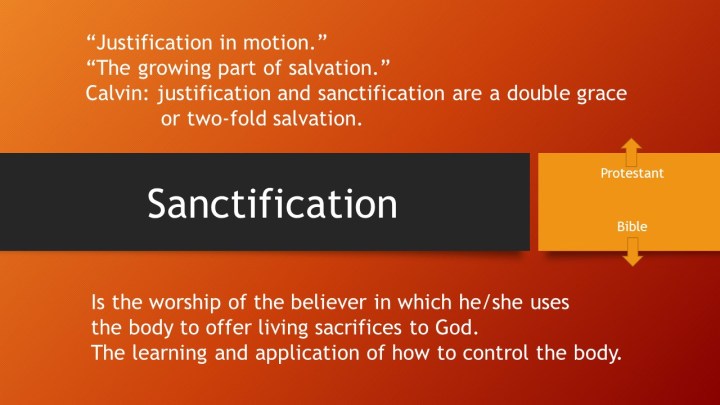
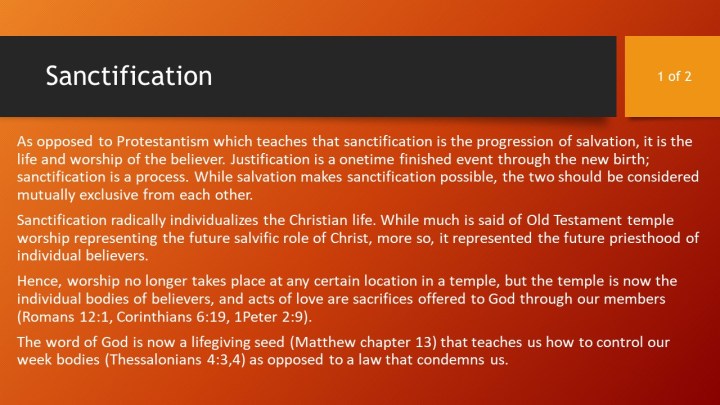
In fact, according to Martin Luther and John Calvin, the big two of the Protestant Reformation, sanctification (the Christian life) is driven by an ongoing fear of damnation. I wrote a book on this subject/fact and will not belabor it here.
When you go to any given church on any given Sunday and look around at all the smiling faces; don’t be fooled, these are people who live under law and its fear of final judgment. The only exceptions are the few who don’t get it which will usually be the newer converts still functioning on intuition. Give it time; a year or so of good old-fashioned Sunday condemnation will take care of that.
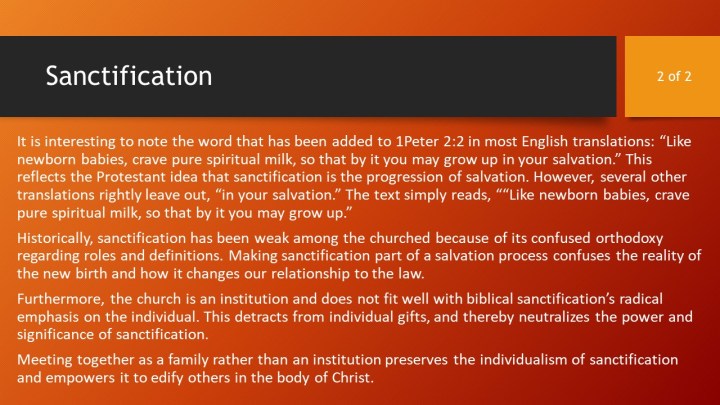
Protestantism, according to its own black and white printed orthodoxy, is a progressive salvation of perpetual new births found only in one’s faithfulness to church membership. Again, I also wrote a book on that as well and won’t belabor the citations here (Ibid). Suuuuure the church believes in the new birth, but of course they do! Question is, how is it defined by the church? The doctrine is Mortification and Vivification, and is the stated Protestant orthodoxy of perpetual re-salvation found only in church membership. And, that’s just documented black and white Protestant orthodoxy; it’s not arguable.
“Well Paul, our church doesn’t believe that.” Very well, then I am sure your elders will be willing to publicly denounce Martin Luther and John Calvin as purveyors of a false gospel. Good luck with that endeavor.
At the beginning of the Protestant Reformation which was an attempt to reform the Catholic Church, and still is, which means the Protestant church, in its heart of hearts still wants to go back to momma, the formed traditions (alterations to Catholic tradition) matched its orthodoxy. Historical events distorted and confused its orthodoxy, but the traditions stayed in place (we tend to be creatures of habit). So, what we have today is traditional functions of Progressive justification that don’t match intellectual understanding.
Hence, Protestant orthodoxy in its plain printed form is denied, but its traditions are maintained. Why do we preach the gospel to supposedly already saved people every Sunday? “Well, you know, there may be unsaved people attending.” And so it goes. However, with the emergence of the Neo-Protestant movement (aka New Calvinist/Neo-Calvinist movement), its authentic orthodoxy is making a comeback. This is why the movement is taking over the Protestant church like a wildfire; the church is already primed for it.
As a result, the Protestant church experience is a morass of confusion and doubt suppressed by a doubling down of commitment to the institution and finding comfort in its authoritative display.
But those who truly love the truth will seek and find with God’s help. Those who are truly reborn of God will seek tenaciously, and if they give up God will intervene. This series will look at the contradictions new Christians will see in the church when comparing it to a face-value interpretation of the Bible.
In this introduction, we can start there; the new Christian, intuitively, will assume that the Bible should be interpreted by a “words mean things” approach. That’s a simple way of saying that the historical-grammatical hermeneutic is assumed. But is that Protestant orthodoxy? Nope. So, how does true Protestant orthodoxy call for the Bible to be interpreted? Well, again, I wrote a book about that. And by the way, we sell our books for what it costs to produce them and ship them, so….
Does this mean that most Protestants don’t even understand how their teachers and pastors interpret the Bible? Pretty much. The “wonderful” messages they hear every Sunday is an assumption of wonderfulness—they don’t even understand how pastors interpret their Bibles.
In part two, we begin to look at the specific contradictions and why they are such. With each, we will match the tradition with the assumed interpretation.
paul



1 comment