Church Divides
 “We don’t worship at church to get more salvation, we worship as a way of life to love God and others while knowing that our salvation is a settled issue. We are not motivated by the fear of condemnation, but rather faith working through love.”
Susan and I have counseled several married couples including a few presently that are in this situation: one spouse goes to church, and the other one doesn’t. And this situation also: both spouses have stopped going to church, but one spouse goes along with the new arrangement grudgingly. If spouse A ever kicks the bucket, spouse B will go running back to the church at breakneck speed.
Then you have this interesting situation: our culture is full of lovable, but leaderless husbands who go along with whatever the wife wants to do, and in our present-day insurgence of discerning women who love the truth, the wife puts a stop to the family going to church. These lovable husbands who are just hanging out and taking life as it comes are happy either way. I am not criticizing these guys; they are usually hard workers who love their families and possess a laid-back personality. It is what it is, and there is at least peace in the family if not outright happiness, especially because the wife isn’t hearing about what a “loser” he is for not being the “leader of his family” every Sunday. Besides, in reality, that really means sub-leadership dictated by the supposed real leaders—the church elders.
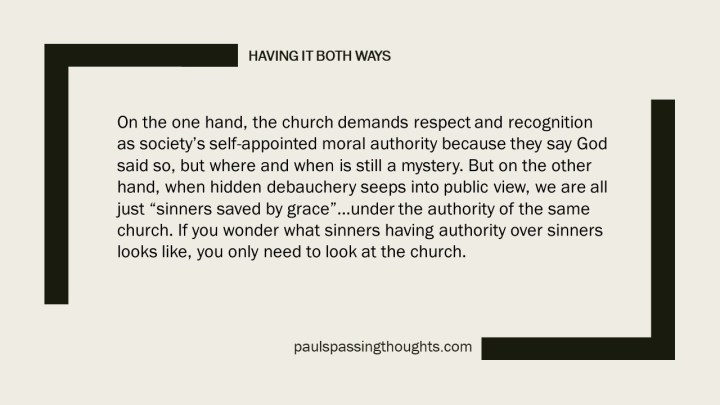
Why does church divide, and particularly in regard to marriages? Because church, according to stated church orthodoxy, deems itself as God’s authority on earth and society’s moral compass. You are either with the church, or the unbelievers. While claiming to be family, it’s more like the Olive Garden; you are only family when you are there. Church will not hesitate to meddle in any personal affair, for church believes it has authority over every square inch of reality. Whether entertainment, art, education, or whatever, the stated orthodoxy of the church is to “take dominion over all of culture.” Hence, we have Christian politicians, Christian schools, Christian bakers, Christian lawyers, Christian musicians…you name it.
Join a church if you will, but this ministry has extensively documented the church’s position on having authority over its membership families. Lately, all but a few leading evangelicals insist that church membership is synonymous with salvation, and requires one to “put themselves under the authority of godly men.” In one Q and A by John MacArthur Jr., he answers the following question with an emphatic, “yes”: Does that mean I have to do what the elders say? Read the Bible for yourselves; Christians weren’t required to even do what Christ or the apostles told them to do. This is the difference between cooperative love and authority.
When two married people disagree on church, the marriage is destined for divorce or miserable co-existence. If one spouse goes to church, he/she will be continually honored as a martyr married to an unbeliever. Note that the church will not hesitate to change a spouse’s perception of their mate, in fact, the church thinks it has a duty to do so. Especially among women, one who is following her husband in being unchurched will hear this when she runs into the former church ladies at the grocery store: “We miss you and are praying for you.” Yes indeed, the poor spouse who is married to a loving husband and good supplier is also married to one who dares to say, “no” to church. Therefore, all bets are off; any good works done by this husband are “filthy rags” before the Lord.
By the way, when wives listen to this sanctified rhetoric designed to conquer and divide, they are dishonoring their husbands. Again, and clearly, churches deem it their duty to divide marriages that have one “unbelieving” spouse. And let’s not play games here: church membership equals salvation; that’s stated black and white orthodoxy.
Let’s just take my own well-documented personal testimony into account. When I took my family and left a mainline evangelical church for doctrinal reasons, they declared me an unbeliever; told my wife that she was not obligated to follow an unbeliever; and in fact, would imperil her soul by doing so; and was still under obligation to obey the church; and they told the congregation to barrage my wife/son with cards, letters, and flowers; and offered her a house, money, an attorney, and a job to come back to the church with or without me. You see, they deemed it their duty to save her soul from being unchurched because of me.
How does this happen? I, myself, ignorantly allowed my family to sit under years of brainwashing that established the church’s pseudo-authority in my wife’s mind. What about their unsubstantiated claim that I had been living in “longstanding patterns of sin”? Well, that’s stated church orthodoxy; EVERYONE is totally depraved and in longstanding patterns of sin. Hence, that can be stated about anyone truthfully in their minds, while leaving the congregation to their own imaginations. In fact, according to letters my wife received that I later obtained, many assumed that I was in an adulterous affair.
This is how it works.
What about families that are faithful to the church? For the most part, as far as family wellbeing, they fare no better than “unbelieving” or unchurched families. Our community, Xenia, Ohio, can definitely be classified as a church community of which my wife Susan was very connected to for years. And, the family testimonies that come out of these churches are one train wreck after another. I mean, really bad, bad, train wrecks. We are not talking about a few boxcars off the track. The supposed model families are comprised of members who have no capacity whatsoever to think for themselves and to a great degree low-functioning in regard to commonsense living.
For church families highly rated by any standard, it’s like socialism paying for the deadbeats—such families are pointed to in the local church to cover for the others. Moreover, the bad testimonies are kept secret until church discipline is necessary where such public disgraces are presented as a rarity. In reality, church discipline is for those who question the church; or said another way, morality is for those that the church wants to get rid of. Nothing is clearer; you can rape, pillage, and plunder, but don’t mess with the church money.
Of course, you can add to this the litany of “fallen pastors” who make the headlines on a continual basis. Of late, this list includes the who’s who of evangelicalism such as RC Sproul Jr., Tullian Tchividjian, Rob Turner, and Tom Chantry. Keep in mind, other than Turner, these are men who come from a deep church tradition. The many fallen pastors, I kid you not, even started their own website, expastors.com where they lick their wounds publicly.
The church claim on marriage has a trickle-down divisive effect on EVERY other personal relationship in life; family, friendships, work…you name it. Its divisive from the top down. Why is this tolerated? Why will people pay this price to be churched? The answer is easy: What will one pay to obtain eternal life? The church sells salvation, and without a doubt has utilized the paramount selling tool: fear. If you don’t submit yourself to the “authority of godly men,” you are going to hell.
What is the answer? Fulltime worship of God is the answer. Seeing worship as intrinsic and mutually inclusive of every element of life is the answer. Christ said the day was coming when people would worship God in spirit and in truth, not at a place. That day is here. What saith the church? Worship only takes place at church. Again, this is also stated black and white church orthodoxy and expressed on placards above sanctuary doors, “Enter here to worship.” or in advertisements, “Come worship with us,” or on the church yard sign, “Worship times are….”
We don’t worship at church to get more salvation, we worship as a way of life to love God and others while knowing that our salvation is a settled issue. We are not motivated by the fear of condemnation, but rather faith working through love.
This is why first century Christians gathered together in personal homes as a corporative body, and why we must do the same in our day. It sends the message that all of life is worship, and that our only authority is Christ, and indeed, is our only mediator who can forgive sin on earth. When you walk into a church building, you are conceding to self-proclaimed mediators other than Christ. Farfetched? Do they not proclaim that heaven will bind and loose whatever they bind and loose? Do they not state this outright in their orthodoxy?
Yes they do. Therefore, home fellowships are not just a different method of some sort, they are a statement concerning our gospel: we are a literal family via the literal new birth meeting as a family with Christ as our only head.
In home fellowships, we strive towards unity according to the one mind of Christ, a mind given to us by new birth. We strive cooperatively as every person is convinced in their own mind. It is a unity based on mutual love for God and others, not authority.
A cooperative love always edifies and unifies; authority dismembers those who dare to think something contrary according to their conscience. And in the mind of authority, collateral damage is irrelevant, and no sacred place deserving of its absence.
paul

The Righteousness of Christ by the Virgin Birth, and Justification by New Birth, and Sanctification by Family Life, NOT Church
 As far as those who want to apply Christianity via church, and try to distance themselves from being Protestant, they answer the following question in the affirmative without hesitation: “Was Christ’s resurrection from the grave an affirmation by the Father that Christ lived a perfect life?”
By answering in the affirmative, they reveal true kinship with Protestant tradition regardless of their denials. Christ didn’t obtain righteousness through living a life of perfect law-keeping, He was holy because He became a man through the power of the Holy Spirit; He was the righteous God-man by virtue of the virgin birth. Nothing following could have made Him any less than what He was or is. No one born of God can be unborn.
No righteousness can come from the law; righteousness comes by being born of God. The New Covenant was a promise made to Abraham and Christ, that the Holy Spirit would raise Christ from the grave as the first fruits of many brethren. This alone ends the law of sin and death for the new creature and allows him/her to live by the law of the Spirit. Same law; different relationship (Romans 8:2).
This is why Christians must insist that we do not sin, if not to at least make the point that we are no longer under law. If Christ kept the law perfectly to prove He is righteous, or as most Protestant theologians shockingly claim, that He actually OBTAINED righteousness by perfect law-keeping, then righteousness is indeed by the law. Who keeps it is irrelevant. What then, defines righteousness? What then, makes us holy? Answer: the new birth.
“And every man that hath this hope in him purifieth himself, even as he is pure. Whosoever committeth sin transgresseth also the law: for sin is the transgression of the law. And ye know that he was manifested to take away our sins; and in him is no sin. Whosoever abideth in him sinneth not: whosoever sinneth hath not seen him, neither known him. Little children, let no man deceive you: he that doeth righteousness is righteous, even as he is righteous. He that committeth sin is of the devil; for the devil sinneth from the beginning. For this purpose the Son of God was manifested, that he might destroy the works of the devil. Whosoever is born of God doth not commit sin; for his seed remaineth in him: and he cannot sin, because he is born of God.”
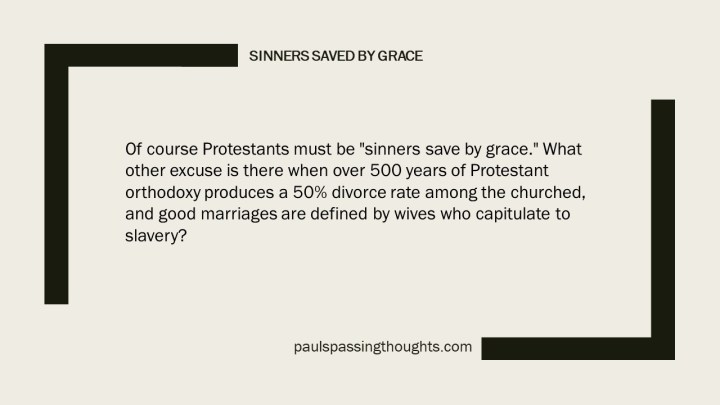
Any questions? The born again may fall short of the law in love because of the weakness of our mortality, but we must reject the whole under-law premise that we are “sinners saved by grace.” All sin is against the law, but where there is no law there is no sin (Romans 3:19,20; 4:15, 5:13, 7:6,8; 10:4, 1Timothy 1:9, Galatians 2:19, Colossians 2:14). Once a person actually grasps that we are no longer under the law, it changes one’s whole perspective on life and their relationship with God and others.
Christ was righteous by virtue of the virgin birth, and we are righteous by virtue of being born again. This is the baptism of the Spirit; we literally die with Christ, and the old us that was under the law of sin and death is gone, and we are resurrected as new creatures with Christ. Christ’s death, burial, and resurrection is the establishment of the new birth…”you must be born again.” We now live by the law of the Spirit of life; we can no longer be condemned by the law, but the law can only give us life to the degree that we fulfill it in love.
This is the significance of the Father and the Son; salvation is a family affair, not an institutional salvation based on law. God’s people meet as a family in a family home because it is a statement of our gospel; salvation is a new birth into God’s family, not a law-based institution.
Justification is NOT a “legal/forensic declaration,” it is obtained by faith in the death, burial, and resurrection of Christ, and following Him in Spirit baptism.
Go now in peace; there is no law to judge you. Go and aggressively love God and others with no fear of condemnation. The banner over us is love, not fear of condemnation. Our goal is not abstaining from law-breaking, our goal is love according to the law of the Spirit of life, not fear under the law of sin and death (Romans 8:2).
We need no “atonement.” Christ didn’t come to cover sin; He came to end it. Church is about an ongoing covering, family is about our true identity in Christ.
paul

 Paul's Passing Thoughts
5 comments