Is John MacArthur More Confused Than the Average Protestant, or Deliberately Deceptive?
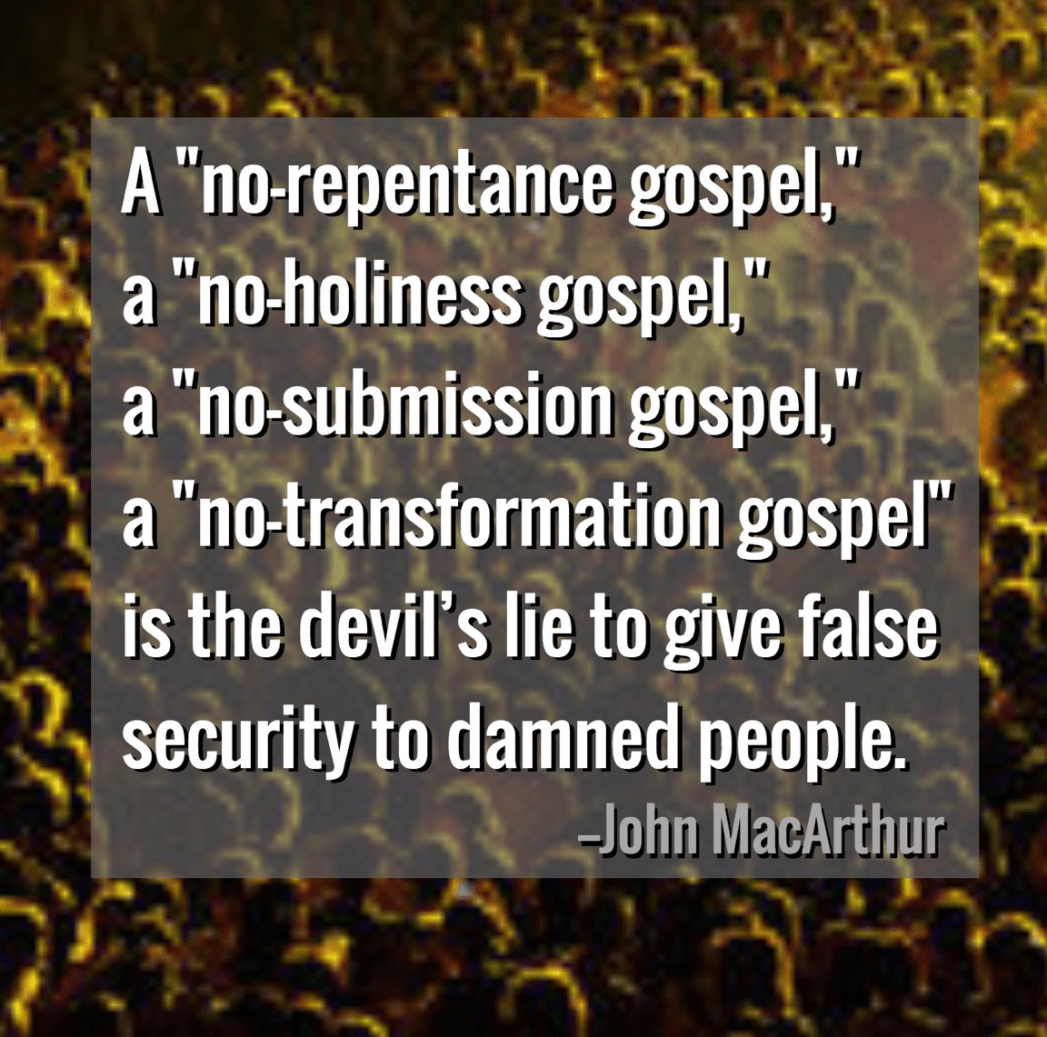
As a very busy person, I have come to appreciate low hanging fruit found on various and sundry Protestant websites. The various postings seem profound on their face, but a little thinking below the surface reveals the utter lack of common sense that Protestantism is adorned with. As a follower of some of these sites, the posts conveniently show up on my Face Book news feed beckoning for a response.
We begin with a meme inspired by a quote from Protestant superstar John MacArthur Jr. If one has actually read the official documents of Protestant orthodoxy, the question is begged: is MacArthur using assumption to deceive (meaning that he actually understands Protestant doctrine), or is he totally confused?
A No Repentance Gospel?
One time, or ongoing, as a way to return to the same gospel that originally saved you in order to keep yourself saved? The former is the assumption that keeps people in the fold until they are gradually indoctrinated into the latter, but the latter is the plain black print on white paper Protestant orthodoxy.
A No Holiness Gospel?
Whose holiness? The assumption is our holiness, but that is NOT Protestant orthodoxy. Per the Protestant doctrine of double imputation, our holiness has no merit because justification, according to orthodoxy, is clearly progressive. We only “experience” the works of Christ that are imputed to us during the “Christian” life. The former is assumed while people are slowly assimilated into orthodoxy, but the latter is the present orthodoxy and Protestant standard.
A No Submission Gospel?
Submission to Whom? The assumption is to God alone, but orthodoxy requires submission to guys accredited by the institutional church, for a fee, I might add, as a requirement for salvation. This was stated in no uncertain terms by Luther, Calvin, and Augustine.
A No Transformation Gospel?
The transformation of what in particular? The assumption is, the believer’s entire being resulting in good works performed by the believer and flowing from the reality of the new birth. But that’s NOT Protestantism—not even close. The new birth, as defined by orthodoxy, is a mere ability to “see,” or perceive the depths of our present depravity resulting in a deeper gratitude for our original salvation, or beginning salvation. That’s the “T” in TULIP. Hence, the cross, or the gospel, is glorified, or made bigger. Calvin and Luther both rejected the new birth as a state of being resulting in a personal ability to do works pleasing to God. This Protestant position is an utterly irrefutable fact. The T in TULIP is assumed to only be regarding the unsaved while folks are slowly indoctrinated into the total depravity of the saints. This is why we must, “preach the gospel to ourselves every day.” This is why Protestantism is an ongoing covering for sin found only in the church rather than an ending of sin, or a “taking away of sin” in a one-time finished work of new birth by the Spirit.
According to new birth justification, the baptism of the Spirit happens once; according to Protestant orthodoxy (justification by faith), the baptism of the Spirit is a repetitive act as a result of repenting of present sin against the law resulting in a re-justification baptism. This is the stated Protestant doctrine of “mortification and vivification.”
A False Security Gospel?
What security? Protestant orthodoxy rejects eternal security in exchange for “final justification” when the true children of God are “verified” at the “final tribunal.” This position is verified by John Calvin’s idea of temporary election; or in other words, only the saints that are granted the gift of perseverance were elected for salvation. That’s the “P” in TULIP. The temporary elect, those Calvin classified as “the called,” are only temporarily “illumined” resulting in a greater damnation. Can any self-respecting Calvinist deny that apostasy is preordained?
In addition, if we have present eternal security, why would we need to return to the same gospel that saved us every day?
A Gospel for Damned People?
Which group of damned people? According to Protestantism, “believers” remain under the “righteous demands of the law.” Biblically, that’s “under law” and not under grace; i.e., the biblical definition of the unregenerate. According to Protestant orthodoxy, “under grace” defines one who is still under law, but depending entirely on the ongoing imputed righteousness of Christ rather than a “righteousness of our own.” This is Luther’s “alien righteousness” which contends that all true righteousness remains outside of the “believer.” This is a denial of the biblical new birth that changes our relationship to the law and our state of being rather than a mere “legal declaration.”
The Unbelievable and Shocking Admission of the Institutional Church: No Clear Agreement on What the Gospel Is
In the ongoing newsfeed are other familiar themes that reveal just how dumbed-down church attendees are. In Dr. Al Mohler’s “The Briefing” program, he reminds us that the Protestant gospel is still an “argument.” I would ordinarily say, “Oh my, am I here right now,” but this is an ongoing theme that continues to trend. The transcript can be read here, but the following excerpt is the most telling:
“But of course that serves to underline the most important question for this generation. That question is not, do we really understand what Luther believed and Luther did 500 years ago today? But do we still hold fast to the gospel to faith alone, grace alone, Christ alone, Scripture alone, to the glory of God alone? That’s the real question, and one way or another this generation of Christians is going to answer it.”
Well, actually, it’s not true that present-day evangelicalism had a proper understanding of Luther 500 years later. In 1970, what Luther really intended was reintroduced to the hallowed halls of Westminster Theological Seminary by a Seventh-Day Adventist leading to the present-day New Calvinist movement of which Mohler is a key figure.
So, on the one hand, Mohler claims that evangelical pastors were ordained by God to “save His people from ignorance,” yet on the other hand, though thoroughly and clearly documented in Protestant writings, the haughty Protestant academics had it wrong for about 200 years after the American Revolution confused the religious/philosophical landscape. Moreover, the aforementioned SDA theologian rediscovered Luther’s original intent by actually reading Protestant orthodoxy for himself rather than depending on traditions passed down over several generations.
Yet, Mohler et al are in essence saying, “We were wrong for 200 years, but please trust us as God’s authority because we have it right this time!” Um, right, thanks to a Seventh-Day Adventist, but no thanks, I’ll pass.
Also, “One of the enduring Latin phrases of the Protestant Reformation is the impressive sounding ecclesia semper reformans, semper reformanda. In plain English, this means ‘the church is always reformed and always reforming.'” Get it? This is no different from the well-traveled cult doctrine of “increasing light.” It is a blank check diplomatic immunity from all error and discrepancy from reason. In addition, “paradox” is an actual theological category of the Reformation that gives license to every contradiction.
The shocking admission that Protestantism never left or departed from Catholicism.
In Phil Johnson’s sermon, “Korah’s Rebellion (another version less relevant here),” at about the 6 minute mark, Johnson refutes the argument that the Protestant Reformation itself was a rebellion against the Church’s authority, but was a mere attempt to “reform” the church. In all of the confusion that is church, this is one of the few things theologians agree on; Calvin and Luther who were both Augustinian theologians NEVER left the Catholic Church. And Augustine, who is a Catholic icon/fixture, is routinely claimed as the one who fathered Protestant doctrine. No surprise then that one of many kerfuffles in Protestant drama is ecumenism. But yet, Protestantism never left the Catholic Church.
Discernment Blogs?
Also not surprising is the massive number of discernment blogs “defending the faith and exposing error.” When there is no agreement on what the gospel really is, and reformation is ongoing, certainly, “discernment blogs” will have an endless supply and demand. Seriously though, in reality, dissecting Protestant truth is a fool’s errand based on the very statements of Protestant academia. In fact, Protestant orthodoxy itself is a theology of moving goal posts…by its very own admission.
So, how much of all of this is confusion versus deliberate deception? For the most part, religion in general would invoke the “noble lie.” Authority is truth because God’s appointed authorities understand that mankind has “total inability” in general, and an inability to understand reality specifically. God’s appointed authorities to “save His people from ignorance,” must teach us how to have our best life now through bedtime stories that the great unwashed can understand. We call that, “orthodoxy.” Confessions and Catechisms tell us what questions to ask, and then answer the questions for us. Obviously, the great unwashed don’t even know what questions to ask which also explains why we dare not ask challenging questions at church. Who are we to think that we even know what questions to ask?
Of course it is all paradoxical, mankind cannot know reality to begin with, and needs to shut up, obey, and support God’s kingdom that is slowly taking over the earth for God’s glory. Supposedly. At this point in history, you can choose your own authority because of the advent of Americanism, and it would seem the only agreement on salvation is loving and obeying the one you are with, or another authority of your choosing in the future. This is no new thing under the sun, and is the hallmark of every religion combining faith and authority/force since the deception in the garden.
Hence, the Protestant gospel seems to be submission for the sake of submission, and the correct authority that will usher us into salvation is anybody’s guess.
As I am often fond of saying, “good luck with that.”
paul
The Church Crazy Train Keeps Rolling Down the Tracks
Have you heard about the latest church drama? Any confused gospel is going to produce one primary result: debate, and more debate, and debates about debating. The latest is the IFD (Interfaith Dialogue) debate. You may find the video below interesting.
Revised: Pastor Todd Pruitt: When Progressive Justification is Too Pagan
 I am becoming more and more convinced: all theological debates within the institutional church boil down to a call for temperament in heresy. The Protestant/Catholic church is supposedly God’s preordained institution that ferries salvation wannabes from point A in justification to point B in justification. God has supposedly given the institutional church, His authority on earth to “bind and loose, and to kill and make alive.”
Yes, it simply boils down to this: you start at point A, and by submitting yourself to the authority of the institutional church, you receive grace gasoline to get your totally depraved junker to point B. The only place you can get grace gasoline is in the institutional church which is the ONLY place “sacraments” can be received which “impart grace” to the believer. By the way, “grace” does not always refer to salvation in the Bible. More times than not it refers to the love of God in action which of course includes salvation, but many other actions as well.
What are these “sacraments”? Answer: baptism (gets you into the grace club), the Lord’s Table, and public preaching of the word. Calvin and Luther stated this grace gasoline idea albeit by other words in no uncertain terms, and they are the spiritual heroes of the institutional church for that reason.
This brings me to an article written by Pastor Todd Pruitt of Covenant Presbyterian Church in Harrisonburg, Virginia. The article was published on the “Crosswalk” .com blog. The name of the blog in and of itself makes my point completely. Get it? “cross”… “walk.” You walk (Christian living) by the cross. You began by the cross (point A), and now there is only one place where you can get what you need to walk by the same cross that saved you in order to get to point B—the institutional church.
Pruitt has a complaint via the article: music in the church has become one of the sacraments that impart grace. It has been added to the list of grace gasolines. We can’t have that. That’s going too far with progressive justification heresy. C’mon people, let’s show some moderation here! If we go too far with these things, it is “pagan” according to Pruitt.
To make his point, Pruitt states that music has been made a mediator between God and man when there is only one mediator between God and man. Huh? I must ask then, what exactly are “ruling elders” in the institutional church? You know, the ones who have the “power of the keys to God’s kingdom” (John Calvin’s “power of the keys”).
Says Pruitt in the article:
It is also ironic that while many Christians deny the sacramental role of those ordinances which the Lord Himself has given to the church (baptism and the Lord’s Supper) they are eager to grant music sacramental powers. Music and “the worship experience” are viewed as means by which we enter the presence of God and receive his saving benefits. There is simply no evidence whatsoever in Scripture that music mediates direct encounters or experiences with God. This is a common pagan notion. It is far from Christian.
Sigh. So let me get this straight: baptism (the rite of church membership according to Calvin), the Lord’s Table, and one he mentions elsewhere, “God’s word” (elder preaching of the gospel), imparts “saving benefits,” but his beef is that music is included in the sacramental list?
Reality check. We don’t gather together to obtain “saving benefits” to get us from point A to point B. That’s ancient pagan caste to the core. There are NO saving benefits left for God’s people—we received the full package when we believed unto salvation. We do not receive the Holy Spirit on an installment plan. An institution where “saving benefits” can be found is MEDIATION, period!
Organized religion with authority structure is a mediator—this is unavoidable. Christians are called on to fellowship together under one authority and to strive for the “one mind in Christ.” Individual gifts are the focus, and fellowship for the purpose of exploiting those gifts to the fullest is the primary purpose of Christian fellowship. Certainly, in striving for the unity of one mind in Christ, things will be done decently and in order, but Christians don’t meet together for the purpose of “worship” to begin with—that is a way of life. Christians don’t meet together for more salvation; they can’t get themselves anymore saved than they already are. Striving to be more “set apart” is not salvation.
The crux of paganism is spiritual caste which is a structured authority for purposes of mediation…and control. All of the white noise in the institutional church regards the question of balanced paganism.
paul
Religious Tyranny: A Case Study; Introduction and Chapter One
Remarkably, the “takeover” of evangelical churches by the “New” Calvinist movement is still a trending thing. Also, and again, remarkably, recent contacts to our ministry are seeking information in regard to the theology and teachings of this aggressive “new” movement that has been around for 47 years. This recently prompted me to crank out this booklet which should serve as a pretty decent prototype for what’s going on with this movement and why it does what it does, and the solution. And tonight, we will continue our BOXCAST series on its history, character, and doctrine.
Source: Religious Tyranny: A Case Study; Introduction and Chapter One
Sunday BOXCAST Live: The True History of New Calvinism
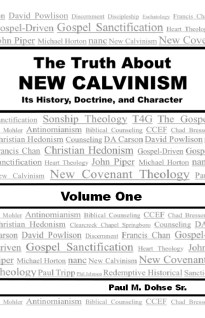 Sunday BOXCAST live stream 10/29/2017 @ 7pm
This ministry is very surprised that many evangelicals think that New Calvinism is a recent movement in the churches. Also surprising is the number of evangelicals who haven’t even heard of New Calvinism!
Tonight at 7pm, TANC ministries, which was the first to publish a definitive history on New Calvinism, will review and summarize what we have been publishing on New Calvinism for ten years. In addition, we are the only ones still publishing an accurate account of this history.
John Piper is NOT the father of New Calvinism…not even close. He is not even a forefather. The true history of New Calvinism is continually rewritten by evangelicals to hide the truth.
Join us tonight live (10/29/17), and join the conversation: email us at pmd@inbox.com and your questions/comments will be addressed during the program.

 Paul's Passing Thoughts
11 comments