Allister Begg Under Fire; Who is Right?
My, my, it feels like old times writing about the weekly drama that occurs in the Protestant church. As you know, Allister Begg sparked controversy because of the following event:
“Alistair Begg, a Scottish pastor ministering in America, recently caused controversy over pastoral advice given to a grandmother invited to attend her grandchild’s wedding to a transgender person. He said it was a matter of wisdom. Many have criticized him, and he has been cancelled from some ministry opportunities.
In an episode of his Truth for Life podcast, Begg gave this advice: ‘Well, here’s the thing: your love for them may catch them off guard, but your absence will simply reinforce the fact that they said, These people are what I always thought: judgmental, critical, unprepared to countenance anything.’ He added that, as long as the grandson knew she was not ‘affirming’ his life choices, ‘then I suggest that you do go to the ceremony, and I suggest that you buy them a gift.’
After Begg refused to retract his opinion or apologize for the advice given, broadcaster American Family Radio said they would no longer air his program.”
http://www.premierchristianity.com/17184.article
My decision to take time from my busy nursing school schedule to post on this was prompted by a response from John MacArthur Jr. during a Q and A at his church. In addition, the insufferably arrogant Steve Lawson weighed in as well. Their assessments were not sugarcoated, so apparently, the political church winds were calling for that level of response. And by the way, what’s up with people standing in line behind a microphone to ask MacArthur questions at the end of a conference (that Begg was barred from) while he stands aloft on an alter behind the “sacred desk”? It’s overt man-worship.
A parenthesis: These people may think they love and care about scripture, they may bark about it constantly, and they may fancy themselves as scriptorians, but a true literal sense of scripture has no place in their financial enterprises. Examples? Where would I even start? First of all, they flaunt the label “Calvinist” as an acceptable category of people within Christianity. Even Charles Spurgeon, the “Prince of Preachers,” said that Calvinism isn’t just a label, but the gospel itself. What could be more obvious than the apostle Paul’s contention against factions with a man being the central focus? (1Corinthians chapter one).
And, this most recent drama in the church offers another example. In MacArthur’s response, he stated that he wouldn’t have answered the question to start with because it was too risky, and by answering the question wrongly, Begg’s legacy would now be defined by that moment of weakness. let all of that sink in for a moment. One supposed mistake, and now his legacy as a pastor is going to be defined by that. Under law much? But, this is indicative of how all of these guys have strayed away from pastoring 101.
As an elder in home fellowship, which is not church in a home, and a former pastor in the church, which is not a Bible word to begin with, you learn real quick that people come to you for permission to do something that they know would make them feel guilty. That’s where all of these spiritual brainiacs missed it. Begg’s first response should have been, What do you think? How is your conscience speaking to you about this matter? If she said something like, “Well, it would probably make me feel like I am dishonoring God,” then, the very simple concept of Romans chapter 14 applies. Doubt is not of faith. It is sin for anyone who thinks it is sin or might be sin. Clearly, from a scripture standpoint, a believer’s conscience is a higher law than a pastor’s opinion and that even includes celebrity pastors.
It’s interesting to me that we never see qualifying questions from these pastors before they give counsel. It doesn’t seem to matter what is going on behind the question, but the priority is the impact of their superior unction. Employing the individual in a cooperation to answer the question together diminishes the authority of these control freaks, right? Better yet, Begg could have asked, Do you want to go? Why? Then why not go? Why are you asking me this question? Not as MacArthur suggested, “Next question please.” Now, depending on where that line of questioning would lead, I might suggest that the grandmother go to the wedding, but not with the same enthusiasm that Begg suggested. I get it; he wanted to emphasize love, but I would have suggested a lowkey appearance to emphasize caring, but not anything that might suggest endorsement of the ceremony and what it represented. Only an under-law mentality would think that merely showing up is an endorsement of homosexuality as MacArthur and Lawson suggested. In fact, they suggested that Begg endorsed blaspheme via his counsel. Again, I believe this unmeasured response is due to a behind the scenes assessment that Begg is expendable.
However, with all of this being said, I believe Begg has the best response post-screwup. Clearly, in regard to the wedding where Jesus turned the water into wine, we don’t know whether or not it was a marriage between two believers. Clearly, Jesus dinned with people of ill report. The question itself is not a cut and dry situation. However, more toward the spirit of what Begg is talking about, the grandmother could have had it both ways. Begg is right about something: in contrast to the responses by MacArthur and Steve Lawman, it is almost never our station as Christians to condemn anything, but employ caring instead. Yes, MacArthur actually used the word condemnation in his response.
So, missing was the idea that the invitation was a ministry opportunity. No Mr. MacArthur, condemnation is not our ministry and it’s not love. That’s what MacArthur said; that sometimes condemnation is an act of love. Oh really? The scriptures define those two things as mutually exclusive. At least Begg was right about that, and he also deserves kudos for not backing down. However, Borrowing from an old TV commercial, Begg could have had a V8. The grandmother could have taken the grand-person out to lunch and reiterated her care for this person, while stating that she wasn’t attending the wedding because she was unsure if God was ok with it under any intentions. Notice that I am using the term “grand-person” here because there are a lot of facts surrounding this issue that are uncertain. In fact, there is a ton of background information missing. Yet, notice how the church is throwing down judgment in a frenzy (viz, “It’s trending”) with limited information. Is that shameful? It’s a rhetorical question.
Full stop: when it comes to family, a church-discipline-like approach, something else that is not in the Bible, that is, church discipline, will yield unfortunate results. I will employ my own personal experience with my brother here. To Begg’s point, my brother always knew where I stood with his relationship concerning his male mate. Yet, I was always careful to maintain a caring relationship with him. Obviously, this excluded condemnation. It is interesting, during my interaction with them, that they respected boundaries.
One time, they approached me and wanted to have a conversation about their view of the apostle Paul’s take on homosexuality. I began by saying, “Do you guys really want to have this conversation with me?” They answered in the affirmative. I then elicited their agreement that my position would not be interpreted as uncaring, and they agreed. Is Begg right? Does rejection of a lifestyle choice coupled with caring yield better fruit than condemnation? Yes, Begg is right. When my brother was diagnosed with ALS, I had full access to minister to him as a Christian and healthcare professional, and he accepted it with open arms. As a result, he reached out to God for salvation. If we were estranged because of condemnation as a way of “love,” would I have had that opportunity? It’s doubtful. Begg is suggesting that we find ways to leave a door open for purposes of future opportunities that may arise, and I agree. Regarding MacArthur and Lawson, I get it, they believe we don’t have anything to do with the salvation of others whatsoever, so, why compromise? Using wisdom, or worse yet, any of our wisdom, even if learned from God, wouldn’t be a “sovereign” view of salvation.
By the way, no institution is more responsible for the estrangement of families than the church, and one proof of that is the Reformed idea that Christians will rejoice in the eternal suffering of the unsaved including unsaved family members. MacArthur and Lawson continually extol the church icons that propagated such ideas, and Lawson himself has suggested that Christ will personally torture people in hell over the course of eternity. I am afraid that in the case of church, momma has raised many fools.
Now, back to my brother. The diagnosis came suddenly and this form of ALS was aggressive, so were all of the residual issues with his mate settled before he died? Probably not. Let me tell you something: the church has made such a mess of truth that I believe God weighs motives more than he normally would. Even though church is an under-law false gospel, I believe I was saved while I was committed to it. And for that matter, I don’t believe God is going to send people to hell for being confused by the morass of theology spewed out by the church since the 4th century. We are buried under 1600 years of church theology spewing out the nonstop musings and imaginations of men. Furthermore, the church has never been a friend of individual understanding of scripture, but rather overtly hostile to it, and no amount of gaslighting changes that fact.
Condemnation leading to probable estrangement from family members due to their choices? And that can be defined as love? More scripture can be noted here. James stated that those who do not supply for their own families are worse than infidels. This, of course, is not limited to monetary issues, and would certainly include any family member that might be in peril. An inability to supply for our earthly family due to estrangement should not be the result of our actions. If the estrangement is due to the chips falling where they may regardless of wisdom, so be it, and our consciences should be clear. Again, Begg is right, this is a matter of wisdom according to the full counsel of God, not a few versus written by Paul condemning the acceptance of homosexuality.
Another issue here is Christian liberty. In regard to Begg, where is it? Whatever happened to Romans chapter 14? While the church bemoans church becoming like the world, what has ever been better at cancel culture than the church? Furthermore, if you are in a disagreement with the church leadership, the first thing they will do is attempt to separate you from your family unless your husband is a pedophile leader they are protecting. In that regard, if you are a mother who separates from your husband to protect your children, you will be brought up on church discipline, which is a soft term for excommunication, which equals loss of salvation according to Calvin’s doctrine of The Power of the Keys. Begg has been censored; that is stunning, and telling. Compare the elements of this issue with Romans 14; much more than an issue of Christian charity was at stake.
A tree is known by its fruit. This is the behavior we would expect from an under-law false gospel. This is behavior we would expect from people who think Christ obtained his righteousness by perfect law-keeping. It is expected behavior by people who make the law a fourth member of the Trinity. This is expected behavior by people who believe Christians are “under the righteous demands of the law” as stated by MacArthur puppet Phil Johnson. Look, I have not only been writing about these issues since 2007, but had friends who were, and still are part of MacArthur’s inner circle, and trust me, he is in no position to be throwing rocks at other people for any reason. His list of bonehead decisions and lack of discernment is a long one, including putting a Larry Crabb disciple in charge of the counseling at Grace Community Church during the 80s. And by the way, TGC and T4G didn’t become a problem down the pike; his endorsement of their celebrity pastors and participation in their conferences showed a stunning lack of discernment and a questionable penchant for the limelight. And if I had Julie Roys laying down the words on me like she is on MacArthur, I for sure wouldn’t even entertain the thought of picking up a rock.
In conclusion, and using this latest trending church drama, I will put in a plug for home fellowship as a worthy alternative to the hot mess called church. All Christians can be free from this soap opera today. We are God’s literal children and part of his family, and should function like a literal family, not an institution. Church is an institution, not an ekklesia. Furthermore, you need to run from the idea that you are a “wicked saved person” as stated daily by these tyrants. The wicked are not saved. So, now you are going to ask if we “have the authority to start home fellowships.”
And that, my friend, is the problem. What part of ALL authority on earth and in heaven has been given to me do we not understand? You have no proof whatsoever that God has given any of these men the authority they claim for themselves, unless the aforementioned fruit is the proof. The only proof you have is what the Bible says, not what these self-appointed celebrity pastors say it says.
Walk away from a focus on judgement, condemnation, and a lording over the flock of God for a focus on love. At least Begg is right about that.
paul
The Alistair Begg Controversy and Protestantism’s Under law Gospel
In case you haven’t noticed, the American Protestant church is a cauldron of nonstop drama. Literally, it is something new every week. If some celebrity pastor didn’t get caught with both hands in someone’s cookie jar, some kerfuffle over doctrine or something else is always readily available. And in-between, you have the massive online bantering and debate over thousands of issues. Then, Sunday church is the end-of-week grand finally where you are reminded of your failures and given opportunity to repent.
Meanwhile, no one can understand why Joel Osteen is so popular. I believe Osteen’s popularity is directly connected to the over-the-top negativity of church culture. People who want to go to church can find some relief there. Yes, it’s a pie-in-the-sky feel good project, but I think there is another side to that: it’s also about what isn’t going on at Osteen’s church; i.e., a bunch of negative drama, incessant sin sniffing, and one scandal after another.
Have you ever thought about a focus on something that is neither of these two extremes? What about a focus on love? Whatever happened to that? I would argue that the Bible states love as our primary focus, not prosperity or a “lifestyle of repentance” or a faith that is “confessional” (“proclaiming the gospel only, not trying to be the gospel”…blah, blah, blah).
This post is about why church is the way it is, but we will touch on what Begg did wrong because it will bolster my overall point.
Alistair Begg, a Scottish pastor ministering in America, recently caused controversy over pastoral advice given to a grandmother invited to attend her grandchild’s wedding to a transgender person. He said it was matter of wisdom. Many have criticized him, and he has been cancelled from some ministry opportunities.
In an episode of his ‘Truth for Life’ podcast, Begg gave this advice: “Well, here’s the thing: your love for them may catch them off guard, but your absence will simply reinforce the fact that they said, These people are what I always thought: judgmental, critical, unprepared to countenance anything”. He added that, as long as the grandson knew she was not “affirming” his life choices, “then I suggest that you do go to the ceremony, and I suggest that you buy them a gift.”
After Begg refused to retract his opinion or apologize for the advice given, broadcaster American Family Radio said they would no longer air his program.
http://www.premierchristianity.com/17184.article
So, we have three sides of this controversy. One side says that going to the wedding is sinful advice. The other argument sides with Begg, except a more middle ground argues that one should go without showing as much enthusiasm. You will search the internet high and low and find no other advice except should I go or not go?
Look, church is NOT about the Bible. Regardless of the fact that the Bible is very clear on this matter, real Bible counsel is nowhere to be found in church drama, per the usual. The mediating factor is that the grandmother called a Protestant expert for advise because she was torn by the question, or otherwise conflicted. Again, the Bible is very clear on this. If you can’t do something with a clear conscience, don’t do it because the decision is not of faith (Romans 14). Begg’s advise to her should have been, “no” based on the fact that she had to ask to begin with. Furthermore, let me state why there is so much “quarreling over disputable matters” in the church: Churchians are not free to follow their own conscience. Due to the fact that the church all but ignores the principles in Romans 14, Q and A panels occupied by celebrity pastors are all the rage. Note that the principles outlined in Romans 14 threaten the authority of the church.
Why does the church behave like it does? That’s what this post is about. This is not my opinion; the church leaders of our day openly state what I am about to write in this post.
First of all, per Protestant orthodoxy, righteousness is defined by perfect law-keeping and not the new birth. The law is not ended, it is retained. The Protestant under law gospel goes something like this: Christ came to live a life of perfect law-keeping so that his perfect law-keeping can be imputed to the Christian life for purposes of being declared righteous. Christ then died for our past, present, and future sins. God then resurrected Christ to confirm that he was the acceptable sacrifice for sin, or in other words, to confirm that Christ kept the law perfectly.
The whole idea turns the true biblical gospel upside down beginning with the idea that Christ came to keep the law perfectly. The renowned Protestant scholar RC Sproul even claimed that Christ obtained his righteousness through perfect law-keeping. We believe Christ has always been righteous by virtue of who he is. We are also incredulous that such an idea doesn’t give people pause to rethink the Protestant gospel.
Secondly, regarding Christ’s death, Protestantism teaches that our past sins are ended, but Christ’s death must be reapplied to present and future sins when they become present through a repentance process. This process is referred to as “The same gospel that saved us also sanctifies us.” Protestantism conflates justification and sanctification and makes them both part of the salvation process. John Calvin called this a “twofold grace.” Read, “twofold salvation.” So, to make their under law gospel work, they conflate some concepts while dichotomizing others. Justification and sanctification are conflated into a twofold salvation process in which justification and salvation are dichotomized. It is said that justification is a “one time declaration” while salvation “is a process.” Incredibly, we have another Protestant concept that doesn’t give people pause; the idea that salvation is a process. We could also ask how a “legal declaration” is a righteousness “apart from the law.”
So, according to Protestantism, Christ died to establish a means for which his death can be perpetually reapplied to pay for future sin through a church repentance ritual known as the Protestant doctrine of mortification and vivification, which redefines the new birth as a perpetual event that re-justifies us and moves the salvation process forward.
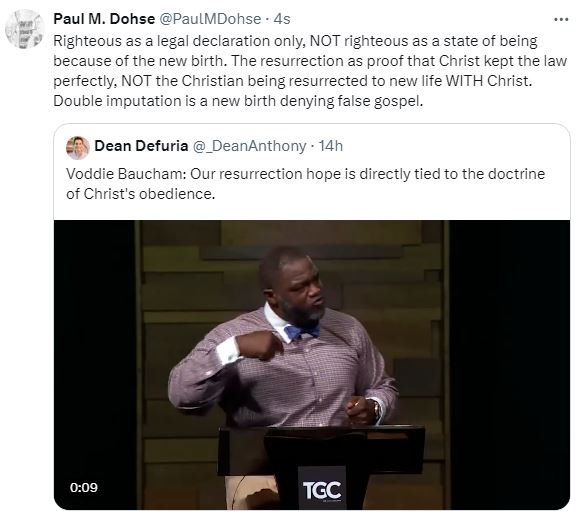
Thirdly, according to Protestantism, it is not enough that your present sins are forgiven until you sin the next time (in other words, you are still under the condemnation of the law), but you also need to be made righteous through the substitutionary works of Christ during his ministry. Hence, his perfect law-keeping is applied to your sanctification as well. This is the Protestant doctrine of double imputation; Christ’s active saving works was his perfect law-keeping during his ministry, and his saving passive work was his death on the cross. According to Protestantism, simply having your sins forgiven does not make you righteous…righteous acts have to be added to your account or in essence, a salvation installment plan. Keep in mind, in all of this, according to Protestantism, you are NOT righteous as a state of being, but this process only enables you to remain under a righteous declaration. In other words, instead of being either under law or under grace…grace is a covering for remaining under law through church ritual.
The results of this gospel are apparent when you observe the fruits of the Protestant tree. These are the fruits to be expected from people who are under the law and its condemnation. The Bible states that the power of sin is the law. Furthermore, if you are under law, you are still enslaved to sin. If you are under grace, you are enslaved to righteousness. You are one or the other. Nevertheless, a cursory observation of Protestantism shows that it hardly teaches that its parishioners are enslaved to righteousness. Far from it. Protestantism teaches that you are both under law and under grace, or what Martin Luther called “simul justus et peccator,” one who is simultaneously just and a sinner. Of course, technically, only declared righteous. Here is how one Lutheran scholar states it:
Luther calls Christians “simultaneously saint and sinner” because he redefines “saint” as a forgiven sinner. We are called saints not because we change into something different but because our relationship with God changes as a result of God’s grace. Luther said: “The saints are sinners, too, but they are forgiven and absolved.”
http://www.livinglutheran.org/2005/04/saints-sinners/
This is stated perfectly, and echoed by the who’s-who of Protestantism constantly. Protestantism’s under law gospel rejects the idea that we are transformed into new creatures by the new birth; we remain unchanged, while it is only our relationship to God that changes. So, if unchanged people wallow around in the law, they are empowering even more sin in their lives. Hence, what we see in the church constantly.
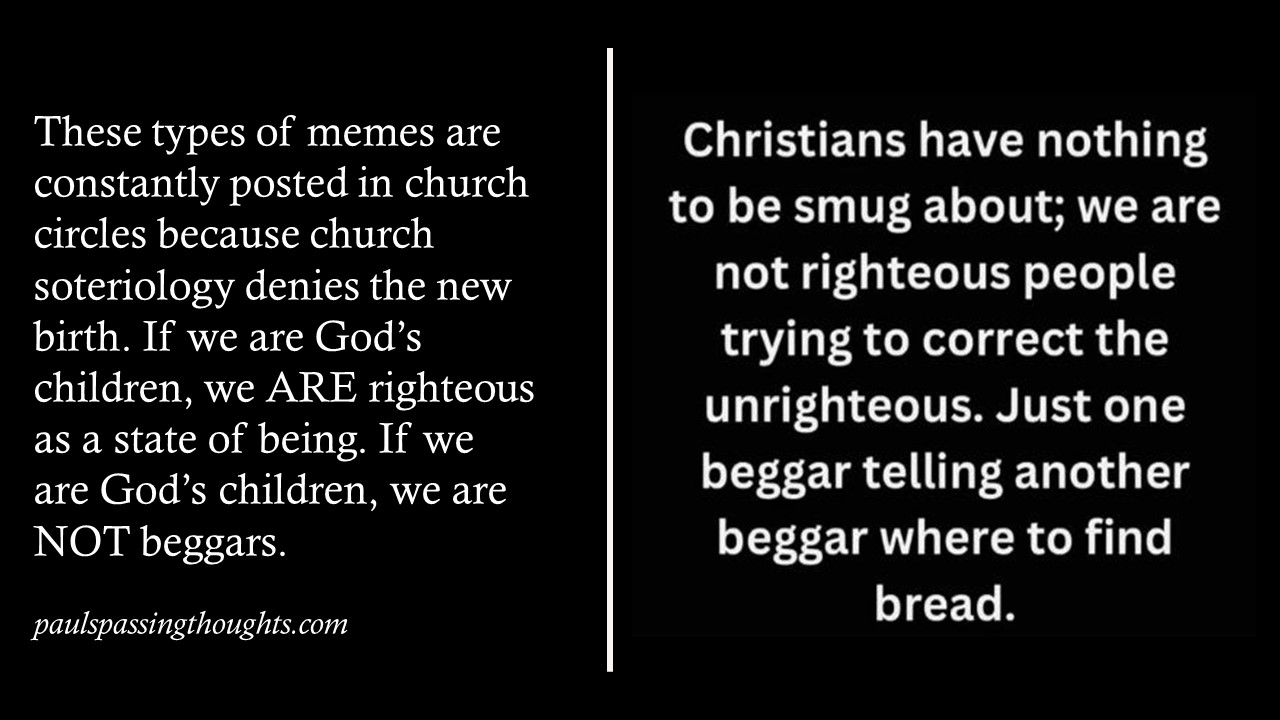
What is the real biblical good news? Christ came to free us from the enslavement of sin and the fear of death. Righteousness is determined by the new birth, not perfect law-keeping (1John 3). Christ didn’t come to merely declare us righteous, he came to MAKE us righteous presently. He didn’t come to cover our sins, he came to end our sins. When we believe, we are baptized with Christ into his death and resurrection by the Spirit (Romans 6). We literally become God’s offspring, and this changes our relationship to the law. We are no longer under its condemnation, but now the Spirit uses the law to teach us to aggressively love God and others with no fear of condemnation (Romans 7, 8). Sure, we fail to love as we should because of weakness, but that doesn’t mean we are still “under the righteous demands of the law” (Phil Johnson). God deals with us as a loving Father, not as those still under the law.
Protestantism is a false gospel with the expected fruits following. Come out from among them and be separate.
paul


leave a comment