Don’t Be Fooled By Church
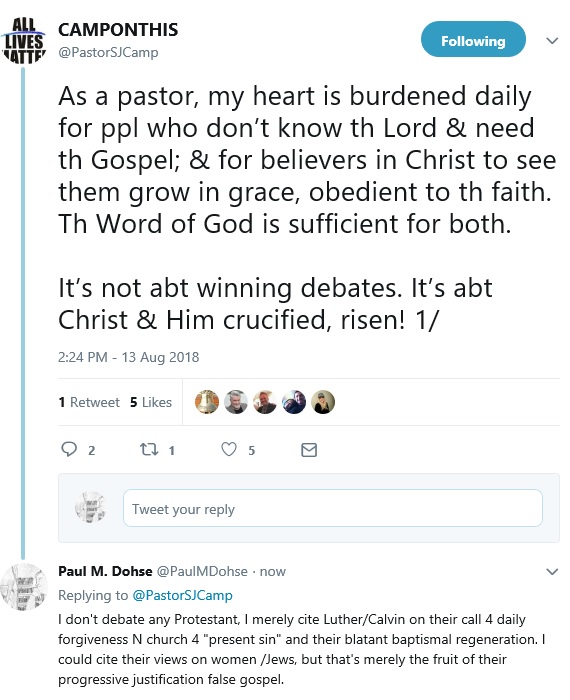
Church orthodoxy and its scholars/academics have redefined every word in the dictionary. In doing this, they play on the assumptions of parishioners to keep them in the camp until they are fully indoctrinated. No pun intended. The following meme posted by Steve Camp is an example. What is the assumption? That the objective truth being spoken of is wisdom for life and godliness, viz, wisdom for sanctification/loving God and others.
Nope, the “objective truth” being spoken of has to do with the “objective gospel experienced subjectively.” I have addressed this Gnostic doctrine in much detail in “Pictures of Calvinism” and other works.
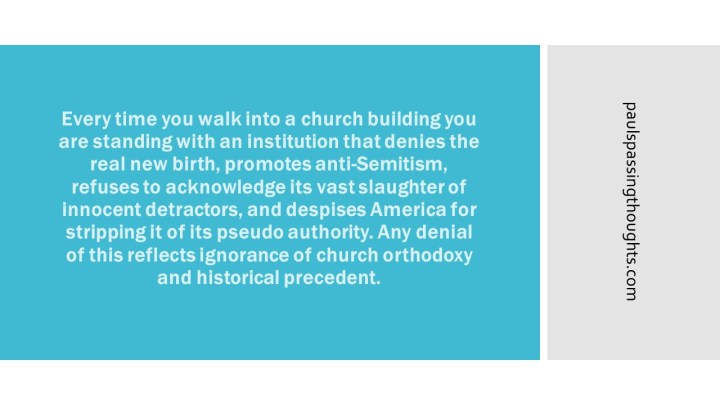
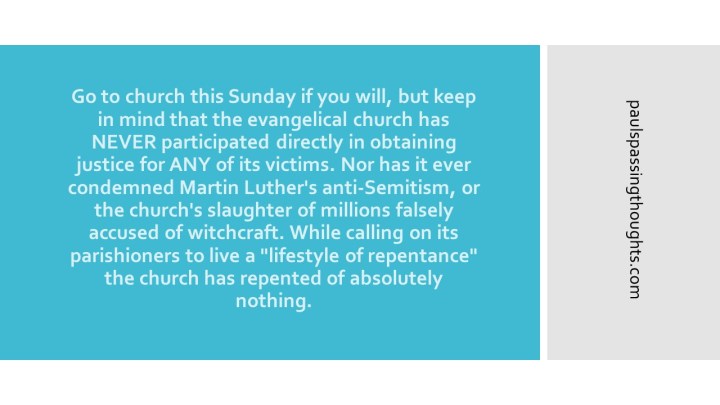
Don’t be fooled by church. Pastors rarely mean what you think they mean by the words they use. Don’t be led to the slaughter like a dumb ox.

Church: the Anti-Love
 As God’s literal children continue to claw their way out of the Protestant Dark Age, we see that the Bible counters the exact same false doctrines of our day that tormented the first century ekklesia. Once we grasp justification by new birth as apposed to the church doctrine of justification by faith, the book of 1 John starts to make sense. Trying to understand 1 John through the prism of justification by faith leads to utter logical chaos.
However, when reading 1 John through the prism of justification by new birth, things start making sense. Seeing the justification by new birth dichotomy between law and love is the key. The new birth, the bigtime theme of first John, changes the believers relationship to the law. CLEARLY, according to justification by faith, a person’s relationship to the law does not change; that’s why Jesus has to keep it for us. That’s why their gospel is substitutionary for both sin and love. That’s why Jesus has to do all of the loving. That’s why Christ warned against “relaxing the law,” because in reality it is relaxing love.
Like justification by faith, many of that day taught that the law of God is a burden. No? During a conference Susan and I attended, we heard John Piper describe how he experiences the day when he first awakes: sin is ruthlessly clawing at him in his mind. Wow. I leaned over to Susan’s ear and said, “That’s a perfect illustration of someone who is under law.” We often hear church scholars speak of the “righteous demands of the law.” Dr. Michael Horton states often that any notion that we can keep God’s law will lead to a “despair of self-righteousness.” Getting back to Piper for a moment, his whole Christian Hedonism construct calls for joy resulting in a greater and greater awareness of our inability to keep the law. As we use the Bible to progressively realize the depths of our own evil as set against God’s holiness, we glorify God based on how different we are from our Father while thinking that we must be more like Him will lead to despair. Hence, Christian Hedonism seeks a joy based on our progressive realization of how much we needed salvation leading to a progressive “gratitude.” This increased vision and understanding is a progressive glory upon glory leading up to redemption. In the end, the level of our gratitude (resulting in joy) will determine the quality of our faith and whether or not we go up to heaven or down to hell.
And then I saw the following meme this morning:
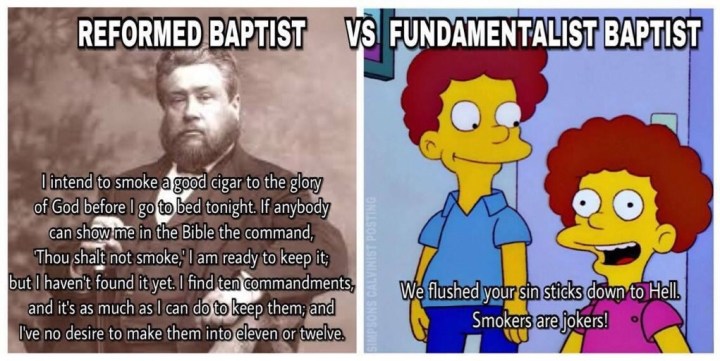
The meme was posted by Steve Camp on Twitter as an attempt towards humor regarding differences between the Reformed and Fundamentalists. The only difference is how two parties apply under law; one relaxes it, what Christ accused the Pharisees of dong, and thereby relaxing love, and those who use it to judge others (condemnation for purposes of control).
Both miss the point of the gospel entirely. We should stop smoking because it isn’t love, not because it breaks the law of sin and death. This is why the law is a burden for those not born again: sin uses the law to create desires to break it. Then, as one partakes in the sin, the depth of desire is increased to the point that saying no is almost impossible, even in the face of dire consequences.
Why are so many famous evangelicals who had the world in the palm of their hand losing everything because of perverted sin? Answer: the gospel of justification by faith that keeps them under the power of sin. Other evangelicals do not fall because they are inclined towards different sinful desires easier to hide or even accepted among evangelicals like control-lust. Evangelicals constantly reveal their desires to control others and this is manifested in church constantly.
When those saved by justification by new birth stop doing A and start doing B because A is not love and B is, and joy comes from loving, REAL change will start taking place. This is John’s point in 1 John 5:1-5:
Everyone who believes that Jesus is the Christ is born of God, and everyone who loves the father loves his child as well. This is how we know that we love the children of God: by loving God and carrying out his commands. In fact, this is love for God: to keep his commands. And his commands are not burdensome, for everyone born of God overcomes the world. This is the victory that has overcome the world, even our faith. Who is it that overcomes the world? Only the one who believes that Jesus is the Son of God (NIV).
And what is “faith”? It is “faith working through love” (Galatians 5:6). It is no surprise that Charles Spurgeon, being a proponent of justification by faith, was indifferent to smoking, other than it being his personal desire, because why make an effort to obey any law when the standard is perfect law-keeping? Listen folks, this is Protestant orthodoxy: people cannot obey the law because every human act is tainted by sin and falls short of perfect law-keeping. Since the law is a burden that cannot be endured by anyone, why bother with making an effort to keep any of it? Suuuuuuure, the law of God speaks against homosexuality, but so what? Nobody can keep the law anyway, so they are welcome in the church; if they overcome their homosexuality it is a manifestation of Christ’s righteousness and not a “righteousness of our own” anyway. But hence, just one more debate in the church adding to its endless drama due to the confusion flowing from justification by faith.
When a truly born again believer starts focusing on doing things because those things are love, not the condemnation of the law, the sinful desire is stripped of its power to enslave and real change is far more likely. CONDEMNATION is sin’s power; that’s what the Bible says. If people are still under the condemnation of the law, and the only righteousness we have is an “alien righteousness” completely outside of the believer that we can only perceive internally (the Protestant definition of faith), we, ourselves, do not love, and have no real power over sin.
Why do you think church looks the way it does in our day? Joy comes from pondering and seeing the depths of our depravity resulting in deeper gratitude for our salvation. What do you think “praise and worship” at church is all about, and listen to the lyrics of these songs; it is all about your sin as set against Jesus’ holiness. While this is not particularly the doctrine of sinning more that grace may abound, it merely assumes the presence of abundant sin is already present. So, rather than making a point to perform the act, you instead sit under “gospel preaching” that enables you to see the sin that is already there and consequently more grace.
Come now, be honest, you hear this in church constantly.
paul

 Paul's Passing Thoughts
2 comments