Church Marriages are Under Law NOT Under Grace
 There are only two people groups in the world; under law and under grace. That’s under the condemnation of the law or under the law of love. Grace is love in action, and uses the law (the Scriptures) as a guide for doing so without fear of condemnation. Those born under the law can only escape its condemnation one way; through a literal new birth by the Spirit. You die with Christ to the life that was under law, and are resurrected with Christ to a new life and relationship to the law. However, this also comes with a new attitude towards the law due to one’s changed nature; those under law are indifferent to the law, while those under grace love God’s law. Said another way, they love God’s truth. Obviously, those who are indifferent to God’s law will hardly use it to love God and others. However, religionists will often use it as a license to hate while assuming the Lord is pleased with their “obedience to the covenant.”
Under law is not only a metaphysical status, but a way of life and a mindset. One of these days I will write a post about under-law thinking and speaking. This post is about how people who go to church view marriage and divorce. Justification by faith is an under-law false gospel which leads to an under-law mindset and worldview. Like everything else, this under-law mindset will be applied to marriage.
Hence, “God hates divorce” means that you never get a divorce except for unrepentant perpetual adultery; because, that’s what the law says…period. In other words, the letter of the law and not the spirit of the law. That’s under-law thinking. God also hates war, but also sees it as necessary at times.
When I came out of retirement to work, I wanted to do something that would teach me more about sanctification. I chose to be a state certified nurse aide, and in regard to teaching about sanctification, I hit the lottery on that. My new career has taught me much about being a believer and living the new life; this is what it has taught me about this particular marriage issue.
At least in Ohio, I think something like twenty years ago, mental health facilities were “deinstitutionalized.” Those diagnosed as “behavioral” have been assimilated, somewhat unofficially, into nursing facilities. Therefore, the care duties of nurse aides necessarily include mental health issues with very little training in that field I might add. Our only salvation is drug treatments which makes this category of care manageable for nurse aides. In the old days, residents in mental institutions were caged, lobotomized, and electrocuted. I like the medication idea better.
Among these behaviors that land people in managed care is chronic verbal abuse towards others. Oh, and by the way, “aide abuse” is not a recognized event or reality in our profession. In our profession, there is no “#Me Too” movement, not even for female aides much less male aides. In all situations, we are instructed to “remain professional.” DONs, ADONs, and charge nurses like to stop to the left or right of a door and listen in on aides interacting with residents who are behavioral. Subtle retaliation or not so subtle retaliation of any sort, or even correcting the resident could lead to termination of employment and loss of your aide license. Being verbally abused by these residents is part of your job description. Furthermore, family members will often hide recorders in the room. After all, it is seen as a condition beyond the person’s control. They are the victim of a mental disease and should be treated like any other disabled person.
In home health care, HHAs (Home Health Aide) are not allowed to be informed of conditions; it’s a violation of HIPAA law. These behavioral conditions qualify under Medicare and Medicaid, and the HHA must perform their duties as if the resident is normal. For a STNA, the situation is a little easier because you are privy to more information lawfully, viz, the situation is more controlled/planned through information, and there is more support where nurses can administer prn (as needed) medications.
I have cared for people with behavioral conditions in both situations. If you reduce the condition, or level of abuse by 50 to 75%, to the point that would be considered under the spectrum of a mental condition, and apply it to a marriage, that would be considered an abusive marriage. However, an aide doesn’t live with the residents 24/7. We get to leave and go home, and ponder new techniques to better deal with the stress. Or, refuse to deal with said resident which is a dog that will hunt due to the extreme shortage of nurse aides.
Here is my point: as an aide, I can tell you that this on-the-job abuse is personally destructive to the aide and the other residents the aide is trying to care for. Dealing with many of these residents is an emotional beatdown that you would have to experience to understand. Nevertheless, it is part of the job because these people would totally destroy any family unit they resided in. It is simply a job someone has to do.
To experience this kind of abuse in a marriage is unacceptable. Living with a verbal abuser will destroy you. Therefore, the idea that a Christian spouse is rebelling against God for leaving an abusive spouse is absurd. As long as the abuser is torturing the spouse on the installment plan rather than the lesser form of abuse via adultery which the other spouse may be totally unaware of to begin with, the abused spouse has “no biblical grounds for divorce.” Hogwash.
This is classic under-law thinking that denies the commonsense hermeneutic. We have a reverse example of this in the Bible.
When Jesus had finished saying these things, he left Galilee and went into the region of Judea to the other side of the Jordan. Large crowds followed him, and he healed them there.
Some Pharisees came to him to test him. They asked, “Is it lawful for a man to divorce his wife for any and every reason?”
“Haven’t you read,” he replied, “that at the beginning the Creator ‘made them male and female,’ and said, ‘For this reason a man will leave his father and mother and be united to his wife, and the two will become one flesh’? So they are no longer two, but one flesh. Therefore what God has joined together, let no one separate.”
“Why then,” they asked, “did Moses command that a man give his wife a certificate of divorce and send her away?”
Jesus replied, “Moses permitted you to divorce your wives because your hearts were hard. But it was not this way from the beginning. I tell you that anyone who divorces his wife, except for sexual immorality, and marries another woman commits adultery.”
Old Covenant divorce law was not restricted to the ideal that Jesus presented to the Pharisees, there were many exceptions, and for the same purpose that Jesus states in this passage: to prevent women from being in bondage to situations of abuse or not being cared for financially. In many cases, receiving a bill of divorce from the husband would leave a woman financially destitute in that culture. Jesus’ focus is the real purpose of marriage while fustigating the use of the law to excuse hardness of heart and using the law as a license to fulfil sinful desires at the expense of others. Remember, in all of this, having concubines was allowable under the law, but there were laws that forbade divorcing a concubine in favor of another and preferable treatment towards one over the other within the household. Yes, you were allowed to have multiple wives, but you couldn’t divorce them for any and every reason. For example, if it was found that a man slandered his wife for purposes of divorce and the accusation was untrue, he wasn’t allowed to divorce her ever (he also had to pay money to the wife’s father). And if he took another wife into the household, the former had to be treated equally.
Let’s look at some examples. The Puritans, who are church heroes, used Bible versus to condone executing accused witches. In many cases, it was to get rid of a wife, because, you know, God hates divorce, but we also know, that you can remarry if your spouse dies, so, too bad she just so happened to be a naughty witch. And if you suspected that your wife might be a witch, they would use the venue of sacred baptism to test the accusation. If your wife floated, she was found to be a witch and hanged. If she drowned, she was innocent, albeit dead anyway. Does this give you an idea in regard to what Moses was doing with Old Covenant law in the face of law-based religion? Take the Sabbath as another example. By the way, Sunday is supposedly the new Sabbath. Good grief. It’s not about you not doing any work so you can keep yourself saved by going to church, it was about giving servants and animals a rest from their work once a week. That’s love. That’s why you were allowed to help people on the Sabbath though the law didn’t specifically specify such. Why? Because love is the commonsense hermeneutic.
For the most part, churches are predicated on what we call, Covenant Theology. Shockingly, it is naked law-based justification. It goes something like this: God made a covenant with Adam, and Adam broke the covenant, and Christ came to restore the covenant through perfect law-keeping. So, if we believe in Jesus, and live by faith alone (because we can’t keep the law perfectly anyway), we are forgiven of the sin imputed to Jesus and also receive a declaration of being righteous though we are not. This is a perpetual upholding of the covenant restored by Jesus that can only take place in the local church. The only glaring problem flows: those under grace use the law for love, so you do the math. Church orthodoxy necessarily excludes love by the parishioners, and if you pay attention to the news much, that would be evident.
And, marriage reflects the same covenant because the church is the bride of Christ. Supposedly. Hence, anyone who breaks the covenant with a local church, or breaks the marriage covenant loses access to progressive salvation. FYI: Paul wrote his letter to the Galatians to refute this very same false gospel. First of all, read your Bible, God never made a covenant with Adam. Again, shockingly, in the verse used to support the idea that God made a covenant with Adam, God is talking with the serpent! Folks, I could understand if church orthodoxy was some sort of genius deception, but it’s not; it is embarrassingly elementary. Now, I could stop short of passing judgement because I was in the church mess myself for like 30 years or so, but in all honesty, even as a pastor, I knew something wasn’t right about church from the beginning.
How does this all flesh out in real life? Well, in so-called “Biblical Counseling,” unless the spouse is guilty of ongoing unrepentant adultery, all bets are off; the “marriage covenant” must be saved at all cost. If the husband is guilty of waterboarding the wife, and asks forgiveness, the wife must “forgive unconditionally in the same way she has been forgiven by Christ.” Of course, more than likely, the abuser will stop waterboarding the wife to save face and save the marriage covenant while moving on to more subtle forms of abuse. If the wife divorces regardless of the abuser’s “repentance,” she will be the one brought up on church discipline and deemed unregenerate.
Consequently, many Christian wives who uphold the church’s bogus covenant either end up on anti-depressants or commit suicide. Like nurse aides, they are damned if they do and damned if they don’t, except nurse aides are supplying a necessary service to save families. And trust me, I know plenty of nurse aides that are on job related anxiety medication. Most verbal abusers that are not in a facility are just below the mental health spectrum. In a facility, the abuser cannot be held accountable because they have to be somewhere. In the case of marriage, divorce is the only way to hold an abusive spouse accountable.
I have exegeted 1Corinthians 7 on this issue before and will not revisit it here, but suffice to say that biblical marriage is predicated on oneness, or a situation where two people are pleased to be with each other and on the same page for the most part. This may even include a marriage between a believer and nonbeliever. The believer, in all cases, is…are you ready for this?…”called to peace.” Got it? Sucking it up and enduring verbal abuse day in and day out is not our calling for the sake of a love principle presented as law.
Here is some information for those who are in church and in an abusive marriage. First of all, you may treat your spouse LIKE they are unsaved because church is works justification under law. You are not passing judgement on their salvation, but the Bible allows you to treat them like an unbeliever. Therefore, the only question that remains according to 1 Corinthians 7 follows: Are they pleased to dwell with you for equitable reasons? Um, if they are verbally abusing you and messing with your head because they are PAPD (Passive Aggressive Personality Disorder), the answer is an obvious, “no.” You may hold them accountable through divorce.
And, in regard to remarriage, “you are not under bondage.” That is, to the former marriage contract. In regard to 1 Corinthians 7 principles, Paul states, “This is me, not the Lord.” In other words, Paul was establishing a New Covenant precedent aside from the point that Jesus was making to the religionists of that day.
Our goal in regard to the law is always love (grace in action, or active grace). Enabling an abuser through law-based justification is hardly our calling, and certainly not love, but rather the promotion of a false gospel to boot.
paul
The Evangelical/Reformed/Protestant Church’s Use of Hebrews 7:25 for Advertising its False Gospel
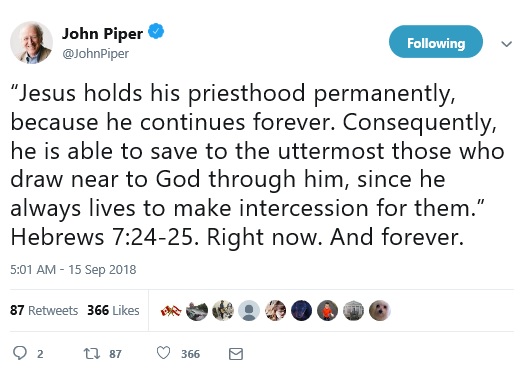
I have a bit of a problem lately. It is difficult to conduct this ministry according to priorities because everything we have been saying for the past ten years is now evident everywhere you look on the internet or in the news. I feel strongly that our new publication, “The Church Lie and the Biblical Alternative” speaks to the crux of the issue, and that it will be widely read for the following reason: unless you have been vacationing on the moon for the past year, you know that church is imploding before our very eyes and people are going to be looking for answers.
So, on my way to getting back to the final tweaking of the book, I stumbled upon the above John Piper tweet. Church loves to twist Hebrews 7:25 to promote its progressive justification false gospel. Supposedly, this verse means that Jesus continues to intercede for those who trust Him for progressive justification experienced subjectively in sanctification. In other words, all good works are only experienced by us, but not performed by us. Justification AND sanctification are both substituted 100% by Jesus.
As stated by the who’s who of church constantly, “Christians” remain unchanged except for their ability to see the depths of their sin which is defined as “faith.” This enables them to return to the same gospel that saved them daily resulting in Jesus doing Hebrews 7:25 and thus keeping them justified. Hence, Jesus is a priest that ever lives to intercede for our justification as we remain faithful to church where we “ratify anew” the New Covenant for “believers and unbelievers alike.”
In classic cult doublespeak, “Yes, but of course, Jesus’ death was a one time historical event,” but that one time event is then reapplied for all future sins. Sin is not ended, but only covered IF we remain faithful to church where we obtain the “means of grace” which is cultic code for “means of ongoing salvation.”
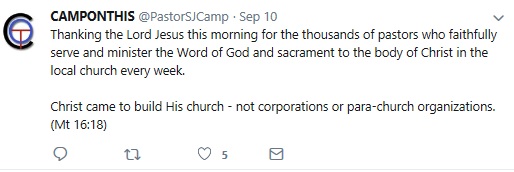
“Sacrament”? What’s a sacrament? And obviously, where is the only place where you can get sacraments conducted by a “lawfully appointed minister (WMC)”? The above screenshot is from a tweet by one who would be considered a mainstream evangelical.
This is what Hebrews 7:25 is supposedly referring to, viz, ongoing intercession for justification; ie, the justification by faith false gospel.
So, what is Hebrews 7:25, and the one other verse like it (Romans 8:34) really saying? Well, since such a rendering of the verse contradicts justification by new birth, we know it’s not that, so what is it? A Greek word study of the verse is extremely complicated so we will skip that and go straight to some commonsense interpretive methods. This is where multiple translations are not a bad thing, but a VERY good thing. What you have with multiple translations is a vast resource of differing judgements on any given passage by Greek and Hebrew scholars. That’s a valuable resource. More on that shortly.
The first thing you want to do is use word study software like E-Sword to find out how the same word is used in other passages. You also want to research how other words that carry the same idea are used. Just because the specific word is “house,” doesn’t mean conclusions cannot be drawn from a different word like, “dwelling” or “abode” or “tabernacle.”
In my case, such a word study found the following: “prayer,” “supplication,” and “intercession” are closely related; in fact, it can be argued that these are three different kinds of prayers. Obviously, a prayer is an intercession for someone, right? Consider 1 Timothy 2:1-2,
I urge, then, first of all, that petitions [supplication], prayers, intercession, and thanksgiving be made for all people—for kings and all those in authority, that we may live peaceful and quiet lives in all godliness and holiness.
If you think about it, for the most part, these four things are primarily executed by prayer. I also want to add that what we intentionally ponder and wish for according to God’s will counts as a type of prayer also.
In addition, keep in mind that “save” doesn’t always refer to the salvation of the soul. Consider Philippians 1:19,
For I know that this shall turn to my salvation through your prayer, and the supply of the Spirit of Jesus Christ,
Certainly, Paul wasn’t saying that he was going to be saved through the prayers of the saints as he was already saved. In James 5:16 we find,
Therefore confess your sins to each other and pray for each other so that you may be healed. The prayer of a righteous person is powerful and effective.
Those who are already righteous don’t need prayer for salvation from those who are already righteous as well. Christ saves to the uttermost, which means being saved from a number of other things in this life aside from eternal damnation. We don’t know how to pray many times because of our weakness, so…
Likewise the Spirit helps us in our weakness. For we do not know what to pray for as we ought, but the Spirit himself intercedes for us with groanings too deep for words.
The Spirit intercedes for us like Jesus does.
Therefore, it is not any surprise that we find this rendering of Hebrews 7:25 from the Wycliff Bible:
Wherefore also he may save without end, coming nigh by himself to God, and evermore liveth to pray for us. [Wherefore and he may save into without end, coming nigh by himself to God, evermore living to pray for us.]
Jesus is not only our High Priest for a one time finished act of saving our souls and justifying us, but He intercedes for us continually in regard to every need in our life. He is a High Priest that ministers to the whole person; that’s the point of Hebrews 7:25.
Romans 5:9 – Since we have now been justified by his blood, how much more shall we be saved from God’s wrath through him! 10 For if, while we were God’s enemies, we were reconciled to him through the death of his Son, how much more, having been reconciled, shall we be saved through his life!
I don’t believe ‘wrath” here only pertains to eternal wrath (damnation), I believe we are also saved from the wrath occurring in this present age. Christ is our savior in regard to every aspect of life, not just salvation of the soul.
What is the significance of this? Well, if church is selling salvation of the soul on the installment plan and using verses like Hebrews 7:25 to do so, what is going to be the emphasis at church? Right, salvation of the soul only, which is why churchians don’t do life very well. One of our sons recently started going back to church and like most grown-up boys in our age, he doesn’t put much stock in what mom and dad says. Nevertheless, he complained last week, “All they talk about at church is salvation” prefaced with the confusion of this because we are already saved. This is why I am anxious to get the new book published; I want to be able to hand it to people in order to answer their questions about church which are many. There are also many who know they needed to get out of church because it’s a crazy train getting ready to bounce completely off the rails, and it would be nice to know why they had to leave. In addition, many are asking where we go from here. If not church, then what?
Church can’t be about doing life well coupled with the idea that our High Priest of the New Covenant is constantly interceding in our present-day lives because that’s not what church is selling.
Church is a sanctuary city with a gospel for getting murderers, hypocrites, liars, pedophiles, and swindlers of every sort into heaven. And on every Sunday, the depth of such depravity determines the vigor in which the praise band leads the celebration. That’s what they call, “grace.”
paul



 Paul's Passing Thoughts
leave a comment