A Response to the Shapiro / MacArthur Interview

There is perhaps no greater example of cognitive dissonance in recent history than the Shapiro/MacArthur interview. The TANC Ministry authors will respond according to the interview’s assertions regarding politics, soteriology, church history, and the Enlightenment Era.
LIVE LINK: https://boxcast.tv/view/a-respose-to-the-shapiro–macarthur-interview-855263
John Immel on Immanuel Kant: https://paulspassingthoughts.com/2017/07/20/the-disaster-of-sacrifice-as-the-ultimate-moral-standard-part-3/
Just Admit It: God as the Creator of Evil is Protestant Orthodoxy
 You will never learn much about world philosophy in church because that’s what its doctrines of salvation are based on. The idea that the Protestant Reformation was born from Martin Luther stumbling upon some epiphany-invoking verse of Scripture in Romans is propaganda. Sola scriptura is a lie; it is the “noble lie” of ancient tradition. More on that a little later. To understand world philosophy is to understand the church lie.
It is amazing to me how Western academia is able to dress up its religion to look more cultured than run-of-the-mill Voodoo in third world countries. But there is no difference. One thing that always confused me is mythology and its relationship to the part of Western intellect that built the wonders of the world. How could Western scholars believe soap opera versions of religion and other narratives concerning Zeus et al that are very far-fetched?
To the credit of the Reformers and their ability to deceive, they made mythology scholarly by relabeling it as “orthodoxy.” Mythology and orthodoxy are the exact same thing. Because Protestantism came out of the mother of all religions, like all other religions; ie., the knowledge of good and evil, there is a dichotomy between knowledge and mankind. Hence, the ultimate knowledge of mankind is that mankind cannot know. That’s Socrates and his understudy Plato.
Sure, mankind can know stuff that works in the material realm, but that is not “knowledge from above.” So, we have a strict dichotomy between the knowledge of good, which is the spiritual/invisible realm, and the evil material realm which includes mankind. Anything that can be perceived with the five senses is evil. That’s Dualism, which Plato later articulated into a science, and became Gnosticism which was the number one nemesis of Christ during His ministry and the apostles afterward.
Catholicism and Protestantism both are predicated on this basic philosophy. Of course, God’s gospel design was specifically designed to drive a spear through the heart of religion based on the philosophy of man; Christ came and joined holiness to the material realm. God’s elected gospel is in direct contradiction to the religion of all religions: the knowledge of good and evil. Hence, Catholicism and Protestantism both stand in opposition to God and His gospel. Protestantism in particular is an antichrist religion.
Clearly, the father of Protestantism, Martin Luther, was a Platonist who believed that goodness and mankind, whether lost or saved, are mutually exclusive. Protestantism redefines the new birth as a sixth sense given to man (and sometimes taken back) that enables man to “see the kingdom” but not participate in it.
Herein is where we inter into a definition of mythology and orthodoxy in regard to the metaphysical narrative or story. Simple stated, a metaphysical narrative is a bedtime story for mortals that enables them to maneuver through the material world of shadows to obtain salvation. Mythology is made up of parables that teach mortals how to obtain some sort of salvation in the end and the best possible “wisdom” for coping in the world of shadows. The humble confess that they cannot know anything good, but orthodoxy/mythology enables them to be guided through a process of salvation of some sort.
Protestantism merely made the Bible THE metaphysical narrative. As John Calvin states in the very first sentence of his Institutes of the Christian religion, ALL wisdom is comprised “entirely” of the knowledge of man and God. In other words, the knowledge of good and evil. That’s the religion presented to Eve in the garden and the same religion from which all religions flow. Whether the half-crazed Voodoo doctor chanting in the jungle, or Albert Mohler sitting in his library—it’s all the same premise.
Yes, one day God decided to write a metaphysical narrative for his own self-love and glory because everything is about God’s glory: “Soli Deo Gloria, glory to God alone.” As far as, “Sola scriptura (Latin ablative, “by Scripture alone”) is the Christian doctrine that the Bible is the supreme authority in all matters of doctrine and practice. Sola scriptura does not deny that other authorities govern Christian life and devotion, but sees them all as subordinate to and corrected by the written word of God,” right, it is the supreme authority for knowing that we cannot know, and is the final authority in regard to what the “other authorities” say that it says. They are Martin Luther’s “theologians of the cross” because they know mankind cannot know save the evil of man as set against God’s holiness. By the way, most contemporary “Biblical counseling” is predicated on this precept. If you want to read a book that lays all of this out in uppity sounding Western scholarship, read Paul David Tripp’s “How People Change.” Well, according to the book, people change by using the Bible to see their own evil in a deeper and deeper way as set against God’s holiness. That’s Protestantism in a nutshell. Tripp does a good job of articulating the hermeneutic in said book.
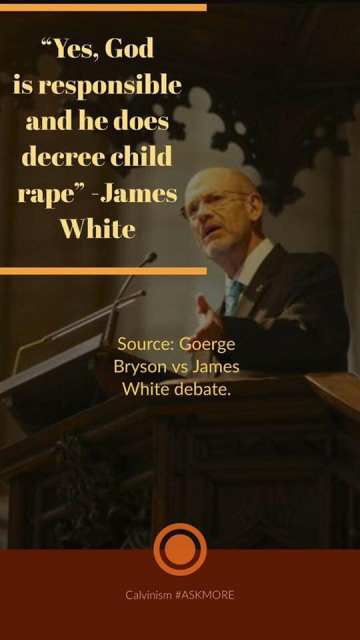
So, now do you understand the “gospel of sovereignty”? Do you now understand how James White can say what he says about child rape? Of course it is decreed by God because all of reality is a redemptive narrative written by God. Everything that happens in reality is an elaborate story written by God. It’s reality as story. Did God predetermine what you will wear tomorrow? Of course He did because that’s the way He wrote that event into the story. And the story is also history.
And since part of the narrative is about man’s evil, that would include some young girl being written into the script as a victim of rape. And remember, the story is reality, it is a metaphysical narrative. Everything that happens in your life was prewritten by God because reality is a story written by God. Once you understand this, you begin to see it everywhere in church and Christian media, particularly the “Gospel Project” which is a “Bible study” program for children. The Protestant people group supplies no better example of a dumb ox being led to the slaughter.
Doctrinally, this is known as the “historical-redemptive” hermeneutic. People assume, “Well, of course the Bible is about redemption!” This is the typical use of assumptions that Protestant scholars use to deliberately deceive church-goers. Another hermeneutic is the “historical-grammatical” which I will not address here, but suffice to say both hermeneutics are based on two different theories of reality and presuppositions about mankind.
As Paul David Tripp states in the aforementioned book, “God invites you to enter into the plot!” Yes indeed, and it would behoove you to enter yourself into the plot as a humble church-goer who knows that you cannot know and therefore willing to “submit yourself to godly men that God has placed in authority over you.”
Because, you know, that’s how God wrote the story.
paul

Trumpism: A Kiss Between the Bible and Reality, and Why Trump is Perfect on a “Ship of Fools”
 Unfortunately, when thinking about the word, “sin,” our minds focus on things despised by common goodness, however one may define that. Though most rightly assume the Bible primarily addresses the problem of sin, how the Bible frames sin emerges as the dominant theme. In reality, there is no dichotomy between the spiritual and what we experience in everyday life. A dominant theme in the Bible that saturates the reality we live in is that of freedom versus slavery. Primarily, the dominant theme of the Bible is that of two masters; Sin, and Christ.
Sin probably resulted as Satan’s cheap shortcut to be equal with God in regard to authority and power. This is because freewill is a major pillar of metaphysics. Satan figured out a way to be a powerbroker in the universe; be the opposite of God. The Bible states that sin was “found IN Satan.” However, in a Frankenstein-like narrative, Satan creates something that is totally out of his control—Sin ends up being the master.
Sin was created within Satan by his desire to be equal with God, and according to the Bible, Sin is also driven by one fundamental desire: to control and enslave everything. Sin is the antitheses of everything God is. God has authority by virtue of who He is, but His authority isn’t at all applicable to His relationship with man. God relates to mankind thorough a freewill love that travels both ways. No act of love involves a practical prevention of consequences. Indeed, “God loves a cheerful giver.” The fruits of God and Sin are opposite; love, life, and peace versus hate, death, and fear.
Christ comes as an opposing master according to God’s elected plan. The Spirit brings forth life and death in God’s spiritual baptism. Christ came to establish spiritual baptism according to the Father’s promise through the Spirit. Those reborn of God literally die with Christ, and are literally resurrected with Him. That does not fit well with a need to be controlled by spiritual elitists. Yet, spiritual caste reveals itself in the world on every level of existence. Caste saturates our existence. This is because that is what Sin does—it has an insatiable desire to control. In the very first gospel presentation ever in the Bible, God told Cain that Sin stalks humanity and uses unloving actions to gain control over individuals, “but you must control it,” that is, Sin. People, because of Sin, must control others, and the use of sinful acts to do so leads to guilt, and hence, in the same discourse, God says to Cain, “If you do well, your countenance will be lifted up.” In the New Testament, Peter states that, “If you will love life and see long years, keep yourself from evil.” Fear, or some form of anxiety exists in EVERY case of mental illness without exception. There is a reason for that.
Hence, Christ comes as the saving master who has purchased every slave for himself. His yoke is light, He is the good master. All enslaved to Sin are free to leave the Sin master and come into Christ’s household. By calling on His name, they die by the Spirit in the Sin master’s custody, and are resurrected to new life in the Father’s household. If the slaves are rightly informed, they should know that staying in the Sin master’s household is a choice. They have been purchased by the King of kings and Lord of lords. But love does not compel; it beckons. “I have come that you may have life, and have it more abundantly.” “Come to me, all of you who are weary and carry heavy burdens, and I will give you rest. Take my yoke upon you. Let me teach you, because I am humble and gentle at heart, and you will find rest for your souls. For my yoke is easy to bear, and the burden I give you is light.”
All politics flow from this metaphysical construct. While not joined at the hip with the gospel in every conversation, all of life, as we experience it, is a question of balance between freedom and slavery. Politicians like the Obamas who want to control every aspect of our lives do so because their ideology comes from Sin. At issue is control-lust; presuppositions concerning mankind are merely the excuse. Sin uses caste for its delightful representation of authority and control on every level of life’s existence. The law is also an excuse; that is, how those full of control-lust interpret the law and also legislate it. A proper understanding of man’s ability and the fact that he is created free and wired for specific purposes is the next best thing that brings about peace and justice other than the gospel itself.
And by the way, is the political shaming of America all about using condemnation to control others? Of course it is.
Yes, President Trump is far from being the most likeable individual on the planet, but he understands the ability of mankind and its need to be free. This is the least common denominator that explains why opposition from every corner of the world is upon him with all fury from hell. And even those who understand the issues of collectivism versus individualism feel that they must be honest about Trump’s flaws for the sake of sanctimonious balance and fairness. That’s a big mistake. If a leader understands freedom, and intends to apply it as a primary objective, especially in our day and age, not nurturing that tiny flame while being stranded in the wilderness is utter foolishness.
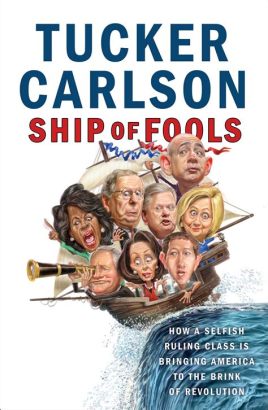
If America is on a “Ship of Fools,” we better wait to focus on Trump’s shortcomings after the tyrants full of control-lust are thrown overboard. If Trump is one of the few leaders in recent U.S. history willing to do so, and he is, and if a closer position to freedom versus collectivism is paramount, and it is, support for Trump, at least for the present, should be all hands on deck.
paul
Protestants Have No Idea What a Protestant Is: Part 2
Part One: https://paulspassingthoughts.com/2018/12/05/protestants-have-no-idea-what-a-protestant-is/
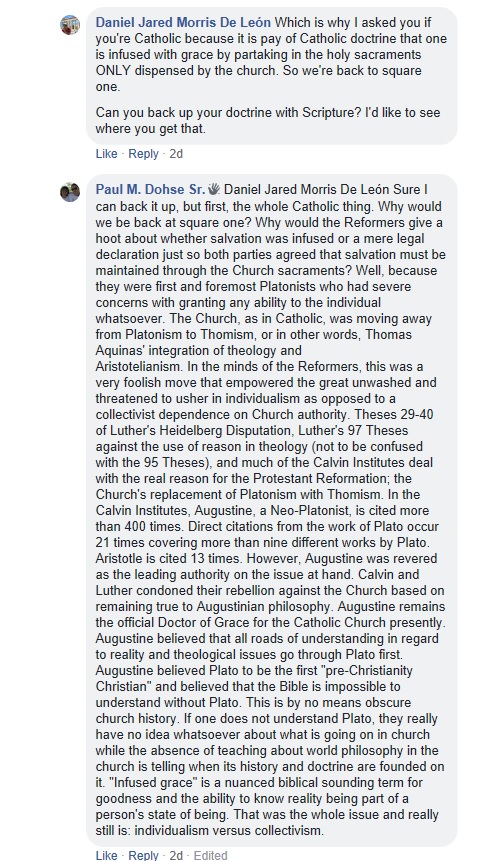
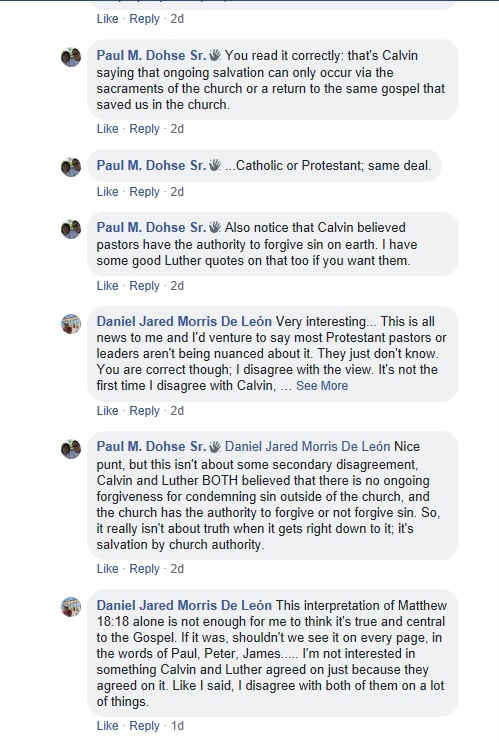
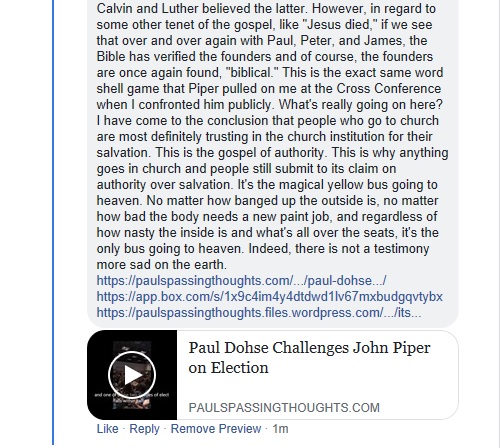
“I have come to the conclusion that people who go to church are most definitely trusting in the church institution for their salvation. This is the gospel of authority. This is why anything goes in church and people still submit to its claim on authority over salvation. It’s the magical yellow bus going to heaven. No matter how banged up the outside is, no matter how bad the body needs a new paint job, and regardless of how nasty the inside is and what’s all over the seats, it’s the only bus going to heaven. Indeed, there is not a testimony more sad on the earth.”



 Paul's Passing Thoughts
7 comments