Paul's Passing Thoughts

For the Sake of the True Gospel STOP Saying that Christ’s Righteousness is Imputed to Us

Posted in Uncategorized by Paul M. Dohse Sr. on June 12, 2019

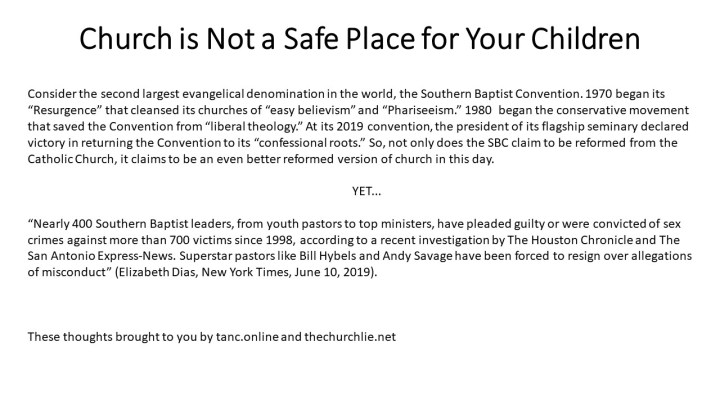
Church is Not a Safe Place for Your Children

Posted in Uncategorized by Paul M. Dohse Sr. on June 11, 2019

The Foundational Premise of Luther and Calvin’s Protestant Reformation: ALL Human Knowledge is Evil

Posted in Uncategorized by Paul M. Dohse Sr. on June 9, 2019

David Powlison’s Real Legacy: He Deliberatley Destroyed The Real Biblical Counseling Movement

Posted in Uncategorized by Paul M. Dohse Sr. on June 8, 2019

ppt-jpeg4“Powlison’s pseudo legacy will undoubtedly include the assumption that he was on the right side of the gospel while allowing the default assumption that Powlison propagated for years: Jay Adams’ biblical counseling construct is predicated on a false gospel. I am writing this article to set the record straight.” 

David Powlison, the longtime biblical counseling icon and faculty member of the Christian Counseling and Educational Foundation at Westminster Seminary has died. He was 69 years old. While I feel no animosity towards Powlison, and as a caregiver do not wish pancreatic cancer on anyone, I am not going to stand by idle while The Gospel Coalition partakes in its usual rewriting of contemporary church history. Not only that, Powlison changed what the church could have become though still found wanting. After all, something is better than nothing. Powlison was a classic mystic despot dressed in scholarly garb, while teaching counterintuitive truths of old without a state to enforce orthodoxy. Nevertheless, he improvised while having the demeanor of Mr. Rogers and the cunning of the Lion King’s wicked uncle “Scar.” That seems harsh, but my rational will be explained further along in this article.

Central to the conversation here is the gospel. Indeed, Powlison said it himself: the biblical counseling controversy between him and Jay Adams involved two different gospels. Yes, I know, everything in the church is destined to become an argument, that’s just church, but that’s what he said….period. So, two different gospels cannot be true; one of them is false, or both are false. Powlison’s pseudo legacy will undoubtedly include the assumption that he was on the right side of the gospel while allowing the default assumption that Powlison propagated for years: Jay Adams’ biblical counseling construct is predicated on a false gospel. I am writing this article to set the record straight.

We all know what I think of Calvinism, and not because of the predestination issue, but because Calvin clearly taught progressive justification. However, the counseling philosophy of a sanctified Calvinist saved my life. The term, “sanctified Calvinist” is reserved exclusively for Jay Adams out of respect. In reality, he is a confused Calvinist for the better but I would never call him that. Adams is a Calvinist who had sanctification half right, which led to an actual revival, a revival that I witnessed firsthand and experienced for myself. Does the gospel have enough power to change lives and spark a revival when it is partially right? Certainly. Part of the gospel message is the issue of people living by their consciences. Do many unbelievers have a healthy conscience? Yes. Will they be happier if they live by it? Certainly. Does the same principle apply to Christians? Definitely. Will living by conscience save you? No. However, this is an example of a practical principle that Adams implemented in his counseling construct because, as we know, if you jump of a cliff, injury is determined by the height of the fall, and God would agree with that assessment.

With Powlison, not so much. Powlison would have said that such a question must be answered in its, “gospel context.” With Powlison, one thing was always certain: any no-brainer question would be answered with a cacophony of nuance in order to further Powlison’s view of spiritual hierarchy. Powlison was the epitome of someone who was all about spiritual caste. Adams was not of the same college. Before I clearly specify the difference, in a manner of speaking, between the Powlison gospel and the Adams gospel, the difference of mentality between the two is an important distinction. The Christian Counseling and Educational Foundation (CCEF) is the counseling wing of Westminster Seminary. NANC, (National Association of Nouthetic Counselors) was a certification organization that many said Adams founded but he didn’t. Adams wanted his counseling movement begun by the controversial book written by him, “Competent to Counsel,” to be a layman’s movement. He believed the average Christian was competent to counsel other Christians. It was Powlison et al (the others will be mentioned further along) who wanted the movement to be an elitist professional movement. This was Powlison’s first act of hijacking the Adams revival. I call it that for convenient nomenclature while noting that Jay would object to me referring to it as such. Adams went along with the NANC thing while seeing little harm in it, but always emphasized the ability of the average Christian to take the word of God and help others with it.

Before we get into the two gospels that drive the two different counseling constructs, we want to take a look at the very important contemporary history of, yes, the crux of this issue, the New Calvinist movement. Adams’ controversial book, “Competent to Counsel,” was published in 1970, and that is an extremely important date. Interestingly, while reading the accoladent articles concerning Powlison’s departure, NANC, which is now ACBC (Association of Certified Biblical Counselors), is scrubbed from the history just like the real history of the New Calvinist movement. Adams, after a traumatic experience with a parishioner, set out to solve the problem of pastoral inability to help people with life’s deeper problems. His findings were published in the aforementioned book, but something else very important was going on in 1970. Following is the dirty little secret the church is presently trying to scrub from contemporary church history: the church, had in fact, lost sight of the authentic Protestant gospel. The authentic Protestant gospel did not see sanctification as separate from justification, but rather the progression of justification. Authentic Protestantism’s gospel was predicated on a strict dichotomy between good and humanity. So, sanctification as a Christian life that is infused with God’s nature and life with humanity was rejected with prejudice by the reformers, viz, Calvin and Luther in particular. According to Protestant orthodoxy, ALL goodness or the ability to do good remains outside of the believer. And “faith” was defined as an illumination that only enables the “believer” to perceive this fact. Hence, faith is all about a deeper and deeper knowledge of how far one is from God’s holiness leading to an increased gratitude for God’s grace and salvation. Sanctification isn’t about being more like our Father, which supposedly leads to the diminishing of the cross’s significance, but rather a deeper and deeper realization of how far we are from God’s holiness, again, leading to a deeper gratitude for salvation.

Well then, obviously, the focus would not be learning God’s truth for purposes of applying it to Christian living, but rather using the Bible to obtain the exact opposite: to learn how far we are from God leading to a greater emphasis on the cross. So, of course Christians lacked an ability to use the Bible to help each other live a more wise and godly life; that was NEVER the Protestant purpose of the Bible. NEVER. However, the advent of Americanism confused that truth. The authentic Protestant gospel that the Puritans had brought to America became integrated with Enlightenment Era ideas. Hence, Christians started reading their Bibles grammatically from an individualistic perspective rather than a redemptive perspective collectively. The result? American churches functioned according to the authentic Protestant gospel while denying its orthodoxy intellectually. This led to the application of biblical generalities leading to a weak sanctification. Nevertheless, this weak sanctification had a profound effect on American culture. Even limited practical application of the Bible made America one of the more moral societies on the face of the earth. Yet, because the church still functioned according to authentic Protestant orthodoxy while denying much of its orthodoxy intellectually, it was primed for a return to the authentic article; in other words, from a weak sanctification back to no sanctification at all. From the beginning, Protestantism was about justification being a mere “legal declaration” and NOT a state of being. In contrast, the church had adopted an Enlightenment idea that Christians are not merely declared righteous, we ARE righteous.

This is where the New Calvinist movement started. An Adventist theologian by the name of Robert Brinsmead discovered the error of the church’s ways and began a movement to bring Protestantism back to its former roots. This was the “Awakening” movement also known as the “Progressive Adventist” movement. Brinsmead was joined by two Anglican ministers and a Reformed Baptist who formed the core four of the “Australian Forum,” which was a Theological think tank that sought to bring the church back to its original gospel roots. By the way, Al Mohler invited one of these members of the Forum to Southern Seminary in 2009 to lecture on what the Reformation was really about. Yes, the problem with the church was the following according to the Australian Forum: it wasn’t vertical enough, and too horizontal. In the same year that the forum started getting traction in the church, Adams was taking the church in the opposite direction; ie., the church was too vertical and not horizontal enough. Adams was, and maybe still is, a Calvinist that had some sanctification; he believed that goodness is inside of believers and enables them to do good things that please God. However, that idea is totally antithetical to authentic Protestant orthodoxy. Also involved in the foundations of the biblical counseling movement was David Powlison who was of the opposite school, that is, the “Vertical Church” view. More on that at this time.

Jay Adams, David Powlison, and a fellow named Dr. John “Jack” Miller were teachers at Westminster Seminary in the 70s. The Australian Forum was actually invited to Westminster to set the Protestant brain trust straight on what the true Protestant gospel is, and they listened. So much for so-called “historical precedent,” for 200 years after the American Revolution, the church in general, and those in the hallowed halls of Westminster didn’t even have a right understanding of what the authentic Protestant gospel is. Nevertheless, this is where the New Calvinist movement started. The “scandalous gospel” indeed, the rediscovery of the true Protestant gospel is owed to a Seventh-Day Adventist.  Dr. Miller took hold of the new revelations delivered by the Forum and put his own spin on it; a program called, “The Sonship Discipleship Course” or simply “Sonship Theology.” David Powlison was mentored by Miller. Powlison and Miller worked together to form their own counseling construct based on the newfound Protestant gospel in opposition to what Adams was doing, and the war was on. Except, Adams had no idea what was going on. He barked about Westminster inviting the Forum to visit, and sarcastically suggested that pork be served for lunch (along with some insults hurled towards Ellen White), and indeed, pork was served during the visit, but he had no idea that the visit would have a future profound effect upon his life and career.

At any rate, my thesis here concerning the lost gospel of Protestantism is confirmed by the all-out civil war that ensued amongst Protestant Calvinists during the 90s. Sonship Theology was nothing less than spot-on Reformation soteriology. And by the way, a Presbyterian minister who was in the middle of the fray defending Sonship was a guy named “Tim Keller,” Is that name familiar? Adams published a book in 1999 against Sonship Theology that was instrumental in defeating the movement, or so everyone thought. The movement went underground and changed its name to “Gospel Transformation” and “Gospel Centrality.” And, to object to the teaching of this movement was to be against what it was named, right? And the ploy worked; if you were against this movement, you were against “the gospel.” Meanwhile, Adams never connected the two movements as being the same thing. Do I attribute this cunning primarily to David Powlison? Yes I do.

By the 90s, Adams had developed a practical application of the Bible to sanctification that was yielding an all-out revival in churches worldwide. I ended up being counseled by a pastor influenced by him. The counseling saved my life, although I could have been healed much faster if the counseling was a thoroughbred biblical sanctification. Not withstanding, the truth of his counseling saved me from a significant time of darkness. I will say this unequivocally; I owe Jay Adams my life, but that does not obligate me to agree with him on everything. I joined the particular church where I received the counseling, and witnessed the Jay Adams revival firsthand. Unbelievers coming to counseling at that church were astounded to find the Bible’s explanations and answers to life’s deepest problems and the hope therein. Consequently, they received Christ and led lives that yielded good fruit. In one year, through the counseling, there were 12 solid conversions, or one per month, and trust me, in a church of 250 members, that is utterly unprecedented. But meanwhile, as the biblical counseling movement skyrocketed, Adams began to experience more and more persecution from within the ranks of CCEF and NANC. This was perplexing to him. The civil war going on within the movement was the elephant in the room that nobody was addressing.

Enter in the second generation of those mentored by Jack Miller and overseen by David Powlison. Primarily, Paul David Tripp. As mentioned earlier, I do not disdain Powlison (besides, he just died), but I am not so sure I can say the same about Tripp. I do, God help me, consider Tripp to be an evil false teacher. But in both cases, the following is not commendable: instead of teaching their own convictions separately and letting God’s people decide for themselves, they deemed it necessary to infiltrate NANC and destroy it, not that it was ever Adams’ organization, but merely because it was strongly associated with him. Powlison won that battle, but I don’t think he won the war…a war against God whether witting or unwitting.

The Gospel Transformation movement was deliberately covert and marked by hostile takeovers of evangelical churches. Even churches founded by the likes of D. James Kennedy stature fell victim. No one knew what was hitting the evangelical church, or why it was happening. The church I mentioned earlier that I joined fell pray to the movement and I was one of the casualties. The leadership that took over was overtly anti-Adams which was perplexing to me. Yes, apparently, all Jay Adams ever did was, “make people better Pharisees.” When I shared with one elder that NANC counseling had saved my life, he openly mocked me. Eventually, I was brought up on bogus church discipline and my family was ripped apart for asking too many questions.

But upon departing from there, I was determined to understand what happened if it took the rest of my life. Funny, earlier in my life, I prayed to God to show me why the church has such a problem getting its act together; he was in the process of answering that prayer. During the Adams revival I thought my prayer had been answered, but that notion was dashed when I witnessed the perplexing pushback against what could only be deemed a blessing. I often think about those like Dr. John Street who now go along with the narrative that those days were a lie. I left and formed TANC Ministries, a research organization. In circa 2007, Adams contacted our ministry, and through mutual correspondence between us, the nameless movement was dubbed “Gospel Sanctification.” A little more than a year later, the movement was known as the “New Calvinist” movement.

The authentic Protestant gospel propagated by Powlison has a particular serious problem: good works cannot be dichotomized from love. Grace cannot be dichotomized from love. If “infused grace” is a false gospel, if only Christ works, then there is no love in any person whether they profess to be a Christian or not, nor can they perform any act of love pleasing to God. This was David Powlison’s gospel. And though Adams professes the Protestant gospel, his sanctification construct calls for the ability of the believer to please God by loving others with a love that is within, so…

…thank God he is confused, or rather, a sanctified Calvinist. I might have to speak better of him after he dies, that is, if he dies. But, the rapture isn’t a Reformed thing either.

paul

The Gospel’s Ground Zero: Romans 8:2, and Why The Church Must Misrepresent It

Posted in Uncategorized by Paul M. Dohse Sr. on June 4, 2019

ppt-jpeg4Church must make the two laws in Romans 8:2 two different realms or two different spiritual forces in order to misrepresent the new birth and the baptism of the Spirit, which is critical to the institution’s survival.  When the verse is evaluated based on the simple meaning of the word used in the verse, “nomos,” it is clear that this refers to two different written standards. In context, two different laws that originated with God. The word is used about 197 times in the New Testament and in every case refers to a written law or God’s written law. In contrast, other words are used when referring to an invisible force or spirit, primarily “pneuma.”

“Yes, but how can there be two laws of God, that makes no sense at all” many will say. Really? Two laws of God are talked about all of the time in church; specifically, Old Covenant/New Covenant, New Testament/Old Testament, etc. Popular theologies are even based on the idea that the Old Covenant was written for the Jews only, and the New Covenant (New Testament) was only written for the Gentiles. At any rate, Romans 8:2 is ground zero for the gospel because in order for the gospel of justification by faith to stand, “nomos” in the verse must be “pneuma” or some other word that refers to a spirit realm or invisible force.

Critical to the gospel of justification by faith is a single perspective on the law in regard to it being the standard for justification. If the law of God has more than one purpose; ie., other than “to show sin,” the gospel of justification by faith collapses. The Spirit’s two uses of the law determined by the new birth/Spirit baptism must be confined to one use of the law, therefore, “nomos” in Romans 8:2 must be a realm rather than God’s written law and thereby redefining the new birth and Spirit baptism.

According to the true gospel, that is justification by new birth, the new birth changes a person’s relationship to the law of God and rejects the law’s single purpose of showing sin. According to justification by faith, the new birth is merely an illumination that enables the “believer” to colabor with God’s law to see how sinful we are which aides in returning to the “same gospel that originally saved us.” It’s a single purpose of the law used in a perpetual re-justification/re-salvation or progressive justification. Proponents of justification by faith deny that it is progressive justification overseen by the church by God’s authority and I have come to believe that they are lying about that and know it. Justification by faith stands or falls on the single purpose of God’s law to show sin. Of course, this is deceptively nuanced thorough sanctification-speak. In justification by faith, sanctification is merely the progression of justification, or “justification in motion.” According to mainstream Protestant pastor John Piper,

Now I want to stop and make sure that you are hearing what I believe the Scripture is saying, because it is not commonly said, but our lives hang on it. There is a real sense in which our justification depends on our sanctification.

Note that Piper is not saying that our sanctification is the natural result of new creaturehood with justification being a finished work in the believer (you are only born into a family once), but justification depends on things that happen in the progression of a “believer’s” life, meaning clearly that justification isn’t a finished work. The redefinition of “nomos” in Romans 8:2 also makes double imputation (a critical doctrine of justification by faith) possible but that is not a subject we will delve into here.

What’s really going on in Roman’s 8:2? We are justified, once and for all time (see Romans 8:1), which completely changes our relationship to the law. Before the old us died with Christ, we were under “the law of sin and death” (see Romans 7), but were raised with Christ and are now under the “law of the Spirit of life.” Same law, two different relationships determined by the new birth. Once you understand this, finally, the Bible starts making sense and the relationship of law and gospel starts making sense. Jurisdiction is the issue here, not a realm. Jurisdiction can include realm in some cases, but not in this case. Here, jurisdiction has to do with life and death; according to Romans 7, the old you is dead, and the law of sin and death no longer has jurisdiction. However, the new you that was raised with Christ is under grace, or the Spirit’s second use of the law; to sanctify via the truth of God’s word.

Furthermore, finally, assurance of salvation is possible because there is no law to judge us, that is, the first law we were under before we were born again. Under justification by faith and its singular perspective on the law (in regard to the definition of righteousness/justification), there is no way to know what your motives are in Christian life. Am I doing this good deed to justify myself in God’s eyes, or purely for love? Well, under grace, or under the law of the Spirit of life, the law for purposes of justification is gone along with the old you, so the only remaining motive is love. “Where there is no law there is NO sin,” so any attempt to outscore sin with good deeds is a nonstarter to begin with. Our faith works, THROUGH LOVE, not law-keeping (Galatians 5:6).

Failure to understand the Spirit’s two uses of the law according to Romans 8:2 leads to a singular perspective on the law regarding justification resulting in a false law-based gospel, while on the other hand, dissecting the law for purposes of bogus secondary and wacky theologies. That’s church in a nutshell.

God’s law (the Bible) has clear and specified roles that lead to an overall understanding of the Bible. If you have the law right, you have the Bible right. The Old Covenant was a will. The will promised that ALL sin would be imputed to the law and that Christ would then come and end the law. The will is “The Promise” which promised that the Spirit would raise Christ from the grave and establish the baptism of the Spirit. This baptizes Jew and Gentile into  the “one new man,” and ends the law with all of the sin imputed to it. Old Testament believers had their sin COVERED by the law (atonement), which made the Old Covenant a “protector” or “guardian” until “faith came” (Christ) and consummated the will. In order for a will to be activated, there must be a death (see Hebrews).

However, this doesn’t mean that the believer is not under a law; it means that the new birth changes the believer’s relationship to the law. The law is stripped of all condemnation, and is our guide for love. Neither does this mean that there are no consequences for failure to love, but condemnation is not the result. That is a matter of a loving Father’s chastisement which is another element of this that will not be addressed in this article.

Also, the word of God as a seed has to do with the new birth, and is not the same exact thing as the baptism of the Spirit, although under the New Covenant consummated by the death of the Testator, both happen at the same time. The word of God as a life-giving seed is another topic, but suffice to say here that Old Testament believers were born again by the “implanted seed.” During the Old Covenant, their sins were covered, under the New Covenant, sin is ended, but nevertheless, they were born again and righteous as a state of being just like those under the New Covenant.

How church redefines all of these terms is an endless study. “Seed,” is redefined as a mere illumination that enables us to see our own sin and inability to do any good work, rather than the very life of God being inside of us as His offspring. This, in fact, makes us righteous as a state of being, and yes, SINLESS, and therefore righteous as a state of being. Look, we have documented this extensively, the Reformation was sparked by the Catholic Church moving away from Augustine’s idea of total depravity, viz, the idea that ALL righteousness remains outside of the “believer.”

But all in all, church denies the new birth and the baptism of the Spirit as defined by the Bible, and accordingly, must misrepresent Romans 8:2.

paul

PS. I realize my distinction between the new birth and the baptism of the Spirit raises a lot of questions and it should! This is uncharted territory deliberately avoided by the church. Per our ministry mode of learning; it is accomplished collectively by the body of Christ. Learning ONLY comes through a collective body effort, NOT top-down hierarchical spiritual authority.