All Churches in a Free Society MUST Eventually Capitulate to the Culture
Excerpt from TANC 2019 conference.
TANC 2019 Andy Young Session 3
Take your Bibles and turn to the gospel of John, chapter 9. I wanted to end my series with this account because it presents probably the most comprehensive examination of the thinking and operation of the leadership of institutional religion. I guess you could say I have saved the best for last. And I wanted to devote an entire session to the exegesis of this one passage simply because it is rather lengthy, but because it is so lengthy it bears taking the time to work through it just so we can fully get a grasp of the implications of all that is taking place in this passage.
This account takes up the entirety of chapter 9. We won’t take the time to examine the entire chapter. This is a story that most of you are probably already familiar with. This account seems to take place immediately after the events of chapter 8, so we have one of those unfortunate chapter divisions. In chapter 8 Jesus was in the temple and we have another rather lengthy passage where John describes in some detail this encounter Jesus had with the Jews.
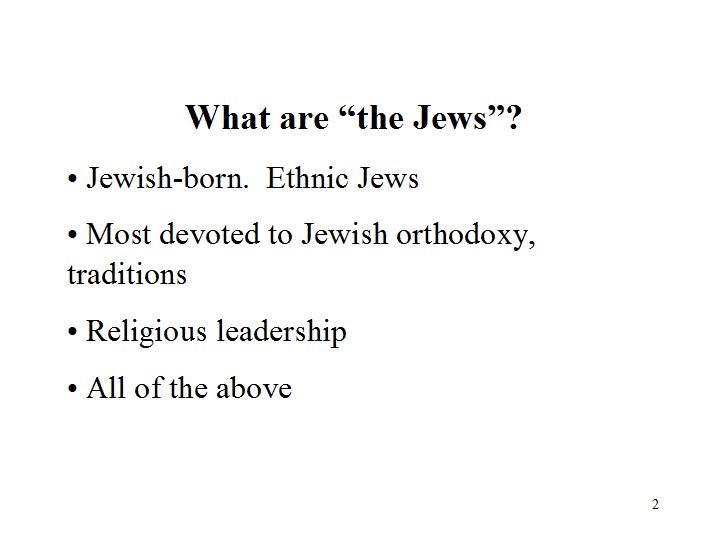
Now, for the sake of clarity, whenever we see this term Jews there are a couple of things this could mean:
Jewish-born. Ethnic Jews
Most devoted to Jewish orthodoxy, traditions.
Religious leadership.
All of the above
So in chapter 8 Jesus had this encounter with “Jews”, and there is a lengthy exchange, and Jesus makes this well known statement, “Before Abraham was, I am.” And at this point the Jews just about went ape, because Jesus was either saying that He existed before Abraham, which is one way this is often interpreted. But Jesus used the expression “I am”, which is the same thing Jehovah said to Moses at the burning bush, so Jesus was actually saying that He is Jehovah.
So the Jews were getting ready to stone Jesus, and Jesus just simply turned around and casually walked through this crowd and left the temple. It says He “passed by”. So then chapter 9 picks up by saying “as He passed by”. So it seems as if this next event happens right after He goes out of the temple.
So very briefly here, Jesus and the disciples leave the temple, they see this blind man (and I use the term “man” here loosely, I will get back to that a little bit later). We are told this person was blind from birth. That is critical to keep in mind. Jesus makes some mud, rubs mud on this man’s eyes and tells him to go wash in the pool of Siloam. The text says the name means “Sent”. But when you examine the Hebrew word from which this name is derived it literally means “cast out”. Now “cast out” certainly conjures up a different meaning from simply “sent”. And this will have clear implications when we see what happens later. You often have to wonder if Jesus was really trying to send a message with these things.
It would be an interesting study to take an in-depth look at the historical significance of this pool, but we won’t get into that here. What I will say is that this pool served as a fresh-water source. It seems that it was located just outside the southern wall of the temple. And if you remember our Acts study from a few years ago, we learned that the southern part of the temple was the main entrance. (beggars) This pool would have most likely been a major public gathering place. And this where Jesus sends this man. Go wash your eyes out in this pool where everyone will see you.
So he does this, and being a very public place, everyone there now sees this blind man who now can see. And so everyone starts talking among themselves. “Isn’t that the blind man? How can he see?”. And so they ask him what happens, and he tells them the story about how Jesus put mud on his eyes and told him to wash in the pool here.
And now this is where I want to pick up the narrative. This is where it gets interesting, because now the Pharisees come into the picture. And as we go through this, I want you to notice just how the Pharisees operate. Let’s start at verse 15.
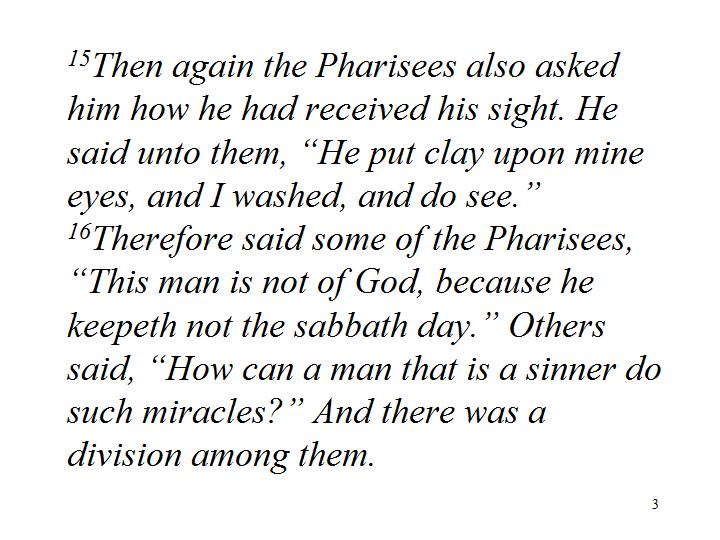
John 9:15-34
15Then again the Pharisees also asked him how he had received his sight. He said unto them, “He put clay upon mine eyes, and I washed, and do see.” 16Therefore said some of the Pharisees, “This man is not of God, because he keepeth not the sabbath day.” Others said, “How can a man that is a sinner do such miracles?” And there was a division among them.
Now there are a couple of interesting things here. First of all, Jesus is considered a sinner because He didn’t keep the Sabbath. Now lets think about this. Let’s go back to the Ten Commandments for a second.
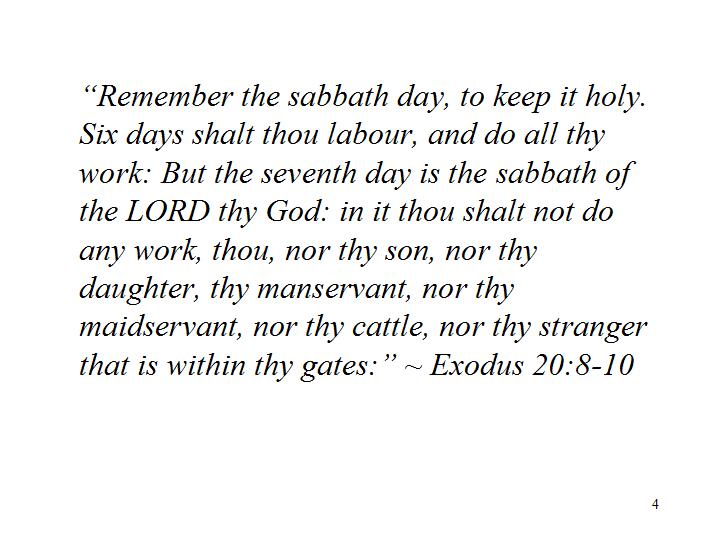
Remember the sabbath day, to keep it holy. Six days shalt thou labour, and do all thy work: But the seventh day is the sabbath of the LORD thy God: in it thou shalt not do any work, thou, nor thy son, nor thy daughter, thy manservant, nor thy maidservant, nor thy cattle, nor thy stranger that is within thy gates:
Exodus 20:8-10
According to Jewish orthodoxy, Jesus violated the Sabbath. Anyone who does even a cursory reading of the NT should be able to come to the conclusion that the Jewish system of orthodoxy was predicated on a justification where perfect law-keeping was the standard. Right? And The Jews had set up this entire system of traditions whereby if you kept this system, that was the equivalent of keeping the law. There was an entire section devoted specifically to regulations for the Sabbath. For example, you could only walk a certain number of miles from your house on the Sabbath. In the case with Jesus:
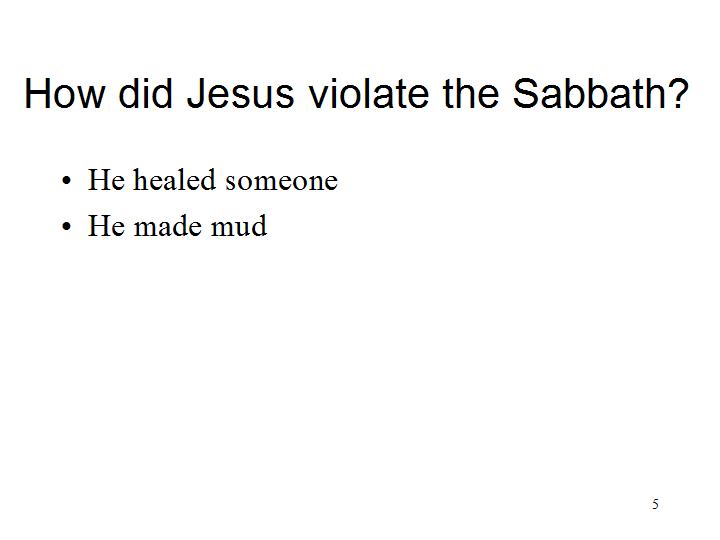
– He healed someone on the Sabbath
– He made mud
He made mud. This is with respect to the Sabbath regulation against making bricks. (Example of how clay bricks are made). So the fact that Jesus bent down on the ground and made mud, He violated the Sabbath. In the second case, He healed someone. To heal someone involves work, and you’re not supposed to do any work on the Sabbath.
Now here is where the Pharisees encounter their first dilemma. And it should be obvious. On the one hand they have labeled Jesus as a sinner because he violated the Sabbath, but on the other hand He performed a miracle, which they acknowledge. They cannot deny what just happened. But they don’t know how to reconcile this.
Now having said all this, we should immediately be able to see a problem with the modern protestant view on justification. It is no different that what 1st century Judaism taught; that righteousness is based on perfect law-keeping. Do you see the problem? And if you don’t, let me put up this slide to give you a clue. (RC Sproul Double imputation)
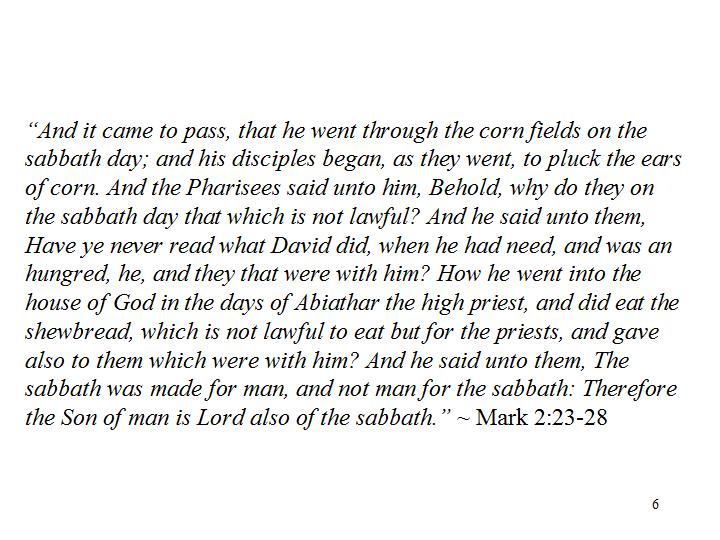
So what’s the problem? R.C. Sproul cannot reconcile his take on double-imputation with the glaring reality that Jesus didn’t keep the Sabbath perfectly! Look at this passage. It’s right there in black and white. You cannot get around it. What about other times when Jesus healed someone on the Sabbath. And we can go to other passages in the gospels and see other examples of where Jesus didn’t keep the Sabbath, like the time He and the disciples walked through a grain field and were plucking the grains off as the went and ate it.
“And it came to pass, that he went through the corn fields on the sabbath day; and his disciples began, as they went, to pluck the ears of corn. And the Pharisees said unto him, Behold, why do they on the sabbath day that which is not lawful? And he said unto them, Have ye never read what David did, when he had need, and was an hungred, he, and they that were with him? How he went into the house of God in the days of Abiathar the high priest, and did eat the shewbread, which is not lawful to eat but for the priests, and gave also to them which were with him? And he said unto them, The sabbath was made for man, and not man for the sabbath: Therefore the Son of man is Lord also of the sabbath.” ~ Mark 2:23-28
“Well, Andy,” you say, “that’s not right. You can’t say Jesus broke the law. Jesus didn’t really break the ‘law.’ You’re talking about traditions of men. Jesus was under no obligation to keep traditions of men. That’s not the same as the law.” You’re right, it’s not the same thing. Neither is it the same thing to say Jesus keeps the law for us and that obedience is imputed to us. That’s not the same thing either. But here’s the point; it doesn’t matter.
Look, we can concede that remembering the Sabbath is part of the Law, do we agree with that? But here is the point, and the apostle Paul bent over backwards trying to make this point clear in both Romans and Galatians. The Law does not justify. Even if you keep the Sabbath, whether it’s the actual law itself or through some system of traditions, it doesn’t matter, the law doesn’t justify. What was the purpose of the law? In 2014 I made the case that it was for sanctification, and you can go back and review that. The law was also a will. The law was also a guardian that took OT saints into protective custody. But moreover, the law is the vehicle for showing love to God and others.
So how does keeping the Sabbath show love? Well, it’s obedience to God first. John 14:15, “If you love me, keep my commandments.” But what was the purpose of the Sabbath? To give man a day to rest. God knew that man needed a day off, so He gave us a day so that we could have leisure and not be burdened with the tasks of labor. So we could recover and have strength and energy to go back to work.
(story of the time I worked 2 weeks straight)
Man needs a day off. This is first and foremost loving ourselves, because we recognize our need to recuperate. Recognizing that need of ourselves motivates us to recognize that same need for others. We give our employees time off so they can have rest. We don’t plow our fields so that even our work animals can rest.
And speaking of animals.
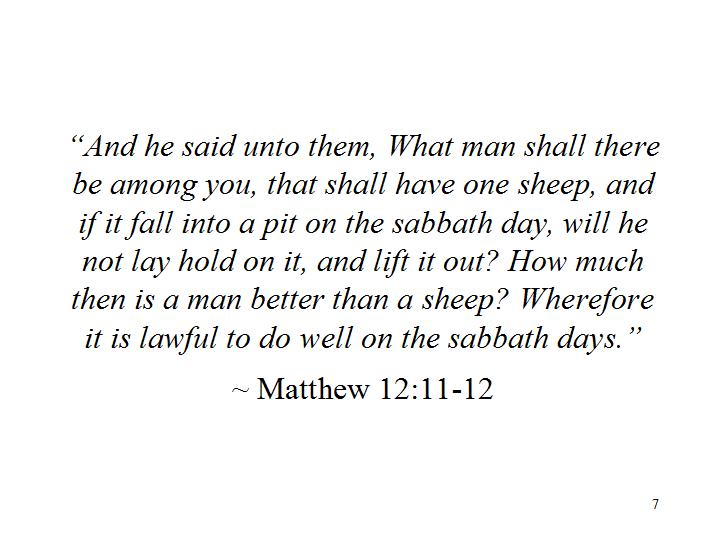
“And he said unto them, What man shall there be among you, that shall have one sheep, and if it fall into a pit on the sabbath day, will he not lay hold on it, and lift it out? How much then is a man better than a sheep? Wherefore it is lawful to do well on the sabbath days.” ~ Matthew 12:11-12
See, Jesus had the right understanding of the Sabbath. Let’s get rid of this notion that Jesus was righteous because He kept the law. The law has nothing to do with His righteousness, and it has nothing to do with our. We are righteous the same way that Jesus is; because we are God’s offspring. You see why a literal New Birth is so important?
So as we get back to our passage here, the Pharisees are having this dilemma, and there is clearly a division between them that they are trying to reconcile. So they go back to the blind man, well former blind man. And if you think about this, it’s actually kind of funny. Look at what they say.
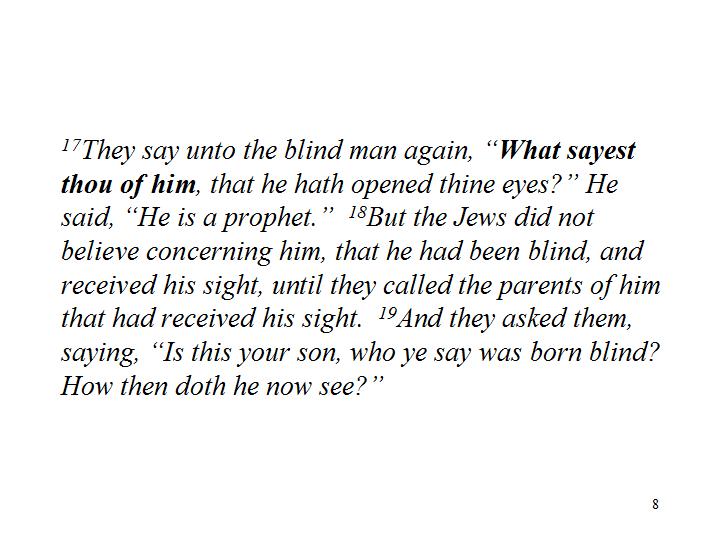
17They say unto the blind man again, “What sayest thou of him, that he hath opened thine eyes?” He said, “He is a prophet.” 18But the Jews did not believe concerning him, that he had been blind, and received his sight, until they called the parents of him that had received his sight. 19And they asked them, saying, “Is this your son, who ye say was born blind? How then doth he now see?”
Now, notice how they are trying to turn this around on him? Do you really think the Pharisees are genuinely interested in this man’s assessment of Jesus? How is this question not a trap? How is this not the same as when a pastor or elder from your church invites you out for coffee on his Starbucks expense account? Trying to get you to talk about your “weaknesses”. So what sins have you been struggling with? We have documented case after case where this is a trap to put you under redemptive church discipline. And if you don’t believe me, I can show you the cases. This is well documented that these things happen. You open up to these guys and they will use that stuff against you.
The man tells the Pharisees that he thinks Jesus is a prophet. So now they think they have something on this guy, because if Jesus isn’t a prophet then this man has been lying all this time. So, not only are they trying to catch Jesus, but they are trying to catch this man as well and use him as leverage against Jesus. And there is a motivation behind this as we will see in just a bit. So they go to this man’s parents and say, is this your son? Is he really blind? How do we know he was really blind? How is it possible that he can now see? See they are starting with the assumption that Jesus was a fraud. This is what they want to establish. They want to create the reality that Jesus CAN’T be who He says He is, and to do that, they have to deny reality. They have to sell you on another version of reality.
Now look at this next part here: Verse 20
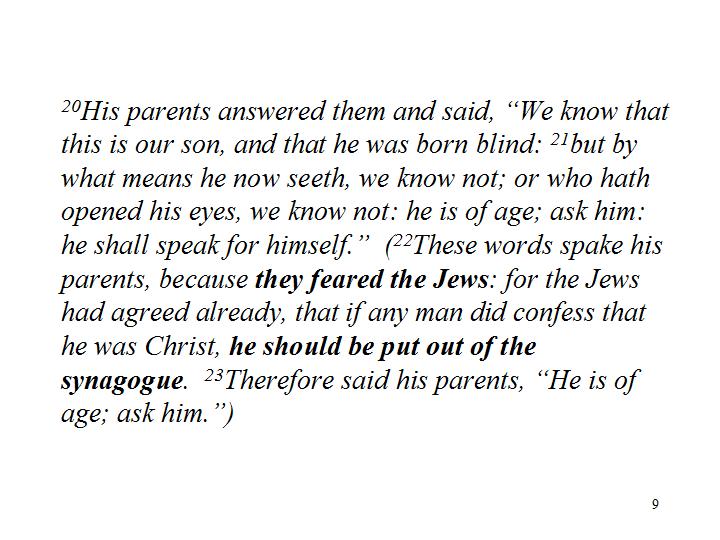
20His parents answered them and said, “We know that this is our son, and that he was born blind: 21but by what means he now seeth, we know not; or who hath opened his eyes, we know not: he is of age; ask him: he shall speak for himself.” (22These words spake his parents, because they feared the Jews: for the Jews had agreed already, that if any man did confess that he was Christ, he should be put out of the synagogue. 23Therefore said his parents, “He is of age; ask him.”)
See, so there is the motivation I mentioned earlier. They wanted to discredit Jesus by trying to marginalize any of His potential followers. So they could say, yeah all these people who follow this guy, they got thrown out of the synagogue. So if you don’t want thrown out too, then you better not say this Jesus is the Messiah. And this was a very serious threat to a Jew, because being part of the synagogue was synonymous with your salvation. You were no longer part of that local community. Chance were that you’d not be welcome in any other synagogue because word would get around. And if you weren’t part of that community, then you couldn’t partake of all the traditions that go along with being a practicing Jew, and if you couldn’t partake of those traditions then you could not practice those things that made you righteous, because according to the Jews, that’s how you kept the Law.
So what is that? That’s salvation by institution. Does any of this sound familiar?
This is also why I find that the name of the pool is ironic. Remember Siloam in the Hebrew literally means “cast out”? And now we are dealing with a situation where you have this man and his parents at risk of being “cast out” of the synagogue. You see why I say, Jesus knows what He’s doing here. Things like this just don’t happen by accident. This is more than just coincidence.
Now here is the other part of this. The parents want no part of this game. They can see what’s happening here. They know if they don’t give the right answer they risk excommunication. So they just defer back to the man. Which makes you kind of wonder, if this blind man is indeed a “man”, with the implication of him being a grown man, why are they going to this guy’s parents? I think there is a hint given in the text when the parents say, “he is of age”. Do you need to even state this if it’s apparent that this is a grown man we’re talking about? This is why I think this man is actually a young teenage boy.
This phrase “he is of age” is important here. Jewish boys come of age at 13. Not only are they considered adults in a social aspect, but from a law aspect it means that they are allowed to partake in all of the religious traditions and become accountable for them personally. So they have to answer for themselves now. It is possible the man is this passage is only about 13 or 14 or 15 years old. Old enough to be “of age” but he still looks young enough that others may not be sure exactly how old he is.
Now I ask you, what kind of parents are willing to throw their 14 year old son under the bus? What kind of parents are these? This is utterly reproachable! Can you imagine the abject fear these parents have of these religious leaders. They are so scared of being labels troublemakers, so scared of being lumped in with the Jesus crowd, so scared of putting their salvation at risk and getting thrown out of the synagogue, that they throw their own child under the bus!
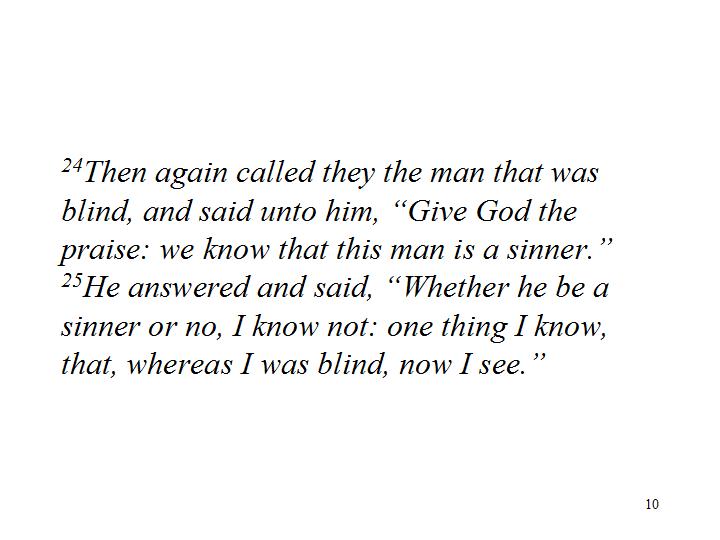
24Then again called they the man that was blind, and said unto him, “Give God the praise: we know that this man is a sinner.” 25He answered and said, “Whether he be a sinner or no, I know not: one thing I know, that, whereas I was blind, now I see.”
You say this man’s a sinner, well, I don’t know anything about that. All I know is used to be blind, he put some mud on my eyes, I washed it off, now I can see. Now look at the rest of this. Look how this “man”, interacts with these Pharisees. Keeping in mind that this is probably a 14 or 15 year old boy.
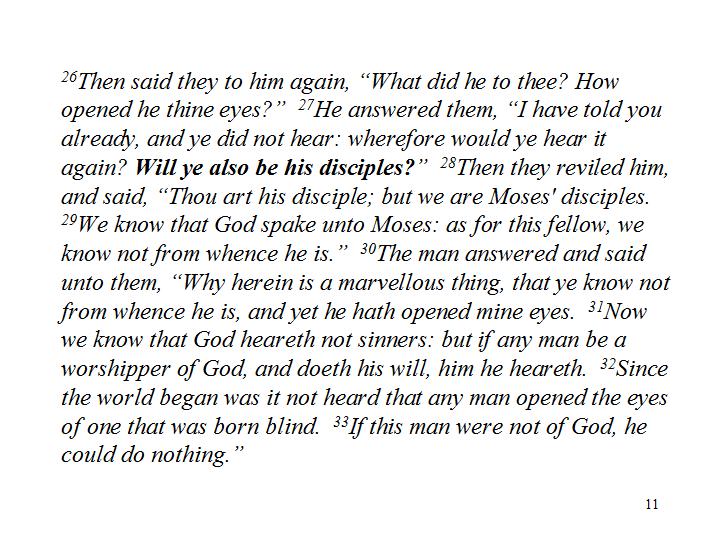
26Then said they to him again, “What did he to thee? How opened he thine eyes?” 27He answered them, “I have told you already, and ye did not hear: wherefore would ye hear it again? Will ye also be his disciples?” 28Then they reviled him, and said, “Thou art his disciple; but we are Moses’ disciples. 29We know that God spake unto Moses: as for this fellow, we know not from whence he is.” 30The man answered and said unto them, “Why herein is a marvellous thing, that ye know not from whence he is, and yet he hath opened mine eyes. 31Now we know that God heareth not sinners: but if any man be a worshipper of God, and doeth his will, him he heareth. 32Since the world began was it not heard that any man opened the eyes of one that was born blind. 33If this man were not of God, he could do nothing.”
Now weather or not this is a 14 year old boy or a grown man, this interaction is fantasic! This guy is a thinker. He is intelligent. He’s not attacking them. He’s attacking there aregument. Look at the reason he’s using with them. He is surgically discecting their conclusions by tearing apart their assumptions. First, he is incredulous that they don’t have an answer about Jesus’ origin. They are supposed to be THE theological experts. They are supposed to be so studied. He’s bringing up points THEY should already know. And he says, if that’s so then shouldn’t the conclusion be this? No one’s ever healed a person blind from birth before. Doesn’t that tell you that this Man is from God?
Nicodemus.
But see, they don’t want to acknowledge this. Why? Because it doesn’t fit their reality. Remember the philosophical progression of all tyrannies. And that is exactly what we are dealing with here with the Pharisees, a religious tyranny. They are the self-proclaimed arbiters of truth because only they have the ability to bring truth to the masses who are fundamentally unable to discern truth themselves. This is their reality. This is the reality they are trying to compel you to accept. And when you don’t, they threaten you with violence. Look how they become indignant. Verse 34
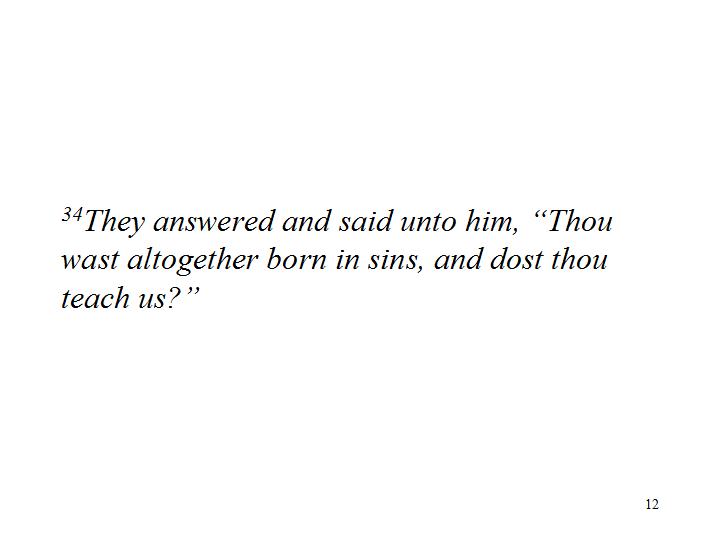
34They answered and said unto him, “Thou wast altogether born in sins, and dost thou teach us?”
You are the one born in sins. You are the totally depraved one. You are the one who doesn’t understand truth. How dare you stand there and presume to teach us?
Does any of this sound familiar?
“And when he was come into the temple, the chief priests and the elders of the people came unto him as he was teaching, and said, By what authority doest thou these things? and who gave thee this authority?” ~ Matthew 21:23
How about when you engage with one of these guys on a Calvinist blog, or you get into a discussion on FB on a Calvinist’s post? What are you credentials? What seminary did you go to? Or like John Immel was asked that one time, have you been “peer reviewed”? How quick these guys are to demand your theological pedigree so they can compare it with their own. And if you don’t measure up to their standard they quickly dismiss you and your argument because you aren’t qualified to have an objective opinion on a matter.
Or when you have that private discussion with your pastor in his office about something he said from the pulpit last Sunday, and you disagree with his conclusions. Well you know the Bible warns against us having our private interpretations. Well, you aren’t submitting to my authority. You aren’t teachable. You think you know more than the pastor who went to seminary. Why are questioning proven doctrine? You’re just being puffed up with knowledge. You’re being arrogant. And then the next thing you know you find yourself under “church discipline”.
Or like John Immel showed us two years ago. You try to nail down John Piper on a specific point of Calvinism, and then he proceeds to engage in the Calvinist Happy Dance. He dances around from one authority to the other to avoid having to answer a direct question, and then in the end he tries to claim that he’s a Biblicist.
But here is the greatest of hypocrisy. You are the one born in sin; the totally depraved one so you can’t understand truth. What should be the obvious question? How are they not a victim of their own depravity? How do they get the epistemological pass on depravity?
What was the end result of this encounter? Did they listen to this man, this boy’s reasoning? Were they persuaded by his argument? Did they concede his argument and stop to consider it in the slightest? Did they stop to think just for a second that this guy might have a point?
And they cast him out [of the synagogue].
Why? Because they wanted their power. They wanted their control. You cannot allow, you cannot grant even for a fleeting second a free-thinking individual. You cannot concede the rational mind
But yet, these are the same people who one day will say this:
“Many will say to me in that day, Lord, Lord, have we not prophesied in thy name? And in thy name have cast out devils? And in thy name done many wonderful works? . . .
And then will I profess unto them, I never knew you: depart from me, ye that work iniquity.” ~ Matthew 7:22-23
It’s the same old song and dance. This very thing happens in churches all over the world to this very day. Protestantism thinks that is gets a pass from error. No, they are peddling in the very same institutional tyranny that the Pharisees did. It is ironic because, pastors will stand up behind their pulpits and declare Pharisees public enemy number one. What do they call them? Legalists. You try to keep the law, you’re a legalist. You’re trying to be righteous. You’re righteousness is filthy rags. You need Jesus’ righteous. You need to live by faith alone.
Then you try to point out scripture to them and reason from the Bible, no look here, it says this. You’re just puffed up with knowledge. You’re not submitting. And before you know it, they are running their bastardized form of Matthew 18 on you. And the next thing you know, you’re out of that church, and you become persona non grata with every friend you thought you had at that church.
Folks, this is nothing new. The writer of Ecclesiastes was right, there is nothing new under the sun. So take heart. Don’t let this get you down. This is not a church issue. This is not really an argument about theology. This is a theological issue. These the the logical conclusions that result from this system of thought. So why should it surprise us when we see it repeat itself over and over? The vicious cycle will only end when you decide that you are no longer going to be their slave.


TANC 2019 Susan Dohse Session 1
Transcript/notes for parts 1 and 2:
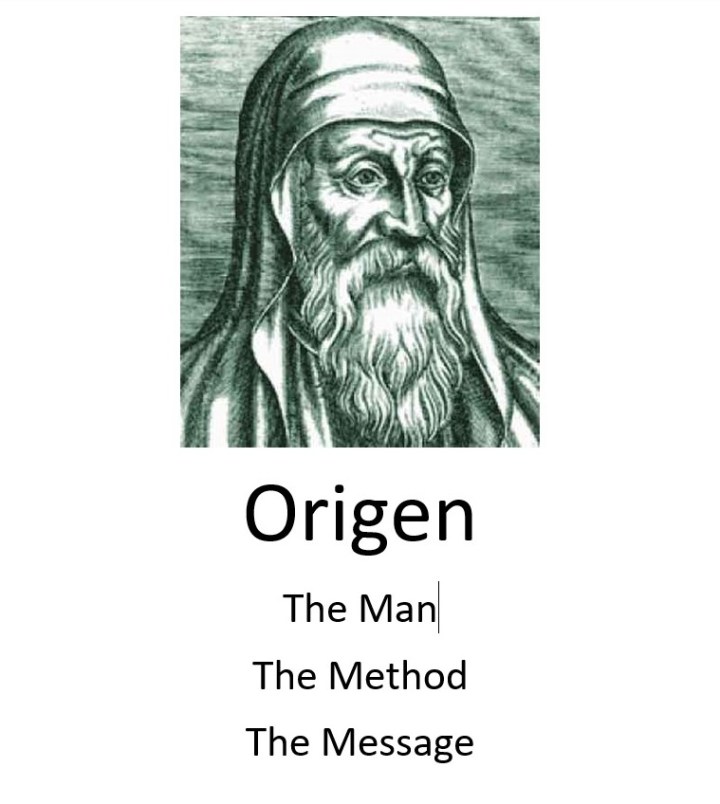
Origen: The Man, His Method, and His Message
You know me, know of me, and some probably wish that they knew less of me. My degree is in education, primarily what is called “special education.” The official title connected to my job is Developmental Specialist and I work with parents who have children with documented delays, medical and/or genetic issues. Truth be known, I get to play with babies and toddlers, for play is a child’s work.
When I decide on a topic to research for our conference my selfishness supersedes all other reasons. For two years this man Origen has been a hangnail irritating my mind so in January I purchased 4 books, and last month I borrowed two books from Ohio’s public library system written by him or about him. What I bring to you today is a sharing of the highlights of my gleanings.
Unlike Jerome, a Church Father I loathe, Origin is difficult to dislike. His message of freedom was to give hope where hope was buried beneath chaos, a mystical man who presents himself in love with the LOGOS, the WORD, Jesus. “Apart from Jesus, nothing to him is worthy of being loved.” He announced to his world that there is no true Christian life in separation from the man who was the Christ and from Mary his mother. He uses endearing terms such as “my Jesus” “my Lord,” “my Savior.” His piety was expressed in his concern for orthodoxy. In one of his homilies he says: I quote: “ As for myself, my wish is to be truly a man of the Church, to be called by the name of Christ and not that of any heresiarch( a founder of heresy), to have this name which is blessed all over the earth: I desire to be, and to be called, a Christian, in my works and in my thoughts.” (Introduction: On First Principles)
To understand in part, the man, Origen, briefly addressing his background, family, education, and community will open opportunities for you to have those “Ah, Ha!” and “So, that’s’ why.” moments. Another way to look at Origen is as if we are peeling off the layers of an onion, some dry layers, some thin and translucent ones, until you get to the parts of the onion that are flavorful and the best for use. Hopefully, you won’t say that Susan’s onion did nothing more than make you cry.
((Powerpoint #1, onion)
Alexandria, “next to” rather than “in” Egypt, a spiritual center of an aggressive Hellenism, a city that was an intellectual and commercial center of the ancient world. Alexander the Great founded it in 331 B.C. and it has been thoroughly Greek since. Alexandria, an Eastern Mediterranean empire with Egypt as its chief province.
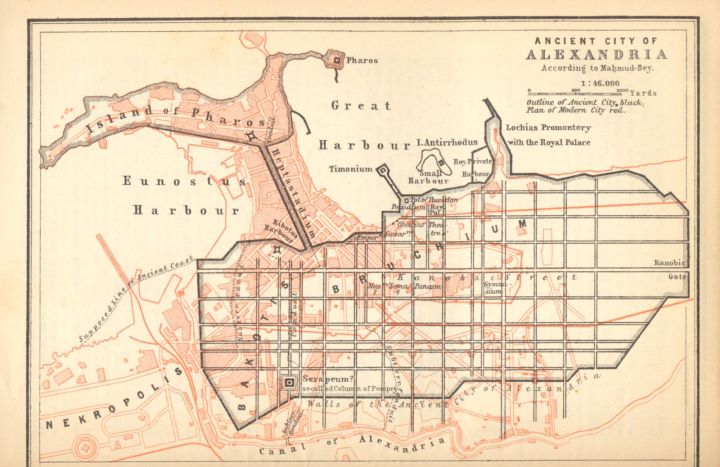
( Powerpoint #2 map of city)
Modern day Urban city planners take note: Alexandria was a model planned city. A grid of broad streets was laid down on the city’s flat and rectangular site. Two chief avenues intersected at the center of the city where stood Soma, “the Body” a mausoleum containing the remains of Alexander the Great.
( Powerpoint #3 city with harbors)
Engineers assured Alexandria’s continuing commercial prosperity by making it the chief port of Egypt with two sheltered harbors, and on the island of Pharos, a 400-hundred-foot lighthouse that became known as one of the Seven Wonders of the World.
(Powerpoint #4 lighthouse)
The Ptolemaic rulers of Alexandria took a small fishing village on the Nile delta and developed it into a great intellectual and cultural center, the greatest city in the ancient world.
Historian Strabo ( 63 BCE-21CE) wrote about the city of Alexandria:
The city has magnificent public precincts and royal palaces which cover a fourth or even a third of the entire area. For just as each of the kings would, from a love of splendor, add some ornament to the public monuments, so he would provide himself at his own expense with a residence in addition to those already standing.
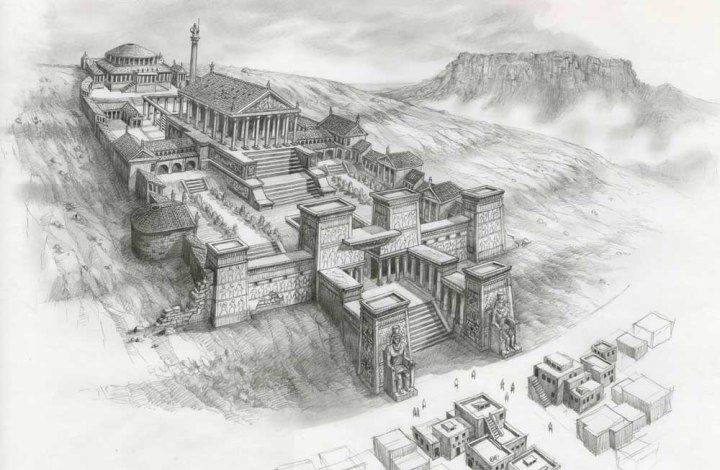
(Powerpoint #5 Library)
The rulers patronized learning to gain prestige. Ptolemy I founded the Museum, an institute for advanced research, and the heart of the Museum was the great library. This library is considered to be the most famous product of Alexandria. Its aim was to collect all the knowledge of the world and house it in a single place. Ptolomy II instituted a practice that required every ship docking at the port to hand over any books on board to be copied out for the collection. The city attracted artists, philosophers, scientists, and mathematicians (like Euclid). Unfortunately, this gold mine of science, history, mathematics, and literature was destroyed. As the city lost control to new governing bodies the Library became a threat to their control. The use waned, and several fires destroyed scrolls and documents. ( Ancient Alexandria, Egypt, by Jocelyn Hitchcock)
The Library, a collect of knowledge from all over the world, became a threat to government control of the people. This was my first “Ah Ha” moment. Knowledge can be a threat to government, and we here all know that knowledge is a threat to the institutional church.
The historian and scholar Mangasarian wrote:
“Under the Ptolemies, a line of Greek kings, Alexandria soon sprang into eminence, and, accumulating culture and wealth, became the most powerful metropolis of the Orient. Serving as the port of Europe, it attracted the lucrative trade of India and Arabia. Its markets were enriched with the gorgeous silks and fabrics from the bazaars of the Orient. Wealth brought leisure, and it, in turn, the arts. It became, in time, the home of a wonderful library and schools of philosophy, representing all the phases and the most delicate shades of thought. At one time it was the general belief that “the mantle of Athens had fallen upon the shoulders of Alexandria.”
( Ancient History Encyclopedia, Alexandria, Egypt by Joshua J. Mark)
This was the city of Origen.
(Powerpoint #6 School supplies)
Shawnee’s first day of school was Monday. He left with a backpack full of notebooks, 1 package of loose leaf wide ruled paper, headphones, and three ring binders. This does not count the school supplies we took to the Open House: 1 can of wipes, 2 boxes of tissues, 3 pink erasers, 4 boxes of crayons, 60 #2 pencils, 10 glue sticks, a pack of washable markers, and a partridge in a pear tree; not at all resembling the ancient school system of the Greeks.
For all of us grandparents who jumped rope at recess, this jump rope rhyme can sum up elementary education in Origen’s day.
Oh, no, here comes teacher with a big black stick, not it’s time for arithmetic. One plus one is? Two plus two is? Four plus four is? Now it’s time for spelling. Spell cat. Spell dog. Spell hot. When the jumper spell HOT, the rope is swung as fast as possible until the jumper misses.
The civilization Origen grew up in cared much about education but cared very little about children. The Greeks despised elementary education, which normally began with a child was 7 years old. Why? Because it only taught the rudiments: reading, writing, counting, and doing sums. They did not learn to read and write words until they had memorized every conceivable symbol. They got to sentence only after they had acquired an inventory of two-three syllable words. Doing sums was more difficult because the Greek number system did not contain the numeral zero. (Here comes teacher with a big black stick…) What supplied the motivation to learn? Corporal punishment. Hellenistic elementary education was mechanical and did not place in its curriculum the molding of attitudes and values such as our educational system tries to do. No DARE programs, in school Scouting, or counseling. When children were ready (when they mastered the content) were passed on, and if their parents could afford it, went to grammar and general education. Grammar was the more important of the two and meant the study of Homer, Hesiod, Euripides, and Menader. General education was the study of arithmetic, musical theory, astronomy, and geometry.
A typical grammar lesson in Alexandria would look like this: When studying a book, or a poem, 4 stages of appreciation were emphasized: criticism of the text, reading, exposition, and judgment. Criticism: the class review the manuscript letter by letter to see if they were identical. Reading the text out loud, which was laborious because the Greek system did not have capital letters, or commas, periods, sentence or paragraph breaks. Third stage: exegesis, the final stage of drawing moral lessons from their reading.
The general education curriculum prepared the student for philosophy. Arithmetic taught number theory and a moral value to numbers, numerological theories figured into allegorical interpretations, (i.e. seven is mystically perfect number) ( Origen uses these numerological theories in his interpretations of some portions of Scripture) astronomy expressed an ideal rationality, geometry taught transcendent reality.
This was the public schooling of Origen.
This city , with its culture, and education system was the nursery that fostered, developed, and promoted Origen, (Powerpoint #6 Origen) the person who would do more than anyone else to relate Greek philosophy to the Bible.
The approximate date of Origen’s birth is 185/6 C.E. His family was devoutly Christian, if reading the biographical account of Eusebius ( U-C-B-us)of Caesarea, but according to the Neoplatonist philosopher Porphyry, ( por-free) he was born of pagan parents. Eusebius’ account is said to be the more accurate. His family was likely highly educated, for his father made sure that Origen was schooled not only in biblical studies, but in Hellenistic education as well.
Piecing together information from the culture, historical documents, and biographical fragments left by other Church writers, we can get a sense of Origen’s family life. Origen’s father was prosperous and a thoroughly Hellenized bourgeois, who had the ability both financially, and socially to give Origen a Greek literary education. His father, perhaps named Leonides, was a Greek convert, an ardent Christian, who personally taught his son the Christian Bible at home. The Old Testament was the Septuagint, and what was considered the essential books of the New Testament; the Four Gospels, the Acts of the Apostles, and Paul’s epistles ( II Peter and Jude were not considered canonical by the church.)
In all likelihood, memorization of Scripture was encouraged, and as an adult, Origen was known to be able to recite long passages of Scripture and could associate verses throughout the Bible on the basis of key words as though he had a built-in Strong’s Concordance. ( Origen: The Bible and Philosophy) It was said, “ he was not satisfied with reading the sacred words in a simple and literal manner, but sought something further, and busied himself even at that age, with deeper speculations, troubling his father by his questions as to what could be the inner meaning of the inspired Scripture. (Eusebius Ecclesiastical History, Lawlor and Oulton) Some historians suggest that Leonides, Origen’s father, marveled at his son’s preternatural (extraordinary and exceptional) intelligence and at night would uncover Origen’s breast and kiss it, venerating it as the shrine of a divine spirit. (Lawlor and Oulton)
This was Origen’s home school education.
It is assumed that Leonides led family worship which was the custom of Christians at this time. They prayed three times a day, reciting the Lord’s Prayer, some psalms, and adding their own petitions. When praying they stood with arms outstretched facing east in the direction they expected their risen Lord to appear on the last day. On Wednesdays and Fridays, they fasted.
This was Origen’s home fellowship.
On Sundays and fast days, attendance at the institution church was expected. The Order of Service resembled this: Prayers and hymns, exposition of Scripture by a qualified teacher who read from both Old and New Testaments, immediately following the reading, the qualified teacher expounded on the meaning of the passage in a sermon. On Sundays, the eucharist was celebrated. Unbaptized persons, including most children had to leave the service.
Ah, Ha! Sounds like the order of service that will be printed in a church bulletin and passed out this coming Sunday. The Order of Service has not changed much since Origen was a child. By the way, if there are changes, church division and dismissal of pastors could be on the horizon.
As soon as he was old enough to learn, Origen’s parents probably enrolled him as a “person under instruction” (catechumen). The church insisted that anyone about to be baptized should have a firm grasp of its doctrines and of the obligations of a Christian life. This instructional period could take several years. When thoroughly instructed and able to give an account of the faith, the person under instruction could be baptized and become a full member of the church.
(pps. 25-56 Origen: Trigg)
Baptism as practiced today in most Christian churches is anemic compared to the rite of baptism Origen underwent. Justin Martyr referred to baptism as “enlightenment”, “likening it to the initiatory rites of the pagan mysteries, rites that produced a sudden mystical insight leading to a sense of redemption and rebirth.” Not at all like the study in the book of Acts done by Andy, where he went to great lengths to explain baptism as it took place in the early church.
Easter, the one festival Origen’s church certainly celebrated, was the usual time for baptism. The timing emphasized the baptized person’s identification with the dead and resurrected Christ. Catechumens about to be baptized prepared themselves for baptism by fasting for some days or weeks before Easter, and the rest of the congregation joined them in solidarity. For those who aren’t aware: This is the origin of Lent. On Easter morning they went to a stream of “living” water (flowing). The catechumens were exorcized, they renounced Satan, and they affirmed their faith publicly. Men and women were baptized separately by Deacons. They were baptized in the nude, in the name of the Father, the Son, and the Holy Spirit. Baptismal nudity reinforced the symbolism of new birth. ( By the way, this was not awkward for early Christians because they were used to public baths.) On emerging from the water, they were given a spotless new white garment to wear to remind them of their newly acquired purity and their need to keep it unsullied by sin. If they could keep their “garment” unsullied by sin they could expect to be among the saints clad in white at the resurrection of the dead. Immediately following the baptismal service, the eucharist was given. The neophytes received milk and honey, the food of paradise, along with the bread and wine. The Bishop then conferred on them the gift of the Holy Spirit by anointing and laying on of hands. They were then full members of the church.
Having been baptized, now Origen could participate in the other Christian mystery, the Eucharist. This was celebrated each Sunday. This was an exclusionary event for only baptized Christians of good standing could participate. The Eucharist fostered a strong sense of sharing in a common life. Christians did not want to partake of the bread and wine along with persons who did not meet their doctrinal or moral standards. Denying communion was a powerful instrument for maintaining church discipline. Being denied the fellowship of other Christians was terribly intimidating to anyone who had adopted the church’s beliefs and standards.
This was the Christian Education of Origen.
The root of the process of church discipline, the tyranny, and the intimidation goes back to the early church, not the early church we study in the book of Acts, but the early catholic church. (Origen was born in 185, and you can see how powerful the institutional church had become in under 200 years.) The doctrine, ethical standards, ideals, worship, and organization of the church did not change greatly during Origen’s lifetime. The changes that did occur included a more fixed doctrine, less rigorous ethical standards, less spontaneous worship, and more rigidity in the organized church. These were internal and external controls on the behavior and views of the individual believer. These controls shaped the perceptions and values of the individual believer.
Follow this progression: the organization of the church kept believers in line, provided them stability, and made them part of a universal movement. It demanded a high degree of loyalty. Origen’s life demonstrated that he actively partook in the ambivalence of the early church, remaining devoted, even fanatical.
This was the Christian Education of Origen.
His father was martyred in the persecution of 202 when Origen was seventeen. Origen wrote to his father in prison and encouraged his father to not falter or waver out of concern for his family and to embrace martyrdom. His mother prevented him from following his father in martyrdom by hiding his clothes so he could not leave their home. Even if this account is based on legend, it points to zeal of a young man for the Christian religion. In a later writing, perhaps to Ambrose, entitled An Exhortation to Martyrdom, Origen wrote, “If we wish to save our soul in order to get it back better than a soul, let us lose it by our martyrdom. For if we lose it for Christ’s sake, casting it at His feet in a death for Him, we shall gain possession of true salvation for it.”
After his father’s death, all wealth and possessions were taken from his family by the government. A wealthy Christian Alexandrian woman, who considered herself capable of judging the contents of faith, took him into her household and enabled him to continue his studies until he could support himself and his family as a teacher of grammar.
The second wave of persecution the Alexandrian church found itself without catechism instructors. Because he was a zealous Christian, a professional teacher, son of a martyr, persons wishing to be baptized sought out Origen to provide them instruction. His employment as a grammarian provided him cover. He had to meet prospective Christians at different houses in order to avoid detection. Although he was not arrested, a pagan mob almost lynched him, and some of his students died as martyrs. When the persecution ended, Origen by default, was the principal Christian teacher in Alexandria. He left his job as a grammarian, sold his Greek literary works for a meager stipend that enabled him to subsist as he devoted himself to the Bible. He was only 18 when he became the Headmaster of the Christian Catechetical School at Alexandria. Undeniably he was a brilliant scholar.
His educational resume ( unlike Lori Laughlin’s children) included studying under Ammonius Saccas ( the teacher of Plotinus). At age of 17 he began writing his theological commentary On First Principles. His thoughts were informed by his Greek philosophical education, the notable Jewish Platonist Philo of Alexandria, and the Neopythagorean philosopher, Numenius of Apamea.
Origen adopted an austere lifestyle embracing a spirit of asceticism. He went without shoes, possessed only one cloak, fasted regularly, took what little sleep he allowed himself by lying on the floor, never on a couch. (Hist. eccl. VI.iii9) At some point during his teaching career a literal reading of Matthew 19:12 led him to castrate himself. “both to fulfill the Savior’s saying, and also that he might prevent all suspicion of shameful slander on the part of unbelievers ( for young as he was, he used his discourse on divine things with women as well as men)” (Hist. eccl. VI.viii.2).
A look at his educational transcripts (sorry, no fake pictures of his Alexandrian rowing teammates) it could look like this:
Home Schooled by his father in the Scriptures
Christian School – (curriculum- church doctrine, polices, procedures and Christian obligations)) Greek/ Hellenistic philosophical education
Mastered the Hellenistic curriculum of Astronomy, Mathematics, Greek literature
Received instruction in Christian morality from the Church
Until the end of his life he remained devoted to the Church and described as a fanatical Christian.
Origen: His Method and Message
Method:
The value of philosophy, according to Clement (who greatly influenced Origen) is a preparation for the deeper Christian mysteries. Philosophy and rhetorical training were the two principal ways to complete an education in Origen’s time. Christians adopted vague philosophical terms such as “The One” or “the idea of the Good” as legitimate ways of speaking of divine reality. In Origen’s time, philosophy was a way of salvation as well as a way of life. He saw Plato and the Bible in profound agreement and molded his understanding of the Christian life.
So, the question arises, was he a philosopher, or was he a churchman? Research authors answer that question this way: Origen was a Christian Platonist. His firm grasp of the philosophical issues of the day show in his writings, for example, in Book IV of First Principles. His commitment to the Christian religion is evident in his essay Exhortation to Martyrdom.
His methods of Biblical study/interpretation reveal that his Alexandrian Hellenism informed his outlook and categories of thought.
Origen, the greatest of all the early Church writers,” the “man of steel” (Powerpoint # 7) in the Church of his day. The methods of modern exegesis were not available to him, and his conception of what he was doing as he interpreted the Bible was quite different from what the modern exegete or biblical theologian thinks he/she is doing.
(Powerpoint #8 triple schema)
He uses what is called a triple schema in two different variations. A) a historical or literal meaning: facts recorded, or the texts of the Law, 2) a moral meaning, which is the application to the soul; and finally 3) a mystical meaning relating to Christ, the church, and all realities of faith. The second variation is a) literal meaning relating to the things of Israel, 2) a mystical meaning relating to the mystery still to be fulfilled ( i.e. Christ and the Church) and 3) a spiritual meaning relating to the soul, the soul as the “spouse of the WORD” in its progress toward full union with God. Allegory and typology were the techniques used within these schemas.
Two examples of his allegorical interpretation of Scripture: the Passover Lamb is a symbol of “holy dogma of the Church of which not one shall be broken.” The second example is the expulsion of Adam and Eve from the garden. This expulsion is the expulsion of human souls from the supersensible ideal world to the material world and the coats of skin God mercifully proved them as our gross, material bodies.
It could be said that Origen used the Bible as a frame on which to hang the various elements of his theology. His Platonizing cast of thought, a sign that he was a Christian thinker in the third century, supplied him with a system to help Christians in the theological reflection. Origen is a Christian Platonist not because he turned Christianity into Platonism, but because he found the Platonic ideas of his day capable of expressing his truth of the Gospel. He made use of Platonism, Stoicism, and popular philosophy as a method for conveying to his contemporaries the intensity and extent of biblical Revelation.
Prayer, exegesis, allegorical interpretation of Scripture, attention to the ecclesiastical canon, the rule of faith, exact philology ( word origins or translations) and search for the spiritual sense are the tools Origen used to create his theological system or “story”.
His theological story can be described like this: “ the rational mind is the protagonist of the drama and the story explains the pilgrimage of the soul from creation to salvation. The setting of this story is within a cosmology that supplies the context for understanding the Christian life.”
(Powerpoint #9 Origen’s system)
Origen’s system, if you want to describe his methods as a system, have three cross-sections: first stratum is his heterodox opinions heavily influenced by Platonist philosophy, myths, and traditions. The second stratum can be described as Origen’s attitude. His attitude is described as directional: the upward-climbing Christian is the lowest stage, and thus faith is the starting point of insight, (perfect faith), the third stratum is the rule of faith.
Origen is not content to invoke “the rule of Scripture” or the “apostolic rule” he constantly appeals to the “rule of the Church.” “the faith of the church” “the preaching of the Church” “the doctrine of the Church”.
His Message: ( free will, falling away, freedom to return to God)
Powerpoint # 10 “In the Beginning”
God’s original creation was the spiritual world of rational creatures. These beings have the gift of reason as their principal attribute and are naturally immortal. The creation of the material world came later. What is his proof text: Genesis 1:1 “In the beginning God created the heavens and the earth.” This verse applies to the spiritual world, and the rest of the chapter in Genesis refers to the material world. (Philo) God created a limited number of rational creatures. He did not create them good, as God only is good, but possession of a free will to choose the good, and the moral responsibility to do so.
Why not an infinite number of rational creatures? An infinite number would be incomprehensible to God, and therefore the All-knowing God to fail to comprehend anything would be a self-contradiction in the nature of God. Origin learned of this from his teacher Numenius: if matter is infinite, it is unbounded, if unbounded, irrational, if irrational, unknowable, if unknowable, without order.” (Numenius: On the Good)
So, my question is: Is math incomprehensible to God? I was taught that numbers are infinite, there is no true first or last number, and there is even a mathematical symbol for infinity. Hmmmm. So if it’s possible that God has difficulty with Math, then because I am made in His image, that explains why I do too?
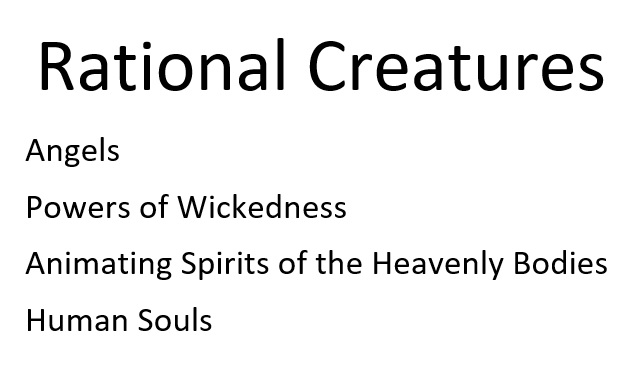
(Powerpoint #11 four Major types of rational creatures)
According to Origen, there are four MAJOR types of rational creatures: angels, the powers of wickedness, animating spirits of the heavenly bodies, and human souls. The human of soul of Christ is a rational creature but is a uniquely different case. Origin takes the verse from Paul: thrones, dominions, principalities, and powers to build his case that within these 4 major categories are ranks, each with it proper dignity, and authority. Angels, animated heavenly bodies, and devils were predominate in theological thought in Origin’s time, and Christians, Gnostics, Platonists, and Jews all affirmed their existence and importance.
However, God is not responsible for the graduation of angelic authority, the varying brightness of the stars and the multiplicity of intellectual and physical endowments that characterize the human race. Each rational creature merits its position in the physical and spiritual worlds on the basis of its free and responsible conduct. Drum roll, please…..
Hence, the fall of rational creatures from an original unity with God.
Origin taught then, that because of this fall from the original unity with God, the creation of the material world was necessary.
Those who fell the least far are the angels. Those who fell the farthest are the powers of wickedness. Humans are the “tweens” the in-betweens.
(Powerpoint #11 the ranks of rational creatures)
Angels are the highest of the rational creatures, they direct nations and churches and are guardians of individuals. The higher the rank, the greater importance an angel’s function. Origen claimed that angels of higher rank are assigned to persons of higher intellectual stature, and consequently greater responsibility than are assigned to the common run of folk. And, you had better watch out, persons who fail to behave worthily of their high calling could be divorced by their heavenly guardians and assigned to an angel of lower rank. Angels sharpen our intelligence, enabling us to better perceive the nature and consequence of our actions.
The rational creatures that sinned most grievously and are, the farthest from God are the powers of wickedness. What about us, the humans? Our embodiment in these grossly material bodies is a punishment for sin, BUT they are also the means whereby we can be disciplined and trained for our return to God. So, the material body is a punishment and a remedy for their fall from God. According to Origen, souls were once minds, but they lost their pure intellectual character in the process of their fall away from God. All rational natures directed their attention away from God (except for the soul of Jesus). Why? Neglect, forgetfulness, boredom, and satiety are the words Origen associates with the fall. The Beginning is unstable, but the END is stable. It’s a process of “cooling” from the ardor of the mind’s natural contemplation of God. Origen derived the Greek word psyche meaning soul from a Greek verb psycho meaning to cool. ( Which by the way he may have borrowed from our Gnostic friend Valentinus) The extent of the soul’s fall from God determines the diversity of human capacities and situations. “Jacob have I loved but Esau I hated.” When you read this from the Old Testament account of Jacob and Esau, what say you as to what the meaning of these words? This was Origen’s proof text that souls preexist the bodies they animate. “How could God, whom we know to be just and good, prefer Jacob to Esau even before either was born except on the basis of the relative merits of their preexistent souls?” (Origen: On First Principles)
Continuing in his ascent/descent doctrine, the fall he proposed away from the mind’s natural contemplation of God did not take away from the rational creatures their ability to choose the good, so that it is always possible for them to turn again toward the contemplation of God and re-ascend to their former estate. It is better to look at the ranks of rational creatures not as true ranks, but stages in their progress toward or away from God. Taking Paul’s verses written to the Philippians( Phil. 2:10-11) “that at the name of Jesus every knee should bow, in heaven and on earth, and every tongue confess that Jesus Christ in Lord, to the glory of God the Father” meant that in the end, all rational creatures will be saved and restored to their original state of contemplative union with God. “for the end is always like the beginning.” ( Origen: On First Principles, translated by Butterworth. P. 53)
This is what Origen refers to as Apokatastasis.
A time will come when all evil shall cease to be and since it has no existence of its own apart from the free will in which it inheres, when every free will shall be turned to God, shall be in God, then evil will have no place to exist. If given enough time, the powers of darkness, and perhaps, even Satan can be restored to the contemplative mind of God. In their free will they must choose good and keep choosing good. Origen proposed that it would take a very long time for Lucifer to be restored because he chooses evil more than he chooses good. This is a process of descending and ascending throughout the two journeys.
Now, John, the mystery of who developed the doctrine of the fall of man is solved. Origen, pious, devout, scholar, the man of steel of theology developed this doctrine, and over time it became one of the foundations of the rule of faith, the ecclesiastical order of the Church, adopted by Augustine, Luther, and Calvin. Remember, It is not “as in Adam we all fall.”
The soul, once fallen is on a pilgrimage, and its destiny is to return to God. It is the soul’s freedom of choice that enabled it to fall in the first place, and it is the same capacity that allows it to choose God again and to move toward Him . This is Origen’s doctrine of descension and ascension. Salvation consists of returning to the original perfection and then to that perfection “by which it remains therein.”
The body is a sign of the fallen state of the soul; the greater the fall, the grosser the body. The body is a punishment that the soul brought upon itself.
The drama of the soul’s struggle to return to God is Origen’s primary interest. His views of martyrdom, prayer, and Scripture merge into one vision: the Christian life is a movement toward perfect knowledge of God and the perfect fellowship with Him through Christ. In his writings he uses three metaphors to articulate his pilgrimage: a) it’s a journey, its growth to maturity, and it’s a warfare against sin and evil.
The journey consists of stages: ( the 42 stages in the book of Numbers and his allegorical interpretation of Israel’s stay in the wilderness) The 42 stages correspond to the 42 generations through which the word of God descended in order to be born of the Virgin. The Savior descended so he can accompany and assist the soul in its journey of ascent to the true promised land. He is the door at every stage. The journey is really two, one in this life by which we progress from virtue to virtue, and one after our death by which we ascend to heaven.
Any Ah Ha! Moments here? Is not this progressive justification?
In a nutshell, I have tried to present three of Origin’s theological doctrines. I feel these three are also the foundational premises of Protestant orthodoxy: free will, the fall, and freedom to return to God (the soul’s descending and ascending back to God or progressive justification). Although laborious, and mind-bending to plow through his writings, or the translations of his works, it was beneficial to me in order to answer “Where did we get that?” I throw down the gauntlet. ((Powerpoint #12 of gloves) Before accepting the traditions of men, the church doctrines, study to find the authenticity and source of what you hold to be true. Is it Scriptural, or is it the private interpretations of men?










TANC 2019 Paul Dohse Session 4
As established in the prior sessions, it is obvious that present-day Christians could have no clue how to live biblically because the church hijacked Christianity in the 4th century and eliminated sanctification altogether. But I do think, if nothing else due to the law written on the heart of every person created by God as discussed in a prior session, that we know some basics that we can build on.
I want to start with under-law thinking. Under-law thinking is the waters we swim in; the “we” is the unregenerate, the religious, and the truly saved. It is a state of being that cannot be overcome except for the new birth. However, even those who now understand justification by new birth will have a long and hard journey climbing out of those waters and learning how to breath on dry land.
Simply stated, under law thinking seeks happiness through not breaking rules/laws, and depends on others not to break rules and laws. Rather than to make the focus on accomplishing love as a way to displace hate, the focus is the negative focus of not hating, and defining the not doing of something as an accomplishment. Hence, the recipe for becoming a good person is to stop doing things that break some rule or standard. Accomplishment is defined as something you don’t do.
This is why people rarely remember what you do right; the focus is what you didn’t do, that is, you didn’t succeed in not breaking a law. Relationally, if you love someone, it means you don’t break their laws. “If you love me, keep my commandments” now refers to everyone in your life, especially your spouse. Most, if not all, marriage counseling is based on the successful law-keeping based on each spouse’s jurisprudence. This is why marriage counseling is almost always an abject failure. The book of James states that people quarrel because of the desires that war within them. What are those desires? The desire that others obey your laws.
Furthermore, this under-law thinking is in-league with sin’s use of the law to control others through condemnation. This reality is seen clearly in nursing facilities among the aides. The aides presently residing at any given facility want the halls to run according to the way they roll. Trust me, when a new aide comes in, they can’t do anything right no matter how good they are. Why? The ruling aides want to control the new aides through condemnation and bring them into subjection in regard to how they run the halls. At home, the punishment for a husband breaking the wife’s laws is nagging, right? This under-law thinking also includes the death penalty in many cases; ie., the silent treatment. You don’t exist. I cut you out of my life, that’s why I don’t hear you talking right now. Of course, husbands also have their own punishments for breaking their personal laws. Drinking, the condoning of adultery, and various and other sentencing at their own private court hearings.
Moreover, in all cases, thanks to church, when the inevitable battles take place when everyone’s laws have been broken, the long drawn out drama of “reconciliation” must take place. Yes indeed, instead of moving on with a focus on love, the criminal offense must be revisited in some reconciliation ritual adding to the condemnation and actually thereby empowering sin. “You will never change.” Well, certainly not, every time said law has been broken and the sin has been committed, a remembrance must take place to deepen the condemnation which empowers the same sin. When you have a pet peeve (law) that your spouse continually violates, cancel the law and give the spouse permission to do it with vengeance and watch the offence go away. When you consider the dynamics of all of this, it is no wonder that reality is divisions upon division and divisions within division. Love seeks to unify, love seeks oneness,
Nothing throws gasoline on the fire of hate like the church’s promotion of a “lifestyle of repentance.” This is a focus on sin for purposes of elevating the act of Christ to end sin. This is an unmitigated metaphysical disaster. According to church orthodoxy, the propensity of man is to think of himself more highly than he ought, and this must be resisted by “owning your own sin” etc. Nothing is further from the truth. Man’s propensity is to condemn self and others. Suicide, in most cases, is the ultimate self-condemnation. People constantly struggle to raise their own self-esteem by condemning others and watch the news to compare themselves with the dregs of society which makes them look better to themselves. And, in their endeavor to control others, they will condemn with what they are guilty of because it is a readily available sin catalogue. If someone falsely accuses you of something, more than likely, they got the idea from what they do in their own life.
What’s the biblical way? Individually, we accomplish and evaluate ourselves according to a truthful assessment. High self-esteem is earned. But, remember, the world at large is out to keep your self-esteem low. Remember, sin seeks to control others through condemnation. Relationally, in regard to other people, we focus on what they bring to the table. A truthful evaluation of a person, hopefully, devalues their faults, that is, faults that are legitimate faults that break legitimate laws or laws that are self-evident to humanity. Your personal preferences are not legitimate laws. As Peter stated, patience is an act of love that covers a multitude of sins, and according to Paul, patience is empowered by focusing on what the person brings to the table, not their faults and especially faults judged faults by bogus laws.
This is a good sanctification principle: associate and fellowship with people endeavoring to build a self-esteem based on truth. Fellowship with those who seek to accomplish things. Associate with people who build.
The Problem with Life
Growing up, nothing intrigued me more than WWII movies. Here these people were, in the middle of fighting for the very survival of humanity, and in the process, were swinging to the music of the big bands, romancing, and dressing up in style, seemingly oblivious that the world was on the precipice of doom, and it was. But those WWII movies reflect reality: life is war. A war for your freedom and happiness is ongoing on the outside, and a war is ongoing inside mentally and physiologically. War defines the present reality. Sanctification is war. Life is war. In regard to some of us, our lives are good and we are thankful. But that will not last if we aren’t on a war footing. Something is always out to destroy us on many different fronts. If you consider the least common denominator, it is death and life. Even if your life is presently good, this does not mean death has declared a ceasefire. This reality transcends all of life from private personal thoughts to statecraft on a worldwide level and everything in-between.
These thoughts occurred to me while studying physiology for school. Good health requires the body to have a good internal balance. This is called “homeostasis.” But often unknown to us, this homeostasis boils down to one thing and one thing only: the war within that is constantly raging is being won by the good guys. And the good guys are not very virtuous looking; they are merciless creatures who take no prisoners.
Homeostasis is the work of the central nervous system and the endocrine system working together. One is electricity and the other is chemicals. The liaison between the two is the hypothalamus, but this article is about the immune system that is part of the endocrine system army. Let me introduce the subjects that are involved in this vicious war.
Specific immunity is the body’s reaction to a certain threat [known threats].
Non-specific immunity is the body’s reaction to anything it does not recognize as a normal body substance [shoot first and ask questions later].
Antibodies are normal body substances that recognize abnormal or unwanted substances. They attack and destroy such substances [search and destroy].
Antigens are abnormal or unwanted substances. An antigen causes the body to produce antibodies. The antibodies attack and destroy the antigens.
Phagocytes are white blood cells that digest and destroy microorganisms and other unwanted substances [they eat the enemy. It is unclear as to whether or not they are nourished by eating the organism ].
Lymphocytes are white blood cells that produce antibodies. Lymphocyte production increases as the body responds to an infection.
B lymphocytes (B cells) cause the production of antibodies that circulate in the plasma. The antibodies react to specific antigens.
T lymphocytes (T cells) destroy invading cells. Known as “killer T cells,” they produce poisons near the invading cells [chemical warfare]. They also call on other cells to then do mopping up operations [probably via cannibalism].
Every day that we feel great is due to the good guys winning the violent war within that involves innumerable troops. The death toll in one person, and in one day, far surpasses the casualties of all wars together in human history. When discussing cells, we are not talking about small numbers. A single person has about 100 trillion cells, and about ten times more of micro-organisms.
However, though this war is automatically fought by intelligent cells apart from our knowledge altogether, we can aid the internal army by making good choices. These choices that properly equip our army involves the following: knowing what brings life and death, and knowing that the rules cannot be changed. These choices range from what we eat and drink, to what we think which leads to what we believe. For example, if we believe the wrong things, especially things that can cause fear, the central nervous system starts partaking in a fools errand and wasting other resources.
Stubborn people don’t know who or what their friends and enemies are, they are unwise in regard to what brings life and death, and they don’t understand how the world works; they think they can change the rules. Where would we begin to cite examples from the big picture of statecraft politics to the homeless drug addict?
Much could be discussed here, but the Bible states that internal misguided desires compel people to choose death instead of life while thinking they can change the rules of how the world works. Or, sadly, the misguided desire has gained so much power in their lives that they are willing to choose death to have said desire for one more moment. That’s a bad idea.
And for the rest of us, we fall into the ignorant idea that happiness means that death has agreed to a ceasefire.
So, why this life? Because Christ came to put an end to this war we call life, and we are His compatriots in that endeavor. Christ has also come to make all of the division one. Who we are and how we live points to the day when our brother and king will bring war to an end. Future hope is why we can be happy in the midst of this war.
Whether having a successful marriage, or raising children successfully, it would seem to help to know why we do such things. The marriage question brings an easier answer than the children question. We get married for companionship and standing together in doing life. But tradition aside, few people really know why they have children, and when they do know, the reasoning is disastrous. For example, if you are having children to “complete your marriage,” your marriage is already doomed. The little completers eventually grow up and move out and will probably only call when they need something.
We have children to build families which are critical to doing life. Families are people within a group that work together to maneuver through life. People within a family contribute to that cause and also contribute in some way to humanity overall. The focus of raising a child is to prepare them to be all they can be; to prepare them to be the best them. In order to do this, they must be taught what the world is and how it works. They must be taught what the purpose of life is and what will give them wellbeing.
We can discuss some very basic things here. First, they must be taught that they were created to be free and the world is out to steal their freedom. Secondly, they must be taught that they were created to produce, and personal wellbeing is found in personal accomplishment. God has created many things in the world to enjoy, but the core fundamental is personal accomplishment. That is the tree, everything else is the branches.
Listen, please don’t have children and raise them to think other people’s thoughts, and don’t trust others to raise them. Know this, the state has a vested interest in keeping your child thoughtless and dumb because people without knowledge are easy to control. A cursory observation of public schools reveals their agenda to keep your child dumb. In regard to my and Susan’s situation with our grandson, you may notice my aggressiveness in trying to get projects wrapped up. Why? Because if he ends up staying with us long-term, his education is going to have to be supplemented if he grows up to be anything.
And, beware of low expectations for your children. I know that pressuring your children to excel gets a bad rap, but I would rethink that if I were you. And another thing; feed your children good food. Remember the adage, “You are what you eat”? That is so true. Nutrition is vital. Later in life, I have taken some very wicked falls and gotten up wondering how I didn’t break a bone or worse. Well, when I was a child, I loved milk and drank a ton of it. I attribute it to that. But overall, mental health and everything, nutrition is vital.
Good practical living and commonsense is next to godliness. Rather than what the world does, which includes religion, and is at enmity with God, bring the material reality as close as you can to spiritual reality. And with caution, I must remind you that children as well as adults are promised a blessed life for living wisely; ” For, ‘Whoever would love life and see good days must keep their tongue from evil and their lips from deceitful speech.'”
This begs the question: is this a promise that living a wise life will prevent bad things from happening in our lives? Not necessarily, although I think that’s true to a great extent, but this is something that I have seen over and over again in my own life and the life of others; even when something bad does happen, God always brings something good out of it. We seem to see this in the garden as God’s MO. Adam and Eve were created beings, but after they were deceived, God’s way of redemption makes mankind His very family and His literal offspring.
Now a word on sanctification and the elderly. People are created to have purpose and to accomplish things. That doesn’t end till the day we die. As a nurse aide, I can’t tell you how many times I have seen it: the difference between the elderly that remain productive as much as they can, and those who are coasting in neutral. Add to that family involvement. My attitude towards the elderly, especially in a facility, is something is better than nothing. I really don’t enjoy taking care of catatonic residents. I see those who partake in meanness as a cut above because at least they are doing something. I also struggle with seeing residents who try to do too much as a problem. Yes, they may fall and injure themselves, but nothing really does more damage overall than inactivity.
Meet Anne, not her real name. She came to my hall in a state of severe depression. Anne was in her 90s, perhaps she still is as I have not worked in that facility for some time. She would not get out of bed, or eat, or talk. Anne was taken from her homestead and put into the facility after she took a bad fall. Anne was put under hospice care and the family pretty much expected her to die in the near future. The aides did everything they could to get whatever nourishment into her they could. That usually meant a bowl of pudding or Jell-O by her bed so whenever an aide was in the room for something, they would attempt to get her to take a bit. Then, with much coaxing, a particular nurse got her into her recliner wheelchair. Every day, they parked her at the nurse station. This interaction resulted in Anne coming back alive. Every day, for as long as I worked there, Anne was there at the nurse station being Anne. What we learned about her follows: she lived an extradentary life. She was also far beyond what we would refer to as a “colorful personality.” Indeed, she became a legend within that healthcare network and certainly the life of Hall 300. Anne found her new purpose, and a new happiness. One day, she was visited by family members who come to the facility to inquire as to why she was still alive. When they saw her in her wheelchair at the nurse station telling jokes to the staff who were buckled over with laughter, the looks on their faces were priceless. Another thing that was priceless was the look on the visiting physician’s faces when they found out she was still under hospice care. They would first go to her room and not find her there resulting in the assumption that she had already passed, then they would find out it was her at the nurse station which usually resulted in something like this being said to the charge nurse: “You are kidding, right?”
We are made to produce, we are made to accomplish, we are made to build things, we are made to create things, we are made to contribute to the lives of others, we are made to be free, and we are made to be happy. This is what it means to be created in the image of God. And we are also made to wage war and make peace whenever we can.
But indeed, reality for us is a WWII movie. Hope enables us to live life to the fullest in the midst of the war. And besides, unlike WWII the outcome of our war is certain. Life as we know it will have the happy ending preordained by God, though the battles in-between depend on us.

 Paul's Passing Thoughts
leave a comment