What is Love?
“Love (agape) suffereth long, and is kind; love (agape) envieth not; love (agape) vaunteth not itself, is not puffed up, doth not behave itself unseemly, seeketh not her own, is not easily provoked, thinketh no evil; rejoiceth not in iniquity, but rejoiceth in the truth; beareth all things, believeth all things, hopeth all things, endureth all things. Love (agape) never faileth:”
~ 1 Corinthians 13:4-8
This passage of scripture is one of the most well-know sections of the Bible. It is most often referred to as the great love chapter, and often the chapter is used in the context of marriage. And while it certainly has application to married couples, the apostle Paul had a much larger context in mind when he began his treatise.
The context actually begins in chapter 12 and extends through chapter 14 of 1 Corinthians. Paul was addressing a specific problem in the assemblies in Corinth and the province of Achaia. The issue was with regard to spiritual gifts among believers, and there were those who regarded certain gifts as more important or of higher esteem than others. More specifically, the Corinthians viewed tongues as the most important gift, and so if you didn’t speak in tongues, then you were considered a lower-class of believer. As a result, everyone wanted to speak in tongues. In 1 Corinthians 12:31 he said you earnestly covet the best gifts (or what they thought were the best). But Paul rebuked them by showing them that this was not loving behavior. This is what prompts the apostle to launch into his in-depth dissertation on the definition and characteristics of love. Let’s consider each one of these characteristics in detail.
“Suffereth long”
μακροθυμει (mak-roth-oo-my) – To be long-spirited. Forbearing or patient. Love hangs in there for the long run.
“Is kind”
χρηστευνεται (chray-styoo-neh-tie) – Derived from the word χρηομαι (chray-oh-my), having to do with the hand in a sense where one is furnishing that which is needed. “Lending a hand”. To show oneself useful. Acting useful. Benevolent. Love does what is needed for another’s benefit.
“Envieth not”
ου ζηλοι (oo dzay-loy) – “oo” being the negative particle meaning “no” or “not”. “Dzay-loy” is derived from the word which means “heat”. To be boiling with heat. Zeal in an unfavorable sense. “Hot headed”; petulant. Love does not behave like a petulant child who doesn’t get his way.
“Vaunteth not itself”
ου περπερευεται (per-per-you-eh-tie) – The prefix “peri” has the meaning of going beyond or further. The double use of “per” in this word gives emphasis of going farther beyond what is necessary, which is what a braggart does. Giving oneself more honor than one should; elevating oneself. Love does not boast, brag, or elevate itself.
“Is not puffed up”
ου φυσιουται (foo-see-oo-tie) – From the root word φυω (foo-oh) meaning to swell up or grow. To inflate or puff up. Used figuratively, to become proud. Love is not proud.
“Doth not behave itself unseemly”
ουκ ασχημονει (ah-schay-mo-nie) – A compound word with the negative particle “a” meaning “no” or “without” and a derivative of two closely related words; εχω (ech-oh) which means to possess some ability, and σχημα (schay-ma) which is some figure, form, or pattern. Literally, it means not being able to possess its form. If someone is behaving in a manner that is considered indecent, he is not behaving the way one would expect him to. Love behaves in a way that would be congruent with what one should expect of love.
“Seeketh not her own”
ου ζητει τα εαυτης (“oo dzay-tie ta heh-ow-tays) – Literally, “not seek of herself”. The key word in this expression is ζητει (dzay-tie), and it has the idea of plotting or making a plan. But it is also used as a “Hebraism” (a Jewish idiom or figure of speech) to indicate worship to God. Either meaning has application. Love does not plan for its own self-interest. Love does not worship itself.
“Is not easily provoked”
ου παροξυνεται (par-ox-oo-na-tie) – A compound word from the prefix παρα (para), meaning along or beside, and οξυς (ox-zoos) meaning keen or sharp or swift. Literally, to sharpen beside. To make “on edge”. If someone is “on edge” they are irritated or frustrated. Love does not become frustrated quickly. Think about how this is related to the first quality of “suffering long”.
“Thinketh no evil”
ου λογιζεται το κακον (oo log-idz-eh-tie to ka-kon). The key word in this expression is λογιζεται (log-id-zeh-tie), and it means to take an inventory. Love does not take an inventory of evil. Or as Paul Dohse says, “don’t keep a sin list.”
Rejoiceth not in iniquity
ου χαιρει επι τη αδικια (oo chai-rie epi tay ah-di-kee-ah) – The word αδικια (ah-di-kee-ah) is a compound word from the negative particle “a” meaning “no” or “without”, and the word δικη (dee-kay) meaning right or just. So this expression literally means “not cheerful about unjustness.” Love does not show joy over unrighteousness.
“Rejoiceth in the truth”
συγχαιρει δε τη αληθεια (soon-chai-rie deh tay a-lay-thie-ah) – The word for truth is interesting. It is a compound word from a negative particle “a” meaning “no” or “without”, and the word “lathano” which means “to lie hidden” or “to be ignorant”. Truth in this sense is literally that which is no longer hidden, or something revealed. Truth is the opposite of ignorance. But notice now that the word “rejoice” translated here has the prefix “soon” before it. The prefix “soon” means “together”. In this one statement, we are to understand that two things are joyful; love AND truth. Each are dependent upon the other. Love shares a joyful symbiotic relationship with truth.
Paul sums up his dissertation on love with four concluding statements.
“Beareth all things”
παντα στεγει (pan-ta steh-geh-ee) – Literally, “to roof over”, that is, “to cover with silence”. In other words, to keep quiet about something. Think about how this relates to “suffering long” and “not taking an inventory of evil”. Love does not bring up past wrongs. It is all-enduring.
“Believeth all things”
παντα πιστευει (pan-ta pis-tyoo-eh-ee) – To have faith in someone or something. To have faith in someone means that you assume the best about them. Love does not automatically think the worst about others. It is all-believing.
“Hopeth all things”
παντα ελπιζει (pan-ta el-pid-zie) – To anticipate with joyful expectation. The Greek word for “hope” does not describe a wishful sort of thinking. It is a looking forward to with absolute certainty, like a child anticipates Christmas morning. He knows it’s going to happen. Love anticipates with certainty the best from others. It is all-expecting.
“Endureth all things”
παντα υπομενει (pan-ta hoo-poh-meh-nie) – A compound word from the prefix “hupo”, meaning “under” and the word “meno”, meaning “to stay or remain”. Literally, “to remain under”. The implications here are both one of submission but also one of support. Love remains supporting even when it has been wronged. It is all-supporting
Something you should notice about chapter 13 is that there is a distinct change in the literary style. To this point, Paul’s style has been logical and conversational. But Paul’s Hebrew cultural influence becomes apparent in chapter 13 as he switches to a very poetic style. One of the most defining characteristics of Hebrew poetry is parallelism. This can be seen in Psalms, where the writer expresses a thought and then restates that same though another way in the next line. The thoughts can either be comparative or contrasting. Paul uses a more complex form of parallelism called inverse parallelism, and you can see it here in 1 Corinthians 13:7. The relationship between these four aspects of love looks like this:
If you go back and consider the commentary we just discussed on each expression, you should notice how closely the inner two characteristics are related and how closely the outer two are related. Another way to see this inverse parallelism is like this:
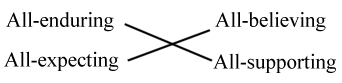
Paul uses parallelism as a poetic way to express his thoughts by restating the same idea in a different way in order to make his point understood. If you look closely at the definitions you will see that the ideas of “bearing” and “enduring” are very much the same thought. Love does not bring up past wrongs (all-bearing/enduring); it remains supporting even when it has been wronged (all-enduring/supporting). It endures those wrongs. Likewise, the ideas of “believing” and “hoping” are also very much the same thought. Love does not automatically think the worst (all-believing), but it anticipates the best with certainty (all-hoping/expecting).
In fact, if you go back and consider the first 8 characteristics of love in verses 4 through 6, they are also arranged in a much larger and even more complex inverse parallelism construct, where one is related to eight, two is related to seven, three is related to six, and four is related to five. Here is a summary of all the characteristics of love just discussed. To help you better see the parallelism just described, I have grouped them accordingly.
Love hangs in there for the long run.
Love does what is needed for another’s benefit.
Love does not behave like a petulant child who doesn’t get his way.
Love does not boast, brag, or elevate itself.
Love is not proud.
Love behaves in a way that would be congruent with what one should expect of love.
Love does not plan for its own self-interest; it does not worship itself
Love does not become frustrated quickly.
Love does not take an inventory of evil.
Love does not show joy over unrighteousness.
Love shares a joyful symbiotic relationship with truth.
Love does not bring up past wrongs. It is all-enduring.
Love does not automatically think the worst about others. It is all-believing.
Love anticipates with certainty the best from others. It is all-expecting.
Love remains supporting even when it has been wronged. It is all-supporting.
Love will never let another down!
Paul’s final statement on love in verse 8 has no parallel line of though with it, but rather it becomes the opening statement to a series of contrasts which we won’t discuss here. Nevertheless, it is still a characteristic of love worth considering.
“Never faileth”
ουδεποτε εκπιπτει (oo-deh-poh-teh ek-pip-tie) – The word for “faileth” is a compound word from the prefix “ek”, meaning “out of” and the word “pipto”, meaning “to fall”, literally or figuratively. In this sense, it does not describe something that comes to an end, but rather something that no longer measures up to a perceived standard of excellence. Love will never let another down.
Think about how these characteristics apply to the use of spiritual gifts among believers. The purpose of gifts is for the mutual edification of the Body of Christ so that each of us may be properly equipped to tell others the good news of the Kingdom. If we are distracted being envious or jealous over each others’ gift or preoccupied over petty disputes or offences toward each other, then we have disqualified ourselves from serving our Father in the mandate He has given us as ambassadors.
Furthermore, think about how love is the antithesis of control. Love does not change behavior by controlling another. It persuades. If we are preoccupied trying to control others, we are not loving them. I am reminded again of the second greatest commandment; love thy neighbor as thyself. Have you ever noticed that it doesn’t say love your neighbor MORE than yourself? No man hates himself. In fact, we are pretty good at loving ourselves. God’s word says to love others JUST AS MUCH AS you love yourself! This means, treat another the same way you want to be treated. That is the definition of love.
Andy
Cooperating with the Spirit

Romans 16:6, 12; 1 Corinthians 3:8-9, 15:58, 16:10; 2 Corinthians 6:1; Galatians 6:4; Ephesians 4:12;
Philippians 2:12; Colossians 1:10, 29; 1 Thessalonians 1:3; 2 Thessalonians 1:11, 2:16-17; 2 Timothy 2:21;
Hebrews 4:11; 10:6; 13:20-21; James 1:25
Maturing in Sanctification
“Prove all things;
– hold fast that which is good.
– Abstain from all appearance of evil.” ~ 1 Thessalonians 5:21-22
The word translated “appearance” is the Greek word ειδος (ei-dos), and it refers to a view or a form. In this sense, “appearance” does not imply, “something that seems to be”, as if one might say, “that appears to be evil”, or, “that seems to be evil”, as if one were making a speculation. Rather it implies something that manifests itself as such.
We are commanded to test (prove) all things. As a result, we should be able to discern good from evil. Having properly discerned, we are further commanded to take action. Hold fast (seize onto, secure tightly) the good things, and hold off from (stay away, avoid) everything that proves to be evil.
God wants his people to exercise discernment. It is a skill that must be learned and perfected (matured). This implies growth. Spiritual growth – part of the sanctification process.
“And that ye may put difference between holy and unholy, and between unclean and clean; And that ye may teach the children of Israel all the statutes which the LORD hath spoken unto them by the hand of Moses.” ~ Leviticus 10:10-11
“And they shall teach my people the difference between the holy (distinct) and profane (common or ordinary), and cause them to discern between the unclean and the clean.” ~ Ezekiel 44:23
Conversely, God strongly rebuked His people and their leaders when they at the very least failed to teach discernment, let alone practiced a laundry list of spiritual abuses against their own people. Consider the entire chapter of Ezekiel 22. Notice the parallels between Israel and its religious leaders and the contemporary religious establishment of Protestantism:
Moreover the word of the LORD came unto me, saying, “Now, thou son of man, wilt thou judge, wilt thou judge the bloody city? yea, thou shalt shew her all her abominations. Then say thou, Thus saith the Lord GOD, The city sheddeth blood in the midst of it, that her time may come, and maketh idols against herself to defile herself. Thou art become guilty in thy blood that thou hast shed; and hast defiled thyself in thine idols which thou hast made; and thou hast caused thy days to draw near, and art come even unto thy years: therefore have I made thee a reproach unto the heathen, and a mocking to all countries. Those that be near, and those that be far from thee, shall mock thee, which art infamous and much vexed. Behold, the princes of Israel, every one were in thee to their power to shed blood. In thee have they set light by father and mother: in the midst of thee have they dealt by oppression with the stranger: in thee have they vexed the fatherless and the widow. Thou hast despised mine holy things, and hast profaned my sabbaths. In thee are men that carry tales to shed blood: and in thee they eat upon the mountains: in the midst of thee they commit lewdness. In thee have they discovered their fathers’ nakedness: in thee have they humbled her that was set apart for pollution. And one hath committed abomination with his neighbour’s wife; and another hath lewdly defiled his daughter in law; and another in thee hahumbled th his sister, his father’s daughter. In thee have they taken gifts to shed blood; thou hast taken usury and increase, and thou hast greedily gained of thy neighbours by extortion, and hast forgotten me, saith the Lord GOD.
“Behold, therefore I have smitten mine hand at thy dishonest gain which thou hast made, and at thy blood which hath been in the midst of thee. Can thine heart endure, or can thine hands be strong, in the days that I shall deal with thee? I the LORD have spoken it, and will do it. And I will scatter thee among the heathen, and disperse thee in the countries, and will consume thy filthiness out of thee. And thou shalt take thine inheritance in thyself in the sight of the heathen, and thou shalt know that I am the LORD.”
And the word of the LORD came unto me, saying, “Son of man, the house of Israel is to me become dross: all they are brass, and tin, and iron, and lead, in the midst of the furnace; they are even the dross of silver. Therefore thus saith the Lord GOD; Because ye are all become dross, behold, therefore I will gather you into the midst of Jerusalem. As they gather silver, and brass, and iron, and lead, and tin, into the midst of the furnace, to blow the fire upon it, to melt it; so will I gather you in mine anger and in my fury, and I will leave you there, and melt you. Yea, I will gather you, and blow upon you in the fire of my wrath, and ye shall be melted in the midst thereof. As silver is melted in the midst of the furnace, so shall ye be melted in the midst thereof; and ye shall know that I the LORD have poured out my fury upon you. “
And the word of the LORD came unto me, saying, “Son of man, say unto her, Thou art the land that is not cleansed, nor rained upon in the day of indignation. There is a conspiracy of her prophets in the midst thereof, like a roaring lion ravening the prey; they have devoured souls; they have taken the treasure and precious things; they have made her many widows in the midst thereof. Her priests have violated my law, and have profaned mine holy things: they have put no difference between the holy and profane, neither have they shewed difference between the unclean and the clean, and have hid their eyes from my sabbaths, and I am profaned among them. Her princes in the midst thereof are like wolves ravening the prey, to shed blood, and to destroy souls, to get dishonest gain. And her prophets have daubed them with untempered morter, seeing vanity, and divining lies unto them, saying, ‘Thus saith the Lord GOD,’ when the LORD hath not spoken. The people of the land have used oppression, and exercised robbery, and have vexed the poor and needy: yea, they have oppressed the stranger wrongfully. And I sought for a man among them, that should make up the hedge, and stand in the gap before me for the land, that I should not destroy it: but I found none.
“Therefore have I poured out mine indignation upon them; I have consumed them with the fire of my wrath: their own way have I recompensed upon their heads, saith the Lord GOD.” ~ Ezekiel 22:1-31
This ought to be a stern warning to those in the institutional church – judgment begins at the house of God! (1 Peter 4:17)
Andy
No Prior Experience Necessary
“For from you sounded out the word of the Lord not only in Macedonia and Achaia, but also in every place your faith to God-ward is spread abroad; so that we need not to speak any thing.” ~ 1 Thessalonians 1:8
The believers from Thessalonica experienced tremendous persecution from the traditional Jewish religious establishment (Acts 17:1-9). Nevertheless, they were equipped by Paul and company to be able to carry the gospel message to the far reaches of their surrounding provinces, so much so that they in effect did Paul’s work of spreading the gospel for him. Evangelism is not something reserved for missionaries or those with “special callings”. Evangelism is an individual mandate!
Andy
Sanctification Transformation
“And be not conformed to this world: but be ye transformed by the renewing of your mind, that ye may prove what is that good, and acceptable, and perfect, will of God.” ~ Romans 12:2
The word “conformed” that Paul uses with the Romans is the Greek word συσχηματιζω (soo-skay-ma-tid-zoh). You should be able to recognize the word “schema” from which we get words like “schematic”. Engineers would be familiar with a “schematic” diagram. It is a pattern to follow. The word here literally means to be patterned-together with.
Now the people of Rome would certainly be familiar with patterns. In the textile industry or clothing industry, one works with patterns for making clothes. And when one thinks of patterns for clothes, uniforms come to mind; uniforms of Roman soldiers, perhaps; something else people in that culture would be very familiar with.
What a perfect illustration Paul uses to make his point! Do not let yourself be patterned together with this world. Do not let the world put you into its uniform. Instead, Paul refers to the “renewing of the mind.” This is an expression referring to the new birth. When someone is born again, his mind has been renewed – he is a new creature! That new mind should cause a transformation in the way that person conducts his life. He should not be just like everyone else in the world. He should be different and distinct.
More than that, he has been set free from the condemnation of the law so that he may show love to God and to others. The rest of Romans 12 talks about that very thing. This is the process of Sanctification!
Andy

 Paul's Passing Thoughts
4 comments