The Assumption of Church Authority
Originally published August 15, 2016
The word “assumption” can have at least two meanings. It can mean to take on or take over for oneself as a responsibility. It can also refer to a starting point of an argument; a premise from which a logical conclusion is drawn. In the case of “church authority”, both definitions are applicable.
Protestants must be aware of the assumption, the beginning premise, held by the “church leadership”, the logical conclusions of which produce the resulting behavior observed by so many who come to this ministry seeking answers. Those in so-called “church leadership” have an assumption (self-appointed) of authority based on a faulty assumption (premise).
As a result there are some questions that must be asked:
- Is it reasonable to assume that elders and pastors, being fallible men (because after all doesn’t “total depravity” apply to them as well?), could ever possibly be in error regarding doctrine and Biblical interpretation?
- If the answer is yes, then what mechanism is there in place, either from Scripture itself or a “church’s” own documented governing principles, to be able to determine if the leadership is in error, thereby making their claim to authority void?
- Maybe the same question only stated another way, if a discerning church member were honestly persuaded by his own personal study and illumination of the Holy Spirit that a pastor or elder was in error and promoting false doctrine, and the elder/pastor refuses to hear him, what recourse does that church member have (aside from leaving the church)? (The assumption here being that the member loves his church so much that he is concerned for the spiritual well-being of the church in general and the pastor, elders, and the rest of the laity in particular).
- If, on the off chance that an elder or pastor ever conceded the fact that the possibility exists that he himself could be in error concerning doctrine or Biblical interpretation, how would he know that? How would an elder or pastor know if he was wrong? (Of course that begs the question, would he ever admit to it?)
 The answers to these questions should be obvious because this is the assumption: the leadership is assumed to never be wrong because they are the authority! The basis for their self-appointed authority is rooted in the simple notion that they know something that you and I don’t know – the knowledge that man cannot know real truth. If you ever make the “mistake” of presuming that you know something, that only reinforces the reality of your own depravity and disqualifies you from taking action for good. It is what testifies to your need for their authority to compel you to good action (“good” as defined by them of course). Their basis for authority IS authority.
This of course is a logical fallacy. Nevertheless, an elder or pastor will ALWAYS defer to some other authority. His answers regarding doctrine and interpretation are never going to be based on sound reason from his own personal study. He will always make an appeal to the authority that instructed him (i.e. seminary, et al).
The only real difference between you or me and the elder/pastor is the amount of money spent on certification training. The man standing behind the pulpit paid good money for nothing more than a piece of paper that tells him that he knows that man cannot know. But the Bible clearly states that all authority rests with Christ. The elder/pastor gets his authority from a framed document hanging on a wall in his office.
Whenever the basis for truth is an appeal to authority, there is no need for persuasion or reasoned debate. Only force and coercion.
~ Andy
“Please, Call Me Rabbi”

“For they bind heavy burdens and grievous to be borne, and lay them on men’s shoulders; but they themselves will not move them with one of their fingers. But all their works they do for to be seen of men: they make broad their phylacteries, and enlarge the borders of their garments, and love the uppermost rooms at feasts, and the chief seats in the synagogues, and greetings in the markets, and to be called of men, Rabbi, Rabbi.” ~ Matthew 23:4-7
Genesis Genealogical Trivia Tidbits
Originally published February 8, 2017
The genealogies recorded in Genesis and in various other places in the Bible are easy to regard as mundane in comparison to other passages of scripture. Reading through verse after verse of “so and so begat such and such” becomes tedious, and it isn’t all that unreasonable that most people simply skip over those verses in their Bible reading. Or when they do read them it is just a formality, and no careful consideration is really given to the words on the page.
I don’t remember what prompted me to do it, but as I was reading through the genealogies in Genesis 5 one day several years ago, it occurred to me that all these numbers and ages might be easier to follow if I organized them into a chart. So I created an Excel spreadsheet, and with the help of a few formulas I was able to easily come up with the following table.
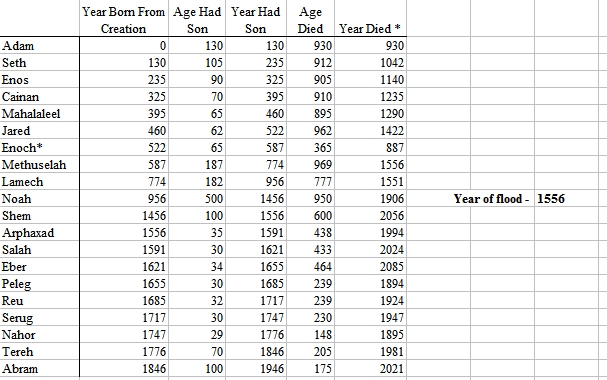
Let me point out that the Bible does not record the specific year in which these men were born and when they died. All it gives is the number of years they lived and how old they were when they “begat” their son for the next generation. But if we use Creation as our starting point, with the use of Excel formulas it is very easy to derive a number of years from Creation when a person was born and when he died.
As I was making this table, I began to see some interesting correlations and relationships that aren’t apparent when you’re just reading words. In order to help these relationships be more evident I created a graph to translate the lives of these men and their relationship to each other into a timeline of sorts.
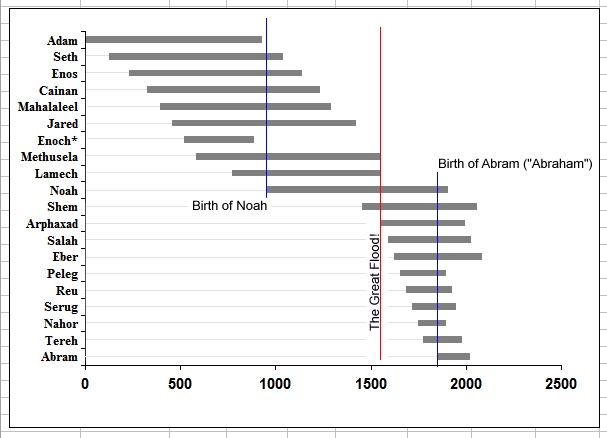
Here are some of the more interesting observations I have made looking at these two graphics.
- There are 8 generations who were living during Adam’s lifetime. If you consider the way that history was passed down from generation to generation in the oral tradition, this means that for 800 years, these 8 generations had direct access to an accurate oral account of Creation from the first human being to ever walk the earth! Think of the bedtime stories Adam could have told to his great, great, great, great, great, great grandchildren!!!
- Lamech, the son of Methusela, died 4 years before his father.
- We will easily recall Methusela as being the oldest man in history as a part of our genus of Bible trivia, but how many of us realize that he died in the same year as The Great Flood? Here are some other questions to ponder. Did he die just before the flood? Or was he one of the countless hundreds of thousands (millions?) to perish in unbelief? How truly tragic that would have been considering he probably knew Adam personally!
- Enoch was taken to heaven at the tender young age of 365. He has the shortest lifespan of any man prior to the Flood that is recorded in scripture.
- The Great Flood occurred 1,556 years after Creation.
- 1,556 years of history are recorded in a mere seven chapters of the Bible. Think about how much more there was that is not recorded. Think about how much God has preserved!
- Arphaxad, the son of Shem, would have been born in the same year as the flood. Since the Bible clearly states that 8 people were saved in the Ark, it is very likely that Arphaxad was born (and possibly even conceived) while Noah and his family were still on the Ark.
- If we exclude Enoch, the average lifespan of the men recorded who lived prior to the Flood was 912 years. Following the flood, the average lifespan of the next four is 483 years, and it drops to 206 after that. What factors contributed to this rapid drop in longevity? Were there certain environmental changes as a direct result of the Flood?
- Abram (Abraham) was born while Noah still lived, and he was about 60 when Noah died.
- Including Abram there are 10 generations who lived during Noah’s lifetime following the flood.
- Again, given the oral tradition and even considering the confounding of languages at Babel and the resulting dispersal of the world’s populace, these 10 generations would still have a very close and accurate account of the Flood.
What observation were you able to make?
~ Andy

What to do if you are being Held Hostage at a New Calvinist Church
Originally Published February 28, 2013
 Nobody wants to be humiliated publicly in a Sunday morning church service in front of hundreds of people. Especially if it is a church where you have been a member for several years, and in many cases, the center of where the majority of your closest friends gather on a regular basis. Not to mention strangers who may be there visiting. Your employer may be a member there, and family members who still trust the leadership may be members there as well.
This is why you are staying put in a church you want to leave. After you informed the elders that you were leaving they placed you under “redemptive church discipline.” This is in-house counseling that deals with “longstanding patterns of sin.” What patterns of sin? Anything that the elders think is such—that’s what. You may have also done something very stupid: entered into formal counseling at said church and revealed intimate details about yourself. Ouch, that is now information that could become public during your excommunication day.
You are now officially a hostage. If you leave you will be excommunicated and humiliated publicly. You are probably in this position because you know something about the leadership that is damaging or you have challenged them doctrinally. You are also not one who is usually excluded from this process: those with power, influence, and money. Your resources are limited. You are in a very bad spot. Walking away could cost you your job, all the friends that you have, and at least some of your family. You are not alone. I contend that thousands of Christians are being held hostage at New Calvinist churches in this way. They are playing along until an opportunity provides itself for a way out. If it ever does.
Let me continue to emphasize that Christians need to wise up and prevent themselves from getting into these situations. If you are the type that is willing to look the other way on everything don’t worry about it, but if you have an inclination to care about the truth, you need to be discerning. Because you are on your own and other churches will not stand with you (if any do, it would be a first), don’t join any church. It’s not necessary. You can be faithful to an assembly and not be a member. If they won’t let you serve in certain areas because you are not a member, so be it. The Scriptures are (I think deliberately) ambiguous regarding formal church membership. Even though many New Calvinist churches think they have authority over you whether you are a member or not—not being a formal member affords some protection. Actually, a lot of protection. In our day, don’t join any church formally—just don’t do it.
And if you do, for crying out loud, do not sign a church covenant. I am going to say this as lovingly as I can: in our day, if you sign a church covenant you are just plain stupid. I love you, but you are stupid. Not only that, in most New Calvinist churches, you are not allowed to leave membership for “unbiblical reasons.” And I will give you three wild guesses as to who determines what is “unbiblical.” If you are a member of a New Calvinist church “in good standing” (i.e., you don’t ask questions) and want to leave for doctrinal reasons, do so carefully. This ministry has, and continues to counsel people who want to leave these churches with as little drama as possible and it’s not easy. If you are in a church that strongly emphasizes formal membership—flee and don’t look back.
Back to those who find themselves in the belly of the beast. You have bitten off the whole enchilada. You are a member. You signed a church covenant. Much of your life is invested in the church. They have counseling records on you, etc.
First, don’t attempt to plead your case biblically; you’re wasting your time, these people play by their own rules. I should repeat that: don’t attempt to plead your case biblically; you’re wasting your time, these people play by their own rules. Do keep detailed records. Communicate as much as you can by email and ask lots of questions. Tape-record all meetings (check laws in your state, but in all but a handful of states it is legal to record private conversations as long as one party (that would be you) is aware the conversation is being recorded) and ask lots of questions. Here’s why: In most states what they are doing is a criminal act. In most states it is against the law to control somebody’s free will of moral actions with threats of reputation loss or financial loss. In the milieu of the mess, get them on record saying they will do this if you do that. Get them on record saying that you are not free to take your family and leave. Get their response on record regarding your concerns that you will lose your job, your family, your reputation, etc. Get them on record stating that they have the authority to void your salvation. Here is how the law reads in Ohio:
2905.12 Coercion.
(A) No person, with purpose to coerce another into taking or refraining from action concerning which the other person has a legal freedom of choice, shall do any of the following:
(1) Threaten to commit any offense;
(2) Utter or threaten any calumny against any person;
(3) Expose or threaten to expose any matter tending to subject any person to hatred, contempt, or ridicule, to damage any person’s personal or business repute, or to impair any person’s credit;
While gathering information, if at all possible, obtain an attorney that will work with you in the situation and contact the elders of said church when you leave post preference. Advise the church that you will be present with your attorney during the excommunication. In most cases the elders will back off and allow you to leave with your family quietly. I have seen this work quite well in lesser degrees of application.
If you can’t afford an attorney, gather good information that violates the coercion laws in your state and then contact the local police. If the church follows through with the excommunication, file criminal charges against the elders.
For further questions regarding this issue, email us at mail@tanc.online
paul

 Paul's Passing Thoughts
1 comment