6 Biblical Indictments Against Protestantism
 As anyone remotely familiar with the Bible knows, Christ made use of parables and illustrations to teach about life and the gospel. This post will point out 5 of His illustrations that contradict Protestant soteriology and will end with Peter’s last exhortation to God’s called-out assembly.
The first is the woman at the well in John chapter 4. Christ explained to the woman that anyone who drinks of salvation will not be thirsty again, and the life of salvation is a well that springs up inside of the saved person. That is not Protestant soteriology. The Protestant Reformation was sparked by the issue of infused grace, which it rejects. Furthermore, clearly, Protestantism isn’t about the gospel fully satisfying the soul without a need to return to the gospel. Hence, “We must preach the gospel to ourselves every day.”
The second is Christ’s statement that we cannot serve 2 masters in Matthew chapter 6. Though the example of money is used, how much more would this be applied to serving God and not the sin master? Though Protestant scholars play word games with the definition of being enslaved to sin, Protestant soteriology rejects the idea that salvation changes the “believer’s” state of being. This is because perfect law-keeping is the standard for justification according to Protestant soteriology—not the new birth. Hence, if the law cannot be kept perfectly, one is not justified as a state of being and necessarily remains enslaved to sin.
Next we have Christ’s illustration of whitewashed tombs in regard to religious hypocrisy in Matthew chapter 23. Actually, Protestantism is the perfect example of whitewashed tomb soteriology. The so-called “believer” remains full of dead bones inside while the outside whitewash is the substituted righteousness of Christ in the double imputation schema of Protestantism. As the Steve Camp song states, “He covers me.”
In John chapter 13, we have the foot washing episode that took place between Christ and Peter. Christ made it clear to Peter that he didn’t need a complete washing as salvation does that in the same way that salvation only requires one drink that results in an inner well of life. Not so with Protestantism; a perpetual return to the cross is needed for continued washing. John Calvin and Martin Luther refered to this as a return to our original baptism.
In the parable of the talents (Matthew chapter 25), Christ speaks of rightous servants using their gifts to produce fruit. The wicked lazy servant hides his talent in the ground and gives the master back what was originally given. Apparently, the servant was afraid that he would fail somehow and lose the original amount he was left in charge of. But this is exactly what Protestant orthodoxy promotes; anything that can be added to any gift given by God is a works salvation.
Lastly, in 2Peter chapter 1ff, Peter is writing about what he thinks is most important for the saints to remember because his departure is near. Preaching the gospel to yourself every day, right? Not moving on from the cross to something else, right? No, the exact opposite. Peter reminds them to add 8 virtues to the foundation of their faith.
paul
Paul Dohse Sessions for TANC 2020
Yearly Speakers: Paul Dohse, Susan Dohse, Andrew Young, John Immel.
Link for 2020 Conference Current Information
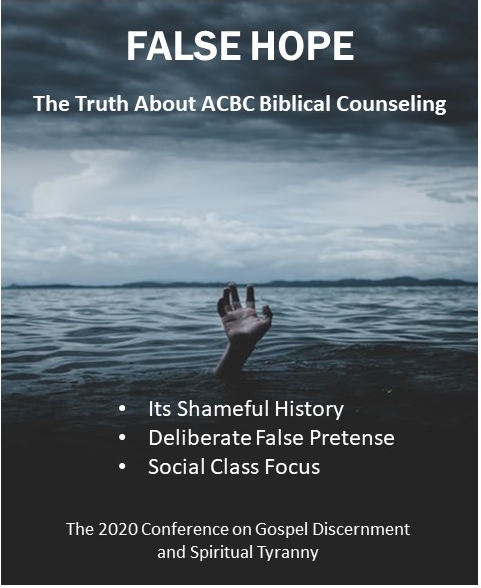
Why does the Association of Certified Biblical Counselors (ACBC) continue to misrepresent what it really believes about personal change and the gospel?
Paul Dohse has written extensively on the biblical counseling movement since 2009 and was formerly involved in the movement as a pastor and counselor. Paul also witnessed the internal struggles over the movement’s definition of the gospel and beliefs about how people change. Does the ACBC really believe people change for the better, and if they do, how? And which gospel finally won the internal civil war which now serves as the basis for their counseling?
Paul Dohse will unravel the nuance and redefinitions of words and terms in his explaination.
Why ACBC Christian Counseling Cannot Help People: Bad Soteriology; Revised and Edited
“The ending of sin is the good news, not a perpetual cover-up. The true gospel is the ending of sin, not a cover-up perpetrated by Christ—Christ recreates; He doesn’t whitewash tombs full of dead bones while legally declaring the dead bones to be holy.”
Note: ACBC; Association of Certified Biblical Counselors
Predominate in Christian circles is the idea that Christ’s death on the cross “covers” the sins that we commit as Christians. This not only sounds logical, but is something I bought into most of my Christian life. One of my favorite Christian songs, formally, states the following:
I know someday I will be free
The weight of sin shall be released
But for now He covers me
In a lesson taught by counseling guru Martha Peace (ACBC advocate and speaker), she states the following:
The Bible teaches us that when God saves someone, he cleanses them from their sin – past sin, present sin, and future sin as the Lord Jesus Christ “bore our sins in His body on the cross” (1 Peter 2:24).
Let’s think about this for a moment. If Christ died for our future sins, does this not necessitate the reapplication of His death to sins committed by Christians? Whether your answer is “yes,” or “no,” that is the assertion and logical conclusion of the soteriology that dominates the American church in our day: Calvinism. Furthermore, it is the soteriology that dominates the present-day Christian counseling culture.
The result is the biggest scam ever perpetrated on Christianity since a counseling session between Eve and the serpent. Christians en masse go to “Christian” counseling centers for personal change, but most often, they are being counseled by those who believe most Christians are not ready for the hard truth of the Protestant Reformation gospel: people don’t change; people can’t change; they can only glorify the works of Christ in the gospel while experiencing joy in the midst of circumstances no matter what they are. It’s reversed self-esteem: feeling good about ourselves because we are doing good is sin, but feeling good because we are totally depraved is God’s glory. We see a hint of this in the aforementioned lesson by counseling queen Martha Peace:
This aspect of Sanctification begins at the moment God saves you and “progresses” throughout the rest of your life. It is a life-long process of being transformed into more of Christ’s image.
Notice that we don’t really change, but are “transformed” into an “image” of “Christ.” Do we change personally as new creatures in Christ, or are we merely transformed into an “image”? Though Peace’s lesson is peppered throughout with lingo suggesting a co-laboring with God in sanctification, her deception, whether deliberate or unwitting, is revealed in her citations of the Protestant Mystic Walter Marshall:
True holiness understands that we are by nature totally powerless and unable to live a holy and righteous life that God requires [viz, perfect law-keeping].
Notice that “true holiness” is NOT something we DO, but something that we “understand.” In a myriad of Protestant contemporary writings, sanctification is framed as an “experience” and a “knowing.” The DOING aspect is continually fustigated in clever ways that suggest well-doing in sanctification necessarily equals an attempt to earn our justification (because a requirement of perfect law-keeping remains as the standard for justification; not the new birth and God’s indwelling seed). As one pastor puts it, “sanctification is done to us NOT by us.” And this, my friends, is the crux of the soteriological issue. If Christ’s death must be applied to Christian sins, the logical conclusion is that justification is not a finished work and further atonement is needed for future sins. This makes the “means” of holiness in sanctification critical. And what are those means? Peace continues:
True holiness understands that God will not help you live a holy life unless you use the means God has given you to pursue this holy life – salvation and sanctification that will give Him all the glory.
Notice that “salvation” is the “means.” Hence, the same salvation that justified you also sanctifies you. Does that sound familiar? And that’s Calvin as well. I wish not to belabor the point as I cite the Calvin Institutes extensively to establish this fact, especially in It’s Not About Election and The Reformation Myth. If you wish, you can read 3.14.11 in the Calvin Institutes for a primer. It is basically preaching the gospel to yourself daily in order to keep future sins “covered” by Christ’s death on the cross.
So, what makes this sanctification covering biblically illogical? Primarily, a proper understanding of biblical law and gospel. Again, I have written extensively on this and do not wish to belabor the point, but will summarize it.
Christ died for sins committed “under the law.” “Where there is no law, there is no sin.” Unbelievers are “under the law” and “enslaved to sin.” Believers are “under grace” and “enslaved to righteousness.” Along with the contrary slaveries, there is also a freedom to do the contrary. No unbeliever sins perfectly, and no believer obeys perfectly. Even though Christians sin because they are free to succumb to the desires of the flesh, Christ is the “end of the law,” and therefore there is “no condemnation.” Clearly, again, CLEARLY, in Protestantism, the so-called “believer” remains under the law and its condemnation.
Furthermore, the old self that was under the law was crucified with Christ and no longer lives; so, see Romans 7, the new us is no longer married to the old us that was under the law. But unbelievers are still under the law, and will be judged by that written law and the law of conscience—that will not go well.
Believers are righteous even as they are righteous—they have God’s seed abiding within them (see 1John 3). Regardless of being clothed in humanity, believers are truly righteous beings who are able to please God by their obedience (see Romans 8). Sin resides in our mortality and weakness, but no longer enslaves us. However, all in all, our new direction is indicative of our righteousness while we are NOT judged by a perfect keeping of the law for we are under grace. “Under grace” is NOT being under the “righteous demands of the law” as the often heard buzz-phrase goes among Protestant pastors and elders.
Therefore, with proper biblical guidance, we are able to change in order to please God. We do not merely contemplate God’s grace and watch for a “transformation” of an “image.” Rather than depending on a finished work for a glory manifestation, we “move on to maturity” by learning how to “control our own bodies in holiness.” Contrary to Peace’s Reformed idea that the finished work of justification must continue to cover future sins by “revisiting the gospel afresh” (Michael Horton via Calvin), we apply God’s truth to our lives, and when we see the results, it makes us more and more sure of our “calling and election” because it indicates that we are no longer enslaved to sin and its desires. On the flip side, disobedience can cause a believer to doubt his/her salvation because they continually violate their consciences. Also remember that unbelievers are not concerned with assurance issues.
In contrast, Peace asserts in the same lesson, as Jerry Bridges and many others, that assurance comes from the belief that we can do nothing to please God in sanctification:
True holiness is produced in someone who is assured that they are forgiven and reconciled to God apart from any human merits in sanctification and justification both.
In other words, effort in sanctification supposedly shows that we are not resting in the continued salvific work of Christ. This is Calvin’s Sabbath rest salvation that I discuss in detail in chapter 4 of It’s Not About Election. In chapter 5, I discuss why this doctrine robs Christians of assurance. Biblical assurance comes from knowing that justification is a finished work that ended sin and its condemnation, not the idea that our sin is merely covered via “returning to the gospel afresh.” The ending of sin is the good news, not a perpetual cover-up. The true gospel is the ending of sin, not a cover-up perpetrated by Christ—Christ recreates; He doesn’t whitewash tombs full of dead bones while legally declaring the dead bones to be holy.
“But Paul, what about sins that we commit in our Christian life?” Well, we hate it, and therefore long to be saved from these mortal bodies of death, but we are not enslaved by it, nor can it condemn us. Assurance comes from the fact that justification and sanctification are totally separate; one is a finished work that ended condemnation, and the other increases our joy by an increased ability to please God by what we DO in kingdom living. We love God—He doesn’t love Himself by transforming us into an image of Himself IF we continue to live by faith alone in sanctification. James condemned that doctrine in his letter to the 12 tribes of the dispersion. Neither should we feel good about our supposed total depravity. Total depravity is not the source of joyful assurance because it increases our gratitude for our original salvation through a deeper and deeper understanding of how evil we are.
This, and many other reasons is why contemporary biblical counseling will not help Christians, but will rather destroy them.
paul


 Paul's Passing Thoughts
leave a comment