The Protestant Twisting of 1John: A Clarification, Part 1
 Originally published March 22, 2015
Listen to audio or download audio file.
Welcome to Blogtalk Radio False Reformation this is your host Paul M. Dohse Sr. Tonight, we are going to attack and unravel interpretive abuses of 1John, particularly 1John 1:9 and 2:1. There is only one other text twisted for ill use more than these two verses, and that would be Galatians 2:20 and 3:1-3. Later, In part 2, I will toss in an exegesis of those verses as a bonus.
There may be a lot of different religions and even more denominations, but for all practical purposes they all have one thing in common: this whole idea that salvation is a process with a beginning and an end. This makes salvation a process that includes our present life.
So, the argumentation between religions and denominations involves the correct way of getting from point A to point B. But there is no point A and point B. When you believe God unto salvation, you get the complete package and the salvation part of your life is finished. It is an instantaneous quickening of the Spirit that transports you from one kingdom to another, from one master to another, from being under law to being under grace, from the old person to the new person, and from darkness to light. You don’t become a servant of righteousness on the installment plan, and you don’t become a kingdom citizen on an installment plan.
How is 1John used to argue for a progressive salvation, and what is John really saying in his epistle? That’s what we are discussing tonight. If you would like to add to our lesson or ask a question, call (347) 855-8317. We will check in with Susan towards the end of the show and listen to her perspective. If you would like to comment on our subject tonight, you can also email me at paul@ttanc.com. That’s Tom, Tony, Alice, Nancy, cat, paul@ttanc.com. I have my email monitor right here and can add your thoughts to the show.
Way back at the beginning of this ministry, I had this nailed down. If salvation is a process, and eternal life as opposed to eternal punishment is at stake, the Christian life is really a minefield. The focus isn’t being the best kingdom citizen; the focus is making sure you don’t mess up your salvation. The focus is salvation, not discipleship. The focus is fear of judgement, not love.
I realize many Christians hold to OSAS, once saved always saved, but the problem is how they are led by pastors trained in seminaries deeply grounded in Protestant tradition. That tradition looks to the institutional church as the primary way of getting God’s people from point A to point B in regard to their salvation. Whether OSAS or not, they are led to do the same things week in and week out. Be here at this time or that time; stand up; sing; sit down; listen to announcements; stand up; sing; sit down; listen to the special music presentation; put your tithe in the plate; listen to the sermon (always about the gospel just in case there are lost people present, wink, wink); stand up; sing “Just As I Am” until someone walks the isle so you can stop singing “Just As I Am”; pray; be dismissed; be cordial to people and tell them how much you love them; go home, and come back next week and do it again.
Why? Because all of that ritualism “imparts grace” and enables us to “grow in grace.” It enables us to “grow up in our salvation.” After all, discipleship is the “growing part of our salvation.” We have all said it, but salvation doesn’t grow. While believing in OSAS, most parishioners are led by pastors who believe in progressive salvation/justification which was clearly the foundational premise of Protestantism with the progression being overseen by the Protestant institutional church.
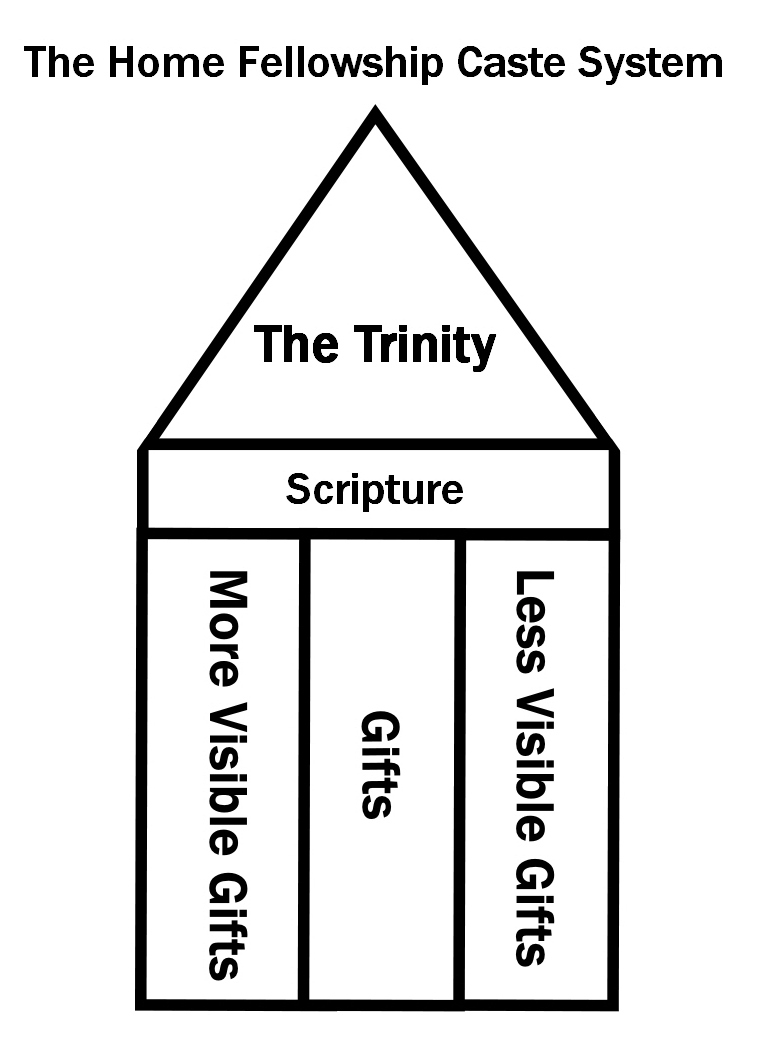
Moreover, let’s face it; while believing in OSAS, there is only one reason people put up with all of the nonsense and drama of the institutional church—OSAS means that if someone leaves the institutional church, they were never saved to begin with. Right? In other words, they function according to the idea that they are led by. It’s OSAS as long as you are “faithful” to the institution. Then each church has its own little “faithfulness” caste system. Those who show up for all of the services are the “core members” that run the church. Those “less faithful” that only come on Sunday mornings are a lower class of member in the caste system.
You have the pastors, staff and deacons, then the “faithful” that attend all of the services and tithe at least 10%, the “casual” attenders that tithe, and then the bottom of the caste strata, even lower than the serfs, the putrid “nonmembers.”
Whether Calvin or Luther, the two icons of Protestantism, these beliefs follow after the doctrine they established for the Protestant institutional church. Access to the institutional church was through water baptism, and the critical need according to the Reformers for formal church membership follows: as Christians, forgiveness for present and future sins can only be found in the institutional church, and those sins condemn us. Forgiveness for all sins does not occur at salvation, but only for past sins. Water baptism initiates us into church membership where forgiveness for present and future sins can be obtained through the sacraments; ie., “gospel preaching,” the Lord’s Table, and anything else deemed as acts of faithfulness to the institutional church not to exclude tithing by any means. Calvin states this explicitly in his institutes, 4.15.1.
All in all, you can say that in Protestantism, the status of sin does not change for the believer—it still condemns requiring perpetual resalvation for every sin committed.
Therefore, 1John 1:9 and 2:1 is interpreted in this light: “If we confess our sins, he is faithful and just to forgive us our sins and to cleanse us from all unrighteousness” (1:9). “My little children, I am writing these things to you so that you may not sin. But if anyone does sin, we have an advocate with the Father, Jesus Christ the righteous” (2:1).
These verses seem to bolster the authentic Protestant position on justification. Confession of sin in our Christian lives keeps us saved. And if we confess our sins, Jesus is up in heaven as our advocate with the Father continuing His work as a propitiation for our sins.
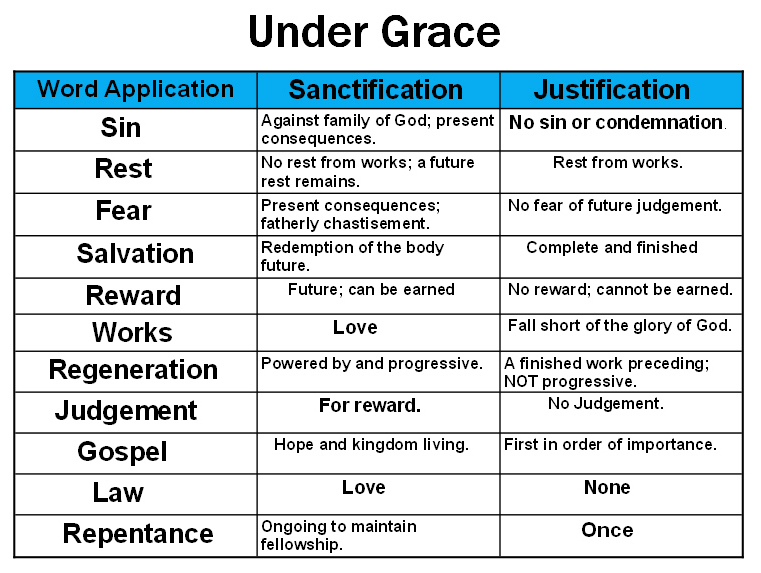
The problem is that this interpretation stands in stark contrast to what other Scriptures state about justification. Biblically, sin has a different classification after salvation—it can’t condemn; it can bring chastisement and present consequences, but it can’t condemn—its ability to condemn has been taken away. Hence, there is no need to have some institution that prevents future condemnation.
Nevertheless, it is easy to understand why the institutional church not only gets a pass on outrageous behavior, but the money keeps pouring in. What will people pay for their salvation and décor that glorifies the institution that saves them? Apparently, no price or compromise is too large. One can also appreciate the fear of so-called excommunication because the institutional church is the only place where one can receive continued forgiveness for present and future sins.
Before I move on, I will solidify my present point. Romans 8:1 states that there is presently NO condemnation for those who are in Christ. In Contrast, Calvin stated that “even saints cannot perform one work which, if judged on its own merits, is not deserving of condemnation” (CI 3.14.9, last sentence). Obviously, the focus is going to be avoiding condemnation, not our freedom to pursue aggressive love in discipleship.
So what are these verses in 1John really saying? Let’s begin to unpack that using the historical grammatical approach to interpretation as opposed to the traditional Protestant means of interpretation, the historical redemptive method. Since Protestantism sees salvation as a process, “redemptive” means that the Bible must be approached with a redemptive prism; ie., the Bible is about salvation. Clearly, this is eisegesis; going to the Bible with a presupposition.
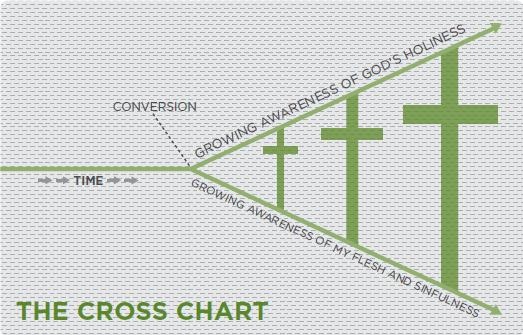
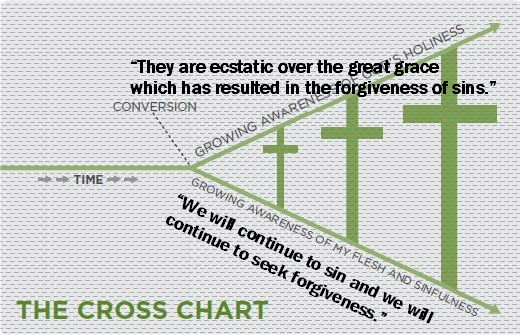
In regard to the history part, this is the belief that history is an unfolding drama about salvation. Hence, all of reality is interpreted through salvation. All of history and the Bible continually reveals the one two-fold redemptive truth/reality: the sinfulness of man and the holiness of God. Salvation begins when we see or understand this reality, and the experience of that reality increases until final salvation.
In contrast, the historical grammatical method uses historical facts to bring more meaning to the text, and all truth is determined by what can be concluded by the grammar—this is known as exegesis. All meaning and truth comes out of the text without anything being read into the text except conclusions from other texts.
In fact, Protestant tradition holds to the idea that a historical grammatical approach to the Scriptures invariably leads to works salvation. Protestant tradition insists that the Scriptures must be interpreted through the prism of total depravity. In this year’s TANC conference, this is what I am going to be hitting on. Christians, save a few, have no idea that Protestant pastors that are leading them view reality in a totally different way than most parishioners. And this is why church looks like it does. And there is no salvaging it—it’s a completely broken system.
So, if you interpret said verses in 1John redemptively, it fits right into their narrative, right? You have to continue to repent for new sins in your Christian life in order to not be condemned and to keep your salvation. A good old fashioned Baptist lady who I am sure would hold OSAS stated this to my wife Susan in the grocery store a couple weeks ago. When Susan asked her why Christians need to go forward during alter calls, she answered, “they have sin that needs to be forgiven.” Well, why can’t they get that forgiveness by praying at home? You ought to see the reaction Susan and I get when we suggest her mother was saved even though not a member of a church.
Protestantism and all of its offshoots including the Baptists is nothing more or less than functioning Calvinism. Election isn’t the point, progressive salvation is the point. Protestants think salvation grows—salvation doesn’t grow—you are either forgiven once and for all time or you aren’t. Look, if you are going to stay in the institutional church, it makes absolutely no difference where you go. Please, stop driving 15 miles to the Baptist church when there is a Catholic Church right across the street—it’s a shameful waste of gas. It’s all progressive justification.
In contrast, we have to see 1John in its exegetical historical context. It must be interpreted according to what was going on during the time that prompted this letter. And what was that?
John was pushing back against the number-one nemesis of the assemblies during that time: Gnosticism. Now, there were many, many different veins of Gnosticism during that time, but like denominationalism, there are basics that are fundamentally the same. Denominationalism quibbles about how to get from point A to point B, but it is all progressive salvation.
When you understand the basics of Gnosticism, it is easy to see that John’s first epistle is a point by point rebuttal of Gnosticism, and NOT the proffering of progressive justification. Protestants can bicker with Catholics all they want to about how to get from point A to point B, but again, it’s all progressive justification. If it’s a religious institution, it’s selling final salvation, PERIOD.
If we follow John’s arguments in this epistle, it also apes the fundamental basics of Gnosticism, and that’s what we are going to do:
1John 1:1 – That which was from the beginning, which we have heard, which we have seen with our eyes, which we have looked upon, and our hands have handled, of the Word of life; 2 (For the life was manifested, and we have seen it, and bear witness, and shew unto you that eternal life, which was with the Father, and was manifested unto us;) 3 That which we have seen and heard declare we unto you, that ye also may have fellowship with us: and truly our fellowship is with the Father, and with his Son Jesus Christ. 4 And these things write we unto you, that your joy may be full. [KJV].
The Gnostics taught that it really wasn’t the spiritual Christ that died on the cross. Gnosticism holds to the idea that material is evil and only the invisible spiritual world is good. Gnosticism rejected the idea that the spiritual realm, or godhood can be one with the material. You must understand: the biblical concept of Godman is a direct affront to the foundation of all false religions, or the knowledge of good and evil. It is the idea that true knowledge cannot be one with the material. Knowledge is good, material is evil and is only a shadow of true knowledge. Knowledge of the material is enslaved and dependent on the five senses.
Now, stop right there. Let me simplify this for you. All false religion flows from the religion of the knowledge of good and evil presented to Eve in the garden. This is also the first sentence of the Calvin Institutes and all of the Calvin Institutes flow from the foundation of 1.1.1., first sentence, viz, ALL wisdom is the knowledge of man and the knowledge of God; man is inherently evil and God is inherently good.
Also, the first sentence of the Calvin Institutes is the primary theses of Luther’s Heidelberg Disputation which is the Magnum Opus of the Reformation. All fundamentals found in contemporary evangelicalism can be found in the Heidelberg Disputation and flow from it. Calvin’s Institutes further articulated the former. In contemporary evangelicalism, we hear constantly that true biblical knowledge is “the knowledge of our own sinfulness as set against God’s holiness.” This is also the pronounced fundamental foundation of the contemporary biblical counseling movement as constantly stated publically in no uncertain terms.
Why am I interjecting this? Because even though much of our knowledge concerning first century Gnosticism comes from the writings of the early church fathers and while they railed against Gnosticism, they themselves were also Gnostics. However, in the process of railing against Gnosticism, they confirm unequivocally that John’s letter addressed the Gnosticism of their day; it just wasn’t the Gnosticism that they preferred.
And by the way, according to some church fathers, John was addressing a Gnostic named Cerinthus who was a contemporary of John and a personal nemesis.
Cerinthus was a gnostic and to some, an early Christian, who was prominent as a heresiarch in the view of the early Church Fathers. Contrary to proto-orthodox Christianity, Cerinthus’s school followed the Jewish law, used the Gospel according to the Hebrews, denied that the Supreme God had made the physical world, and denied the divinity of Jesus. In Cerinthus’ interpretation, the Christ came to Jesus at baptism, guided him in his ministry, but left him at the crucifixion.
He taught that Jesus would establish a thousand-year reign of sensuous pleasure after the Second Coming but before the General Resurrection, a view that was declared heretical by the Council of Nicaea. Cerinthus used a version of the gospel of Matthew as scripture.
Cerinthus taught at a time when Christianity’s relation to Judaism and to Greek philosophy had not yet been clearly defined. In his association with the Jewish law and his modest assessment of Jesus, he was similar to the Ebionites and to other Jewish Christians. In defining the world’s creator as the demiurge, he emulated Platonic philosophy and anticipated the Gnostics.
Early Christian tradition describes Cerinthus as a contemporary to and opponent of John the Evangelist, who may have written the First Epistle of John and the Second Epistle of John to warn the less mature in faith and doctrine about the changes he was making to the original gospel. All that is known about Cerinthus comes from the writing of his theological opponents (Wikipedia).
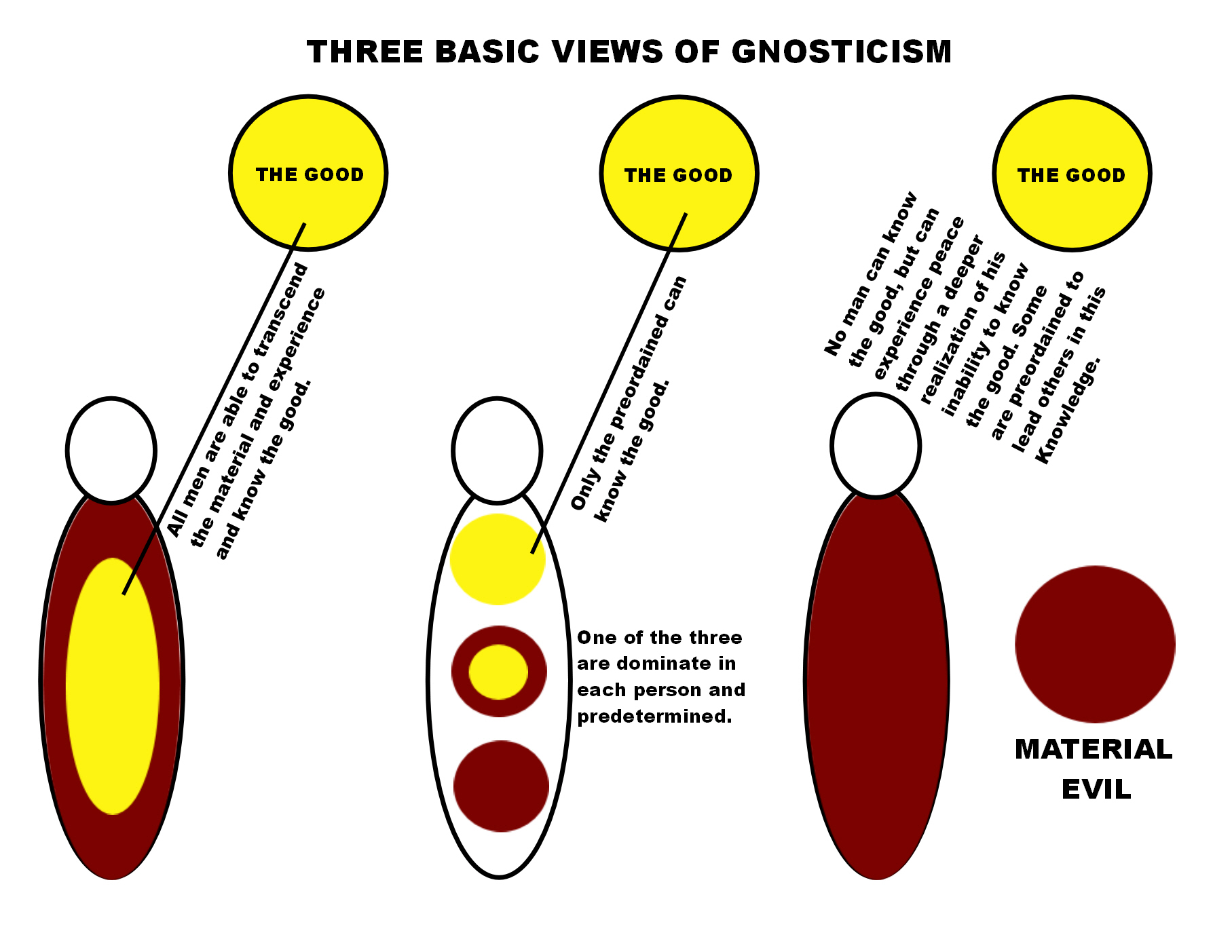
At any rate, the teachings of Cerinthus follow the basic fundamentals of 1st century Gnosticism of which there were two schools of thought unchanged from the cradle of society: intuitive knowledge within versus knowledge outside of man. While both schools held to the strict dichotomy of material being evil and the invisible good, and true knowledge being beyond the five senses, they disagreed on where that knowledge is found and whether or not it is intuitive among all men, or a select few preordained by nature or some supreme being.
Cerinthus followed the philosophical school of Idealism which holds to the belief that the one cosmic mind has an intuitive connection within every individual. Finding that knowledge is often a complex mind-numbing epistemology, but curiously, Luther and Calvin had their own angle that built on the Neo-Platonic teachings of St. Augustine.
This Gnostic bent actually allowed for Christ to be human, or at least some form of humanity. Apparently, God became exasperated with man’s penchant for trying to gain knowledge through the material world, and said in essence, “Ok, since you like to think you can know something and try to gain knowledge through the things that are seen, I am going to send my Son to die on the physical cross, and now all knowledge will only be gained through suffering—there mankind, take that!” This is the essence of the Heidelberg Disputation which is a philosophical treatise, not a theological one by any stretch of the imagination. Luther states plainly in the document that ALL knowledge is hidden in the suffering of the cross. Anyone who thinks they can understand Protestantism without a good grasp of world philosophy is sadly misguided. It is one of the historical necessities of historical grammatical hermeneutics.
Hence, in the Gnostic Protestant construct, Christ and His gospel is the only true objective knowledge and is outside of man. Man is not to seek any knowledge within himself, but all knowledge must be sought outside of him in contemplation of the gospel. All of reality is interpreted by the suffering of the cross. The cross is the epistemology from the material to the invisible, or from the evil to the good.
In contrast, other schools believe the epistemology is intuitive within all men because all men have a spiritual being separate from their material being, and the spiritual part of man is nonmaterial and therefore SINLESS. The material body of man is evil because it is material, but his invisible being is good and has a connection to the cosmic spiritual world that must be cultivated by transcending the material. This was key to the drug culture of the 60’s as LSD trips enabled the individual to transcend the five senses and see into the invisible spiritual world. Supposedly.
Other schools of thought believed that even though all men have a material and spiritual aspect, the spiritual anthropology has classifications in regard to who is able to see true knowledge and who isn’t as determined by the cosmos or cosmic mind; ie., determinism. And consequently, if utopia is to ever be achieved, those with the ability to see knowledge must rule over those who have the inability to transcend the material and are enslaved to it. How do you reason with people hopelessly enslaved to the material? They either understand that they can’t know reality and get with the program, or you kill them.
According to the Reformers, utopia is achieved by understanding that all reality is interpreted through the cross of redemption. This concept was established by Luther’s Heidelberg Disputation and is known as being a “theologian of the cross.” Theologians of the cross are able to know the “cross story,” or interpret reality through the cross, and all others are enslaved to the “glory story” or the story of man. This is the dichotomy of the knowledge of good and evil, or material versus spiritual.
Furthermore, the Reformers believed that the new birth entailed the gift of outward seeing only. All goodness remains outside of man. This is the pious distinction they claim over their fellow Gnostics. Unlike Cerinthus, who would be the modern equivalence of existentialism, no good can be in man, because that does not limit knowledge to suffering and the cross. Even though the early church fathers believed that material is evil and only the invisible is good like all ancient Gnostics, they labeled those heretics who believed that the invisible spirit within man was a connection to the good. That was heresy in their minds. And if you really understand what John Piper et al believe in our day, NOTHING HAS CHANGED.
The true Christians of that day had a different metaphysical take: the material realm is NOT evil, it’s weak. Something that is weak can still be good. The born again Christian struggles with sin because he/she is weak, not because the material realm is inherently evil. Christ really did come adorned in humanity in every since of the meaning because the material is not evil. This understanding of being fits together with the true gospel.
But what Cerinthus et al was teaching speaks directly to what John wrote in his first epistle, and we have addressed some of it in John’s introduction. John, in essence, said the following: Christ was 100% humanity and 100% God. We saw Him, we heard Him, we touched Him, we saw Him die on the cross, there isn’t two Christs, there is only one.
What Cerinthus et al taught explains everything John wrote in this epistle and why he wrote it. It not only explains why John wrote what he wrote in 1:9 and 2:1, it sheds light on why John wrote what he wrote in the rest of the book as well.
And that is what we will look at next week. We will do a point by point fly over of 1John while interpreting it according to this historical context of Gnosticism. John will address the definition of sin in contrast, the definition of knowledge and truth in contrast, the definition of the true gospel in context, the definition of love and hate in contrast, and the definition of the new birth in contrast.
See you next week.



Why the “Sinner’s Prayer” is NOT the Gospel
 Nowhere in the Bible are we instructed to lead someone into salvation by reciting the “sinner’s prayer,” and there is a reason for that; it’s not the gospel. The following is a typical rendition of said Prayer:
“Heavenly Father, I come to you in prayer asking for the forgiveness of my sins. I confess with my mouth and believe with my heart that Jesus is your Son, and that he died on the cross at Calvary that I might be forgiven and have eternal life in the kingdom of heaven. Father, I believe that Jesus rose from the dead and I ask you right now to come into my life and be my personal lord and savior. I repent of my sins and will worship you all the days of my life. Because your word is truth, I confess with my mouth that I am born again and cleansed by the blood of Jesus. In Jesus’ name, Amen.”
The great danger of something like this becoming an orthodox canned ritual to obtain salvation is fully realized in our day. As a recovering baptaholic, I have witnessed the falling away of most people who are “saved” by this prayer or responding to an alter call at an institutional church. Also, I have witnessed the lack of alarm following in response to this reality.
Why the lack of alarm? It’s the “prayer of faith” that saves and not the realty of it. Let me repeat that: It’s the “prayer of faith” that saves and NOT the reality of it. “It” being the reality of salvation itself. Salvation is a reality and not a mere mental assent to the facts of the gospel. However, no evidence of a new life is acceptable in Protestant circles because its gospel is a “believing only” definition of faith rather than a decision. The difference is major.
Note the structure of the prayer; it’s a disaster. Why? First of all, on the one hand, it calls for belief only rather than a decision, coupled with a commitment: “[I] will worship you all the days of my life.” Totally confusing. Is salvation by faith alone or not? “Repentance” is NOT a commitment, it is a change of mind—it is a decision to go in a different direction; specifically, from death to life.
And that is the crux: the new birth. Though the new birth is in the prayer, it is framed as something that you believe mentally only rather than something that you decide to accept as a gift. Salvation is a decision to accept the gift of the Spirit and His baptism. It is a onetime decision to follow Christ in death and resurrection, and this is only possible through the gift of the Holy Spirit otherwise known as the new birth. Salvation is NOT, I repeat, not… “Asking Jesus into my heart” or “Asking Jesus to come into my life.” No, no, no, and in fact, where are we told in Scripture to “ask” for salvation? We are told to “believe” (mental assent to the facts of the gospel) AND repent – a decision to follow Christ in death and resurrection, or a passing from death to life made possible by the Spirit, and “you WILL” receive the GIFT of God’s PROMISE concerning the Spirit (Acts 2:37-39). I hope you see the major difference here.
The correct gospel has an expectation of new life built in. It is a decision to die to the old self and become new with Christ who also received the promise of the Spirit when He resurrected Christ from the grave (Galatians 3:16). Christ paid the penalty for our sins, but without the promise of the Spirit, there is NO salvation. An overemphasis on some “receiving of Christ” in lieu of the promise of the Spirit is an ill advised gospel presentation (Galatians 3:1,2).
Salvation is a decision to accept a promise to all people. It is a repentance, not an asking. When one decides to turn from their old self to a new self made anew by the promise of the Spirit, they WILL receive the promise. This is EXACTLY what Christ was talking about when he said “follow me.” This is EXACTLY what Christ was talking about in regard to losing one’s life in order to find it. He was talking about the promise. He was talking about passing from death to life. He was talking about the new birth. He was talking about the baptism of the Holy Spirit.
Indeed, the reality of Protestant professions that do not pan-out in large numbers is due to a canned orthodox gospel that exchanges a promise for an ambiguous “asking Jesus into my heart.” It redefines the promise of the Spirit and denies the reality of a literal passing from death to life.
This is why the “walk of the new man” is optional in regard to any great concern in the institutional church while the flippant truism “We are all just sinners saved by grace” plays in our minds like a bad song that we cannot get out of our heads.
By its fruit the tree is known.
paul
It’s Not About Election: Why Calvinism is a False Gospel
Read PDF ebook by clicking on following link: It’s Not About Election ebook
TANC 2015 – Andy Young, Session 1: Challenging Presuppositions of the Believer’s Identity
So I had originally chosen a few other topics on which to speak. And then several weeks ago Paul and I were chatting on Facebook, and I think it was following something he had just posted on the blog – I don’t remember the exact circumstances now – but I had been sitting there thinking about this, and the thought came to me, “Believers don’t really know who they are!” And I was overcome by the realization of this, how profound this was. Here we are, some 2000 years after, if you want to call it the “birth of Christianity”, some 500 years after the reformation.
What do we have?
- Grand churches with their grand buildings and their programs
- Christian schools
- Christian universities
- Seminaries turning out all these pastors
- all these resources
And with all of this, people are sitting in churches Sunday after Sunday, and they still don’t even know who or what they are. They are not aware of the reality of their existence. And that is what it really boils down to is this philosophy of existence. Who are we? What are we? And I don’t want to delve into a fundamental discussion about what is man. That’s a really esoteric subject, and not that it’s not worthy of discussion or that it’s not relevant, but I’ve only got so much time here, and I want to focus on something more specific.
Specifically, what is a Christian? You remember that it was in Antioch of the province of Syria that the term “Christian” was first coined, but not in a good way. It was a pejorative. It was meant as an insult. In the Greek, the word literally translates, “Christ ones”. We can make it sound even more derogatory by saying “christers”. You’re one of those “christers”. One who goes around talking about Christ. It was meant to be an insult. In fact, every time you see the word “Christian” used in the NT, which isn’t often, it is generally used in a negative context.
Of course, the fact that is was meant as an insult is what caused the term to be adopted as badge of honor in later decades and centuries, in a sort of ironic fashion. And to this day the word “Christian” is very common and normal and doesn’t carry the stigma with it. People in churches gladly call themselves Christians. Now granted, in recent years there has been a growing intolerance of what passes for Christianity, but for many years that wasn’t the case. It was almost popular to be a “Christian”.
But we’ve seen, I’d say in the last 10 years or more, a growing animosity towards Christians once again, and that isn’t necessarily for the reasons that we think of immediately. You know the first thing that comes to mind is this conflict between government and religion and the whole separation of church and state issue. But more and more I see that being a secondary issue. What we really have is a growing hatred for those who call themselves “Christians” because of what they represent. And that is, on an institutional level, on a theological level, on a philosophical level, it has to do with this seeming indifference to abuse and suffering both inside and outside the institution. Christians are viewed as uncaring and insensitive. You have Hollywood actors referring to God as a sadistic monster. And I can’t necessarily blame them for that kind of assessment. You look at the way “Christians” behave, especially toward each other.
And if you don’t believe me, watch what happens when you try to ask a question in Sunday school that questions the orthodox position. Or you leave a church over doctrinal matters and see how many of those people who you thought were friends continue to have contact with you. Or you watch how downright vicious they get with you when you try to present a rational argument in a Facebook discussion. One has to ask themselves, if they treat a fellow brother like that, how do they treat a lost person? How do they treat someone they are trying to evangelize?
And you don’t think the world sees this? You don’t think the world looks at the behavior of Christians, and then we wonder why they don’t want to have anything to do with us. What did Jesus say?
John 13:35 By this shall all men know that ye are my disciples, if ye have love one to another.
Does the world see us loving each other? How can they believe anything we have to say? Dear lost person, I want to share with you the gospel because I love you. Oh, like you love that other guy who calls himself a Christian? I see the way you treated him.
The blame for this rests squarely on Augustinian/Reformed/Protestant orthodoxy. Traditional orthodoxy has created a god in its own image that IS without a doubt a sadistic monster. And so as a result, you have followers of this god going around treating people the exact same way that they believe their god treats them. Why should we expect any different. And this is the reason then that the term “Christian” has become a pejorative once again. And it is for this reason why I no longer refer to myself as a “Christian”. I call myself a believer. Or follower of Christ. A disciple of Christ. I prefer believer.
So along those same lines then, this becomes the foundational premise for why those who call themselves “christians” don’t even know who they are. What is the primary defining term that traditional orthodoxy uses today and has used for centuries to determine our identity as believer? When you sit in that pew, or that stadium chair, or whatever kind of seats your church uses, and the pastor/elder/bishop/apostle or whatever he wants to call himself, stands in front of the plexiglass podium, and he’s standing up there, and he’s looking so hip with his goatee or soul patch, in his blue jeans and turtleneck and sports coat and brown suede shoes, and he starts to deliver his sermon, what is the one theme that is driven home to you over and over and over again? What does he want you to know about yourself? What are you?
SINNER!
This is the theme. This is what defines you. It’s in the songs we sing. Only a sinner saved by grace. Amazing grace…that saved a wretch like me. I need thee every hour! And I could go on. We see it in the pithy little memes on Facebook. Here’s one I saw recently….I’m not a christian because I am strong and have it all together…Of course the question we should immediately ask ourselves is, why do Christians need a savior? But we never ask those questions, do we? Here’s another one. I’m not that perfect Christian, I’m the one who knows I need Jesus. Of course there’s a subtle snarkiness to this one. It’s almost a kind of holier-than-thou attitude. It almost seems to contradict the very humility it’s supposed to be trying to convey. I’m so humble that I know I’m not perfect, but at the same time, I know something you don’t know. I know I need Jesus and you don’t. And of course at first glance, no one is going to argue with that. How can you say you don’t need Jesus? But what they don’t realize is that, wait a second, believers already have Jesus. We’re already saved. Why do I need a savior over and over? But you will see this theme over and over all over the place. Don’t forget, Christian, you’re a sinner!
Now of course what do they mean by that? Well they say, well I still sin. Right. They like to ask that question. Did you sin today? Then you’re a sinner. And of course they think they trick you when they ask you that question. They think they’re being clever if you come to them with some notion of righteousness. And of course their mistake there is equating righteousness with obeying the law.
But the fundamental flaw in this assumption about being a sinner is this. If you make this your assumption that because you sin you are therefore a sinner, what you are doing is allowing your identity to be defined by a practice or a behavior. (let me say that again.) You are allowing your identity to be defined by a practice or a behavior.
Now on a certain level this is not necessarily incorrect. This is something we do all the time in our everyday life. We tend to categorize ourselves and others by what we do. We do this in our jobs. I have my own business. I earn my living by cooking food. So since that is a behavior in which I engage, I can legitimately say, I am a cook. Or Paul writes for a blog, therefore Paul is a blogger. Or Cam Newton plays football for the Carolina Panthers, therefore Cam Newton is a football player. (I threw that one in there for Zach). Ok, all of these are examples of behaviors or activities that we use to categorize each other and to compare ourselves with others to help organize our world, and so all of these things are true. But do those things define us as individuals? In other words, aren’t we more than just cook, or blogger, or football player?
There is a tendency to divide people up in to groups and call them “communities”. And these so-called “communities” are defined by the behaviors and actions of those who would identify with them. And so what ultimately ends up happening is you have those who say they are part of this “community” as if everything they are, who they are, is defined solely by the behaviors that are common to those in this community. The LGBT crowd is a great example of this. How do they refer to themselves? They say the LGBT “community”. Well what does that mean? Their whole identity is wrapped up in a specific behavior. Now I’m not going to get into, is this a choice or are they born this way, that’s irrelevant to this point. Even if you assume you are born this way, it is still a behavior, and you are choosing a behavior to be the basis of your identity.
Why don’t we do this with other behaviors? Why don’t we have a pedophile community? Why don’t we talk about the serial killer community? Or the alchoholic community? And I’ll stop there because I don’t want to go too far and have the analogy fall apart, but I think you should begin to see the point I’m trying to make here. We don’t define ourselves by our behavior. And this has tremendous ramifications.
So how do we define ourselves? I think a great place to start is asking how does God define himself? Is God defined by His attributes? We say God is love, God is just, God is holy, God is immutable. But again, is this how God is defined, or are these all abstract concepts that man has assigned to God to help organize the world around him, and so we create these aspects of God so that we can try to understand Him? How did God define Himself? How does God identify Himself?
Moses asked this very question at the burning bush. You remember that he was to be the leader of Israel, and he was concerned that they would not follow him, and he asked God, who should I tell them sent me? How will they know You sent me? And so in Exodus 3:14 God answers Moses, and He says:
Exodus 3:14 “And God said unto Moses, I AM THAT I AM: and he said, Thus shalt thou say unto the children of Israel, I AM hath sent me unto you.”
God said, I exist! Do you realize what a profound declaration that is? God was not just being coy with Moses. In this simple three-word declaration in Hebrew, God was establishing the fundamental definition of self. I EXIST. Who am I? I am me. I am who I am. I exist! That is such a profound declaration. To declare your own existence is to acknowledge your right to self. But there is even more to this, as I was discussing this very point with Zach last week, as he pointed out, and I agree, that there is a corollary to this truth. That when God declared I EXIST, at the same time He declared, YOU EXIST. To recognize self also means to recognize the existence of other “selfs”. This is especially profound when we consider that God made man in His image. That God is “self” also means that man is self. So that man can also legitimately declare, I exist! I am! And because he can declare this, he must also recognize other “selfs”.
So if we truly understand this, we can see that man cannot be legitimately defined by actions or behaviors. He can only be defined as “self”. He is who he is. Who am I? I am me. You are you. That is who I am. That is the definition of my existence. You can categorize me anyway you want, but that is not who I am. And I’ll let you ponder all the ramifications of that.
But this is where we must start before we can even begin to discuss who we are as believers. What is means to be born again. Because first and foremost we are creatures made in God’s image whether we are born again or not. Everything I just said must be true of all mankind. We have to begin with the right assumption about man in general. Only then can we have a valid discussion and understanding about who we are as believers.
So that was a big long introduction. And now we’re finally ready to get into the meat of this whole topic. But that was some necessary ground work. So, as believers, who are we, really? If we are not defined as “sinners”, if we are not defined by behavior, who are we then?
Born again
I want to start off with this right here. This single statement by the apostle Paul is the single-most emphatic statement regarding the reality of the new birth.
“Therefore if any man be in Christ, he is a new creature: old things are passed away; behold, all things are become new.” ~ 2 Corinthians 5:17
In fact the structure of this verse in the Greek is rather interesting. I’m not going to get into a deep study of the grammatical structure of this verse, but there are a couple things I want to point out for starters. Most obvious in this verse is this contrast Paul uses between old and new. And I’m going to speak in depth on this contrast in the next session. But what I want you to see here are the words that Paul uses to express this contrast.
First of all, the “old things”. Now Paul uses a word here that is rarely used for “old”. In the NT there is another Greek word for “old”.
“Old” – παλαιος (pal-ay-OS) – antique, not recent, worn out. Paleontology.
This is the word used most frequently. In other words, when you are reading through the NT and you see the word “old”, most of the time it’s going to be this word “palaeos”. What is worth noting here about this word is that there is an age aspect involved. So this is old with respect to age. I might say, my grandfather is “old”. Or my car is “old”. I’m talking about it being old in years or months or whatever. And like I said I’ll talk more about this in the next session.
But Paul uses a different word here. And this is the word:
αρχαια (ar-KAY-ah) – original, that which was from the beginning, the former.
This is old not with respect to age but with respect to comparison. Someone might talk about his old school or his old job, or his old girlfriend. Now the old girlfriend might not like being referred to as “old”, but in this context we mean former or previous. This is the idea behind the word “archaiah”. So when Paul talks about the old things, he’s talking about the former things or the previous things. Now this is going to be important to understand later on when we talk about this again in the next session, because there is a time aspect involved in that we are referring to something that was in the past, but we are not specifically referencing the age of something. OK? So keep this in mind, we are differentiating between previous things and the age of something.
So Paul contrasts these old things, or these former things, or these previous things, with new things. He says all things are become new.
“New” – καινος (kay-NOS) – new with respect to freshness as opposed to age. Different. A replacement.
“He got a new job”. “My son just transferred to a new school.” “He has a new girlfriend”. You see the meaning here? We’re not talking about the age of something. When I say he got a new job I don’t mean a job that didn’t exist before. Although that could be the case, but fundamentally I’m referring to it being different. Different from the one he had before. This word presents the perfect inverse comparison with “archaiah”. It’s a comparison not of age but to indicate a difference or a distinction between the two. He left his old job; he started his new job. He left his old school; he’s going to a new school (Not one that was just built). He broke up with his old girlfriend; he’s dating a new girlfriend (not one that was just…what? can we say born? Let’s hope not. But you get the idea.)
It’s a profound distinctiveness. There is nothing that remains of the former. You don’t keep any of it around for sentimental reasons. It’s not like you took that which is former and restored it. Or rehabilitated it. No, you completely eliminated the former, the previous, in exchange for a different one. You have something now that is different from what you used to have. And this is a description of the new birth.
Jesus taught this very thing. In the middle of the night, a Pharisee named Nicodemus came to Jesus to ask him questions about His teaching. And he came at night because he didn’t want to be seen talking with Jesus. It would not have been good for him to be seen with Jesus. Because Nicodemus was genuinely interested in what Jesus had to say. And almost immediately Jesus responds to Nicodemus by teaching him about the new birth. He says In John 3:
John 3:3-7 “Jesus answered and said unto him, ‘Verily, verily, I say unto thee, Except a man be born again, he cannot see the kingdom of God.’ 4 Nicodemus saith unto him, ‘How can a man be born when he is old? Can he enter the second time into his mother’s womb, and be born?’ 5 Jesus answered, Verily, verily, I say unto thee, Except a man be born of water and of the Spirit, he cannot enter into the kingdom of God. 6 That which is born of the flesh is flesh; and that which is born of the Spirit is spirit. 7 Marvel not that I said unto thee, Ye must be born again.’ ”
This expression that Jesus uses is two words in the Greek.
γενναω ανοθεν (gen-AH-oh AN-oh-then) – to be born on high, from above
Now Peter takes this expression that Jesus uses, born from above, and he takes that idea with the proper understanding uses a different word altogether. He takes the word “genAHoh”, and combines that with the prefix “ana”, which if it’s used alone it means “up”. But when you combine it as the prefix of another word it adds a meaning of repetition or intensity. So in 1 Peter 1:23, Peter uses the word
αναγενναω (an-a-gen-AH-oh) – to be born again, to be reborn.
1 Peter 1:23 “Being born again, (αναγενναω) not of corruptible seed, but of incorruptible, by the word of God, which liveth and abideth for ever.”
These are the only two passages in the NT where you will see the expression “born again”. It is important for believers to realize they are born again. Why? How is this significant regarding a believer’s identity? Well here it is. Being born again is the basis for righteousness. Let’s run through this again. Why did Jesus die? Did Jesus die to shed his blood to be a covering for our sin? No, Jesus died to end the law. Specifically the law of sin and death. Jesus didn’t cover our sin, He took it away, as far as the east is from the west. What did John the Baptizer say when he saw Jesus coming? “Behold, the Lamb of God which taketh away the sins of the world!” This is the imagery of the scapegoat from Leviticus 16. You remember this? (See video below, mark 37:00, for summary of the scapegoat).
This is what Christ did for us. When he died he ended the law and took away all our sins. They aren’t covered, they are gone! Because what happens when we believe? When we believe on the Lord Jesus Christ, the old man dies. That old man that was under law is dead. The law can’t touch him any more. He was crucified with Christ. And a new man is resurrected in his place. A new man is reborn. The old law of sin and death can’t touch him. And where there is no law there is no sin. Where there is no sin there is no condemnation. Therefore, there is now no condemnation for those who are in Christ. There is no condemnation for the new man. There is no condemnation for the one who is born again because there is no sin because there is no law to condemn him. I know it sounds like I’m repeating myself, but I want this to be clear. I want you to get this.
Now if that wasn’t exciting enough, consider this. You tell this to any of your protestant/reformed friends, you tell them that you are righteous – not just positionally righteous, or forensically righteous, or declared righteous, but that you ARE righteous. That’s your identity. Righteous. Righteous because you are born again. What’s the first they will say to you? “Well did you sin today?” And they are so smug when they say that. They say it like they just gotcha. Ah ha! See! And if you say, no I didn’t sin, then they will immediately pull out 1 John 1:8
1 John 1:8 “If we say that we have no sin, we deceive ourselves, and the truth is not in us.”
Of course this is a proof text taken out of context, but they won’t hear you on that because it doesn’t fit in with their reality. Remember what is their reality? What is man? For that matter what are believers? SINNERS. To them, that is our identity. But let me show you something else John said in that same letter. And I tell you, I’ve read this passage in 1 John many times, and I’ve struggled with it, but then I was preparing this lesson, and I had one of those lightbulb moments, and my jaw hit the floor! And the reality of what I read just thrilled me! And I’m like, of course! That’s it! Let me show you this. Look at 1 John 3:8. Let’s start with that first.
1 John 3:8 “He that committeth sin is of the devil; for the devil sinneth from the beginning. For this purpose the Son of God was manifested, that he might destroy the works of the devil.”
Now the protestant/reformed crowd has a hard time with that verse because that would suggest that if believers still sin then we are still of the devil and not really saved. So they reinterpret it to better fit the orthodoxy. In fact the ESV translates that verse by saying “Everyone who makes a practice of sinning”. So the idea is that a believer sins, but he doesn’t make a practice of sinning. Which,if you think about it, is still an outright contradiction because according to them if it is our nature to sin then we can’t help it anyway, so calling it a practice means that somehow you can choose not to. So this is just one more example of the blatant hypocrisy in reformed doctrine. They play these word games with the text and try to get you to think they don’t really mean what they say.
But then we come to verse 9, and this is where the lightbulb went on. Remember we’re working with the conclusion where there is no law there is no sin. Did you sin today? You can state most emphatically, NO! Why?
1 John 3:9 “Whosoever is born of God doth not commit sin; for his seed remaineth in him: and he cannot sin, because he is born of God.”
Do you realize what this says? The reality of this is incredible! John says plainly, the born again believer does not sin. Not only that, he CANNOT sin! Is this talking about ability? One would think so, but think about what this has to do with the law? Where there is no law there is no sin. The believer CANNOT sin because there IS no sin! This is yet another contrast between the old and the new. Verse 8 and 9. Verse 8 is the old. Before you were born again you committed sin because you were under law. The law condemned you. Therefore you were of the devil. But that was then. The old passed away (the previous, the former). It was replaced with the new (something different). You were reborn and the law was ended and sin was taken away. Therefore you CAN no longer sin because there IS no sin. But it doesn’t end there. John goes on later in the letter and says the same thing again.
1 John 5:1 “Whosoever believeth that Jesus is the Christ is born of God: and every one that loveth him that begat loveth him also that is begotten of him.”
Again, talking about the new birth. Who is the one that begat? That would be God, the Father. We are born of God. Not only do we love the one who begat us, ok, not only do we love the Father, but we also love others, we love everyone else who is also born again. We’ll talk about this some more later on in another session as well. So we have the reality of the new birth once again. But then he continues. Look at verse 18 same chapter.
1 John 5:18 “We know that whosoever is born of God sinneth not; but he that is begotten of God keepeth himself, and that wicked one toucheth him not.”
Do you see how all of this so wonderfully fits together with the rest of what scripture teaches! How wonderfully consistent this is when we understand it in context. There is no conflict here. We don’t have to twist the words around to make it fit. It is logically consistent. This is the reason why believers are righteous. This is why we can say without a doubt, nope, I didn’t sin today. I am not condemned today. See and that’s really what they are talking about when it comes right down to it. Sin has to do with condemnation and judgment. Their reality says that when you sin, you need another covering to keep you from being condemned. But you see, this is what they don’t get about it.
So, what is our identity as believers? Are we sinners? No, we are born again. We are righteous. We cannot sin because there is no sin. The law was ended and our sins were taken away. We are truly righteous by virtue of our new birth. Do you see how important this is to understand? This reality alone is so liberating. Once believers come to the realization of who they are because of the new birth and what that actually means. This has got to be such an encouragement. To get out from underneath this burden of being constantly reminded that you’re a sinner, you’re a sinner, you’re a sinner, and to suddenly realize that no, I cannot sin. Not just I do not sin, but I cannot sin. How tremendously freeing that has to be for someone who’s been told otherwise all his life. So that is where I’m going to stop for this session. We’ll look at some more examples of the believer’s identity in the next session.
Practical Application: How to Lead Your Calvinist Husband to the Lord
I really appreciate the clamoring I hear in regard to Biblicism; the comprehensive alternative to Protestant orthodoxy, “How can we apply this to our lives?” Well, that is new territory that must be mined by the laity since everything has been about justification for 500 years. All that we will receive from Protestant academia is some new version of progressive salvation, and there is no exception to this rule. And frankly, my sanctification, ie., faith working through love, will be hindered if I have to learn everything for myself. Let’s get busy and study the love book for ourselves and teach each other. Two Spirit born brains are better than one, but forget Protestant scholars – they are a complete waste of time.
By and large, the inquiries TANC ministries receives most about practical application comes from women married to Calvinists. While most of these women have been declared unbelievers because they reject Calvinism, and are yet married to one, they want to know how one proceeds with life in a way that pleases God. Even though I am, like all Biblicists, a rooky pioneer in the ways of sanctification as I claw my way out of the Protestant Dark Age, I can offer some basics to those married to Calvinists.
First, know this: your husband clearly believes a false gospel. The only saving grace in it all is that many Calvinists don’t really know what Calvin believed and may be confused enough to be saved. However, you must treat him as if he is an unbeliever because he proclaims a false gospel. As a Biblicist, you must be well informed on these theological issues in case he would question you about the true hope that you have in Christ.
But at this point, persuading him through theological debate is absolutely futile. He must be won over by your good behavior—albeit not compromising behavior.
The key follows: as a Calvinist, your husband is under the law of sin and death while you are under the law of the Spirit of life (Romans 8:2). He must focus on sin in order to keep himself saved. The Calvinist must consider himself condemned in order to have a shot at “final justification.” Basically, if he can pile up enough new birth experiences, the righteousness of Christ will cover his condemnation enough to earn heaven. This is the Calvinist definition of the new birth: you focus on your depravity leading to “despair of soul and death at hand” resulting in resurrection (some sort of joy experience). The “deep repentance” part is supposedly the “believer’s” work resulting in a new birth experience (God’s part in the process). Obviously, it’s works salvation via “deep repentance.” Let’s look at some evidence:
“. . . forgiveness of sins is not a matter of a passing work or action, but comes from baptism which is of perpetual duration, until we arise from the dead” (Luther’s Works: American ed.; Philadelphia: Muhlenberg Press; St. Louis: Concordia, 1955, vol. 34, p. 163).
“Certain learned men, who lived long before the present days and were desirous to speak simply and sincerely according to the rule of Scripture, held that repentance consists of two parts, mortification and quickening. By mortification they mean, grief of soul and terror, produced by a conviction of sin and a sense of the divine judgment. For when a man is brought to a true knowledge of sin, he begins truly to hate and abominate sin… By quickening they mean, the comfort which is produced by faith, as when a man prostrated by a consciousness of sin, and smitten with the fear of God, afterwards beholding his goodness, and the mercy, grace, and salvation obtained through Christ, looks up, begins to breathe, takes courage, and passes, as it were, from death unto life. I admit that these terms, when rightly interpreted, aptly enough express the power of repentance; only I cannot assent to their using the term quickening, for the joy which the soul feels after being calmed from perturbation and fear. It more properly means, that desire of pious and holy living which springs from the new birth; as if it were said, that the man dies to himself that he may begin to live unto God (Calvin Institutes 3.33).”
“This renewal, indeed, is not accomplished in a moment, a day, or a year, but by uninterrupted, sometimes even by slow progress God abolishes the remains of carnal corruption in his elect, cleanses them from pollution, and consecrates them as his temples, restoring all their inclinations to real purity, so that during their whole lives they may practice repentance, and know that death is the only termination to this warfare…It is not denied that there is room for improvement; but what I maintain is, that the nearer any one approaches in resemblance to God, the more does the image of God appear in him. That believers may attain to it, God assigns repentance as the goal towards which they must keep running during the whole course of their lives (Calvin Institutes 3.3.9).”
“He, however, who has emptied himself (cf. Phil. 2:7) through suffering no longer does works but knows that God works and does all things in him. For this reason, whether God does works or not, it is all the same to him. He neither boasts if he does good works, nor is he disturbed if God does not do good works through him. He knows that it is sufficient if he suffers and is brought low by the cross in order to be annihilated all the more. It is this that Christ says in John 3:7, »You must be born anew.« To be born anew, one must consequently first die and then be raised up with the Son of Man. To die, I say, means to feel death at hand (Martin Luther: Heidelberg Disputation, theses 24).”
“In obedience to God’s word we should fight to walk in the paths where he has promised his blessings. But when and how they come is God’s to decide, not ours. If they delay, we trust the wisdom of our Father’s timing, and we wait. In this way joy remains a gift, while we work patiently in the field of obedience and fight against the weeds and the crows and the rodents. Here is where joy will come. Here is where Christ will reveal himself (John 14:21). But that revelation and that joy will come when and how Christ chooses. It will be a gift… Heaven hangs on having the taste of joy in God. Therefore, it might not be so strange after all to think of fighting for this joy. Our eternal lives depend on it (John Piper: When I Don’t Desire God; p.43, p.34).”
Here is what I am saying: the differences in worldview are radically different. Your gospel is a positive and radically different alternative; all you have to do is model that. Your gospel is a display of assurance, hope, love, and life while his propagates fear, condemnation, and death. Joy is experienced only as a rejoicing in evil which is the antithesis of love. Calvinism models death, your gospel models life. Merely strive to grow under the law of the Spirit of life.
“[Father,] sanctify them in the truth; your word is truth” (John 17:17).
Work on talking with your way of life lived out while excelling in the knowledge of justification AND sanctification. Refuse to talk about theology until he is begging you to share the hope you have in Christ rather than a theological debate. Such debates are futile because your perception of reality is radically different.
Also, love him and respect him for what he is apart from Calvinism. He’s NOT totally depraved and neither are you. Make a list of his positive attributes apart from the Calvinism. Calvin is dead, why should he be messing with your marriage? Let you husband know that you are not going to let some dead guy get in the way of you loving him. Your savior is alive—Calvin is dead.
And refuse to play the everything is about sin game. The Christian life is about love and hope, not fear and death. Listen to the apostle Paul on this wise:
“Finally, brothers, whatever is true, whatever is honorable, whatever is just, whatever is pure, whatever is lovely, whatever is commendable, if there is any excellence, if there is anything worthy of praise, think about these things. What you have learned and received and heard and seen in me—practice these things, and the God of peace will be with you.”
Can you have peace while living with a Calvinist? Looks that way to me. Can a Calvinist have peace by dwelling on sin and death as a way of earning salvation? No way in hell. Show forth your peace in God, and let the chips fall where they may. You are God’s literal child and nobody can steal your joy…
…least of all a dead heretic.
paul

 Paul's Passing Thoughts
1 comment