Election and the Real Golden Chain of Salvation: Part 1
Let’s discuss yet another Reformed doctrine; the ordo solutis, or “order of salvation.” This is also known as the “golden chain of salvation” and the proof text is Romans 8:29,30.
For those whom he foreknew he also predestined to be conformed to the image of his Son, in order that he might be the firstborn among many brothers. 30 And those whom he predestined he also called, and those whom he called he also justified, and those whom he justified he also glorified.
It goes something like this: God fore-loved certain individuals and not others. He then predestined them to salvation. He then at some point in time calls them, and then justifies them resulting in glorification. Here is a Reformed illustration below:
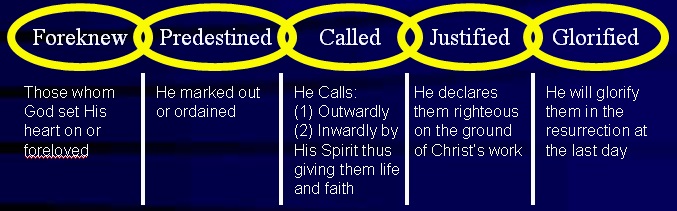
Catholic theologians often object to this take on Romans 8:29,30 because they reject once saved always saved, but they misunderstand, authentic Protestantism does NOT hold to OSAS. More to the point here, the golden chain of salvation is seen as individual, rather than a means of salvation. And that’s what election is: it chooses the means of salvation, and chooses individuals who have roles in the various purposes of salvation. God chose Christ to die on the cross, therefore Christ is elect; He chose the holy angels for certain roles in the salvation process, therefore they are elect; He chose the nation of Israel as part of the process, therefore the nation of Israel is elect, and He chose certain individuals throughout history to contribute to the process of salvation, therefore they are chosen as well to play a part in the means of salvation. That does not mean that they did not have a choice to follow God prior to that choosing for a role in God’s salvific plan. For instance, obviously, God chose the virgin Mary to bear and give birth to Christ as part of the salvation plan. It is also obvious that Mary was saved prior to that choosing. It is obvious that Christ chose the 12 disciples for a role in the slavific plan, but that doesn’t mean they had no choice in choosing God prior to that, hence,
You did not choose me, but I chose you and appointed you so that you might go and bear fruit—fruit that will last—and so that whatever you ask in my name the Father will give you. This is my command: Love each other.
In context, Christ is referring to their election as apostles, not some inability to choose God. As we shall see in the future parts, the REAL golden chain of salvation is a mode of salvation and those used by God to execute it, not a golden chain of salvation that pertains to individual salvation through determinism. Let me now make a beginning case for your consideration. Let me create some reasonable doubt in regard to the Reformed ordo solutis.
First, if you will note once again the Reformed illustration posted in this first part, it illustrates a past tense that preludes present continuous action. This, of course, is necessary for a deterministic conclusion. However, if you carefully examine Romans 8:29,30 it is strictly past tense. Paul is speaking of something that has already taken place. Any other conclusion is presumptuous at best. Paul is writing about something that has been established in the past, or a group of people who have already been glorified. This clearly casts reasonable doubt on the ordo solutis.
Secondly, the ordo solutis would indicate that all of those who are called are also justified, or saved. This is clearly not the case.
Matthew 22:1 – And again Jesus spoke to them in parables, saying, 2 “The kingdom of heaven may be compared to a king who gave a wedding feast for his son, 3 and sent his servants to call those who were invited to the wedding feast, but they would not come. 4 Again he sent other servants, saying, ‘Tell those who are invited, “See, I have prepared my dinner, my oxen and my fat calves have been slaughtered, and everything is ready. Come to the wedding feast.”’ 5 But they paid no attention and went off, one to his farm, another to his business, 6 while the rest seized his servants,treated them shamefully, and killed them. 7 The king was angry, and he sent his troops and destroyed those murderers and burned their city. 8 Then he said to his servants, ‘The wedding feast is ready, but those invited were not worthy. 9 Go therefore to the main roads and invite to the wedding feast as many as you find.’10 And those servants went out into the roads and gathered all whom they found, both bad and good. So the wedding hall was filled with guests.11 “But when the king came in to look at the guests, he saw there a man who had no wedding garment. 12 And he said to him, ‘Friend, how did you get in here without a wedding garment?’ And he was speechless. 13 Then the king said to the attendants, ‘Bind him hand and foot and cast him into the outer darkness. In that place there will be weeping and gnashing of teeth.’ 14 For many are called, but few are chosen.”
In this passage, the “called” are defined: the called are all peoples who are invited to believe in the gospel of the kingdom, and those who except the invitation are of the elect group. Not all of the called are elect. This throws a very large monkey wrench into the Reformed golden chain/order of salvation. Hence, John Calvin came up with three categories of individual preselection: the non-elect; the called; or those temperately chosen/illumined/born again, and those who persevere; or those who are both called and elected in the final analysis. Therefore, assurance of salvation is absolutely impossible in context of the ordo solutis. NO ONE can really know for certain that they are saved until they are “manifested” in the “final tribunal” where “final justification” is determined.
Yet, the apostle John wrote an epistle so that we may “know” presently that we are born again (1John 5:13). The Reformed order of salvation seems apparent based on its deterministic presuppositions, but further investigation is needed.
paul
The Protestant Twisting of 1John: A Clarification, Part 3
 Originally published April 5, 2015
Listen to full show audio here in separate window.
Welcome to Blogtalk Radio False Reformation. This is your host Paul M. Dohse Sr. Tonight, part 3 of “The Protestant Twisting of 1John: A Clarification.” If you would like to add to our lesson or ask a question, call (347) 855-8317. Remember to turn your PC volume down to prevent feedback. Per the usual, we will check in with Susan towards the end of the show and listen to her perspective.
If you would like to comment on our subject tonight, you can also email me at paul@ttanc.com. That’s Tom, Tony, Alice, Nancy, cat, paul@ttanc.com. I have my email monitor right here and can add your thoughts to the lesson without need for you to call in.
We are going to back up a little bit to start tonight’s lesson in order to observe some very important addendums to our series. I am just going to simply state the first one that is something to keep in mind while you read the book of 1John. John states two primary purposes for writing the letter. First…
1John 1:4 – And we are writing these things so that our joy may be complete.
Tradition holds that the apostle John wrote this book, and obviously on behalf of the apostles. Note how the ESV translates “our joy.” Taking other translations into consideration, the “our” probably includes all those who have fellowship with the Father. Also…
1John 5:13 – I write these things to you who believe in the name of the Son of God that you may know that you have eternal life.
The achievable goal for every Christian is joy and assurance of salvation. Obviously, falling into the false teachings that John was contending against was going to steal that from them. More importantly, we must keep in mind that this letter claims to have the knowledge that leads to joy and full assurance of salvation.
But in addition, there is something else I want to take note of. It’s a third primary reason that John writes this epistle:
1John 1:3 – that which we have seen and heard we proclaim also to you, so that you too may have fellowship with us; and indeed our fellowship is with the Father and with his Son Jesus Christ.
You might miss it because instead of referring to the writing of it, John wrote that “we proclaim also to you,” and the stated reason is mutual fellowship with the Father and the Son. These aren’t the only stated reasons for writing this epistle, but they are primary and let’s review them: joy, assurance, and fellowship.
Note that the apostles didn’t write this letter demanding that their authority be followed. The letter is written for the benefit of the readers and fellowship. Again, notice the fellowship is mutual fellowship with the Father and His Son. The goal is a mutual goal of fellowship, joy, and assurance. We find this elsewhere in Scripture.
2Corinthians 1:21 – And it is God who establishes us with you in Christ, and has anointed us, 22 and who has also put his seal on us and given us his Spirit in our hearts as a guarantee.
23 But I call God to witness against me—it was to spare you that I refrained from coming again to Corinth. 24 Not that we lord it over your faith, but we work with you for your joy, for you stand firm in your faith.
That’s it. Teachers don’t lord it over people’s faith, they co-labor for their joy. This pattern of co-laboring versus authority saturates the New Testament while elder authority is conspicuously missing. Do you know why proponents of elder authority always go to Hebrews 13:17? Because that’s the only verse they have, so let’s address it. This series is about why Protestants twist 1John and we have looked at a lot of things in the first two parts, but a distorted view of what Christian assembly really is also comes into focus in this discussion.
Are we merely part of a club that gets us into heaven in the end, or is salvation a settled issue leading to the gathering together for service and good works? Obviously, as with the Protestant case, if you need a continued forgiveness of “present sin,” and that forgiveness can only be found in allegiance to the institutional church, your whole interpretation of Scripture is going to be overshadowed by that.
The introduction to 1John emphasizes what gathering together as Christians is all about: fellowship, not authority. Home fellowships are an organized body of gifts under one head for the purpose of faith working through love. The church is a mediator of progressive salvation through authority structure and co-mediation with Christ. The goal of the institutional church is getting people from salvation point A to salvation point B and collecting a temple tax for that purpose. The goal of home fellowships is the full exploitation of the gifts granted to every believer. Leaders equip for that purpose and lead by example while the only authority is Christ. Throughout the New Testament assemblies are called on to strive for unity in the one mind of Christ.
That’s what we are going to focus on tonight. We are going to debunk the whole notion that there is horizontal authority in the body of Christ. All authority is vertical because Christ said ALL authority has been given to Him, and ALL means “all.” Let’s think about this: a horizontal authority also assumes the dictation of truth by those who have an elevated ability to understand truth. Folks, you cannot separate authority from a claim on truth. We hear this all of the time in the church, this idea that the elders need to be obeyed because they are preordained to understand things you cannot understand. We hear this all of the time. And does this impact the book of 1 John? Sure it does.
1John 2:19 – They went out from us, but they were not of us; for if they had been of us, they would have continued with us. But they went out, that it might become plain that they all are not of us. 20 But you have been anointed by the Holy One, and you all have knowledge. 21 I write to you, not because you do not know the truth, but because you know it, and because no lie is of the truth. 22 Who is the liar but he who denies that Jesus is the Christ? This is the antichrist, he who denies the Father and the Son. 23 No one who denies the Son has the Father. Whoever confesses the Son has the Father also. 24 Let what you heard from the beginning abide in you. If what you heard from the beginning abides in you, then you too will abide in the Son and in the Father. 25 And this is the promise that he made to us—eternal life.
26 I write these things to you about those who are trying to deceive you. 27 But the anointing that you received from him abides in you, and you have no need that anyone should teach you. But as his anointing teaches you about everything, and is true, and is no lie—just as it has taught you, abide in him.
Why do you think John wrote that? Those who were trying to deceive them were claiming a higher knowledge that the common believers were supposedly not privy to. And by the way, this is a hallmark of Gnosticism which was cut from the same block as Plato’s epistemological caste system. Anyway, let’s debunk this whole idea of horizontal authority among God’s people.
Before I do, I would like to add yet another thought. I have spent eight years researching the Protestant false gospel of progressive justification and refuting it, but I am beginning to think of it as just another mere symptom of the bigger problem: “the church,” the marriage of authority and Christianity.
The Bible states that there is one mediator between God and man, the Lord Jesus Christ (1Timothy 2:5). I now realize the real significance of that after eight years of research. I see “one” really means “one.” Something has happened this week that this ministry is taking note of: HBO’s documentary “Going Clear” on Scientology premiered 3/29/2015. Megan Kelly of Fox News interviewed one of the key figures featured in the documentary who shared an astonishing bit of information: members who offend leadership are locked up in a literal prison until they repent of whatever the offense is; release is contingent on signing a written confession. Kelly was incredulous that any adult would agree to such a thing and asked the guest if he could explain it. I was surprised when the guest said he could not explain it.
Maybe the explanation is too simple, but here it is: every false gospel opposed to the gospel of Jesus Christ is predicated on the idea of an additional mediator between God and man other than Christ. Even if one man or women is representative of the false doctrine, it will always be expressed in the form of an institution and its authority. Rather than all authority and mediation being in Christ, a subset of Christ’s mediation and authority is claimed; a claim that has no biblical merit whatsoever. These religious institutions always claim authority to grant salvation on behalf of God as co-mediators, but will also use the authority of government whenever they can get away with it.
So why do the institutional members of “the church” agree to every insane notion proffered by these institutions? It’s not complicated in the least: their salvation depends on it. The temptation is great; people relate truth with authority and want to be told how to get to heaven. Some sort of lofty authority gives the seekers confidence that God will accept their salvific pedigree. And Scientology has all of the elements common with these institutions, especially a strong emphasis on glorious infrastructure.
This documentary is important because Scientology is indicative of institutional religion in general. It claims authority and mediation it doesn’t have, quibbles over words, and entangles itself in the frivolous affairs of the world. And another important element–a major one should be noted as well: cults are spawned by authority. Hence, religious institutions often get a pass on being cultic because people don’t understand the catalyst of cultism: authority.
The alternative is a functioning body under one head. Gifts replace rank, and fellowship replaces authority. The goal is agreement on truth as defined by Christ and agreement according to conscience determines who fellowships together. Christ said, “All authority has been given to me.” ALL means “all.” If people get together for the purpose of following an authority anyway, why not Christ as opposed to some man or institution? If the divide in regard to what Christ is saying is too wide, go start your own group–Christ is the final judge anyway. A final point: institutions focus on getting people to heaven; fellowships focus on the unfinished work of service to God and others.
The following are relevant audio clips that make the point. First two are from Pastor John MacArthur Jr., and the third is from Pastor James MacDonald.
These clips are just too rich and could be the whole show. I mean surely, someone has some thoughts on theses clips. Where to start? When MacArthur talks about putting ourselves under the authority of godly men, what are the parameters of such authority? Historically in regard to the institutional church, this authority knows no bounds. And did you notice who decides what your gifts are? That’s right, not you, the leadership. Oh my, let’s just throw out one little example of this going completely wrong. If a guy gets saved but his wife doesn’t, she just may divorce him eventually. The Bible is very clear on this; the believing spouse is no longer obligated to that marriage. But if that young man comes to believe that he is called to be an elder—you can forget it. So, he will not fulfill his gift because of the traditions of men, and that’s a pity.
Many more examples could be given, but let’s get into our argument against authority among God’s people, or what I will call horizontal authority. The argument is that God’s people are a body of gifts cooperating together with one head. Horizontal co-laboring with vertical authority. I am going to be arguing this from a message I taught on Romans 14:2-12 titled, “Authority’s Assault on Unity.” So here we go, let’s see if we can learn anything.
The week before this lesson we talked about the mystery of the gospel. The mystery is God’s intention to bring Jew and Gentile into one body by the Spirit. Undoubtedly, this posed significant unity challenges because of the diverse cultures. When the Romans inquired of Paul as to whether or not they should bother associating with Jews due to these cultural differences, it sent Paul scrambling for his writing utensil because that issue is one of the core values of the gospel itself.
The bone of contention was dietary laws and the observance of days which would have been deeply entrenched traditions for the Jews. In addition, there were a plethora of issues among the Jews concerning the decadent culture of the Gentiles. Some of these issues included the eating of meat and its preparation according to Old Testament law. For sure, pork was out, but there were other issues, apparently, with meat sacrificed to idols and then sold on the open market at a reduced price. Hence, because what had been done with meat would have been ambiguous in many cases as far as its source and preparation, it’s possible that many Jews decided to play it safe and become vegetarians.
As far as convictions concerning the observance of days in this transition from the old covenant to the new, there would have been many days sacred to the Jews that would have had little significance among the Gentiles. So, what is Paul’s solution to these differences for purposes of fulfilling the mystery of the gospel?
In verse 2, Paul identifies the two parties: Gentiles who believe they can eat anything, and the weak Jew who understandably was not yet up to speed on the mystery of the gospel in regard to the law. Also consider, much like today, the Jews had been dumbed down in regard to Scriptural knowledge. The leadership of that day replaced Scriptural truth with the traditions of men. Specifically, like today, the integration of Gnosticism with Scripture saturated Jewish thought and religion.
In verse 3, Paul defines the attitudes that fueled the division between Jew and Gentile: the ones who eat should not “despise” the ones who don’t eat; i.e., the Jews, and the Jews should not “judge” the ones who eat according to what? Right, the law. And why? Because God had come to receive who? Right, the Gentile. Paul shifts his focus to the Jewish responsibility of accepting the ones God received into the one body regardless of the fact that they did not keep or regard much of the Old Testament law. This would have been a really challenging transition of thought for the Jew. But the main point here is that the Jew had a tendency to “judge” because they had the what? Right, the law.
The way Paul addresses this (v. 4) towards the Jew is very interesting. In that culture or the Jewish culture as well, it would have been very uncouth to tell another person’s slave what to do. It would have been absurd. In ancient times there were many types of slaves in regard to social strata, but let me use the types of slaves that were more like today’s employee as an example. It would be like a manager from Wendy’s walking into a Kentucky Fried Chicken and telling those employees what to do. Or, closer to the point Paul is making, openly criticizing them in some way. The absurdity demonstrated in this illustration falls a little short because the servants Paul is talking about only served their own masters whereas in my illustration you could argue that the Wendy’s manager was a customer at KFC and had a right to complain about something. But slaves of Paul’s day only served one master. Christ used the same kind of illustration Paul is using here when he said you cannot serve two masters.
So, what Paul is saying is that ALL Christians, Jew and Gentile, only have one master, Jesus Christ.
4 Who are you to pass judgment on the servant of another? It is before his own master that he stands or falls. And he will be upheld, for the Lord is able to make him stand.
“It is before his own master that he stands or falls” is a reflection of the slave culture. Typically, slaves only answered to one master. This is interesting to think about in our day. First, like most of the New Testament writings, and for that matter the Old Testament writings as well, the letter is addressed to the whole group. It also regards the problem with arguing over what Paul called, “opinions.” In all of this, where is elder involvement discussed? Thirdly, Paul is about to teach us that no one has a right to judge you or others in the Christian realm because everyone answers to one master and one master only—Jesus Christ.
The more one studies the Scriptures independently, the more one notices that elders (or pastors) are conspicuously missing. The context of Romans 14 makes the absence of elders odd in our minds because of what we have been taught about “elder authority.” We see this elsewhere concerning conflict among God’s people. In Matthew 18:15-20, again, elders are conspicuously missing. Often we hear the call to be willing to “place ourselves under the authority of godly men.” What I understand here is that we only have one master. Salvation is not in view here, the authority to pass judgment on another is what is in view. What is in view is a judge who is able to make the Christian “stand or fall.”
What becomes more and more clear is the fact that “pastor” or “elder” is just another gift and has NO element of authority. It has even been suggested that elders are optional for home fellowships where Christians gather together for edification and fellowship. The suggestion is that 1Timothy 3:1 could refer to a fellowship’s desire to have an elder and not necessarily an individual’s desire to be an elder. Practically, this makes sense because wherever God’s people meet there may not be any elders. What I am saying follows: in geographies where there is no sound gathering of professing Christians, saints are not forced to fellowship there because eldership validates an assembly. Clearly, it can be surmised that some 1st century Christian fellowships had elders and others didn’t.
But at any rate, elders are not lords (1Pet 5:3), they are leaders. Even the apostle Paul stated that he was to be followed only as long as he followed Christ (1Cor 11:1).
Putting all of these ideas together, I like the rendering of 1Timothy 3;1 by the Complete Jewish Bible (CJB):
Here is a statement you can trust: anyone aspiring to be a congregation leader is seeking worthwhile work.
Elders lead by example. I believe their oversight is primarily a proper interpretation of the Bible. They are ministers of the word (Acts 6:4). We only have one Lord—Jesus Christ. The apostle Paul continually pointed to the authority of God’s truth as the only authority:
Galatians 1:8 – But even if we or an angel from heaven should preach to you a gospel contrary to the one we preached to you, let him be accursed.
1Corinthians 3:21 – So let no one boast in men. For all things are yours, 22 whether Paul or Apollos or Cephas or the world or life or death or the present or the future—all are yours, 23 and you are Christ’s, and Christ is God’s.
Paul sets forth another rule in verse 5: Each believer should be persuaded (KJV) in their OWN mind. There needs to be space given for everyone to grow in wisdom. See here that we don’t believe certain things just because certain people believe it. We are to be persuaded in our OWN minds through the continued study of God’s word. PERSUASION is a major theme in the New Testament. The idea of persuasion is often translated “obey” in English translations for some incredibly strange reason. Listen, “obedience” is not the heavy emphasis among believers, persuasion is the key. Here is the word for persuaded in verse 5:
g4135. πληροφορέω plērophoreō; from 4134 and 5409; to carry out fully (in evidence), i. e. completely assure (or convince), entirely accomplish:— most surely believe, fully know (persuade), make full proof of. AV (5)- be fully persuaded.
Listen, before I develop this important aspect of persuasion, I am going to jump ahead to Paul’s next principle of motive in verse 6:
The one who observes the day, observes it in honor of the Lord. The one who eats, eats in honor of the Lord, since he gives thanks to God, while the one who abstains, abstains in honor of the Lord and gives thanks to God.
Giving room for motive is huge in our day because we are all so dumbed down theologically. Admittedly, these are difficult waters, but if the home fellowship movement is going to work, we need to chill out on the dogma thing and emphasize the fact that we all need room to grow in God’s word. What we are looking for is honest seekers of truth—people who are persuaded by truth and the one mind of Christ that brings unity. Basically, a genuine love for the truth. That’s THE truth not A truth.
Meanwhile, Paul is saying that the spiritually weak have the right motives and are thankful to God. Other than a love for the truth, even the spiritually weak will have a spirit of thankfulness.
Probably, the beginnings of fellowship should begin with a fundamental agreement on the gospel of first importance and the sufficiency of God’s word. From there, you study the Scriptures together and let all be fully persuaded in their own minds. It boils down to this…
Does the person love THE truth? (2Thess 2:10).
Now, back to developing verse 5. I am going to develop this point by looking at Hebrews 13:17:
Obey your leaders and submit to them, for they are keeping watch over your souls, as those who will have to give an account. Let them do this with joy and not with groaning, for that would be of no advantage to you.
As we can ascertain so far, no one among God’s people can demand that you believe anything—only Christ has the authority to demand that you believe something. Otherwise, it would have been like passing judgment on someone else’s slave which was an absurd notion in that culture. In contrast, what is in vogue in our day is this whole idea of “putting yourself under the authority of godly men” lest you be a spiritual sluggard. A verse often used is Hebrews 13:17.
The word for “obey” is the following word:
g3982. πείθω peithō; a primary verb; to convince (by argument, true or false); by analogy, to pacify or conciliate (by other fair means); reflexively or passively, to assent (to evidence or authority), to rely (by inward certainty):— agree, assure, believe, have confidence, be (wax) content, make friend, obey, persuade, trust, yield.
The idea is to be persuaded, or following as a result of being persuaded or convinced. The same word is used about 50 times this way in the New Testament. Here is just one example:
Matthew 27:20 – Now the chief priests and the elders persuaded (peithō) the crowd to ask for Barabbas and destroy Jesus.
There is a Greek word for outright obedience, it is…
g5219. ὑπακούω hypakouō; from 5259 and 191; to hear under (as a subordinate), i. e. to listen attentively; by implication, to heed or conform to a command or authority:— hearken, be obedient to, obey.
Here is one example of about 20 in regard to how the word is used in the New Testament:
Matthew 8:27 – And the men marveled, saying, “What sort of man is this, that even winds and sea obey (hypakouō) him?”
Again, among fellow Christians, we don’t demand obedience, we persuade. Elders lead, but they do not have Christ’s authority. You obey Christ no matter what. Such is not the case with elders or pastors. Notice in all of chapter 14, the key to unity is not the authority of leaders.
Continuing on…
7 For none of us lives to himself, and none of us dies to himself. 8 For if we live, we live to the Lord, and if we die, we die to the Lord. So then, whether we live or whether we die, we are the Lord’s. 9 For to this end Christ died and lived again, that he might be Lord both of the dead and of the living.
Honestly, I am not entirely sure of the point Paul is making in verses 7-9. There is even the transition “For” that links this idea to the previous thought in verse 6, but it’s like Paul just parachutes this idea in here out of nowhere. Each sentence in verses 7-9 link together with verse 6 by a conjunction, “For,” “So then.” Somehow, Christ being the Lord of those who have passed on figures into the equation, but I simply don’t know how.
At any rate, Paul is back to the main point with verses 10-12:
10 Why do you pass judgment on your brother? Or you, why do you despise your brother? For we will all stand before the judgment seat of God; 11 for it is written, “As I live, says the Lord, every knee shall bow to me, and every tongue shall confess to God.” 12 So then each of us will give an account of himself to God.
This is clear, we will all give an account for ourselves regarding what we have done as Christians in the body (1Cor 3:10-15, 2Cor 5:10). Therefore, do not judge a fellow believer who is doing his/her best to honor God with what knowledge they presently have.
Second, let them be convinced in their OWN minds.
Third, stay focused on glorifying God in regard to the purposes of the mystery of the gospel.
At this time, let’s go ahead and take calls.
Romans 9:11- God Does Not Choose, He Calls
 How should we interpret our Bibles? Clearly, Christ set the example. Throughout the gospels He reasoned with many via interpretation based on the technical meaning of words and how they are used in a sentence. We are to interpret the Bible grammatically. Also, the Bible is purposely written in a way that defines certain words according to the plain sense of context; so, while knowing Greek and Hebrew may be helpful, it’s far from being a prerequisite to understanding. The rules of grammar, for the most part, transcend culture. A noun is a noun, and a verb is a verb in any language. To even cite examples of this is to state the obvious, but I will mention Christ arguing for the resurrection based on the tense of “I am” in Matthew 22:31,32.
So, in regard to the question of determinism and the idea that God chooses some for salvation and others for damnation, we find something in the grammar of Romans 9:11 that should give us pause.
…though they were not yet born and had done nothing either good or bad—in order that God’s purpose of election might continue, not because of works but because of him who calls—(ESV)
If the point of Romans 9 is God’s pre-choosing of some for salvation and not others, why would Paul not have written, “because of him who chooses” rather than “him who calls”? Did Paul have a senior moment? Also peculiar to this passage is the stated purpose of election: the eradication of works from salvation. It seems that election accomplishes this for purposes of God calling all people to accept salvation as a pure gift rather than God’s choosing being the linchpin. Note the following:
For the gifts and the calling of God are irrevocable (Rom 11:29).
Again, why is it not the choosing of God that is irrevocable rather than the calling? This grammatical roadblock to determinism was not missed by John Calvin. If choosing and calling are something different, it could mean that the means of salvation was chosen for a particular purpose and then offered to all people as a gift that they could choose themselves or reject. Hence, Calvin separated determinism into 3 separate categories: the non-chosen, the temporarily chosen (the called), and the truly chosen (those who persevere). But of course, Calvin’s three-fold election construct is rarely discussed in Reformed circles for obvious reasons. You can add this fact to the list of other Reformed dirty little secrets relegated to the closets lest they would incite some sort of chemical reaction of thought within the cranium cases of Reformed Kool-Aid drinkers. And of course, no one is going to challenge me to come up with the specific citations from the Calvin Institutes because they know I can.
Here is my rudimentary hypothesis at this time: “election” is primarily a noun in the Scriptures that denotes a category of people and purpose while “calling” is the action taken by God, or the verb. God calls people, He doesn’t choose them. God chose the means of salvation, and calls all people to accept the means of salvation as a gift. The purpose of election is that salvation would be by PROMISE, and not works. Also, “election” is primarily defined in terms of miraculous new birth into the family of God and something made entirely possible by God alone. Any Bible passages that seem to make a direct connection between election and God’s choosing of individuals are rare, or completely absent at most, and ambiguous at least.
Let’s also remember that those who are not in need of salvation are also considered to be God’s “elect”; namely, the holy angels and Christ. The nation of Israel is elect for a particular purpose, and this is perhaps the best definition of election: it is a chosen means to obtain a particular purpose. God chooses the means of salvation, not individuals. Election makes salvation a pure gift and promise apart from the will of man or his abilities, but mankind is free to choose or reject the gift. True, because man fears the condemnation of God, his tendency is to not seek God, but the loving God seeks out mankind through the gospel. God seeks out man and corners him with the truth of the gospel, but man’s tendency to hide from God does not mean he has no ability to make a choice.
A good example of the ambiguity that surrounds the idea of God choosing individuals is 1Peter 5:13. Depending on the translation, it’s the “sister” that is chosen or the “church.” If the latter, that makes my point, but more interesting is the disagreement in translations concerning “elect” used as a noun or adjective as opposed to “chosen” or “elected” regarding those defined by an action, or verb. While the likes of the ESV translate “elect” as… “elected,” or “chosen,” many other mainstream translations like the ASV translate it “elect” without the ed suffix. In other words, a statement concerning the fact that we are all part of the family of God and His plan of salvation does not necessarily equal determinism, or the idea that “elect” equals those who were predetermined to be in the family of God coupled with total inability on man’s part to choose God.
And, if Christ wasn’t mincing words in His argument for the resurrection, neither is this consideration by any stretch of the imagination. And it’s funny; when I was doing word study on this and initially observed 1Peter 5:13 with the word “elected,” I assumed that if my hypothesis held any water that I would also find translations using the word “elect,” and as noted, that in fact ended up being the case.
If you follow the apostle Paul’s argument throughout Romans 9, 10, and 11, and Galatians 3 for good measure, the concern is that salvation is solely by the promise of miraculous new birth. Whether Sarah, Rebekah, Elizabeth, Mary, or the Spirit’s role described in Galatians 3, salvation is NOT by any will or work of man, but a onetime miraculous new birth. A denial of literal new birth paves the way for progressive justification via determinism which is the number one nemesis of the true gospel.
The new birth is a work of God alone, but that doesn’t mean man cannot choose it.
paul
The Protestant Twisting of 1John: A Clarification, Part 2
 Originally published March 31, 2015
Listen to show or download audio here.
Listen or download full show uninterrupted.
Welcome to Blogtalk Radio False Reformation this is your host Paul M. Dohse Sr. Tonight, part 2 of “The Protestant Twisting of 1John: A Clarification.”
How is 1John used to argue for a progressive salvation, and what is John really saying in his epistle? That’s what we are discussing tonight. If you would like to add to our lesson or ask a question, call (347) 855-8317. Per the usual, we will check in with Susan towards the end of the show and listen to her perspective.
If you would like to comment on our subject tonight, you can also email me at paul@ttanc.com. That’s Tom, Tony, Alice, Nancy, cat, paul@ttanc.com. I have my email monitor right here and can add your thoughts to the lesson.
Ok, so this whole idea is very Protestant, that we must keep going back to the same gospel that saved us in order to keep ourselves saved. But, it’s all good because we are going back to the “gospel” and the “gospel” is by faith alone so going back to the gospel is a faith alone work which isn’t really a work. So, it’s ok to do something to keep ourselves saved as long as it’s a faith alone work.
As we discussed last week, here is where the home fellowship movement stands apart from the institutional church: salvation is a finished work; salvation is NOT a progression from point A to point B. The new birth is a onetime instantaneous quickening of the believer. The believer then in fact does move on to something completely different—kingdom living, or discipleship. Central to Protestantism is the idea that moving on from the gospel to doctrinal maturity is an abomination. The who’s who of Protestantism can be cited many times in stating this in no uncertain terms.
The home fellowship movement is not a mere preference over the institutional church—it is an anti-progressive justification movement. It is a return to the true gospel of Christ. All of the institutional church either embraces progressive justification or is willing to fellowship with it and is therefore altogether guilty.
Last week, we also introduced the fact that 1John must be interpreted according to its historical context. The number one nemesis of the 1st century assemblies was Gnosticism and 1John is a treatise against it. We covered John’s introduction which was a direct pushback against the Gnostic idea that the spiritual Christ did not die on the cross. We believe that John was specifically addressing the Gnostic teachings of Cerinthus. He taught that there was more than one Christ; one born naturally of human parents that will be resurrected with all other men in the last days, and the spiritual Christ who dwells in heaven. Elsewhere, John wrote:
1John 4:1 – “Beloved, do not believe every spirit, but test the spirits to see whether they are from God, for many false prophets have gone out into the world. 2 By this you know the Spirit of God: every spirit that confesses that Jesus Christ has come in the flesh is from God, 3 and every spirit that does not confess Jesus is not from God. This is the spirit of the antichrist, which you heard was coming and now is in the world already.”
The very definition of antichrist teachings is the denial that the true Christ (Messiah) was part of the material world, or actually came in the flesh. Gnostic systems of thought are very complex, but the cardinal principle is that material is evil and the spiritual or invisible is good.
The important distinction is that biblically, the material creation is not inherently evil, but weak. This is an important distinction because Christ coming as man makes it possible for men to be literally recreated and part of God’s literal family. The teaching that “denies Jesus is the Christ” (Messiah: 1Jn 2:22) circumvents the new birth. Throughout this epistle, John refers to the recipients as “little offsprings”(teknion; little children). I want to dig into this a little deeper; the new birth and its relationship to apostolic succession, but first, let me address the crux issue here.
John was also addressing an aspect of Gnosticism that believed the following: sin only resides in the material, and the spiritual part of man is sinless and has never sinned. In essence, it doesn’t matter what we do in the body because the spiritual part of man is sinless and has never sinned, and that is the only part of man that is eternal anyway. Many scholars concur that this was a common form of Gnosticism. Of course, this disavows any need for Christ to die on the cross and makes the knowledge of this supposed lie salvation itself. Salvation by being made into something new is out—coming to grips with the gnosis regarding man’s inner spark of divinity is in. This backdrop now explains exactly what John was getting at in 1John 1:7-10 and 2:1,2.
1John 1:7 – “But if we walk in the light, as he is in the light, we have fellowship with one another, and the blood of Jesus his Son cleanses us from all sin. 8 If we say we have no sin, we deceive ourselves, and the truth is not in us. 9 If we confess our sins, he is faithful and just to forgive us our sins and to cleanse us from all unrighteousness. 10 If we say we have not sinned, we make him a liar, and his word is not in us.”
1John 2:1 – “My little children, I am writing these things to you so that you may not sin. But if anyone does sin, we have an advocate with the Father, Jesus Christ the righteous. 2 He is the propitiation for our sins, and not for ours only but also for the sins of the whole world.”
“We” in these verses should be viewed as speaking to mankind in general while including both saved and unsaved individuals. Recognizing that Christ came to deal with man’s sin problem is efficacious to the gospel.
John is NOT stating the Protestant gospel of “deep repentance” which teaches that we keep ourselves saved (or washed) via a “lifestyle of repentance.” That would be a perpetual return to the same gospel that saved us for relief from “present sin.” That flies in the face of biblical justification. This makes “if” in these verses a conditional conjunction. That would mean that our sins continue to be forgiven, or washed, or cleansed “if” we “walk in the light” and continue to repent. That’s clearly works salvation, and clearly a reapplication of Christ’s sacrifice to present sin. As actually taught in Protestant circles, the sacrifice only happened once, but the remembrance of it continues to cleanse present and future sins.
This is the whole deal behind, “We must preach the gospel to ourselves every day” and the vital union doctrine. Living a “lifestyle of repentance” or deep repentance “keeps us in the love of Jesus.” This is salvation by Jesus + deep repentance to keep ourselves saved. The Reformed say, “No, it’s not works because repentance is a faith alone work,” but not even a so-called faith alone work can keep you born again—you can’t unborn yourself by not doing something. Look, here is the money point on all of this: the needed present and future forgiveness can only be found in the Protestant institutional church via baptism/formal membership. And we will be addressing that a little further along.
One of the many problems with this is, in regard to believers, follows: in order for present sin to exist, there has to be a law, and the blood of Christ ended the law—it’s a onetime cleansing. To have some need to reapply the blood of Christ to present sin implies that there is still sin, and there is not because where there is no law—there is no sin, and Christ died on the cross to end the law. This fact is found in Romans 3:19,20, 4:15, 5:13, 7:8, 10:4.
Some insist that John’s context here is fellowship, and since fellowship is the context, John is writing about repentance that is necessary to keep us in proper family relationship with God, and not a repentance that keeps us in the family of God; ie., John is talking about sanctification and not justification. Frankly, that’s the view that I used to hold to as well.
But John is talking about the onetime cleansing that justifies. Note that throughout these verses that it is a forgiveness that cleanses from “all sin” and “all unrighteousness.” That has to be justification. What John is saying is that no matter who you are in humanity, you have need to be forgiven of sin by believing that Jesus is the Christ and died for you. Note the subjects of these verses: “He is the propitiation for our sins, and not for ours only but also for the sins of the whole world.”
However, John is also saying that this fact doesn’t give us a license to sin any more than the Gnostics, “I am writing these things to you so that you may not sin.” But watch this: “But if anyone does sin, we [everyone] have an advocate with the Father.” Ok John, an advocate for what purpose? Answer: “He is the propitiation for our sins, and not for ours only but also for the sins of the whole world.” Who are the subjects? It’s obvious who the subjects are.
If this isn’t speaking to a onetime cleansing of sin, the world doesn’t need the new birth any more than Christians—they only need to ask forgiveness so the blood of Christ will be applied to the particular sin. Not only that, the new birth is also disavowed through the denial of a new creaturehood displayed by people who have passed from death to life. And John is speaking directly towards this issue as well. You see, who the “we” are and what the “if” is—is critical to interpreting these verses properly. The “we” are the “anyone.” The “if” is a cause and effect conjunction and not a conditional conjunction.
And let me tell you something, Protestant theologians rarely have any qualms about saying that God’s promises are conditional. I mean, what’s the paramount example? Replacement theology/supersessionism, right? This whole idea that Israel’s election was conditional on them holding up their end of the covenant. I just don’t know what can be more obvious, and this is their exact take on justification as well.
This is the crux. John is saying that if we walk in the light, it’s because we have been born again, not that we keep ourselves born again if we do our part by walking in the light. Walking in the light is not our part of the so-called vital union, we walk in the light because that’s what new creatures do; cows like hay and ducks like water—it’s a cause and effect conjunction not a conditional conjunction.
Now, here is where we really struggle with these verses: in verse 7, the English word in the plural strongly suggests a present continuous action. Verse 9 really isn’t that much of a problem as it’s merely saying that anyone that confesses their sin is cleansed of all unrighteousness. Note the following verse 10 that can be rendered this way: “If we say we have not [never] sinned.” The English “ed’ on the end of sin indicates past tense like, “I sinned.” That’s past tense. If John is speaking to the present continuance, why would he have not written, “if we say that we do not sin.” Right? Verse 9 simply fits into the Gnostic motif that John was arguing against.
Neither is 1John 2:1, 2 a problem. John is simply stating that anyone who recognizes their sin and wants to do something about it has an advocate in Christ who cleanses all sin. And by the way, the rest of John’s letter backs up my Pauline argument to the hilt. Just, all over the place in the rest of the letter, for example,
1John 3:3 – “And everyone who thus hopes in him purifies himself as he is pure. 4 Everyone who makes a practice of sinning also practices lawlessness; sin is lawlessness. 5 You know that he appeared in order to take away sins, and in him there is no sin.”
He came to “take away sin,” not to cover it with His own righteousness and to continue to forgive it. Christ came to end sin altogether. Are we “in Christ”? Well, in Him there is NO sin. So if we are in Him, why would we need forgiveness for present or future sin in regard to justification? In 1John 2:12-14, forgiveness of sin and overcoming the evil one is spoken of in the past tense.
The only matter at hand is the word “cleanses” in verse 7. Let me point something out to you. Most of the English translations that we have come out of the Protestant Reformation. Therefore, and there are myriads of examples of this, the translations are tainted with progressive justification presuppositions. And unfortunately, this includes the Greek word-study helps. Here is something I read in one:
Every encounter with a command to obey, is our opportunity to jettison self-reliance and to yield to the enabling power of the Holy Spirit. Supernatural commands from the supernatural God can only be carried out with reliance on His supernatural power! The Spirit is called the Helper, but don’t let His Name mislead you. To say that we need His help is to imply we have some ability of our own to obey and are in need of a little “push” so to speak.
See the problem? You can know the Greek backwards and forwards, but what good does it do if “help” doesn’t mean “help”? Look, what good have all of the Protestant Greek scholars done for us? I came to realize the problem of progressive justification by my own independent study in Romans. The basic concept easily understood regardless of the language, “where there is no law there is no sin.” That statement astounded me, but was the key to unraveling the whole mystery. Once you understand that fundamental, the rest of the Bible, when taken in context, fits together perfectly in every way. How much did any knowledge of Greek aid me in this understanding? Nada. Goose egg. Zilch. Loco zippo.
Greek can be confirming, and helpful, but the Bible is written in definitive structures that mean the same thing in all languages and that is no accident. You can translate the fact that Christ died on the cross to end the law, and where there is no law there is no sin, any way you want to—it’s going to mean the same thing in any language. Then you start seeing where the concept fits together with everything else in the Bible which enables you to nail down what the anomalies are. And a lot of the anomalies are bias towards a certain worldview.
Notice in the example I gave there is no room given for an authentic colaboring between us and the Holy Spirit. It is either all us or all of the Holy Spirit. My friends, that is the Protestant redemptive-historical worldview to a T and it is fundamentally Gnostic in its premise. Hence, when you use Greek word-study helps, you are often dealing with the same bias. This is why I eventually threw away my Kenneth Wuest expanded New Testament translation. I started seeing clear bias in how he processed the Greek verbs and I was totally done with him at that point.
I spent the better part of yesterday researching 1John 1:7 and the word “cleanses” therein. We know from biblical context that this verse cannot be saying that the one sacrifice of Christ continues to rewash us IF we continue to walk in the light; ie., Protestantism. And let me give you the thumbnail: if you remain faithful to the institutional church and its sacraments/ordinances, that keeps you saved. Even if the Greek usage indicates a present continual action there is no way to distinguish that from the simple reality of being washed once and remaining clean thereafter. In other words, there is no way to definitively distinguish between two intents: a required reapplication to reinstate a status or an unchanged status that continues in the same state without any further action.
Though “cleanses” appears to be some kind of continuing action in the ESV version of 1John 1:7 as well as many other versions, we know that this same cleansing of regeneration is clearly stated as a onetime final act in many, many other Bible passages. For example,
1 Corinthians 6:11- “And that is what some of you were. But you were washed, you were sanctified, you were justified in the name of the Lord Jesus Christ and by the Spirit of our God.”
Ok, you have “were” in there four times with sinful lifestyles being in the past tense, and sanctified, justified, and “washed” being in the present tense. It is one event that happens one time and transforms us into an immutable state. Period. This is irrefutable. And by the way, if you do a New Testament word search on the exact form of the Greek word “cleanses” (other translations “cleanseth”) in 1John 1:7, it is almost always used as a onetime ceremonial cleansing.
Matthew 8:2 – “And behold, a leper came to him and knelt before him, saying, ” Lord, if you will, you can make me clean.” 3 And Jesus stretched out his hand and touched him, saying, “I will; be clean.” And immediately his leprosy was cleansed.” [Here in Mathew 8:2, the same exact form of the Greek word is used for past, present, and future tense. “Ed” is added to the English word “cleansed” to indicate past tense].
Note how Young’s Literal Translation has 1John 1:7.
“and if in the light we may walk, as He is in the light — we have fellowship one with another, and the blood of Jesus Christ His Son doth cleanse us from every sin;”
Now, not only does this simply state the fact that the blood of Christ cleanses us from every sin with a much less conditional translation, it’s interesting that the YLT picks up on something that Andy related to me yesterday in regard to the word “may”:
What is interesting is that all of the examples that John uses where he says “if” are all 3rd class conditions. All the key verbs are in the subjunctive mood.
Here is an excerpt regarding 3rd class conditions…
“The third class condition often presents the condition as uncertain of fulfillment, but still likely. There are, however, many exceptions to this…The third class condition encompasses a broad range of potentialities in Koine Greek. It depicts what is likely to occur in the future, what could possibly occur, or even what is only hypothetical and will not occur” (Wallace, p. 696).
So John is really posing a series of future hypothetical situations. Any place where it says “if” you should read it as “if ever in the future…” or “if at any time in the future…”
It would appear that this seems to be an exercise in reason using hypothetical examples to refute the gnostics that were among them in those assemblies. Notice that the present tense verbs are present tense because they are in the conclusion (apodosis) to the proposed hypothetical conditional premise (protasis). But the verbs in the premise (protasis) are in the subjunctive mood.
Also, you cannot read verse 7 without verse 6. Verse 7 is an antithetical conclusion of verse 6. In other words, you can’t properly interpret vs 7 without vs 6. In fact, notice how 7 contrasts 6, AND vs 9 contrasts vs 8 also! They are parallel arguments, and then vs 10 kind of sums it up.
This bolsters my contention that John is addressing people in general regarding the ramifications of their beliefs about sin in contrast to Gnosticism. That’s the crux here: the backdrop is the Gnosticism John is addressing. If you say that you have no sin, for whatever reason, you are making God out to be a liar. But if you confess your sin, God will cleanse you from all unrightousness. And, that will have an effect on your life because you have been cleansed. John does not hone-in on the new birth right here, but does so in chapter 3 bigtime. Really, chapter 3 clarifies exactly what is being stated in the first two chapters.
In addition, John is saying that even though those who confess their sin are cleansed of all sin, that is not a different kind of license to sin without ramifications. Hence, “…I am writing these things to you so that you may not sin.” But if you do recognize that you have sin, we have an advocate with the Father that is a propitiation for all sin, those who confess that they have sin, and those who may in the future confess that they have sin—this is what is going on in this passage. And by the way, this is another refutation of limited atonement as well.
Let me give another example that might help clarify all of this. One Reformed fellow (a disciple of Paul David Tripp) arguing against me in regard to all of this stated the following:
In John 4, we are to drink once, but that one drink becomes a reserve that refreshes continually. The substance that refreshes is the same (Christ’s salvation, in an ongoing manner)…For Calvin, the cleaning is ongoing, because there WILL be new sins, and 1 John tells us there are new sins. WERE IT NOT FOR the ongoing cleaning and forgiveness, we would exit the family of God, but the faithful know of a certainty that this cleansing is ongoing and present.
See the problem with not interpreting this passage in its historical context? John isn’t talking about “new sins,” he is talking about SIN period. Where is there anything stated in this passage in regard to “new sins”? What relevance does “new sins” have with the unsaved world that is one of the subjects of this passage? The unsaved have “new sins”?
Also, Christians do not have “new sins” because Christ ended the law and where there is no law there is no sin. This is exactly why the Protestant gospel keeps people under law—the whole concept of “new sin.”
In addition, notice what he states about John 4 that is a common Reformed position:
“In John 4, we are to drink once, but that one drink becomes a reserve that refreshes continually.”
This statement is a common smoking gun that damns Protestantism. In that passage, Jesus said that those who drink of the water will never… (what?) again? Right, they will NEVER “thirst” again. Christians may need refreshment against the weakness of the flesh, but we never need our justification to be refreshed—that’s just a blatant false gospel.
Moreover, note, “WERE IT NOT FOR the ongoing cleaning and forgiveness, we would exit the family of God, but the faithful know of a certainty that this cleansing is ongoing and present.” This is where the “if(s)” of 1John totally shoot Protestantism in its gospel foot. If you take this approach, the if(s) of 1John 1:7-2:2 are conditional upon confessing “new sins.” This clearly makes the cleansing of sin that makes us part of God’s family conditional. It makes the new birth conditional. “If” we don’t confess, we can be unborn.
Doesn’t it make much more sense if John is saying that we (people in general) have to recognize that men have sin in order to receive a cleansing from it? Sure it does. John is pushing back against a philosophy that taught the following: man is spirit and therefore without sin; only the material world has sin. Therefore, it doesn’t matter what people do in the body, it’s all just part of the material world that is passing away. This also rejects the new birth and its righteous lifestyle that walks in the light as Christ is in the light and there is no darkness in Him. Those who walk in the light are born of the light and they are of the light because they recognized the need to confess their sin in order to be cleansed. Hence…
John 3:2 – “Beloved, we are God’s children now, and what we will be has not yet appeared; but we know that when he appears we shall be like him, because we shall see him as he is. 3 And everyone who thus hopes in him purifies himself as he is pure.”
Next week, we are going to look at how the rest of the book of 1John fits into this Pauline soteriological schema perfectly. Why does John follow our passage at hand with a discussion of love and then the new birth? How do we get from the gospel anomaly of “new sins” to “love,” and what does that have to do with the new birth? How does all of this make walking in the light synonymous with the new birth?
See you next, and now let’s go to the phones.
The Heidelberg Disputation Series Part 12, Theses 22 and 23: The Vital Union, Ritual, and Law
 Live Link to Program Tonight @7pm
If you would like to add to our lesson or ask a question, call (347) 855-8317. Remember to turn your PC volume down to prevent feedback over your cellphone. If you choose to use Skype to listen to the show, my advice is to just dial direct from your Skype account without using any of the Blogtalk links. 347-855-8317.
Per the usual, we will check in with Susan towards the end of the show and listen to her perspective.
Remember, you may remain anonymous. When I say, “This is your host; you are on the air, what’s your comment or question”—just start talking.
If you would like to comment on our subject tonight, you can also email me at paul@ttanc.com. That’s Paul @ Tom, Tony, Alice, Nancy, cat .com. I have my email monitor right here and can add your thoughts to the lesson without need for you to call in. You can post a question as well.
Tonight, we continue in our sentence by sentence evaluation of the HD with thesis 22. This is where we get into the true heart of the Protestant Reformation which concerned philosophy, or state of being.

 Paul's Passing Thoughts
4 comments