New Calvinism’s Contribution to the Church: it Reveals What Calvin Really Believed
 “A question we often hear is, ‘What is the difference between an Old Calvinist and a New Calvinist?’ The answer: maybe the music style and dress code, but that’s about it, Old Calvinists that don’t know what Calvin really believed about soteriology notwithstanding.…. This is the one area where New Calvinists can recommend themselves: they have a firm handle on Calvinology.”
Once upon a time, there was a family in Christianville that was highly respected among all of the town’s people. They owned the town’s water purification plant and purified the town’s water with a formula that had been in their family for centuries.
Then a distant relative of the family moved into town. He was obviously a fellow of the baser sort. “Well, every family has a black sheep” the town’s people reasoned. But then they found out this relative had also purified water in other towns with the same family formula resulting in the death of thousands. Apparently, for the first few years, the formula appears to improve the health of people, but ill effects follow in the long term.
The prestigious family objected and insisted that the family member had tampered with the original formula. What will Christianville do now?
No doubt, New Calvinism must be exposed and stopped, but its unwitting service to the church should not go unmentioned: it has exposed the original family formula, the same formula that evangelicals have fustigated the Catholic Church for over the years. For some reason, we are willing to buy into the idea that three Catholics founded an anti-Catholic movement and never stopped being Catholics. Truly, our Enlightenment forefathers would be ashamed of us for believing such.
Supposedly, the “Reformers” modified the original formula enough to bring life out of death. Now there is debate between the New Calvinists and the Old Calvinists in regard to the originality of that formula. Old Calvinists say the New Calvinists modified the formula. That’s not the case. A question we often hear is, “What is the difference between an Old Calvinist and a New Calvinist?” The answer: maybe the music style and dress code, but that’s about it, Old Calvinists that don’t know what Calvin really believed about soteriology notwithstanding. This is the one area where New Calvinists can recommend themselves: they have a firm handle on Calvinology.
Old Calvinists are obviously very threatened by what the New Calvinists have brought to light. Those who proudly label themselves with something that they misunderstood to begin with fall significantly short of being impressive. But their dilemma is understandable to a point. The Reformers interpreted all reality through Martin Luther’s Theology of the Cross. This seeks to use the Bible as a tool for gospel contemplationism only. The sole purpose of the Bible is to show us our sin (mortification), and God’s holiness, leading to a gospel visitation afresh (vivification). The Bible aids us in perpetual rebirth experiences. This is known as the Redemptive Historical use of the Bible.
But that is not the normative in regard to how people interpret literature or reality. Naturally, we interpret literature grammatically. Intuitively, we are exegetical beings. The way words are arranged in a sentence interprets our realty. Until Adam named the animals, they had no part in reality. You say, “Yes they did, even though they were unidentified, they were there—they had presence.” No, the word “unidentified” gives them their meaning in reality. Words interpret our reality. In the Redemptive Historical construct, all the words in the Bible must serve to show us our need to be saved perpetually—those words must continually show us our ruined state so that we can experience salvation (vivification) rather than being a participant in it via sanctification. That would be works salvation according to the Reformers.
To simplify this, it is fair to say that the Reformers brought an Eastern way of interpreting reality into the Western religious world. So, as Christians throughout the centuries read their Bibles, they are/were naturally drawn away from the original Reformed epistemology. The New Calvinists basically rediscovered the original epistemology of the Reformers. Their interpretive construct is critical for living by faith alone in sanctification as a way to maintain justification.
The proof in the pudding is interaction with Old Calvinists who scoff at the idea that New Calvinism is the same thing as their vaunted Reformed heritage. I cite here a debate I recently had with Calvinistic pastor Bret L. McAtee on a social network. The debate represents something that the laity must overcome in regard to seeking out truth and standing for it: academic antagonism. This is a Reformed mainstay. Much of the populous is eliminated from the debate because of a standard set up by the Reformers themselves. This was borrowed from the Eastern concept of social caste. The Reformers established a whole other standard of truth through councils, creeds, and catechisms attended by, “Divines.” Notably, those who drafted the Westminster Confession of Faith are known as the “Westminster Divines.” This is no more or no less than the Hindu Sage. True, Hinduism looks inward to interpret reality beyond the five senses while Reformed theology looks outward. But both interpret reality through an anti-grammatical construct. New Calvinists state implicitly that a literal, grammatical interpretation must bow to the redemptive interpretive process and its mortification /vivification experience.
Point being, throughout my debate with Pastor Bret L. MacAtee, he resorts to this, you’re a peasant and I am a sage communication technique. He also tried to use the Reformed debate technique of assumptive metaphysics. What’s that? That is the assumption that the reality established by the Reformers is truth because they state it so. And this has worked well. Most Christians associate truth with “orthodoxy.” Orthodoxy is a truth established by men. The Reformers play word games here by calling documents such as the Westminster Confession, “subordinate truth,” but that is disingenuous. In fact, those who reject orthodoxy are referred to as “heterodox,” and as we shall see, MacAtee makes that synonymous with rejecting the gospel itself. Part and parcel with debating a Calvinist is their attempt to set the metaphysical parameters of the debate. I did not allow this to happen.
Let’s review these important points: a debate with a Calvinist will always involve academic antagonism and metaphysical assumption.
Note: Posts on social internet threads don’t always appear in the intended order because of varied response times to particular points. Also, it was a lengthy thread, and only the posts that articulate my summation here are included, and in the order that best clarifies the points that are being made.
McAtee got the ball rolling by using academic antagonism right out of the gate:
BM: And that New Calvinism is authentic Calvinism is a howler of a statement.
PD: Bret, It’s a “howler” because you get your information from men. I get my information from 6 years of research on the Reformation and the Calvin institutes. You are clueless.
BM: LOL … Your indicting the wrong Chap Paul. Want to compare our reading over the years in Calvin and Calvin studies?
You’d lose.
And … I’ve read your books as well.
Those well versed in Reformed theology need not bow to this antagonism. We are in the truth business and are not bound by the musings of men. One must bring the debate to one or more subjects where Calvinism is vulnerable; in this case, progressive justification:
PD: Oh, so you believe in Progressive Justification?
BM: Nope … I believe in eternal justification, objective justification and then subjective justification … rightly explained and understood.
PD: “Nope”? Really? So tell me what book and chapter in the Calvin Institutes where Calvin talks about Progressive Justification.
PD: You there Brett?
BM: Yes yes Paul … I’ve read your open letter. An open letter that suggests you don’t know what you’re talking about and are a theological novice.
Two things here. First, his description of what he believes about justification is in fact New Calvinism to a “T.” New Calvinists, like Calvin, believed that grace remains completely outside of the believer and is only objective truth outside of us. Justification during our Christian life continues and is experienced subjectively. “Eternal justification” could refer to election or final justification which he seems to have left out. Nevertheless, note his description in relationship to the New Calvinist mantras, the centrality of the objective gospel outside of us and the subjective power of the objective gospel. The illustration below shows the kinship between New Calvinism and what McAtee stated:
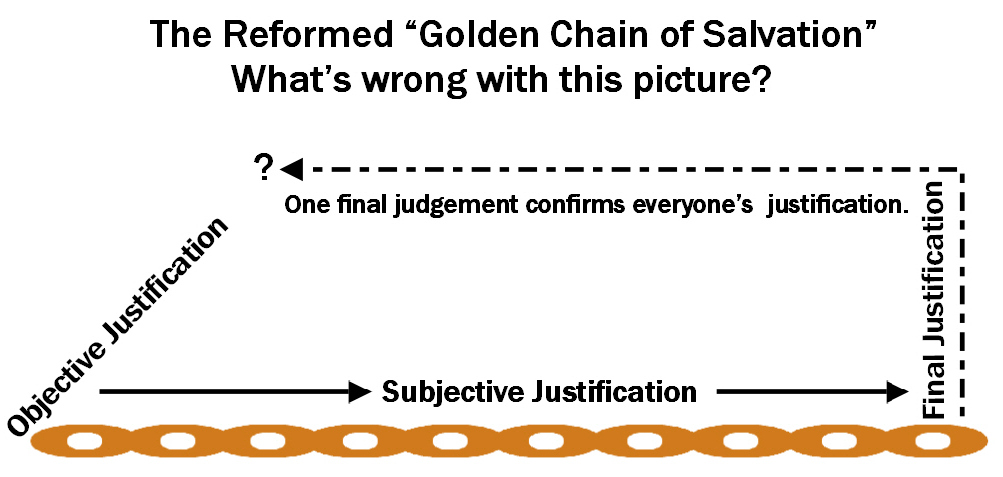
One Achilles’ heel for Calvinists is while denying that they believe in progressive justification, the title of book three and the fourteenth chapter of the Calvin Institutes is, “The Beginning of Justification. In What Sense Progressive.” This is what I was trying to get McAtee to explain. He once again resorted to academic antagonism by calling me a “theological novice” while this is one of several questions that he wouldn’t answer.
PD: So, when Calvin said that justification is progressive, he really didn’t mean that justification is progressive. Is that what you are saying?
BM: I’m saying you don’t know the difference between progressive and perpetual.
PD: Both move forward in time.
PD: No? Am I missing the definition in its “gospel context”?
PD: Both move forward in time—yes or no big guy.
This is the whole motif that Calvinists are on some higher plane of understanding to the point where what seems obvious to the peasantry really isn’t realty. Hence, “progressive” and “perpetual” are supposedly different concepts that the common man is unable to understand. Again, I ignored the academic antagonism and asked him if both words have the idea of moving forward in time. He wouldn’t answer the question; instead, he posed a question based on Reformed pseudo-church history:
BM: Only an idiot could believe that Cardinal Sadolet and Rome hated Calvin because he agreed with them on Justification.
This response combines academic antagonism and metaphysical assumption. The assumption is that, according to the Reformed motif, there was a great gulf in the view on justification between Rome and the Reformers, and the only reason Rome hated the Reformers is because of their diametrically opposed views on justification. This is not reality at all for a couple of reasons. First, Calvin got his theology from St. Augustine who is a celebrated spiritual hero in the Catholic Church till this day. Secondly, Augustine, Luther, nor Calvin ever renounced their own membership in the Catholic Church. Here is how I sated it further along in the debate:
PD: Bret, let me also say that a cursory observation of church history shows that Augustine, Calvin, and Luther never left the Catholic Church. Yet, you are incredulous that their take on justification would be basically the same. So is it, A. You just don’t know any better, or B. You know, but you are deliberately keeping your flock dumbed down? Augustine was a die-hard Catholic till the end while Calvin cites him more than 400 times in the Institutes. And the idea that they had the same basic approach to justification as Rome is an over the top idea?
McAtee continued to bear down with heavy doses of academic antagonism and metaphysical assumptions with this statement:
BM: Like all idiots you are reading Calvin through a keyhole and then reinterpreting him through the Keyhole instead of letting his whole corpus of thought inform you. You are an example of someone that got in way over his head into areas he was not yet ready to think about. You may yet return to Biblical Christianity Paul and leave your heterodox ways and thinking.
Please remember at this point that he refused to answer the simplest of questions: did Calvin mean progressive by “progressive,” and does both perpetual and progressive have the idea of moving forward in time? Instead, he suggests that all of Calvin’s massive literary droning would have to be read and studied to properly understand what Calvin meant by the very use of specific words. Of course, that is a ridiculous notion, but not a rare argument among the Reformed. The same argument is often used to defend John Piper who has also written a huge mass of literary droning. Note also that my “heterodox” (other than orthodoxy) is likened to a departure from “Biblical Christianity.” The mode of operation is to demean and argue from a reality that results in the desired outcome.
McAtee then introduces another Reformed technique of debate that we will call, drowning by orthodoxy. He then began to copy and paste a mass of Reformed orthodoxy that would take two days to read. The assumption is that I am not familiar with what he pasted into the stream. It assumes the response, “Oh my! I don’t understand any of this deep orthodoxy! And there is so much of it! Hark, I know nothing! What to do? His mind is so far above me!” Actually, I am very familiar with the information posted, especially his references to articles in the Trinity Review. Ironically, if that is a strong enough word, the founder of the Trinity Review bought into New Calvinism during the 90’s. I stated the following later in the thread:
PD: Furthermore Bret, you said you read my book, but yet you quote John W. Robbins’ Trinity Review above to make your point. As clearly documented in my book on pages 63-65, I show that Robbins bought into the Forum’s teachings via the SDA theologian Robert Brinsmead in 1995. As you know, New Calvinism came out of the Forum and Graeme Goldsworthy is popular in the movement till this day. Robbins reprinted Brinsmead’s magnum opus on justification in the Trinity Review, yet, you cite The Trinity Review as proof that Calvinists are not New Calvinists. Now if anything is funny, that is.
One of his several references to the Trinity Review follows:
The Trinity Foundation – Calvin on the “Pernicious Hypocrisy” of Justification by Faith and Works
http://www.trinityfoundation.org
That some serious slippage has occurred away from the classical Protestant doctrine of justification sola fide has been well documented in many religious publications. Certain teachers – Douglas Wilson.
Furthermore, his excerpts copied and pasted from the Calvin Institutes contained things like the following:
…a great part of mankind imagine that righteousness is composed of faith and works [but according to Philippians 3:8-9] a man who wishes to obtain Christ’s righteousness must abandon his own righteousness…. From this it follows that so long as any particle of works-righteousness remains some occasion for boasting remains with us [Institutes, 3.11.13].
This is yet another technique used by Calvinists to confuse those who are trying to nail their false doctrine by making distinctions between justification and sanctification—they continually refer back to justification and Sola Fide. Any attempt to make theological distinctions between the two is answered with more and more Reformed sanctification by justification orthodoxy. Even his Institute pasting was in context of what the Trinity Review said about it. This elicited the following responses from me:
PD: Brett, smothering me in all of this orthodox propaganda isn’t answering my question. Have you read CI 3.14 on what Calvin said about progressive justification or not? Why are you citing other people? I asked you as someone who says he reads the CI. You deny that your information comes from men, and then you cite a bunch of men. I want to know your specific evaluation of CI 3.14
[Note: all of his citations avoided the aforementioned title of CI 3.14 which resulted in the following reply: “I’m citing Calvin Paul. Read the quotes from the Institutes. You can’t make CI 3.14 disagree with the rest of what Calvin said on the subject. Good grief man … this is elementary hermeneutics” ( i.e., progressive doesn’t mean “progressive” because of other things Calvin wrote)].
PD: Right, he is applying justification truth to sanctification, so what’s your point?
PD: No Bret, I am not confused by your discussion of sanctification in a justification way.
I will shortly pause here and introduce yet another debate tactic of the Calvinist: the divine unction by a philosopher king declaring me to be unregenerate. Simply pronouncing a curse on your opponent has to be the quintessential easy button:
O Foolish Dohse … who has bewitched you?
Like all good Calvinists, McAtee believes in Calvin’s “power of the keys” that gives Reformed elders the power to loose or bind sin on earth. I have received several veiled threats by Reformed elders to bind my sin on earth. Some not so veiled.
McAtee’s comment about “elementary hermeneutics” was also addressed:
PD: “Elementary hermeneutics” ? Which hermeneutic? You act like there is only one.
BM: I’m talking about the place of Hermeneutics in interpreting literature. You’re hermeneutic on Calvin sucks.
PD: Redemptive or Grammatical Bret? Which one?
BM: Paul … I’m not talking about hermeneutics in terms of reading Scripture. I’m talking about hermeneutics in terms of reading Calvin which should be Historical Grammatical.
Here, McAtee seems to infer that there is a different hermeneutic for interpreting literature, and a different hermeneutic for interpreting the Bible. I will let that statement stand on its own and move on to the part of the debate where McAfee concedes that perpetual forgiveness, the same kind of forgiveness that saved us, needs continued application in the church:
PD: (Quoting BM) “Do you really want to advance the idea that Calvin and Rome agreed on Justification? Is that really your position Paul?” (Answer) Both held to a linear gospel which is progressive justification. They disagreed on how to get from justification to glorification.
But when it gets right down to it, BOTH by ecclesiastical absolution. Citations from CI available upon request.
BM: LOL!
PM: Bret, may I list the very fair questions you have not answered yet?
BM: Paul … purple.
BM: Paul … should I post again the very fair quotes from Calvin’s own pen indicating that he did not believe in progressive justification and so did not believe that one had to be sanctified before one could be justified?
PD: Of course not, he believed sanctification was progressive justification. But here is the better question: Why did he believe a justifying forgiveness of sins needed to be continually sought IN the church?
After all of his vehement denial that Calvin believed in a progressive justification, he begins to concede that a perpetual forgiveness for sin in the church for the purpose of keeping us justified is needed:
BM: “Not by righteousness which we have done, but according to his mercy he saved us”; that being justified by his grace, we might become the heirs of everlasting life, (2Ti 1: 9; Tit 3: 4, 5). By this confession we strip man of every particle of righteous, until by mere mercy he is regenerated unto the hope of eternal life, since it is not true to say we are justified by grace, if works contribute in any degree to our justification. The apostle undoubtedly had not forgotten himself in declaring that justification is gratuitous, seeing he argues in another place, that if works are of any avail, “grace is no more grace,”
(Rom 11: 6). And what else does our Lord mean, when he declares, “I am not come to call the righteous, but sinners to repentance?” (Mat 9: 13). If sinners alone are admitted, why do we seek admission by means of fictitious righteousness?
BM: Why do we expect corn plants to be irrigated outside a corn field?
PD: So, the point you are making here agrees with Calvin in context of sanctification. Justification must continually be sought in sanctification to retain a just standing before God.
BM: Section 11. In addition to the two former arguments, a third adduced against the Sophists, to show that whatever be the works of the regenerate, they are justified solely by faith and the free imputation of Christ’s righteousness….[Finally, BM quotes from the infamous 14th chapter of book three from the Institutes. Curiously, he only cites the section. Calvin’s point in sections 9-11 (BM’s long copy and paste is omitted here) is that Christians are not capable of doing any meritorious work before God. Therefore, they need “perpetual reconciliation” in the church. BM cites theses sections from the Calvin Institutes to make the very point that he denied throughout the whole debate].
PM: Bret, why did Calvin believe that a justifying forgiveness had to be continually sought in the church?
BM: The Church is the body of Christ where Christ is proclaimed. Where else would one go to be reminded that they are forgiven? [Do Christians need to be “reminded” that they have been forgiven? Peter said that we only forget that we are forgiven when we fail to ADD works to our faith (2PET 1:5-11)].
PD: Bret, he wasn’t talking about being “reminded” he was talking about perpetual “reconciliation.”
PD: What does “reconciliation” mean Bret?
PD: Do we need continual reconciliation?
BM: Paul … does Christ ever live to intercede for us?
Why?
PD: So, you are saying that is to keep us justified?
BM: Are you saying that we could be justified without His ongoing Intercession? Could we be justified by a Christ who was not at the right hand of the Father as our continual advocate? If Justification is merely in the death of Christ then there was no reason for Him to have been resurrected, ascended and set apart for the continual Priestly work of Intercession.
PD: Then why did Calvin teach that we have to continually seek that forgiveness in the church? If Christ is doing all of the work in heaven?
BM: Why do we expect corn plants to be irrigated outside a corn field?
[Note: We have to keep ourselves justified by staying in the cornfield of justification. He is conceding what he denied throughout the whole debate].
BM: The Church is the body of Christ. The minister the voice of Christ pronouncing the reminder of sins forgiven.
[Note: We have to be continually reminded that we are forgiven in order to stay justified].
PD: So, there is a continued need for forgiveness of sins to remain justified?
BM: Ask Jesus,
5 Then he poured water into a basin and began to wash the disciples’ feet and to wipe them with the towel that was wrapped around him. 6 He came to Simon Peter, who said to him, “Lord, do you wash my feet?” 7 Jesus answered him, “What I am doing you do not understand now, but afterward you will understand.” 8 Peter said to him, “You shall never wash my feet.” Jesus answered him, “If I do not wash you, you have no share with me.” 9 Simon Peter said to him, “Lord, not my feet only but also my hands and my head!” 10 Jesus said to him, “The one who has bathed does not need to wash, except for his feet, but is completely clean.
PD: You make my point for me. Calvin clearly said the whole washing of the body is continually needed.
PD: Jesus said it isn’t needed, Calvin said it is. That is, “the washing” which Calvin called “ablution.”
McAtee unwittingly cited John 13:5-10 in an effort to make his point. Jesus’ point in the passage is that once a person is washed (justified: 1COR 6:11) they are clean and have no further need of washing. There is a need to seek forgiveness for daily sin that disrupts our family relationship with God. That is probably what Christ is talking about in regard to the washing of feet. I would probably include 1John 1:9 here as well. This is further seen in what Christ told the woman at the well. When one drinks the water of salvation, they will never thirst again. In other words, there is no need for a perpetual returning to the well of salvation/justification.
paul

 Paul's Passing Thoughts
[…] New Calvinism’s Contribution to the Church: it Reveals What Calvin Really Believed. […]
LikeLike
Reblogged this on Clearcreek Chapel Watch.
LikeLike
Wow Pastor Bret really got caught there on perpetual justification? Good debate.
All I could ever say to him is — “Calvin is just a man for goodness sakes”!!! and then proceed to pull my hair out.
LikeLike
“BM: Why do we expect corn plants to be irrigated outside a corn field?”
“The field is the world.” (Matthew 13:38)
LikeLike
James,
As opposed to the church? If that is your point, it is a good one.
LikeLike