The Thief on the Cross
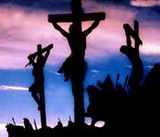 New Calvinism says you must live by faith alone in sanctification to keep your justification. Those are ill motives. The motive is not love, it’s to keep your just standing. It’s staying nailed to the cross in order to keep our salvation. In contrast, the thief on the cross readily recognized that he was going to be with Jesus in paradise that day, but if Christ had released him from that cross, he would have loved Christ with everything in him by obeying everything Christ commanded. “If you love me, keep my commandments.”

 Paul's Passing Thoughts
Rae, the whole point of the lordship salvation false gospel is that a person can never truly be sure of their salvation, since they’re always checking works. I am one hundred percent sure of my salvation based only on John 3:16 and the hundreds of verses like it.
LikeLike
Just clarifying, Piper’s clearly stated that salvation cannot be lost and that assurance can be had.
Piper on losing salvation: http://www.desiringgod.org/interviews/can-a-born-again-christian-lose-salvation
Piper on assurance: http://www.desiringgod.org/interviews/how-do-i-know-i-m-saved
LikeLike
KM,
Thanks for the link. It’s a good example of John Piper demonic double speak. Listen to what he is saying carefully, according to Reformed tradition, he is not advocating assurance.
LikeLike
@Paul, what specifically is it that you see as not advocating assurance?
LikeLike
KM,
Do you believe that all realty is interpreted through redemption?
LikeLike
@Paul, I believe reality is properly interpreted in light of God’s revelation, I’m not sure what it means to say it’s interpreted through redemption.
Could I ask how that’s related to the question about Piper not advocating assurance?
LikeLike
KM,
Yes, you may ask. You catch me in a transformation of thinking in how I have decided to deal with debate over John Piper. For years, I have engaged people on the fruits that flow from the roots of his philosophical tree. I have decided to no longer do that. Piper holds to authentic Reformed thought and soteriology which interprets ALL reality through the cross. KM, the issue really isn’t points of theology, it regards the very interpretation of reality itself. The Reformers en masse are guilty of no full disclosure on this–it’s intentional deception because the great unwashed just wouldn’t understand. I address the issue in this article: http://wp.me/pmd7S-4gH In short, I am no longer going to serve Piper by debating all of the side issues that flow from his mysticism, I am going to address his core ideology.
Now KM, sigh, I know the one link you sent starts out with Piper stating emphatically what seems to be OSAS. But you have to understand that Piper, like all mystics, speaks from his own definition of terms. He doesn’t define the new birth the same way you probably do. Please note carefully what he goes on to say: “We are already participating in the eternal life to come.” Note that it is a “participation” in something that is not here yet. This fits with his Reformed “Vital Union” doctrine also known as “participation in Christ.” How we participate in the eternal life to come determines if we get it in the end. Km, this is known as “final justification.” That’s their term, not mine. Obviously, we are not completely justified yet. Piper has stated in no uncertain terms that we are not “home free” when it comes to salvation and that Christians “still need salvation.”
KM, I have written on this extensively and have been a student of these issues for eight years. If you are an honest seeker, email our moderator “Pearl” at mail@ttanc.com and she will send you several articles to read in regard to this issue on Piper.
LikeLike
Hi @Paul, thanks for these details. On the surface, I have to disagree though. All I’ve ever seen from Piper’s words myself point to this idea of certainty of salvation. Yes, he believes we participate right now in something that will be fully realized later, but he’s correct on that as part of Christian life is enjoying God right now. The Bible commands this.
I’m not sure why you’d use the term ‘OSAS’ as I’m sure you know that’s not a Reformed concept, Reformed doctrine would refer to assurance as ‘Perseverance of the Saints’. It’s very simply, the idea that God has begun a good work in a person and has promised to ensure that good work if followed through to the glorification of that person.
I do understand your point about the redemptive historical hermeneutic. I myself follow more along John MacArthur’s line of interpretation, a literal-grammatical-historical method. I see this as necessitating the points of Calvinism because there would be no contextual warrant for alternative explanations to clear teaching on predestination and election.
Really, I think any disagreement can be handled relatively easily though, whether regarding hermeneutics or otherwise. Most times, we can simply do as the Bereans did and test what people say. If what they affirm can be turned against them, we know it’s not true.
Would you agree? And if so, is there anything in particular about Piper’s statements that you see as being contradictory to what else he’s affirmed?
LikeLike
KM,
Ok, um, I guess I never learn, but anyway, your second paragraph makes my point. Words mean things; note the word, “if” in that paragraph. What assurance is there in “if”? See, once again I feel like people are jerking me around with word games. God’s giving of eternal life is an absolute fact and we can have absolute assurance that God gives eternal life-ahhhhmen!…”if”…fill in the blank. Furthermore, the “if” is IF we live by faith alone; ie., if we believe Jesus does the work and not us.
Bottom line KM, once one receives a gift, they own the gift. It doesn’t make one the originator of the gift. If you do not have a righteousness of your own through the new birth, you are not born again. I highly recommend that you not stake your salvation on a murdering mystic despot named John Calvin. The Reformation is a wide road unto destruction, and many follow the Reformers on that road.
There is good news and bad news here: bad news; this conversation is over. Good news: you can contact Pearl and get a free copy of “It’s Not About Election” mailed to you (mail@ttanc.com). Read it if you dare.
LikeLike
Hey @Paul, oh I’m terribly sorry for my typo! That “if” in the second passage was supposed to be an “is”. I don’t remotely believe that salvation is somehow conditioned on anything other than God’s sovereign choice. Salvation is secured based on God’s foreknowing and predestining people, nothing in the human creature.
I’m not sure why you’d see the reformers in such a negative light as a whole though. I’m not one to defend Calvin’s work in Geneva, but his work in systemitizing theology was very impressive.
But so I understand where I might differ from you belief-wise, could I ask if you believe that salvation is in any way based on man’s final say? I mean, is it man’s choice ultimately, or is it strictly God’s choice?
LikeLike
KM,
You are displaying the classic either/or hermenuetic of Reformed theology that has been drilled into our heads. It’s EITHER ALL God’s choosing OR ALL of our choosing. The primary root of this is the idea that all existence and being is either good or evil/material or invisible.
At any rate, my answer: God chose/elected the means and plan of salvation; man either chooses it or rejects it.
And KM, we must not forget Calvin’s 3 categories of elect: non-elect, the called (temporarily elected/illumined and will therefore suffer a greater damnation), and those that persevere.
Hence, there is absolutely no way for a Calvinist to know whether or not they are of the perseverance class until the end.
Now KM, I am sure you would agree that if Calvin was wrong about that, he could also be wrong about other things.
LikeLike
Hi again @Paul, I actually don’t follow Calvin per se. I just appreciate the work he did with his systematic theology. I believe there were scores of others before him who believed many of the same things, though his systematic work showed the necessity of some basic truths. I agree he was in error at some points.
To clarify though, I don’t hold any classic “either/or” error. Very simply, I hold that a proposition is either true or false. And on that basis, I recognize it’s either true or false that ultimately, it’s God’s or man’s decision whether he’s saved or not. We can all agree that man must choose to repent in order to be saved. I simply argue that God brings that choice about by way of a changed heart. Because God changes a person’s heart, they love Him and proceed to follow His commands.
Deuteronomy 30:6 And the LORD your God will circumcise your heart and the heart of your offspring, so that you will love the LORD your God with all your heart and with all your soul, that you may live.
One of those commands is to believe. This belief extends to more than just belief in Christ, but the entirety of God’s Word, which entails a fear of God that leads to knowledge.
Proverbs 1:7 The fear of the LORD is the beginning of knowledge; fools despise wisdom and instruction.
It’s for that reason that I know I’ll be saved, because God’s Word has guaranteed and informed me of it, with the Holy Spirit testifying to and illuminating that fact.
Ephesians 1:13 In Him, you also, after listening to the message of truth, the gospel of your salvation– having also believed, you were sealed in Him with the Holy Spirit of promise, 14 who is given as a pledge of our inheritance, with a view to the redemption of God’s own possession, to the praise of His glory.
To be very clear, I know not because I chose to, but because God necessitated it. It’s not my mere opinion, but God’s very movement. This is the basis of assurance. Calvinists who fail to see this have an inconsistency in their view.
LikeLike
Okay, Kawika, we get it: you’re a Calvinist. You believe in a determinist god. You know, Paul was onto you from the get go, but I, being a softy, wanted to believe that if the right information was presented to you, you’d recognize the inconsistencies and ask to learn more. Seems you’re no different – you hope that if only we understood, we’d repent in sackcloth and ashes and all would be well with the world. It’s not going to happen.
Now, with Paul, I’m finally persuaded that you have no inclination to be moved from your convictions. Perfectly fine. You’ve been a gracious polite guest, albeit a persistent proselytizer. Get your own blog, dude.
LikeLike
KM,
Right, your assurance is based solely on the fact that you believe that you had no choice and man cannot choose to believe. This is called the “gospel of sovereignty” or simply “sovereign grace.” Or “total inability.” Hence, anyone who believes they have the ability to choose is taking part in their own justification. This is a common take among Calvinists. And more and more, Calvinists are being clear about that in their gospel presentations. “Here is what God did; and if you believe that, and believe the only reason you believe it is because God gave you the belief, you are saved.” I have been informed many times of late that I believe a false gospel because I believe man has the ability to choose.
And of course, you have played the “I don’t believe everything Calvin believed” card. Well then, do you agree with him on particular redemption? What about double imputation? Is being under the authority of church membership synonymous with being part of the body of Christ? Do elders have the authority to forgive sin? Where do you stand on these?
LikeLike
Hey @Paul, I just want to quickly clarify that where a person has a belief that is impossible to prove wrong, that belief is legitimately knowledge. My belief about God causing my belief (faith) is of that nature. The reason it’s impossible to prove wrong is because on the opposing view, it would only be possible to have opinions, knowledge itself would be impossible. But that’s obviously absurd, because it would render true, the proposition that there is only one knowable fact, that we can only have opinions. God has instilled that knowledge in me. It’s not something I, by my amazing powers of reasoning, figured out on my own.
The practical outworking of this belief is what Scripture describes rather than what you’ve depicted. Very simply, to be saved, one only needs to believe in Jesus Christ. While the Gospel is that simple, the many illustrations and biblical texts that describe it serve the purpose of showing us what all it entails.
I do agree with Calvin on particular redemption, though I think it helps to clarify that all mankind is, by nature, bound by sin and worthy of death and that God is in no way required to save anyone from that just end. Regarding the Church, every legitimate believer (those who actually do believe rather than just say they do) is part of it. The Reformers had the concept of the “invisible Church” to describe this. All believers should want to be held under a local authority for reasons of accountability and growth, some fight this, thus why Paul addressed it. Also, all believers have the authority to forgive sin. As for double imputation, I do agree that a believer’s sins are imputed to Christ and that His righteousness is imputed to a believer.
@Pearl, PPT Moderator, I’ve actually been open to considering any legitimate flaw in my thinking. But I stepped into this discussion because I noticed some harsh statements made about pastors like Piper and MacArthur. So I wanted to clarify at least Piper’s stated position, and then ask for more detail, thinking I may have missed something. I expect that where someone makes an accusation, they’ll be able to prove their point, which typically is easily done by showing a legitimate contradiction in a person’s stated position. That hasn’t been done in this case.
I hope that helps to see, I’m in no way proselytizing. I haven’t even read much else from this blog to know what I’d be proselytizing for. Instead, I was seeking to find substance behind some prior accusations. In turn, I’ve been accused myself. 🙂
I suspect the reason you’re quick to judge is because you’ve met a lot of harsh opposition yourself. But by judging so quickly, you only meet more opposition.
Take care. 🙂
LikeLike
Kawika, if I’ve misjudged you, then I sincerely beg your pardon. Only you and God know your true motivations, so I will take you at your word and trust that you really are open to considering any flaw in your thinking which is not an easy, overnight process. Forgive my intrusion.
And yes, you are right: we do get all kinds of opposition and have grown weary of the drama to the point of recently amending our comment policy to address only those who are sincerely looking to understand, which you say you are.
You come across as an articulate, intelligent person. I hope you will invest the time to honestly peruse the site, especially those posts which address what you consider harsh judgments against MacArthur and Piper; their ministries have been meticulously researched, documented and discussed. In addition to that, we have conferences posted to Youtube going back to 2012 (see the right column) addressing every angle of Reformed Orthodoxy by Paul, his wife Susan, John Immel and, most recently, Andy Young.
We take this very seriously. It’s a matter of discerning between a false and true gospel: souls are at stake.
LikeLike
KM,
We will end the conversation here by pulling in the reins on you setting the agenda. Fact: John Calvin believed in progressive justification–the gospel of the Reformation which is false. Fact: Calvin believed Christians are still under law making double imputation necessary. Fact: His election construct includes the temporarily elected which makes assurance impossible. Fact: He believed elders have authority on earth to forgive sins. Fact: He believed that present sin removes one from justification unless a member of a Reformed church via water baptism.
This conversation has gone from discussion to you seeking a platform to defend Calvinism. So, this is where we part ways.
LikeLike
Thanks Sean, and I forgot the biggie. Fact: the Reformation gospel is daily resalvation via repentance for “present sin.” It is a constant circle of death (self deprivation through repentance), and resurrection. It is the Reformed doctrine of “mortification and vivification.” This is a daily imputation of the righteousness of Christ as a covering for “present sin” and boils down to nothing more or less than works salvation. It is keeping yourself saved by “preaching the gospel to yourself every day.” Oh, and by the way, mortification and vivification can only be applied under the authority of the local church via membership confirmed by water baptism. Go figure.
LikeLike
I guess this unfolding conversation is why I avoid the Calvinist debate.
The pro “Reaffirmed tradition crowd” are intellectual cheats. They are at the same time self appointed arbiters of “sound doctrine:” but at no point responsible for their intellectual conclusions.
Notice this juxtaposition.
KM: “I just want to quickly clarify that where a person has a belief that is impossible to prove wrong, that belief is legitimately knowledge. My belief about God causing my belief (faith) is of that nature. The reason it’s impossible to prove wrong is because on the opposing view, it would only be possible to have opinions, knowledge itself would be impossible. But that’s obviously absurd, because it would render true, the proposition that there is only one knowable fact, that we can only have opinions. God has instilled that knowledge in me. It’s not something I, by my amazing powers of reasoning, figured out on my own.”
VS
KM: “I actually don’t follow Calvin per se. I just appreciate the work he did with his systematic theology. I believe there were scores of others before him who believed many of the same things, though his systematic work showed the necessity of some basic truths. I agree he was in error at some points.”
KW’s first paragraph holds this basic epistemological assertion: “real” knowledge is only possible because God determines (causes/imputes/reveals). So what he believes correctly is really God’s compulsion. There is no reason qua reason to hold his intellectual conclusions. His “correct” intellectual conclusions are because God made him think correct.
But now notice in the second highlighted paragraph that he has the temerity to presume independent judgment. Beyond the wonderful irony of a Calvinist saying they don’t follow Calvin all the while insisting that the doctrine within the Institutes of the Christian Religion represents THE definitive doctrinal statement for Christianity, how does a man who believes correct thinking is the product of divine imputation, ever get to make a claim to his own critical judgment? If knowledge is determined how can a man ever say, “But I disagree?” Or more pointedly . . . how can he ever utter the words “I think Calvin was in error?”
By definition he has no independent rational faculty. His knowledge is the product of divine compulsion. Period.
So the question that must be asked is, how come there is a breach between what God compelled John Calvin to believe and what God is compelling KW to believe? And since John Calvin’s theology is held up as the defacto standard of “Salvific” Christian thinking, the logical conclusion is that KM is not part of the elect crowd. Obviously God doesn’t want him to believe the right things.
But whatever . . .
This Calvinist intellectual two step is the root of their intellectual cheating.
What they “believe” is inarguable because it is the magical product of God’s special revelation. The reason they say “You don’t understand what the bible really says . . . bla bla bla” is because God hasn’t revealed the mystery to you. Your misunderstanding is spiritual blindness ergo your logic, your reason, your rational faculties are suspect. But the moment you point out that they are—by self admitted doctrinal standard—mindless automatons they rail and moan they have spent decades “studying” and revile anyone who dares point out their intellectual inferiority.
Cheater, Cheater Pumpkin eater!
LikeLike