The True Gospel Verses Calvinism: Part 1
 “The difference between Calvinism and the true gospel is a fine line of distinction with eternal consequences.”
“Justification is a finished work that guarantees glorification apart from anything that happens in progressive sanctification….Justification is a finished work that guarantees glorification completely apart from progressive sanctification.”
“All bible verses must be interpreted by, verse….for justification, or verse….for sanctification.”
This post is actually in reply to the following question posted in the comment section of this blog:
Paul, please explain in layman’s terms how Calvinism views justification and sanctification. I am trying to understand this. Does this have anything to do with the saint’s persevering?
My initial response was several hundred words which were deleted somehow when I was near completion; I must have hit a wrong key or something, but this time I will be smart and type it on Microsoft Word first.
Let me begin by addressing this part of the reader’s question first: “Does this have anything to do with the saints persevering?” No. Please, let’s just focus on the foundation—you can address all of the many other issues later, but you will be unable to address them definitively until you have an understanding in regard to the first part of your question: “….how Calvinism views justification and sanctification.”
Short answer: It views them as being the same thing, and that’s a false gospel, and I will explain why (the forthcoming long answer). But first, know this: election does not necessarily mean that God predetermined before creation who was/is going to be saved and not saved. How God weaves His sovereignty together with our choices is a mystery. For example, “The heart of man plans his way, but the Lord establishes his steps (Proverbs 16:9).” Does this mean that we shouldn’t bother planning because the Lord has already determined our steps? Hardly. Proverbs 16:9 is speaking of the mystery/paradox of God’s weaving together of what we do and His sovereign will. Does prayer change things? Certainly it does. When we present the gospel to someone, do we say, “I am just here to find out whether you are one of God’s chosen or not. So, I am going to present the gospel to you, and if you believe and repent, you are one of the chosen, if you don’t, you are toast for eternity.” No, we persuade with all diligence and knowledge (like the apostle Paul did) as if it depends on us, because to some degree, it does. Bottom line:
How then will they call on him in whom they have not believed? And how are they to believe in him of whom they have never heard? And how are they to hear without someone preaching? (Romans 10:14).
God’s offer of salvation is a legitimate offer.
Justification 101 (For now, forget about sanctification, this concerns justification only!)
Nevertheless, when they/we believe, we know it’s because of Romans 8:30, which will be the focus of my explanation/long answer. Let’s now observe Romans 8:30:
And those whom he predestined he also called, and those whom he called he also justified, and those whom he justified he also glorified.
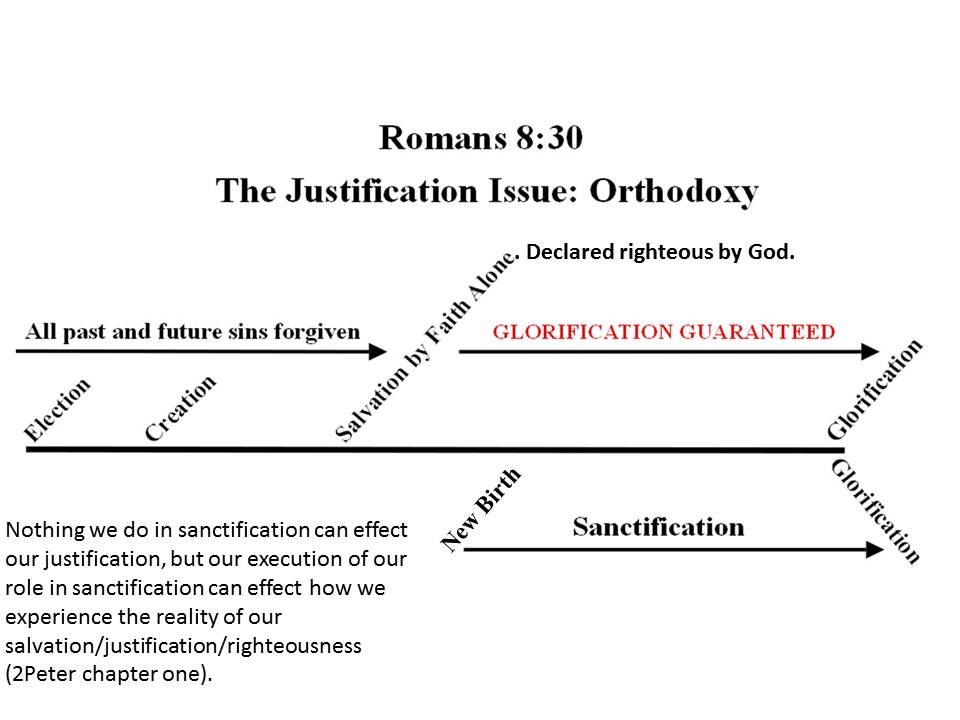
Done deal. Finished before the creation of the world. He predestined us, then called us, then justified us, and finally, glorified us. The word “justified” is dikaioo. It is a legal declaration of innocence that sets one free. Christians are declared righteous before creation, and glorification (when we will be instantly transformed completely at the resurrection) is guaranteed. We cannot mess that up. It’s a finished work by God before we were born. How can we possibly mess that up? We can’t.
Law/Justification [Gospel]
Also, the law can’t touch us. Why? We are already declared righteous, that’s why. Stop everything you are thinking about and take note of this: the law is no longer the standard for maintaining our salvation/justification. Do not turn your mind off here because of familiarity—this is not what you think it is. Pay attention! The difference between Calvinism and the true gospel is a fine line of distinction with eternal consequences. Caution: this is a concept that it so simple that it escapes us. We are no longer ….key word alert,….UNDER the law. In the book of Romans, Chapter 7, Paul compares our relationship to the law as a marriage covenant that is no longer valid because one of the spouses died:
Do you not know, brothers —for I am speaking to men who know the law—that the law has authority over a man only as long as he lives? 2 For example, by law a married woman is bound to her husband as long as he is alive, but if her husband dies, she is released from the law of marriage. 3 So then, if she marries another man while her husband is still alive, she is called an adulteress. But if her husband dies, she is released from that law and is not an adulteress, even though she marries another man.4 So, my brothers, you also died to the law through the body of Christ, that you might belong to another, to him who was raised from the dead, in order that we might bear fruit to God.
Now, I will slightly digress and bring danger of confusion, but will then quickly return to the subject of justification. Paul is talking about justification in this passage, and then finishes the thought with a mention of justification’s purpose; sanctification: “….in order that we might bear fruit to God.” BUT, as we shall see, other than the fact that justification makes sanctification (our kingdom living) possible, the two are totally separate, and the separation of the two is the key to understanding the issue at hand, and the true gospel in general.
….for justification.
We, as Christians, are dead to the law. It can’t touch us. We are no longer UNDER it:
Romans 2:12
All who sin apart from the law will also perish apart from the law, and all who sin under the law will be judged by the law.
But not us. The law can’t judge us, we are no longer under it:
Romans 3:19
Now we know that whatever the law says, it says to those who are under the law, so that every mouth may be silenced and the whole world held accountable to God.
Note that the world is under the law, but we are not. We have no regard for the law whatsoever, ….for justification.
Slavery/Justification
Paul also described our relationship to the law in regard to not being enslaved by it. To be evaluated by the law is to be in bondage to it:
Romans 6:14
For sin shall no longer be your master, because you are not under the law, but under grace.
Galatians 4
21 Tell me, you who want to be under the law, are you not aware of what the law says? 22 For it is written that Abraham had two sons, one by the slave woman and the other by the free woman. 23 His son by the slave woman was born according to the flesh, but his son by the free woman was born as the result of a divine promise.
In fact, Paul said for us Christians, ALL things are lawful!
1 Corinthians 6:12
All things are lawful for me, but not all things are profitable. All things are lawful for me, but I will not be mastered by anything.
All things are lawful, but not all things are profitable. All things are lawful, but not all things edify.
But not expedient, or profitable….
….for sanctification. Sanctification 101
There are two kinds of sanctification, but only one kind of justification, and the two sanctification are totally separate from justification. If not, we are eternally doomed. Justification must be a finished work that we have no part in except for showing others how they can be justified like we are; saved, if you will. Note: Romans 8:30, the epic verse of justification, does not include the subject of sanctification because the two must be separate. One is a finished work (justification), the other, sanctification (or, kingdom living) is progressive. In fact, Dr. Jay E. Adams states well that sanctification (our Christian life) does not in any way draw it’s life or power from justification because justification is a legal declaration that determines our POSITION:
The problem with Sonship™ [same thing as New Calvinism prior to 2008] is that it misidentifies the source of sanctification (or the fruitful life of the children of God) as justification. Justification, though a wonderful fact, a ground of assurance, and something never to forget, cannot produce a holy life through strong motive for it. As a declaration of forgiveness, pardon, and adoption into the family of God, it is (remember) a legal act. It changes the standing, but not the condition, of the person who is justified.
That’s because justification is a finished work, and discipleship (sanctification) is not; it’s progressive. But, there is also a positional sanctification that is also a finished work that even preceded justification. But like justification, it is a finished work and cannot produce progressive life, because for crying out loud, a finished work doesn’t continue to produce a progression. This would seem evident. Remember this: sanctification is a word that merely means, “to set apart.” So, sanctification is a progressive separating from the world. As we progress in our sanctification, we look more like Christ, and less like the world. But there is also a positional separation from the world that is also a finished work that includes predestination, election, calling, justification, and a setting apart:
Such were some of you; but you were washed, but you were sanctified, but you were justified in the name of the Lord Jesus Christ and in the Spirit of our God (1Corinthians 6:11).
Notice the past tense of the verse. Our position is a finished work. We were washed, set apart, and justified. Peter asked Jesus to wash him. But Christ told him that there was no need for him to be washed because it had already been done, he only needed a daily washing of his feet:
The evening meal was being served, and the devil had already prompted Judas Iscariot, son of Simon, to betray Jesus. Jesus knew that the Father had put all things under his power, and that he had come from God and was returning to God; so he got up from the meal, took off his outer clothing, and wrapped a towel around his waist. After that, he poured water into a basin and began to wash his disciples’ feet, drying them with the towel that was wrapped around him. He came to Simon Peter, who said to him, “Lord, are you going to wash my feet?” Jesus replied, “You do not realize now what I am doing, but later you will understand.” “No,” said Peter, “you shall never wash my feet.” Jesus answered, “Unless I wash you, you have no part with me.” “Then, Lord,” Simon Peter replied, “not just my feet but my hands and my head as well!” Jesus answered, “A person who has had a bath needs only to wash his feet; his whole body is clean. And you are clean, though not every one of you.” For he knew who was going to betray him, and that was why he said not everyone was clean (John 13:2-11).
Justification and the New Birth
Though justification is a finished work, it passes the torch to something that is a mark of true salvation. This is where sanctification draws its power. This element of sanctification is a Proof of Purchase Seal that you and I have been purchased by God with the price of His Son. It is the new birth. We are born of the Holy Spirit into new creatures. Our spiritual growth is now a colaboring with the Holy Spirit who indwells us. He also colabored with saints of old, but His permanent indwelling of New Testament believers is probably related to the engrafting of the Gentiles. But whatever the reasons, remember that the saints of old were also justified by faith alone, and like us, they were not UNDER the law….for justification.
Paul makes this point in Galatians 3:13-18:
Christ redeemed us from the curse of the law by becoming a curse for us, for it is written: “Cursed is everyone who is hung on a tree.” He redeemed us in order that the blessing given to Abraham might come to the Gentiles through Christ Jesus, so that by faith we might receive the promise of the Spirit.
Brothers, let me take an example from everyday life. Just as no one can set aside or add to a human covenant that has been duly established, so it is in this case. The promises were spoken to Abraham and to his seed. The Scripture does not say “and to seeds,” meaning many people, but “and to your seed,” meaning one person, who is Christ. What I mean is this: The law, introduced 430 years later, does not set aside the covenant previously established by God and thus do away with the promise. For if the inheritance depends on the law, then it no longer depends on a promise; but God in his grace gave it to Abraham through a promise.
Hence, the law CANNOT be our standard…. for justification. Paul makes that clear by pointing out that the law didn’t come for 430 years after Abraham was justified according to the covenant of promise. Nevertheless, we must be born again (new birth). Again, the new birth is proof of Justification, but is not powered by it. The new birth is the indwelling Holy Spirit colaboring with His new creatures. Theologians call this, regeneration. We, like the saints of old, MUST BE BORN AGAIN. Before the cross, and before Pentecost, Christ made this clear to Nicodemus in the present tense, and expressed surprise that he was ignorant of the new birth (John, chapter 3).
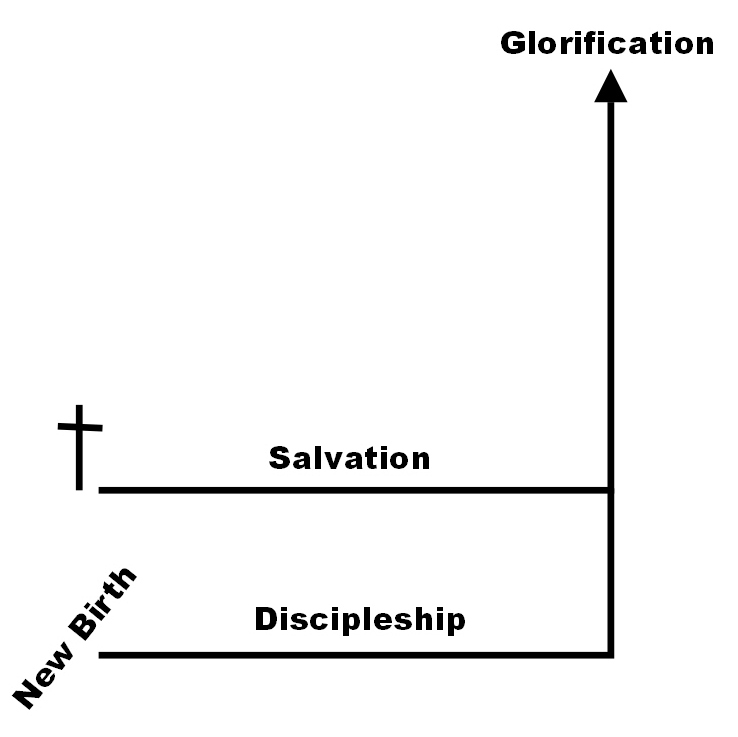
And this is very, very important: regeneration does not work towards/for glorification. Sanctification (the progressive type) is NOT a link to glorification. Remember, glorification is a finished work. Romans 8:30 speaks of it in the past tense. It is the guarantee of our justification. Both happened before the creation of the world. Some theologians call glorification, “final sanctification.” Perish the thought! Glorification is the manifestation of positional sanctification (both are final, finished works), NOT the completion of progressive sanctification. Though the completion of progressive sanctification happens at the same time as glorification—glorification is a finished work, and therefore is not the culmination of progressive sanctification’s progressive work; it is rather, redemption. Redemption is the manifestation of glorification when God cashes in on his purchase:
There will be signs in the sun, moon and stars. On the earth, nations will be in anguish and perplexity at the roaring and tossing of the sea. People will faint from terror, apprehensive of what is coming on the world, for the heavenly bodies will be shaken. At that time they will see the Son of Man coming in a cloud with power and great glory. When these things begin to take place, stand up and lift up your heads, because your redemption is drawing near (Luke 21: 25-28).
Though the Bible speaks of glorification as a future event, Romans 8:30 refers to it in the past tense. This is because it does not need progressive sanctification to complete it (again, progressive sanctification is not included in the list of Rom. 8:30), and the past tense usage points to the guarantee that accompanies justification.
Justification and progressive sanctification are totally separate. Progressive sanctification DOES NOT link justification to glorification. Justification is a finished work that guarantees glorification apart from anything that happens in progressive sanctification. This is why progressive sanctification is excluded from this paramount justification verse….for justification, and speaks of justification and glorification in the past tense. Justification is a finished work that guarantees glorification completely apart from progressive sanctification.
One Law; Three Relationships/Standards
Hence, the law, which includes all of Scripture (see Matthew 4:4, 2Timothy 3:16) must always be read in this context: ….for justification, or….for sanctification. The standard/relationship…. for [our] justification is ZERO LAW. The standard/relationship….for [our] sanctification is….100% law! Why not? It’s not related to our justification anyway! Therefore:
Do not think that I have come to abolish the Law or the Prophets; I have not come to abolish them but to fulfill them. For truly I tell you, until heaven and earth disappear, not the smallest letter, not the least stroke of a pen, will by any means disappear from the Law until everything is accomplished. Therefore anyone who sets aside one of the least of these commands and teaches others accordingly will be called least in the kingdom of heaven, but whoever practices and teaches these commands will be called great in the kingdom of heaven. For I tell you that unless your righteousness surpasses that of the Pharisees and the teachers of the law, you will certainly not enter the kingdom of heaven (Matthew 5:17-20).
The word for “set aside” is lou. It means to “relax” or loosen. That is, in regard to the “least of these commandments.” So, do we interpret this way: “Whoever practices and teaches these commands”….for justification; or, ….for sanctification ? The framing of a house and the rightness of its foundation will determine its quality. Are the frame and the foundation going to be perfect? No. But is that the standard? One would hope so. We should strive for perfection in sanctification for many reasons, but most of all, because it has no bearing on our justification which is a settled issue. However, Christ links a poor attitude towards the law in sanctification to an absence of the new birth/ new creaturehood:
For I tell you that unless your righteousness surpasses that of the Pharisees and the teachers of the law, you will certainly not enter the kingdom of heaven.
Unfortunately, the relationship/standard in regard to the unregenerate is perfection ….for justification because they are UNDER the law and in bondage to it. Christians are free from the law for justification and “uphold” (Romans 3:31) it…. for sanctification. That is why James refers to it as the “perfect law of liberty” in James 1:25. All Bible verses must be interpreted by, verse….for justification, or verse….for sanctification.
Eschatology and Justification
This is why in the study of biblical last things (eschatology), we find two resurrections and two judgments. One resurrection and judgment for the saved, and a separate resurrection and judgment for the unsaved. Unfortunately, the standard for the second set will be perfection, and nobody will measure up (Revelation 20:4-6; 11,12). We will be a part of the “resurrection of the just” (Luke 14:14) and will not stand in such a judgment because we have already been declared just. Our judgment will be for rewards:
For we must all appear before the judgment seat of Christ, so that each of us may receive what is due us for the things done while in the body, whether good or bad (2 Corinthians 5:10).
Obviously, we can’t do this: 2Cor 5:10…. for justification. That would be a huge problem.
I will conclude with a visual chart to help clarify the above. In the second part, we will examine the difference between this and Calvinism.

 Paul's Passing Thoughts
Well Jeff to your verses these are right on track too….of course there will only be those few because many will not believe and therefore will not be of the called or elect. I personally believe predestine means as a people- the church are predestined to be called by God; predestined to be saved by God as a people set apart. This I believe is as a collective whole. Just as Israel, as a country, was predestined and called as a nation unto God. But each person has a responsiblity to freely choose whether they want to serve God or not. The Bible is filled with decisions that God expected individuals, Israel, and the church to make. He would not have put expectations on the backs of His creation and then pull the rug and say “Well, it really does not matter because I predestined it to happen so whatever you have chosen is mute anyway.” That is a cruel joke to play and I know God does not play cruel jokes. He states it clearly in Scripture that He wants all to come to the knowledge of Christ, yet many will not. Now IS it the Lord Jesus who brings us to Salvation? Of course but that was already extablished at His death and resurrection and the sending of the Holy Spirit to guide in ALL truth, but I believe that we have a responsibility to seek it.. Why then would Jesus say SEEK and you WILL FIND? Why in the world would Jesus be knocking at the door if He was not waiting for you to open it? What a silly illustration to make if this was just based on the Calvinists viewpoint. Why would there have to be a door and why would Jesus say SEEK if every decision was preplanned in the first place? Does not make sense. The Bible is filled with action verbs- to do, to go, seek and find, obey, listen- all requiring thinking skills and reason and action.
Luke 9:56 Well of course because those who don’t NEED it means they chose not to want it; but those who knew they were lost wanted it.
LikeLiked by 1 person
I meant “moot anyway”.
LikeLike
“The rest of the verses – I never said that salvation doesn’t require action on the part of the person saved. I only said that God initiates the salvation process.”
Hi, Jeff…well, I might be able to concede that point. However, if you are saying that God’s initiation means that man will choose God; that is, this initiation results in utterly irresistible action to accept God on the part of the believer, then I have to veer off there. That essentially is just another way of saying God picks and chooses on a whim.
I understand that this topic can get so nuanced and tedious that people eventually shrug and say “Well, who knows; God’s will be done.” But I think it is so very important to have a real, conscious grasp on this because so much of how we view people and the world depend on it. Romans Chapter 9 IS very compelling for your argument, and I admit it gives the “free will”: crowd just pause. But in light of all of Romans, it’s hard to make the argument that it means “election”, as in, man has utterly no say. If you look at Chapter 5 (?), Paul is talking about salvation by “faith” by those who “believe”, not “works”. So faith and belief are not works. So to say free will means man is working for his salvation is wrong. Belief comes first, then faith, then works (sanctification, I mean). The “believing” has to be from man’s choice. The saving faith may be from God, but the belief is of man’s free will. I have yet for anyone to offer a compelling argument as to how man is not utterly irrelevant if the concept of “election” as Calvinists understand it is accepted. And if man is irrelevant, then how can the cross be relevant? I just plead with people to take a minute and think about this…not filter it through a verse, but just think. If man cannot choose, and God must choose for him or somehow compel him to irresistibly choose, how can he be relevant? If he is given a reward he does not have the power to accept, how can Christ’s Cross be truly appreciated? And if the greatest sacrifice on earth cannot be appreciated or received by the “elect” it was designed for, how can it be truly great? How can it have any real meaning?
Jeff, it is clear you are a very kind person. I’m sorry I come off strong in my responses. I honestly love people, and don’t mind disagreement. I’m learning how to be a “better blogger”, so to speak. LOL! 🙂 I really do HATE angry conflict, but I realize that my heated responses sometimes bring it on or stoke the fire of some. You’ve been very kind to me in light of my responses, and I so appreciate that. You are much more mature than I am, I think.
For documentation: Here is a sermon by Tiim Shorey, a pastor for SGM who gave a guest sermon at Living Hope Church in Harrisburg, PA entitled “Reality Check: Real Hearing”. In it, you will hear him describe how the sermons of the SGM pastor are every bit as binding to the believer as God’s word; in fact, he advocates spending less time reading Scripture and more time applying sermons. Why? Because the average Christian has not been specially ordained by God to really understand God’s word.
I think this will help you see exactly where I’m coming from. I would love to hear what you think. Here’s the link: http://www.lhc-pa.org/guest-speakers/
LikeLike
Argo and trust4himonly,
I was a believer for a few years before someone gave me an article about the Calvinist view of election. As I recall, I was somewhat shocked. I had objections that were similar to yours. I only came around to believing it after a lot of time and study. Even now I see that it’s not a belief that is so crystal clear from Scripture that I have absolutely no doubt about it. Thank God it’s not a first-tier doctrine. I would not defend it with my life.
I am aware that there are verses that “don’t fit” this view of election. I think there are reasonable explanations for some of them and maybe not so reasonable for others. I do think that Scripture is weighted more on the Calvinist view than on the Arminian view. Of course I am not referring to the caricature of it practiced by many (all?) of the New Calvinist leaders. We will have to disagree on whether or not Calvinism was always like this.
Since words like “predestine” and “election” are in Scripture, we must all in good faith try to determine what they mean. It’s an in-house debate among believers.
I agree with Paul that the justification/sanctification issue is more important. Anyway, I think we’ve gone about as far as we can on this topic.
Argo, I appreciate your kind words. It’s taken me an embarrassingly long time to not take it personally when people “attacked” my viewpoint. You come across as more frustrated than angry, and I fully understand that. The topic lends itself to frustration. Thank you very much for the link; I’ll listen to it soon and give you my “report.”
LikeLike
Jeff you have been very gracious so I certainly don’t have any gripes. 🙂
I will have to say I am definitely not an Arminian because of their total free will; that God does not involve Himself in any way. Also Arminianists a works based doctrine- in this I heavily disagree.
I do believe in the fact that predestination and free works side by side; I do not completely understand that but Paul stated that the church was a mystery. I think Calvinists go to far in trying to explain something that maybe God leaves to Himself and we are to accept that these two (predestination and free will) are in perfect balance to each other. When a side, such as Arminianism or Calvinism, go too far into one then this is where things get screwed up. I see both predestination and free will, but I also realize my incability of understanding the complexity of how it works together for Gods glory. It is indeed a mystery. When I went to a Reformed church I did start to think everything was predestined, but then started to noticed that there were contradictions and confusion with was being taught and actually practiced. I left church with doubt about my standing with Jesus Christ and the personal relationship I had with Him once before was diminished. It was a horrible experience because to go through a spiritual estrangement was not something I went through before. I feel that Calvinists cross the line and try to make more of what the Bible says about predestination and many other things- they in my opinion ADD to Scripture certain doctrines that may not be accurate and then state what they have come up with as Gospel. Very dangerous in my opinion to play this game.
LikeLike
I am truely sorry for the errors- my kindle fire gets funny with words..
Sometimes it changes my actual words mid- stream. Lol
LikeLike
trust4himonly,
Thanks. I have no gripes with you either.
To give it its due, Arminianism doesn’t believe that God doesn’t involve Himself. They see salvation as man doing his part and God doing His part.
You’re right, the intersection of God’s sovereignty and Man’s free will is ultimately a mystery. If any Calvinist says that he understands it completely, he’s a fool.
Sorry about the experience you went through. I’ve gone through something similar, though not involving a doctrine, and, yes, it’s painful.
LikeLike