By Request, But….
A reader viewed the Old Calvinism / New Calvinism chart ( http://wp.me/pmd7S-Bc ) and the GS / Sonship heart model chart ( http://wp.me/pmd7S-BD ), and found them both “helpful.” She then asked if I had an Old Calvinism / New Calvinism heart model comparison chart. Uh, well, ya, I do, but it was really just something I was playing around with. However, since the individual has impressive theological credentials–maybe the charts aren’t as, well, non-helpful as I thought they were. So, here they are, BUT remember: these are just tools to hang our thoughts on.
But I will say this, I think the charts bring up some interesting points:
1. As I was developing the OC chart, I was struck by how several Scriptures came to mind on each element. To the contrary–that was not the case with the NC chart. HOWEVER, it would be awesome to have a NC proponent tag the different elements of the NC with Scripture. For sure, that would be an interesting challenge.
2. Keep in mind, the charts are in regard to sanctification and the “heart” which is being used to refer to the inner man. With that said–interesting observations can be made; such as, a two-fold limited model verses a many faceted model, and what is inner verses outer.
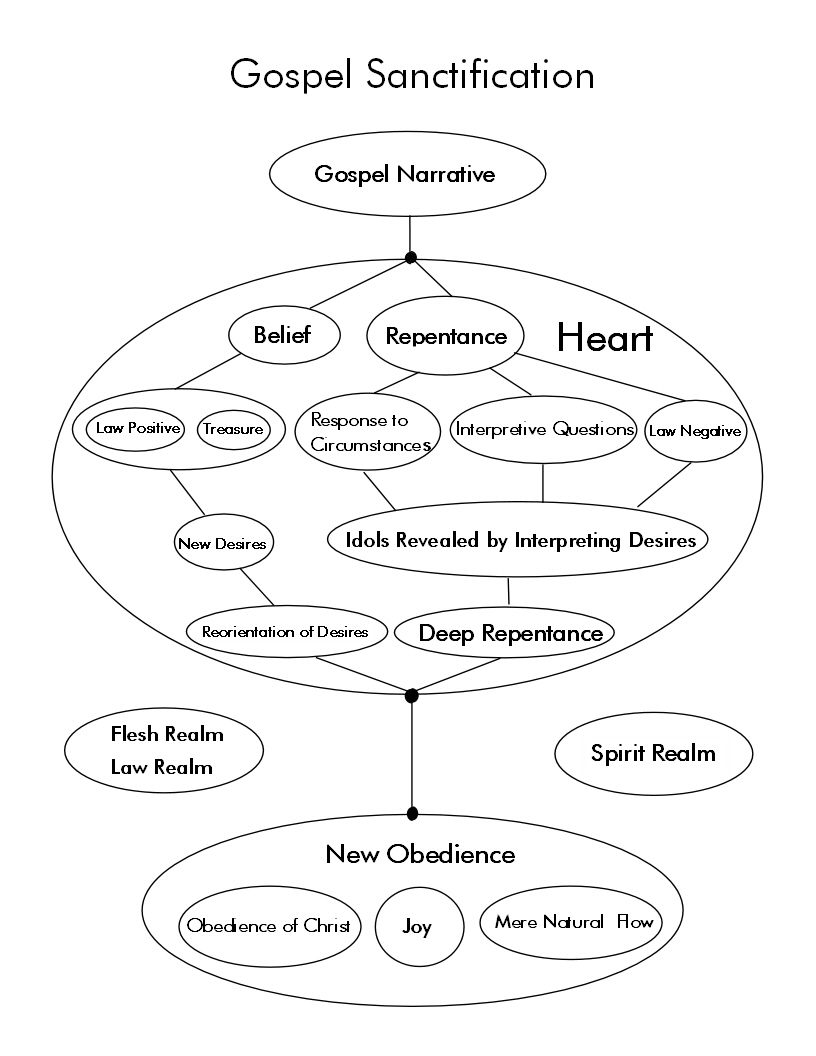
3. The NC chart needs explanation which follows before the charts.
4. I hope somebody takes this concept and develops something awesome. I really see myself as a get the ball rolling guy.
Gospel Narrative:
It all starts with the Bible being a gospel narrative only. The belief is that the Spirit only sanctifies through the contemplation of the personhood of Christ (whatever that means exactly), or who He is as a person and His works. For instance, to read the Bible with the goal of ascertaining instruction, even by Christ, and applying it to ones life, is an improper use of Scripture (according to GS), and an endeavor that the Spirit will not honor because it focuses on our efforts, and not who Christ is, and what He has done and accomplished for us. To do the prior is to use the Bible as a “instruction book” and not to gain a deeper understanding of the finished works of Christ. Therefore, proponents of GS do not believe that spiritual growth is really taking place in Christian circles where the Scriptures are used for any other purpose than the Chrstocentric approach.
Belief:
Now we come to one of two elements of justification moving forward via the gospel narrative. GS believes that the same gospel leading to justification that saved us, also sanctifies us. Hence, like justification (salvation), their is only two things we can do to grow spiritually, believe and repent. The GS doctrine holds that gazing upon the gospel narrative will lead to more belief, and belief will always produce proper behavior on its own, being earmarked by the right desires. We will follow belief to the bottom of the chart, and then start back at the top with the second, or other half of the sanctification process according to GS, repentance.
Law Positive:
Proper use of the Scripture (according to GS) sees the Law as a description of what Christ has already done for us, fulfilling the law with His life because we are unable to, even as Christians.Therefore, seeing all of the laws Christ has fulfilled for us gives us a deeper appreciation of who He is and what his works accomplished for us.
Treasure:
Seeing who Christ is, and all of His works in Scripture, and all that he has done for us, causes us to treasure Him above all else. Therefore, it becomes our desire to be whatever He is. GS believes that we are primarily driven by desire; and in fact, enslaved by it. Therefore, change the desires, and you change behavior. Assumes our appreciation of Christ’s greatness and mercy is all the motivation we need to change our desires.
Repentance:
This is the second part of our limited role in the sanctification process according to GS. All other activities are a mere natural flow from the Christ in us. It is not we who live, but Christ who lives in us (Galations 2:20). Again, like salvation, the same gospel that saved us, also sanctifies us, and is limited to belief and repentance, with everything else flowing from Christ who lives in us.
Response to Circumstances:
God’s purpose in all circumstances (according to GS) is to reveal idols of the heart so that we can repent of them. How we respond to circumstances reveals what we desire more than Christ. The particular idol that caused us to respond in a Christless manner can be identified by asking ourselves interpretive questions (what did you want? [more than Christ?]). Scripture, which is (according to GS) a grand gospel story (gospel meta narrative), can also reveal to us what the heart idol might be by how other saints responded to the same circumstances in redemptive (gospel) history. So, another limited purpose of Scripture is to help us determine idols of the heart so that we can repent of them.
This is done by showing us what other saints in redemptive history wanted (desired) more than Christ. As you might imagine therefore, how GS effects biblical counseling is profound. The focus will be on identifying heart idols and their attached desires, and changing desires of the heart, rather than behavior through biblical prescriptions born of other approaches to biblical interpretation. Some would argue: objective (behavior) verses subjective (heart issues).
Interpretive Questions:
These are merely “desire” questions that can help us determine what we love more than Christ. The most common one is “What did you want more than Christ?” Or simply, “What did you want?” However, the Christian Counseling and Education Foundation has a list of about one-hundred that they call “X-Ray questions.”
Law Negative:
This is the use of the Law (in Scripture) to drive us to despair by suggesting that we attempt to uphold the Law by application, and thereby driving us back to the cross (being impossible to accomplish). According to GS, the Law is still a schoolmaster that drives us to Christ in sanctification, and in the same way that it does in justification as well; unless, It is seen as being the works of Christ fulfilled for us (Law Positive). Law Negative has a purpose in revealing heart idols to us as well; such as, the desire to be self-dependant (heart idol of pride). Besides, the law has no use to us anyway (Christians) because it has been fulfilled by Christ and replaced by the one Law of love (I will not address this here for lack of room). According to GS advocates, Christians are only obligated to uphold the singular law of love. However, both Law Positive and Law Negative have their respective antithetical purposes for being present in the gospel narrative.
Idols Revealed by Interpreting Desires:
When the methods under “Repentance” are employed to determine idols, we can then repent of them, resulting in “Deep Repentance.”
Deep Repentance:
Also known as “intelligent repentance.” We can eliminate the idol by repenting of the thing we desired more than Christ, and replace it with a truth about Christ that we should desire or treasure more than anything or anyone. This is also known as the “reorientation of desires.” This leads to “New Obedience”
Flesh Realm:
Most GS advocates do not believe that the fight between us and sin takes place on the battle ground of the “flesh.” They believe the battle ground is the “heart.” Though they often speak of the “flesh,” they don’t think it is an inner turf where the real war takes place. This Theory makes our own efforts a point of contention in favor of a more passive viewpoint.Most GS advocates believe it is a realm that puts pressure on us, and at any given time, we either yield to the Spirit or yield to the flesh (a sinful, or worldly realm).
Law Realm:
Since the Law is sometimes said to aggravate sin, some GS proponents also attribute the Law to being part of the Flesh Realm.
Spirit Realm:
The other realm that exerts pressure on us. We simply yield to one or the other.
New Obedience:
New obedience is the natural result of “Belief” and “Deep Repentance.” Since belief is the result of seeing the glory of Christ in the gospel narrative, and causing us to desire and treasure Him more than other things, new obedience will naturally be accompanied by joy and experienced as a “mere natural flow.” Some GS proponents teach that it is actually Christ obeying for us. This is called the “imputed active obedience of Christ.” However, more GS advocates believe this than are willing to admit it.
Addendum: New Desires and Reorientation of Desires:
This is merely what happens automatically when Christ fills the void of eradicated idols through the only two disciplines of sanctification according to GS: belief, and deep repentance.
 If anybody would like these charts in some kind of file: pmd@inbox.com
paul

 Paul's Passing Thoughts
Paul,
Please correct me if I’m wrong, but in your representation, the flesh is shown to reside in the heart. That seems to me to make it appear that warfare is in the heart, which is what GS proponents want us to believe. However, the heart resides in the flesh (Ez. 11:19) and when scripture talks of giving us a new heart of flesh in place of stone, that is merely reference to the substance (pliancy) of the heart. Therefore, I think the picture should place flesh outside of the heart.
God bless,
Jess
LikeLike
Jess,
Good point. That’s why I put “But” in my title. Pictorial models are risqué. Check-out Brian Jonson’s post here on PPT (link is in infonet sidebar).Also, I will try to get you some info on the Adams/Welch debate on Heart/Flesh.That debate really clarifies the issue.
paul
> —–Original Message—– >
LikeLike
Thanks for your help, Paul. I’ll check out the link and look forward to additional info.
Jess
LikeLike