How and Why “Gospel-Driven” Sanctification / Sonship Theology Creates Cult-Like Churches
In all of my writings on gospel-driven sanctification / gospel sanctification, and its apparent mother, Sonship Theology, I have primarily addressed the error, and not its ill effects on discipleship and people’s lives. Basically, refutation of false doctrine has prevention in mind, not theological debate for entertainment purposes.
My firsthand experience with a “gospel centered” church is applicable here because this same church and its leaders are well respected in Reformed circles, and especially among those who propagate gospel-driven sanctification. Paul David Tripp speaks at this particular church often, and others such as Stewart Scott and Robert Jones have recently participated in major events there as well. Therefore, it is fair to conclude that this particular church’s activities are not considered to be abnormal among “gospel centered” persuasions.
The church I am using as an example regarding the “what,” (I will write about the “how” last) would classify themselves as being a New Covenant Theology church. They consider “Theology of the Heart, redemptive-historical hermeneutics, gospel-driven sanctification, and Christian hedonism to be tenets of NCT. What does this church and many others look like as a result of this theology?
Foremost, the leadership is very controlling. Members must have permission from the elders to vacate membership status. Those who attempt to leave membership for “unbiblical reasons” can be placed under church discipline. I have personally counseled former parishioners of said church on how to “get out of there” with minimal stress, and how to leave without being placed under church discipline. At this particular church, leaving for doctrinal reasons is considered “unbiblical.” In one particular case where the elders deemed the reason for departure “biblical,” the parishioner informed me that the chairman of the elders told him, “We would never prevent you from leaving for that reason.”
These elders are also very controlling in the area of thought. In a sermon preached by one of its elders entitled, “How to Listen to a Sermon” the following idea was introduced: Christians are not able to grow spiritually from personal study, but must only learn from sitting under preaching; specifically, preaching by the elders at that church. Here is an excerpt from the manuscript:
“You think, perhaps, that [you] can fill up the other half of the plate with personal study, devotions, or quiet times, or a radio program. Beloved, you cannot. Scripture is relatively quiet on such practices. [Particularly on the issue of radios]. But on preaching, the case is clear and strong. Neglect preaching and neglect your soul. I know that some are kept from services for legitimate reasons which are out of their control, but I doubt that is the case for most. I beseech you, change your ways for the good of this people and for the good of your own selves. Give the Word its rightful place. As I have often said, there is no better place you could be than here, under the preaching of the Word.”
Of course, the first thing that would come to mind for any thinking Christian is the biblical account of the Bereans who studied the Scriptures on their own to determine the truthfulness of Paul’s teaching. But according to this elder, the account in Acts 17 wasn’t referring to that, but rather was illustrating the proper way to listen to a sermon:
“The text here implies that there was an interactive nature between three entities: The preacher, the hearers, and the Word. Note this cycle: Paul, from the Word, delivers words. The Bereans, from Paul’s words, go to the Word. The Word cycles from God, through the preacher, to the people, back to the Word, and this, verse 12 tells us, produced belief in the God of the Word.”
In other words, personal study alone cannot produce belief; preaching from an elder must be part of the “cycle” that produces belief (notice the emphasis on “belief” rather than increased knowledge per the progressive justification element of gospel sanctification). In fact, he said that personal study only “flavors” the preaching:
“ So a good preparation for the public preaching of the Word is the private consumption of the Word. It will be the seasoning that brings out the flavor – salt on your French fries, if you will”
So, personal Bible study isn’t the food, it’s just the flavoring. And, personal Bible study is for “flavoring,” not discernment. Buyer beware.
In another category under mind control, separate small groups that meet during the week under the supervision of individual elders in homes of members are instructed not to associate, or speak with members who have left for doctrinal reasons. Also, the primary purpose of the meetings is to get feedback from the parishioners on what was taught the previous Sunday, and fielding objections or concerns. In other “gospel centered” churches, these mid-week meetings are closed to outsiders, or non-members. These meetings have also been known to produce weird occurrences like the time an elder unexpectedly produced all of his financial records in plain view of the group for their inspection. A parishioner confided in me that he found the incident to be surreal, and more information than he cared to know about.
Unknown, for the most part, is the gospel-driven use of what’s called redemptive church discipline. It is a staple of these churches, and it is a very broad use of church discipline. Reformed Christians who join “gospel centered” churches assume it is a reference to traditional forms of church discipline. Parishioners can be placed in this process for any sin, and without any prior notice or inclination. It is not the normal process of inquisitive steps to determine a Christian’s willingness to repent, but more like a counseling process in which elders judge when the parishioner has actually repented. Verbal repentance on the part of the subject is not accepted. Members are not free to leave membership while in this process without being excommunicated for supposedly attempting to vacate membership while in the midst of an unresolved sin issue. Those who dispute gospel sanctification are often placed into the process to convert them to a “redemptive” view of sanctification. They either convert, or they’re excommunicated. Accounts of “gospel centered” churches using this process to control parishioners is vast.
However, the major complaint coming out of these churches is the ignoring of clear biblical mandates by their elders. Parishioners are often perplexed by this. But this is because the elders of these churches believe the Bible is solely for the purpose of showing forth redemptive principles (ie., the gospel) and not instruction. Per New Covenant Theology, they are only obligated to a “higher law of love” which replaced biblical imperatives. The idea is the following: all actions done with the motive of love are righteous. As Francis Chan wrote, “….because when we are loving, we can’t sin”(Crazy Love p.102). As in one case when an elder was caught counseling someone’s wife without the husband’s knowledge – his defense was that he did so “in love.” Therefore, just about anything goes in gospel-driven churches, and well published accounts include excommunicating hundreds of members at one time for non-attendance, which is a questionable act when Scripture is considered to say the least.
How does this happen? First, it begins with a niche doctrine. Propagators often admit that gospel sanctification is a “radical departure” from orthodox doctrine. Those are the words of the propagators, not mine. Any movement that begins with a niche doctrine is in danger of becoming a cult, that’s Cult Apologetics 101. My research has made the following evident: the doctrine was conceived by a man named Jack Miller in, or about 1980.
Secondly, the niche doctrine draws leaders who are more interested in being unique than being in the truth. Take note of what one of the elders of the aforementioned church said while introducing a Sunday school class teaching Christian hedonism: “This doctrine is what makes us unique.” Whenever the goal is to be unique, trouble is not far behind.
Thirdly, niche doctrines and a striving to be different leads to subjectivity and confusion because the leaders are constantly striving to make the doctrine fit with reality and orthodoxy. This results in the kind of events mentioned above.
Fourthly, these elements mixed with the fact that most Reformed churches are autonomous in their polity is an extremely dangerous combination. Basically, the leadership is not accountable and the congregation is on their own.
Niche doctrines, the control of members in thought and action, the ignoring of clear biblical mandates, misuse of unbiblical church discipline in order to control parishioners through fear, manipulation, and intimidation; this is how the “gospel centered” leaders of our day adorn their vile doctrine. Therefore, perhaps they should be named with the cult leaders of ages past accordingly.
Psychological Theory: Antinomians Want to Be Caught, Part 2
In part 1, I mention that I will dissect Michael Horton’s written denial that he is an antinomian by reiterating his antinomian doctrine in the same denial. My comments are in [brackets]:
“What’s striking is that Paul answers antinomianism not with the law but with more gospel!
[No, what’s striking is Paul is refuting those who teach that less law leads to more gospel. In fact, Paul does answer with the law: ‘Are we to continue in sin that grace may abound?’ John said the biblical definition of sin is the transgression of the law (1Jn 3:4). Paul’s point following is: to sin in order to get more grace is to contradict the very purpose of grace, which is to defeat sin itself (1Jn 3:8). Secondly, why would grace break the power of sin if more sin brought forth more grace (Rom 6:6)? That’s Paul’s point – not what Horton says. Paul doesn’t preach grace to the exclusion of the law in sanctification. In fact, one definition of biblical sanctification is abstinence from what the law instructs us to avoid (1Thess 4:3). You are saying that Paul emphasized grace to the exclusion of the law in regard to the antinomian question (‘not with the law’ / ‘but with more gospel’). That’s not true.]
In other words, antinomians are not people who believe the gospel too much, but too little!
[That’s not true either. Paul said they are trying to get more grace with less law, the opposite of what you are saying.]
They restrict the power of the gospel to the problem of sin’s guilt, while Paul tells us that the gospel is the power for sanctification as well as justification.
[No they don’t – they don’t see guilt as a problem at all because we are supposedly ‘dead to the law,’ ie., free from its obligations in sanctification. Why would guilt even be an issue?]
The danger of legalism becomes apparent not only when we confuse law and gospel in justification, but when we imagine that even our new obedience can be powered by the law rather than the gospel.
[Nobody ever said the law ‘powers’ our obedience. It is the standard that we align our life with while trusting God for the necessary strength to do so. You use the term ‘new obedience’ which is a gospel sanctification / Sonship Theology term that refers to Christ obeying for us. If we are not obligated to uphold the law, but rather believe that Christ obeys it for us, that’s still antinomianism because it excludes the law from our realm of responsibility.]
The law does what only the law can do: reveal God’s moral will. In doing so, it strips us of our righteousness and makes us aware of our helplessness apart from Christ and it also directs us in grateful obedience.
[This is the gospel sanctification / Sonship Theology concept of law negative, which means the law serves the exact same purpose in sanctification that it does in justification – to show a supposed inability to keep the law and reveal our ‘helplessness’ (in keeping the law). However, the Bible doesn’t say that the application of the law to our lives leads to ‘helplessness,’ but rather happiness and blessing (James 1:25), and strength (Matt 7:24,25). Also, the gospel sanctification / Sonship Theology doctrine also says that any effort on our part to obey the law is an attempt to establish our own righteousness apart from Christ, which can be seen in ‘….it strips us of our righteousness and makes us aware of our helplessness apart from Christ.’ Furthermore, the gospel sanctification / Sonship Theology element of Christian hedonism can also be seen in Horton’s statement which teaches that true obedience is always accompanied by a willing, joyful spirit. That’s how we supposedly know that it is Christ obeying through us: ‘….it also directs us in grateful obedience.’]
No one who says this can be considered an antinomian. [Gag! Why not? What Horton is saying is antinomian!]
However, it’s not a matter of finding the right “balance” between law and gospel, but of recognizing that each does different work.
[The law has different roles in justification and sanctification. But gospel sanctification / Sonship Theology teaches that the role of the law is the same in both.]
We need imperatives—and Paul gives them. But he only does this later in the argument, after he has grounded sanctification in the gospel.”
[The indicative does not always precede the imperative in Scripture. And in some cases, the imperative is based on something Christ has not even done yet, which doesn’t include the finished work of the gospel ( Heb 10:24,25 and 2Peter 3:11,12).]
paul
Psychological Theory: Antinomians Want to Be Caught, Part 1
Don’t get me wrong, I’m thankful; it’s about time antinomians of our day have to answer the charge. But have you ever heard the theory by psychologist that serial criminals want to be caught? In regard to applying the same theory to the serial antinomians of our day, I have to think the theory has merit.
Consider what has happened this week. A writer for “Pyromaniacs,” a blog authored by Phil Johnson, (an associate of John MacArthur Jr.), wrote a six-page open letter to Micheal Horton and others at the “White Horse Inn,” another blog of the Reformed sort. Horton responded to the open letter by denying that he was an antinomian while defending another proponent of gospel sanctification / Sonship theology who had supposedly been accused as well by pastor Jason Hood, via an article Hood wrote in Christianity Today. A rough week for antinomians, supposedly.
But the fact that Horton responded to the open letter as if it was an accusation that he is antinomian – is surprising because it would take at least five attorneys to interpret the letter that way, if in fact it was an accusation of antinomianism to begin with; I certainly didn’t take it that way.
So why did Horton respond that way? See, it’s true; deep down, they want to get caught. Horton initially defended himself in the first paragraphs of his response, but then toyed with his “accuser” by dropping in clues as to what they should really be accusing him of: antinomianism based on his doctrine! After his defense, his suggested cure for antinomianism was “more gospel”(hint, hint). So after denying that he’s antinomian, he actually launched into a full-blown antinomian doctrine! I will dissect his response in part 2, but in essence, he said “more justification in sanctification.” I posed this question in the comment section and expect it will never get out of moderation purgatory:
“Dr Horton: or anyone else,
If we are sanctified by justification, and we don’t have a role in justification, how can we have a role in our sanctification? And if we can’t have a role in our sanctification, isn’t that antinomianism by default? I don’t have to obey / I can’t obey. What’s the difference?”
But it gets better. In the other article Horton complains about, Hood doesn’t accuse the new pastor of Coral Ridge Presbyterian (the late James D. Kennedy’s church) of antinomianism, but rather only complains that Tullian Tchividjian bragged about being an antinomian! See, again, Tchividjian is another example of a serial antinomian who wants to get caught; so he bragged about being an antinomian. However, it didn’t work.
Will the Keystone Discernment Police ever figure it out? Stay tuned. But meanwhile, here’s another clue for Team Pyro: you don’t need six pages – you only need six words; “How is progressive justification not antinomianism?
paul
The First Documented Gospel Presentation
 The Gospel Truth
____________________________
There is much written in this book about the false gospel of antinomianism which presents Christ as Savior only, and not Lord. Much is also written about the breed of antinomianism prevalent in our time, gospel sanctification. But I would be amiss to present my complaints about this false gospel without also presenting a true gospel from Scripture.
The word “gospel” means “good news.” How did Jesus Christ Himself present the gospel? When He initiated His ministry, He introduced it as the “good news of the kingdom”(Matt 4:23). Christ came to mankind in this worldly kingdom of darkness and despair, and announced that God had His own kingdom that humanity could be a part of while escaping this present kingdom of darkness. That’s good news.
How did this reality come about? There are many Scriptures that could be utilized to explain this, but the gospel truth can be found in the very beginning in the beginning, we find that God is a creator. He created a splendid being that was the prince of His creation (Satan), but one day, “sin was found in [him].” Where did the sin come from? Most certainly, we have no idea, and to even speculate is to ascribe to ourselves more brain power than we may ever have. God informs us on a need to know basis, and He cannot lie; the “Day Star, son of the Dawn” rebelled against God and took a third of the other angels with him, and God saw fit to allow that kingdom of darkness to dwell for a time (Isa 14:12, Eze 28:12-19, Rev 12:4).
In Genesis 1:1-2:2, we have the creation account, and for His own good reasons, God presented a standard that was paramount in maintaining a valid relationship between Him and the beings He created: “The LORD God took the man and put him in the Garden of Eden to work it and take care of it. And the LORD God commanded the man, ‘You are free to eat from any tree in the garden; but you must not eat from the tree of the knowledge of good and evil, for when you eat from it you will certainly die’”(Gen 2:15-17).
Throughout Scripture and creation, we see an order in all that God creates. Even in the Trinity, we see specific roles. How much this (or the prior rebellion) has to do with God setting a condition for spiritual life and death between Him and Adam is not known, but nonetheless, it is the fact of the matter. It is also apparent that Satan had one specific goal in mind when he approached Eve; his goal was to to get Adam and Eve to disobey God.
Obviously, obedience is no trite matter; the misery that has come upon humanity because of that one act of disobedience perpetrated by God’s enemy cannot be comprehended. It is also worthy to note that the enemy’s purpose and tactics have not changed. If you are God’s enemy, what will you do? Attack heaven? Hardly. There is but one way to attack God – disobey. These are the very first words God said to Adam when He found him after the fall: “And he said, ‘Who told you that you were naked? Have you eaten from the tree that I commanded you not to eat from?’”(Gen 3:11).
We now see two things almost immediately in the very beginning: God’s atonement for sin in order to reconcile mankind, and the warfare that commenced between the kingdom of darkness and the kingdom of light: “So the LORD God said to the serpent, ‘Because you have done this, cursed are you above all livestock and all wild animals! You will crawl on your belly and you will eat dust all the days of your life. And I will put enmity between you and the woman, and between your offspring and hers; he will crush your head, and you will strike his heel”(Gen 3:14,15).
Christ, the Son of God, would be born of a woman (the virgin Mary), and the warfare between the two kingdoms will cause Christ much trouble, but He will eventually crush the head of the ruler of this world. And the sacrifice of Christ to reconcile mankind to God was immediately pictured by the way God covered their nakedness: “The LORD God made garments of skin for Adam and his wife and clothed them”(Gen 3:21). It may be assumed that an animal of some sort was slain for the skins that would cover their nakedness (sin). We also see that a prescribed form of worship in regard to this symbolism was established by God:
“Adam made love to his wife Eve, and she became pregnant and gave birth to Cain. She said, ‘ With the help of the LORD I have brought forth a man.’ Later she gave birth to his brother Abel. Now Abel kept flocks, and Cain worked the soil. In the course of time Cain brought some of the fruits of the soil as an offering to the LORD. And Abel also brought an offering—fat portions from some of the firstborn of his flock. The LORD looked with favor on Abel and his offering, but on Cain and his offering he did not look with favor. So Cain was very angry, and his face was downcast”(Gen 4:1-5).
Whether or not there is relevance to the idea that Cain offered the works of his hands rather than the sacrifice Able offered (killing an animal and dressing it is also work) is not the point. The point is: Cain did not offer worship as prescribed by God. Worshipers of this day may also want to take note of that. What follows is the first documented gospel presentation, and presented by God Himself: “Then the LORD said to Cain, ‘Why are you angry? Why is your face downcast? If you do what is right, will you not be accepted? But if you do not do what is right, sin is crouching at your door; it desires to have you, but you must rule over it’”(Gen 4:6,7).
Abel was righteous (Heb 11:4), so God’s words to Cain must be a call to righteousness as well (God’s counsel rarely, if ever, offers a temporary fix). God tells Cain that he will be “accepted” if his faith is demonstrated by doing what is right. That is what submission to God’s will is all about; it is a way to demonstrate what we believe about God and who he is. Saving faith and obedience cannot be separated. The Hebrew writer stated it this way: “By faith Abel brought God a better offering than Cain did. By faith he was commended as righteous, when God spoke well of his offerings. And by faith Abel still speaks, even though he is dead”(Heb 11:4).
There is another important principle here. The unrighteous will not truly follow God’s way, but will rather offer God things that are of their own device. Again, a submission to God’s will is synonymous with saving faith. We also see God calling Cain to fight against the sin within: “sin is crouching at your door; it desires to have you, but you must rule over it” Therefore, Cain was called on to demonstrate his faith by following God’s ways (“If you do what is right, will you not be accepted?”) and going to war against his own sin, and sin in the world. Furthermore, demonstrating your faith through obedience comes with the promise of blessings: again, “If you do what is right, will you not be accepted?” God makes Cain’s downcast state synonymous with not being accepted by God. There is NO true happiness apart from being a citizen of God’s kingdom (see Matt 5:3-12).
We see the warfare between the two kingdoms from the beginning, and Abel is the first casualty, or what we call a martyr: “Now Cain said to his brother Abel, ‘Let’s go out to the field.’ While they were in the field, Cain attacked his brother Abel and killed him”(Gen 4:8). Christ said this about Abel being the first casualty in the war between the two kingdoms: “And so upon you will come all the righteous blood that has been shed on earth, from the blood of righteous Abel to the blood of Zechariah son of Berekiah, whom you murdered between the temple and the altar”(Matt 23:35).
As the Hebrew writer notes, the account of Cain and Abel is an apt gospel presentation, especially in regard to worship and a true believers willingness to worship in a way prescribed by God. However, all of life is worship, including the finer details of life. How we talk to other people is worship, and the Bible has much to say about godly communication. How we relate to our wives is worship, and the Bible certainly has much to say about that as well. How we think is worship, and God already destroyed one kingdom of darkness because, “The LORD saw how great the wickedness of the human race had become on the earth, and that every inclination of the thoughts of the human heart was only evil all the time”(Gen 6:5). And the Bible certainly has much to say about right thinking.
These things are not only worship, but the Scriptures instruct us on the finer points of being God’s kingdom citizens as well. The Sermon on the Mount was the Lord’s kingdom proclamation, and He concluded the sermon this way: “Therefore everyone who hears these words of mine and puts them into practice is like a wise man who built his house on the rock”(Matt 7:24). After His resurrection, this was His mandate to the church: “Therefore go and make disciples of all nations, baptizing them in the name of the Father and of the Son and of the Holy Spirit, and teaching them to obey everything I have commanded you.” This, because it demonstrates our faith (like Abel), and makes us workman in the kingdom that need not be ashamed (2Tim 2:15; 3:16,17).
When we were saved by believing that Christ died for our sins and rose from the grave on the third day as pictured by Abel’s worship, “He rescued us from the domain of darkness, and transferred us to the kingdom of His beloved Son”(Col 1:13). We were given new life, and clothed with the righteousness of Christ as pictured by the skins that God clothed Adam and Eve with. Having no righteousness of our own, the righteousness of Christ was credited to our account. But now our reasonable worship is to put off the old self, and put on the righteousness of Christ that is a free gift from God. The apostle Paul stated it this way in Ephesians 4:20-24:
“That, however, is not the way of life you learned when you heard about Christ and were taught in him in accordance with the truth that is in Jesus. You were taught, with regard to your former way of life, to put off your old self, which is being corrupted by its deceitful desires; to be made new in the attitude of your minds; and to put on the new self, created to be like God in true righteousness and holiness.”
God did not create us in the same way people bake cookies; we are all different in personality, appearance, and life experience. Though the gospel has a core truth that never changes, that truth can be expressed from many different perspectives. Certainly, a cursory observation of the different ways the gospel was presented in the book of Acts is testimony to this fact. But one fact is absolutely critical: Christ is the king of His kingdom, and no person who will not recognize that has rightful entry thereof. Jesus said: “Not everyone who says to me, ‘Lord, Lord,’ will enter the kingdom of heaven, but only the one who does the will of my Father who is in heaven”(Matt 7:21). That’s worship. Doing the Father’s will, which is not necessarily praise :
“As Jesus was saying these things, a woman in the crowd called out, ‘Blessed is the mother who gave you birth and nursed you.’ He [Jesus] replied, ‘Blessed rather are those who hear the word of God and obey it.’”
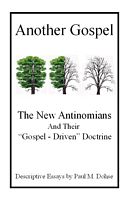
This book challenges a doctrine that calls our roll into question regarding Christ being the true Lord of our life. It seems we have the Savior part down; all evangelicals agree that we are saved by faith alone. But getting the Lord part wrong is still a half gospel, in fact, “Another Gospel” because Christ is indeed both (2Pet 1:11, 2:20, 3:2, 3:18). Whether one holds that Christians are not obligated to the Law (the Bible, God’s word) or simply unable to uphold it, the result is the same. True Christians proclaim their faith with their mouth, and proclaim Christ as Lord with their actions. Besides, Christ said, “If you love me, keep my commandments.”
Is Gospel-Driven Sanctification Really “Sonship” Theology?
Two weeks ago, sitting in my office with my feet propped on a bookcase and chatting with Susan, I happened to be looking up at my Jay Adams shelf. Since it had been too long since I’d read any of his material (at least two weeks), I put my feet down on the floor and began perusing what I haven’t lent to other people; and thinking, “Hmmm, wonder what this is: ‘Biblical Sonship.’”
I always read the preface. So you have the cover, cover page, copyright, contents, and preface. I was reading the first page of the preface, and in the third paragraph, when I read the following: “It claims that a person can change this sad state of affairs by continuing to preach the gospel to himself and by repenting and believing over and over again. It teaches that not only justification, but also sanctification, is by faith in the good news.”
Barely a hundred words into the book, and I was stunned. That is the exact same thesis as gospel sanctification, a movement I have been researching for three years. The movement (gospel sanctification, or “gospel-driven sanctification”) is huge and its propagators are the who’s who of the evangelical world that they are supposedly trying to save: DA Carson, Michael Horton, Paul David Tripp, David Powlison, Tim Keller, John Piper, Al Mohler, Mark Devers, Francis Chan, Jerry Bridges, and many, many others. The theology is also propagated by several missionary alliances and church planting organizations like the Antioch School in Ames, Iowa.
As Jay Adams notes in his book, the Sonship movement was started by Jack Miller, a former professor of practical theology at Westminster Seminary who is now deceased. According to other sources, Jack Miller’s epiphany concerning Sonship occurred while he was on an extended trip in Spain with his family. An article I read by Geoff Thomas in Banner of Truth was written in 2003, and he mentions the trip to Spain as being about twenty years prior; so figure 1980, or around that time, for the birth of Sonship theology.
In all of my studies concerning gospel sanctification, I had never heard of Jack Miller or Sonship theology, but it became clear from the Jay Adams book that the two theologies are the same thing with the usual peripheral aberrations from the basic form; and the basic form being, but not confined to, progressive justification, sanctification by faith alone, substitutionary monergistic sanctification, and the total depravity of the saints. There is absolutely no doubt – this theology turns orthodoxy completely upside down while the intestinal fortitude of the rest of the evangelical community wanes. Apparently, big names like Jerry Bridges and others are like GM, they’re just too big to fail. As one brother wrote to me: “How dare you criticize DA Carson, one the greatest theological minds of our day!” Furthermore, as Dr. Peter Masters has noted, it is interesting that doctrine doesn’t matter if you are “gospel-driven” in your beliefs. For example, Charismatic and emergent church leaders are readily excepted into the new Calvinism clan if they are “gospel-centered.”
But what came first? Sonship, or gospel sanctification? Did gospel-driven sanctification come from Sonship? Is Jack Miller the father of new Calvinism? It’s looking that way. Historical precedent for gospel sanctification (GS) cannot be found before (approx.)1980. It is the brainchild of Dr. David Powlison, professor at CCEF, the biblical counseling wing of Westminster Seminary. GS came out of his “Dynamics of Biblical Change” curriculum developed and taught by him at Westminster. Two of his former students articulated the doctrine in the book “How People Change.” This is made clear by Powlison in the forward he wrote for the same book. Shortly prior to the book’s release, the doctrine’s theories were tested in local churches via a pilot program. In the reformed church I attended that was part of the pilot program, the curriculum was taught in a Sunday school class with a limited number of participants.
“How People Change” articulates a theology that is virtually identical to Sonship theology. And, it just so happens that David Powlison himself claims that Jack Miller is his “mentor.” He recently stated this as fact while teaching a seminar at John Piper’s church, and in the midst of fustigating Jay Adams for criticizing Jack Miller for telling people to “preach the gospel to themselves everyday” *see endnote. I thought this phrase was originally coined by Jerry Bridges, but Jerry Bridges attributes the phrase to Jack Miller in the preface of “The Disciplines of Grace.” Tim Keller, a looming figure in the new Calvinism / gospel-driven / gospel sanctification movement, was teaching GS under the “Sonship” nomenclature as late as 2006. On the Puritan Board, a faint cry for help was uttered by a person saying the following: “ The Sonship theology of Tim Keller has taken a hold of the church I attend. Am I the only one, or does anyone else have a problem with this?”
Furthermore, my research would strongly suggest that the development of other contemporary theologies like New Covenant Theology, (many attribute its conception to Westminster Seminary sometime during the 80’s or 90’s), heart theology (definitely conceived at Westminster during the 90’s), redemptive-historical hermeneutics, and Christian hedonism (latter conceived by John Piper in the 80’s) were primarily driven by the need to validate Sonship / GS doctrine. Sonship needs the NCT perspective on the law, the supposed practical application of finding idols in the heart via heart theology, the perspective of how Sonship is experienced through Christian hedonism, and more than anything else, an interpretive redemptive prism supplied by the redemptive-historical hermeneutic.
But why has gospel sanctification enjoyed freedom from ridicule not afforded to Sonship? They are, for all practical purposes, the same exact thing and encompass many of the same teachers. Probably because gospel sanctification has the word “gospel” in it. In this age of hyper-grace, people will shy away from any appearance of being against “the gospel.” I have to believe that the movement has traded the Sonship label, with its share of bullet holes, for the “gospel-driven” label. Sonship has been besieged by two works, the book by Jay Adams and a lengthy article by Van Dixhoorn, a former student at Westminster. Sonship has also been pelted with its share of the “antinomian” accusation, and rightfully so. In my second addition of “Another Gospel,” I write the following on page 78:
“….if the same gospel that saved us also sanctifies us, and Christ said that we are sanctified by the word; and certainly He did say that as recorded in John 17:17, then every word in the Bible must be about justification, or what God has done and not anything we could possibly do, being a gospel affair. Furthermore, if we are sanctified by the gospel which is God’s work alone, we may have no more role in spiritual growth than we did in the gospel that saved us. The Scriptures are clear; no person is justified by works of the law. Is that not the gospel? Therefore, when the antinomians speak of obedience, it should be apparent that they are not speaking of our obedience, even though they allow us to assume otherwise.”
At least one book, a lengthy pamphlet, and several articles defend Sonship against Adams and Van Dixhoorn, but the theological arguments are woefully lame. Nevertheless, my point is that gospel sanctification, though the same thing, is enjoying widespread acceptance throughout the church without controversy while unifying camps that are theologically suspect to say the least.
It is what it is; while mad theological scientist concoct all sorts of new potions in the lab and send their minions out to commit first-degree doctrinal felonies in broad daylight, while many who profess to love the real gospel say nothing. I pray that will change, while thanking God for those who love the truth more than the acceptance and praises of men.
Endnote:
Powlison failed to mention that the criticism came in the form of a book that is an apology against Sonship theology. Failure to mention that put Adams in an anti-gospel light as well as depriving him of the ability to contextualize the criticism. As an aside, Powlison, in the same seminar, criticized “idol hunting”; but yet, he is the inventor of “X-ray questions”(which he also mentioned in positive terms without the “X-ray” terminology, but rather something like “reorienting questions”) which are designed to identify heart idols (see page 163 of “How People Change”). His mentor, Jack Miller, developed a complex system of idol hunting that included twenty different categories of heart idols (Jack Miller, “Repentance and the 20th Century Man”CLC 1998). This kind of disingenuous double-speak is commonplace within the movement.

 Paul's Passing Thoughts
1 comment